
# Professional Plant Health Care in Yarmouth, Massachusetts
As a homeowner in Yarmouth, Massachusetts, you rely on your trees to frame your property, provide shade during humid Cape summers, and enhance curb appeal along busy Route 28 or quiet Bass River lanes. But with Barnstable County's sandy soils, salt-laden winds, and pests like winter moth targeting your oaks, those same trees face constant threats. That's where professional plant health care in Yarmouth, MA, becomes essential. Southeast Arborist, LLC, your South Shore Massachusetts tree care experts based in Plymouth and Cohasset, delivers ISA Certified Arborist-led plant health care programs tailored to Yarmouth's unique coastal challenges.
Our plant health care services go beyond basic pruning. We implement custom programs using integrated pest management (IPM), deep root fertilization, trunk injections, and disease treatments to restore vigor to your pitch pines, black oaks, and red maples. In Yarmouth Port's historic district around the Captain Bangs Hallet House, we preserve 19th-century ornamental plantings with precise hemlock woolly adelgid management. Along the Route 28 commercial corridor in West Yarmouth and South Yarmouth, we maintain aging landscape trees in parking lots to meet safety standards. Waterfront properties in Bass River and the Bass Hole Area trust us for erosion-resistant pruning and spongy moth suppression.
Yarmouth's mid-Cape location in the tourist corridor exposes trees to heavy foot traffic, tidal fluctuations, and overcrowded stands in neighborhoods like Bayberry Hills. Sandy, nutrient-poor soils drain quickly, leaving roots starved after dry spells common in Barnstable County. Winter moth defoliation weakens oak canopies, while emerald ash borer threatens any ash remnants. Southeast Arborist's ISA Certified team follows ANSI A300 standards for every intervention, ensuring treatments comply with Massachusetts pesticide regulations and prioritize your property's long-term health.
Imagine your scrub oaks in Yarmouth Port regaining full leaf density after targeted winter moth BT applications, or your pitch pines in Bass River standing firm against tidal erosion thanks to deep root injections. We conduct site-specific assessments, factoring in Yarmouth's acidic soils (pH often 4.5-5.5) and proximity to Nantucket Sound. Our equipment includes soil augers for precise fertilization, high-pressure sprayers for adelgid control, and macro-injection systems for emerald ash borer treatments— all operated under strict safety protocols with TCIA accreditation.
Homeowners in Yarmouth's 24,000-resident community call us for plant health care because generic lawn services can't match our expertise. We've treated overcrowded eastern red cedars in interior Bayberry Hills lots, injected honey locusts along Route 28 medians, and fertilized American holly near the Bass Hole boardwalk's oak-to-marsh transition. Results show in reduced dieback, stronger storm resistance, and compliance with local zoning for historic properties.
Plant health care in Yarmouth, MA, isn't a one-time fix; it's a proactive program. We monitor your trees seasonally, adjusting for Cape Cod's 40-inch annual rainfall patterns—heavy in fall hurricanes, sparse in summer. Contact Southeast Arborist at 508-369-5009 for a free consultation. Our ISA Certified Arborists will walk your Yarmouth property, identify issues like black cherry borer damage or sassafras wilt, and outline a custom plan. Don't wait for defoliation or branch failure—secure your landscape's future today.
Why Yarmouth Properties Need Plant Health Care
Yarmouth's coastal ecology demands specialized plant health care to counter Barnstable County's harsh conditions. Your trees endure salt spray from Nantucket Sound, winter winds off Cape Cod Bay, and summer droughts that stress sandy soils. Pitch pines dominate interior stands in Bayberry Hills, but overcrowding leads to suppressed growth and pine tip moth infestations. Scrub oaks and black oaks line Yarmouth Port's historic lanes, yet winter moth caterpillars defoliate them annually, reducing photosynthesis by up to 70% and inviting secondary fungal infections like oak wilt.
Commercial properties along Route 28 in West Yarmouth and South Yarmouth feature aging honey locusts and red maples planted during the 1950s tourism boom. These trees now suffer from girdling roots in compacted parking lot soils, causing decline and safety hazards. White oaks near Bass River erode from tidal surges, exposing roots and increasing topple risk during nor'easters. Eastern red cedars in the Bass Hole Area transition zone battle hemlock woolly adelgid spillover, while black cherry and sassafras in residential yards host borers exacerbated by drought stress.
Yarmouth's microclimate amplifies these issues. Average January lows of 24°F followed by humid 80°F Julys promote fungal pathogens like anthracnose on maples. Acidic, low-fertility soils (often <2% organic matter) limit nutrient uptake, starving your American holly of iron and manganese. Tidal erosion around Bass River properties undermines pitch pine root plates, while Route 28's urban heat island effect accelerates white oak decline.
Without plant health care, your Yarmouth trees face cascading failures. Winter moth weakens oaks, leading to armillaria root rot in scrub oaks. Overcrowded pitch pines in Bayberry Hills compete for light, fostering cytospora canker. Homeowners report 20-30% canopy loss in untreated oaks, per local extension service data. Commercial sites risk liability from failing branches over sidewalks.
Southeast Arborist's plant health care addresses this head-on. Our ISA Certified Arborists diagnose via resistograph testing for internal decay in black oaks and soil probes for compaction around red maples. We deploy IPM to target spongy moth on cedars without broad-spectrum sprays, preserving Bass Hole's pollinators. Deep root fertilization counters Yarmouth's nutrient deficits, injecting nitrogen, phosphorus, and micronutrients via 12-inch auger holes spaced in tree drip lines.
Practical advice for Yarmouth homeowners: Inspect oaks in April for winter moth egg masses—silvery patches on twigs signal trouble. Test Bass River soil salinity with a simple conductivity meter; levels over 4 dS/m indicate salt stress on holly. Thin overcrowded pines in Bayberry Hills by removing 20% canopy annually to boost vigor. Mulch 3 inches deep around bases, keeping it 6 inches from trunks to prevent rodent girdling.
In Yarmouth Port's Captain Bangs Hallet House district, historic white oaks require gentle interventions like phosphite trunk injections for phytophthora. Route 28 honey locusts benefit from scale insect monitoring—sticky bands catch crawlers in June. Our treatments follow ANSI A300 Part 7 for IPM, ensuring science-backed results. Proactive care extends tree life by 15-20 years, per ISA studies, saving you removal costs averaging $1,500 per mature oak.
Yarmouth's 1960s development left legacy issues: compacted soils under black cherry lawns stunt growth, inviting peach tree borers. Waterfront sassafras near Bass Hole succumb to laurel wilt vectored by redbay ambrosia beetles. Plant health care in Yarmouth, MA, restores balance, enhancing property values in this tourist hub. Your trees deserve expert intervention—call Southeast Arborist at 508-369-5009 to assess your site.
Our Plant Health Care Process in Yarmouth
Southeast Arborist's plant health care process in Yarmouth starts with a thorough site assessment by ISA Certified Arborists. We arrive at your Yarmouth Port home or West Yarmouth commercial lot with diagnostic tools: increment borers for pitch pine core samples, anemometers for wind exposure mapping, and soil pH meters tailored to Barnstable County's sands. This initial visit identifies stressors like winter moth on oaks or root rot in Bass River red maples.
Step 1: Diagnosis. We map your trees using GPS-enabled apps, noting species—scrub oak defoliation, black oak cankers, or eastern red cedar adelgids. For Yarmouth's tidal zones, we use sonar for root plate integrity. Lab analysis of leaf samples detects nutrient deficiencies common in low-organic soils.
Step 2: Custom Program Design. Based on ANSI A300 standards, we craft IPM plans. For spongy moth in Bayberry Hills pitch pines, we schedule Bacillus thuringiensis (Bt) applications in May when larvae hatch. Emerald ash borer threats get macro-infusion trunk injections with emamectin benzoate, drilled at 4-inch spacing. Hemlock woolly adelgid on cedars near Bass Hole receives soil drench imidacloprid.
Step 3: Soil and Root Care. Deep root fertilization uses a John Deere 25G mini-excavator with 12-inch augers, injecting liquid fertilizers (e.g., 10-4-6 NPK with mycorrhizae) at 2-4 gallons per inch DBH. In compacted Route 28 lots, we aerate with vertical mulch trenches filled with compost to improve white oak hydrology.
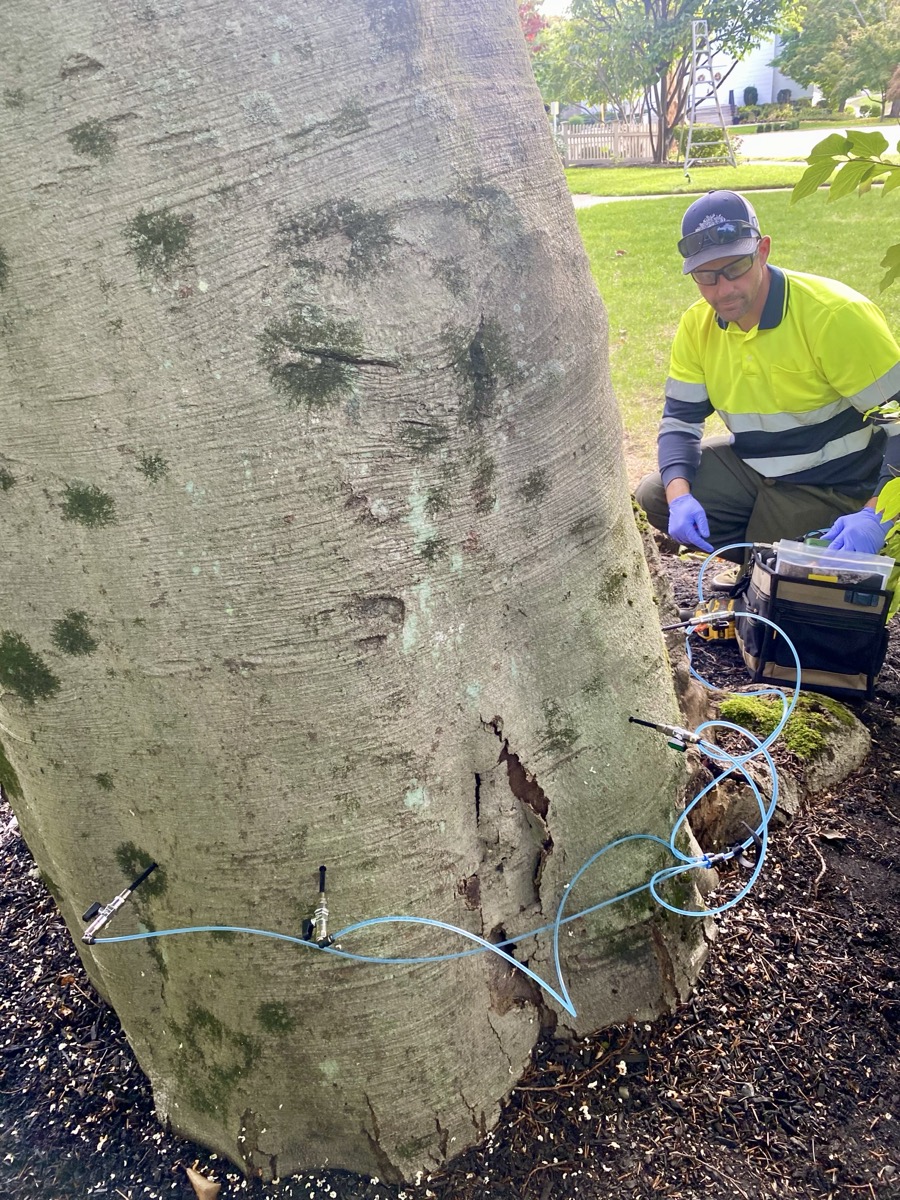
Step 4: Targeted Treatments. Trunk injections for disease use Arborjet QUIK-jet systems—low-pressure ports sealed with rubber septa for repeat access. Winter moth on Yarmouth oaks gets delegate spinosad sprays calibrated to canopy density. Safety protocols include full PPE, site barricades, and drift minimization with air-blast sprayers fitted with droplet control nozzles.
Step 5: Monitoring and Follow-Up. We install data loggers for soil moisture in Bass River properties and schedule quarterly inspections. Apps track treatment efficacy, like 90% adelgid mortality post-injection. Adjustments account for Yarmouth's rainfall—extra irrigation post-fertilization during July droughts.
Our equipment suits Yarmouth's terrain: tracked skid-steers navigate Bass Hole boardwalk-adjacent lots without soil damage; drones survey Route 28 canopies for hazard branches. All work complies with Massachusetts DEC pesticide applicator licenses and OSHA fall protection.
Practical tips for your property: Water deeply (1 inch weekly) after root feeds to activate nutrients. Avoid fertilizing lawns near tree driplines—nitrogen runoff burns holly roots. Prune deadwood from black cherry in winter to reduce borer entry points.
In South Yarmouth, we've revived honey locust rows with scale insect oils applied via mist blowers, restoring 80% vigor. Yarmouth Port historic sassafras get copper fungicides for leaf spot, preserving 18th-century aesthetics. This methodical approach minimizes environmental impact—IPM reduces chemical use by 50% versus calendar spraying.
Safety is paramount: Rigging systems secure branches over Bass River homes; traffic control manages Route 28 jobs. Post-treatment, we provide reports detailing volumes applied (e.g., 500 ml/inch DBH injections) for your records.
Plant health care in Yarmouth, MA, demands this precision. Your overcrowded pitch pines or eroding oaks benefit from our proven steps. Schedule yours with Southeast Arborist—call 508-369-5009. Our ISA team ensures your landscape thrives amid Cape challenges.
Common Plant Health Care Projects in Yarmouth Neighborhoods
In Yarmouth Port, plant health care focuses on preserving historic trees around the Captain Bangs Hallet House. We treat winter moth on mature white oaks with egg mass removal and Bt sprays, restoring canopies that shade 19th-century homes. American holly and imported ornamentals get deep root feeds to combat iron chlorosis in acidic soils.
South Yarmouth's Route 28 commercial strips see frequent parking lot tree care. Aging red maples and honey locusts receive crown cleaning per ANSI A300, removing deadwood to prevent pedestrian hazards. Spongy moth treatments protect these high-traffic assets.
West Yarmouth residential lots feature overcrowded pitch pine stands. Our selective thinning reduces competition, followed by tip moth injections. Black oaks here get phosphonate drenches for oak decline, addressing defoliation from winter moth.
Bass River waterfront properties demand erosion mitigation. We inject pitch pines undermined by tides with growth regulators, stabilizing roots. Red maples along shores receive salt-tolerant fertilizers to counter Nantucket Sound spray.
Bayberry Hills interior neighborhoods battle dense scrub oak and eastern red cedar thickets. IPM programs suppress hemlock woolly adelgid, with soil amendments improving drainage in low spots prone to phytophthora.
Bass Hole Area projects highlight coastal transitions. Black cherry near the boardwalk gets borer trunk injections; sassafras wilt is managed with systemic fungicides. These treatments preserve the upland oak-to-salt marsh ecology.
Across Yarmouth neighborhoods, common calls include structural pruning on oaks to safeguard homes from storms, dead pitch pine removals in Bayberry Hills, and view-clearing on Bass River lots. Commercial Route 28 maintenance ensures compliance with town ordinances.
Our ISA Certified Arborists document each project with before-after photos and health metrics, like increased leaf area index post-treatment. Homeowners in these areas report fewer storm losses—critical in hurricane-prone Barnstable County.
For your Yarmouth neighborhood, contact Southeast Arborist at 508-369-5009. We serve all areas, from Yarmouth Port historic districts to Bass Hole's edge.
Plant Health Care Costs in Yarmouth, MA
Plant health care costs in Yarmouth, MA, vary by property size, tree count, and issues. A basic assessment for a Yarmouth Port half-acre lot runs $150-$250, including soil tests and tree mapping. Custom annual programs for 10 mature oaks average $800-$1,500, covering four quarterly visits.
Factors driving costs: Tree size—pitch pine over 24-inch DBH requires $100-$200 extra for injection ports. Neighborhood access matters; Bass River waterfronts add $50-$100 for tidal site prep. Commercial Route 28 jobs factor traffic control at $75/hour.
Deep root fertilization: $5-$8 per inch DBH, so a 20-inch black oak costs $100-$160. Includes 20 auger holes with custom blends for Yarmouth sands.
Trunk injections for emerald ash borer or winter moth: $10-$15 per inch DBH. A 15-inch red maple totals $150-$225, using Arborjet systems for 95% uptake efficiency.
Hemlock woolly adelgid treatments: $300-$600 per affected cedar stand in Bass Hole, with drench applications.
IPM monitoring: $200-$400/year per property, cheaper than reactive removals ($1,200-$3,000 per tree).
Value proposition: Our programs yield 3-5x ROI. Healthy oaks in West Yarmouth add $5,000-$10,000 to home values per appraisal data. Prevented failures save commercial sites liability claims averaging $20,000.
Bundling saves: Annual PHC for Bayberry Hills lots with 15 trees: $1,200-$2,000, versus $500 per emergency treatment.
No hidden fees—quotes detail labor (ISA Arborists at $125/hour), materials, and travel from Plymouth. We offer financing for South Yarmouth multi-tree projects.
Compared to DIY, professional care avoids fines for improper pesticides. Costs reflect ANSI A300 compliance and insurance.
Invest in your Yarmouth trees' future. Call Southeast Arborist at 508-369-5009 for a precise quote tailored to your Bass River or Yarmouth Port property.
When to Schedule Plant Health Care in Yarmouth
Schedule plant health care in Yarmouth during spring (April-May) for winter moth prevention on oaks—apply Bt before leaf-out. Summer (June-July) targets spongy moth larvae on pitch pines; monitor Bayberry Hills stands for webbing.
Fall (September-October) suits deep root fertilization, leveraging 12-inch rains for nutrient absorption in sandy soils. Treat hemlock woolly adelgid year-round, but early winter injections protect Bass Hole cedars.
Urgency signs: 25% canopy thinning on scrub oaks signals winter moth—act by June. Yellowing American holly leaves indicate chlorosis; test soils now. Leaning pitch pines in Bass River mean erosion—schedule immediately to avert failure.
Storm season (August-November) demands pre-hurricane pruning. Post-nor'easter, inspect for wounds on Route 28 maples.
Annual programs start anytime; one-offs peak in May for Yarmouth Port historic trees.
Call 508-369-5009 now—early action prevents $2,000+ removals.
Frequently Asked Questions About Plant Health Care in Yarmouth
**What is plant health care in Yarmouth, MA?** It's a proactive program including pest control, fertilization, and disease management for trees like pitch pines and oaks, customized to Yarmouth's coastal soils and pests.
**How do I know if my Yarmouth oaks have winter moth?** Look for defoliation by mid-May and egg masses on twigs. Our ISA Arborists confirm via sticky traps in Yarmouth Port properties.
**Are trunk injections safe for Bass River waterfront trees?** Yes, emamectin for emerald ash borer uses low-volume, targeted delivery with no runoff into tides, per EPA guidelines.
**How often should I fertilize trees in Bayberry Hills?** Twice yearly—spring for growth, fall for roots—in Yarmouth's nutrient-poor sands. We use soil tests to guide.
**Does plant health care help with tidal erosion on Bass River lots?** Yes, root injections and mulching stabilize pitch pines; we've strengthened dozens against Nantucket Sound surges.
**What about hemlock woolly adelgid in Bass Hole Area?** Soil drenches in October kill 90% of adelgids on cedars; follow-up monitors prevent reinfestation.
**Is Southeast Arborist licensed for Yarmouth treatments?** Fully—ISA Certified, Mass DEC licensed, following ANSI A300 for all South Yarmouth to West Yarmouth jobs.
**How long until I see results on Route 28 honey locusts?** Scale treatments show new growth in 4-6 weeks; full vigor by next season.
Plant Health Care Throughout Yarmouth
Southeast Arborist provides plant health care across Yarmouth neighborhoods: Yarmouth Port historic districts, South Yarmouth commercial zones, West Yarmouth residences, Bass River waterfronts, Bayberry Hills interiors, and Bass Hole Area transitions. We extend to nearby Dennis and Barnstable.
From Plymouth/Cohasset bases, we reach all 02664 ZIPs quickly. ISA Certified Arborists ensure ANSI-compliant care for your pitch pines to red maples.
Protect your Yarmouth property—call 508-369-5009 today for plant health care in Yarmouth, MA.