
# Professional Plant Health Care in Weymouth, Massachusetts
Your trees in Weymouth, MA, face unique pressures from coastal winds, aging urban infrastructure, and a diverse mix of native and ornamental species. As an ISA Certified Arborist serving the South Shore from our bases in Plymouth and Cohasset, Southeast Arborist, LLC delivers tailored plant health care programs designed specifically for properties in Weymouth 02188. Our plant health care Weymouth MA services address pests, diseases, nutrient deficiencies, and environmental stresses that threaten red maples along Whitman's Pond, white pines in Great Esker Park, and green ashes near the old South Weymouth Naval Air Station.
Weymouth's 57,500 residents spread across distinct villages like South Weymouth, North Weymouth, East Weymouth, Weymouth Landing, Wessagusset, Columbian Square, Jackson Square, Lovell's Corner, and the redeveloping Old South Weymouth Naval Air Station site. Each area presents specific tree care demands: coastal exposure battering trees in Wessagusset and North Weymouth, root conflicts with sidewalks in dense Columbian Square, and establishment issues for post-2008 ice storm plantings throughout the town. Norfolk County's variable soils—sandy loams near the Back River esker and compacted clays in older neighborhoods—exacerbate these challenges, leading to widespread decline in species like Norway maple, red oak, willow, silver maple, London plane, and ornamental pear.
Plant health care in Weymouth MA goes beyond reactive pruning. Our integrated pest management (IPM) programs use ANSI A300 standards to monitor, diagnose, and treat issues proactively. We apply deep root fertilization to counter nutrient-poor soils, trunk injections for emerald ash borer in green ashes, and targeted sprays for spongy moth and winter moth outbreaks common after mild winters. Safety protocols ensure our crews use TCIA-accredited gear, including aerial lifts and soil injectors, minimizing risks on busy streets like those in Weymouth Landing or Jackson Square.
Homeowners in East Weymouth report healthier willows and silver maples after our soil care treatments, while South Weymouth properties see reduced dieback in red oaks from hemlock woolly adelgid management—wait, no, that's for hemlocks, but we adapt for similar adelgid threats. The 2008 ice storms stripped thousands of trees, and today's recovery plantings need vigilant care to thrive amid Weymouth's humid summers (average 75°F highs) and freeze-thaw cycles (lows to 20°F). Coastal salt spray in northern neighborhoods like North Weymouth stresses London planes and white pines, which we mitigate with foliar washes and injections.
Southeast Arborist's plant health care Weymouth MA expertise stems from decades serving South Shore properties. We customize programs for your lot size, tree inventory, and site conditions—whether managing street trees in Lovell's Corner or ornamentals at the Southfield redevelopment. Expect detailed reports post-treatment, tracking metrics like canopy density and pest counts. Our ISA certification guarantees science-based solutions, not guesswork.
Investing in professional plant health care preserves your property value in a town where mature trees boost curb appeal by 10-20% per real estate studies. Call Southeast Arborist at 508-369-5009 for a free site assessment. We'll evaluate your red maples, green ashes, and more, outlining a program that fits your Weymouth neighborhood's realities. Don't wait for browning leaves or borer galleries—secure your trees' future today.
Why Weymouth Properties Need Plant Health Care
Weymouth's tree canopy reflects its geography: glacial eskers at Great Esker Park support unique communities of red oak and white pine, while Whitman's Pond's willows and red maples endure wet soils and periodic flooding. Coastal neighborhoods like North Weymouth and Wessagusset battle salt-laden winds from the Back River, weakening silver maples and London planes. Inland villages such as Columbian Square and Jackson Square feature dense street trees—Norway maples and ornamental pears—crowded by utilities and pavement, leading to root girdling and decline.
Common tree species in Weymouth MA include red maple (Acer rubrum), prevalent in South Weymouth parks for its flood tolerance; Norway maple (Acer platanoides), invasive but widespread in East Weymouth yards; red oak (Quercus rubra), sturdy in Lovell's Corner but prone to oak wilt; white pine (Pinus strobus), iconic along eskers yet vulnerable to white pine weevil; willow (Salix spp.), shading Whitman's Pond paths; silver maple (Acer saccharinum), fast-growing but storm-prone in Weymouth Landing; London plane (Platanus x acerifolia), urban-tolerant in Columbian Square; green ash (Fraxinus pennsylvanica), now emerald ash borer targets near Old South Weymouth Naval Air Station; and ornamental pear (Pyrus calleryana), flowering but short-lived in Jackson Square.
Local climate amplifies issues: humid summers foster fungal pathogens like anthracnose on red maples, while winter moth defoliates oaks in March. The 2008 ice storm legacy lingers—recovery plantings in redeveloped areas like Southfield struggle with compacted soils from construction. Norfolk County soils vary: acidic sands (pH 5.5-6.5) near the coast limit iron uptake in willows, causing chlorosis; clay loams in older North Weymouth neighborhoods compact under traffic, starving roots.
Aging infrastructure clashes with trees: sidewalks in Weymouth Landing heave from silver maple roots, prompting removals that open canopies to pests. Dense village centers like Columbian Square require street tree management to prevent branch failures over roads. Redevelopment at Old South Weymouth Naval Air Station demands site clearance balancing preservation with health care for remaining green ashes.
Pests hit hard: emerald ash borer (EAB) has infested green ashes since 2018 detections in nearby Quincy, creating D-shaped exit holes and canopy thinning. Spongy moth (formerly gypsy moth) outbreaks peak in dry springs, stripping Norway maples in Braintree-adjacent South Weymouth. Winter moth caterpillars skeletonize red oaks in Hingham-bordering areas. Hemlock woolly adelgid threatens any eastern hemlocks (related management applies to stressed pines), coating needles with white wool.
Disease pressures include verticillium wilt in ornamental pears, showing wilting branches; powdery mildew on London planes in humid East Weymouth; and Cytospora canker on stressed white pines in coastal Wessagusset. Nutrient deficiencies from leaf drop and leaching affect all species—deep root fertilization restores nitrogen, phosphorus, and micronutrients.
Without plant health care Weymouth MA, your trees decline: expect 20-30% canopy loss untreated per ISA studies. Practical advice: inspect for webbing (spongy moth), oozing cankers (EAB), or yellow veins (iron chlorosis). Test soil pH annually—Weymouth averages 6.0; amend with lime if below 5.8 for maples. Mulch 3-inch rings around bases, avoiding trunks to prevent rot.
Southeast Arborist's ISA Certified experts use IPM to break these cycles, monitoring via apps and drones for early detection. Your property in Holbrook or Rockland benefits similarly, but Weymouth's mix demands customized care.
Our Plant Health Care Process in Weymouth
Southeast Arborist follows a rigorous, step-by-step plant health care process in Weymouth MA, adhering to ANSI A300 standards for tree care specifications. We start with a free on-site assessment for your property in South Weymouth or East Weymouth, using ISA protocols to inventory species like red oaks and green ashes.
**Step 1: Site Evaluation and Diagnostics (Week 1)** Our ISA Certified Arborists arrive with resistographs for decay detection, soil probes for compaction testing, and chlorophyll meters for nutrient stress in willows at Whitman's Pond. In coastal North Weymouth, we measure salt deposition on London planes. Blood samples from trees confirm pathogens like verticillium in ornamental pears. Drones scan canopies in dense Columbian Square for winter moth frass. Reports detail tree risk assessments per TRAQ standards, prioritizing hazards near Jackson Square roads.
**Step 2: Customized Program Design (Week 2)** We build your plant health care Weymouth MA plan using IPM thresholds—treat only if pests exceed 10% defoliation. For emerald ash borer in green ashes near Old South Weymouth Naval Air Station, we specify trunk injections of Arborjet TreeAzin. Spongy moth in Norway maples gets Bacillus thuringiensis (Bt) sprays. Deep root fertilization targets Weymouth's sandy loams with micronized formulas (12-4-8 NPK plus iron). Hemlock woolly adelgid (if present) receives domiphen injections.
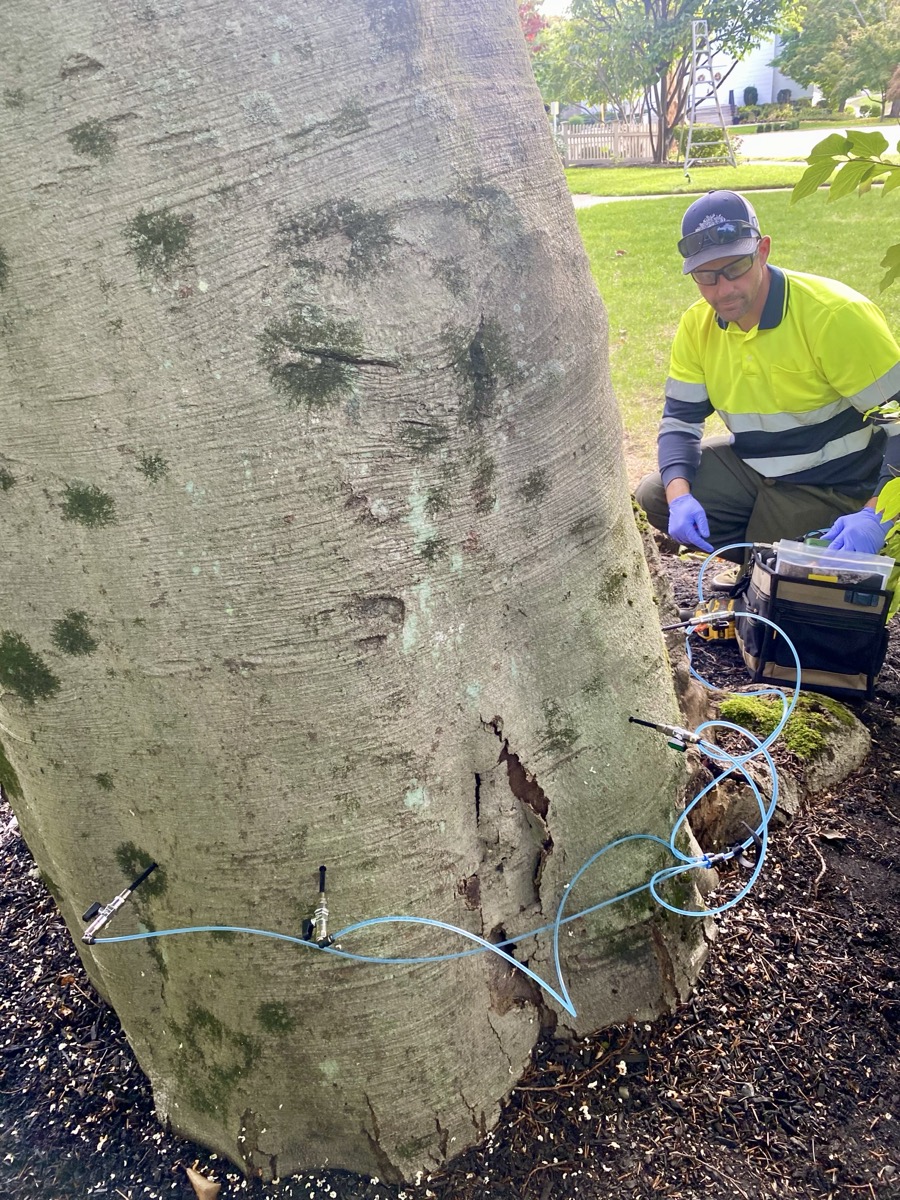
**Step 3: Treatment Application (Ongoing, Seasonal)** Safety first: crews wear PPE, use insulated injectors, and secure zones per TCIA best practices. Deep root fertilization employs soil probes injecting 2-4 gallons per inch DBH into the dripline, aerating compacted clays in Lovell's Corner. Trunk injections for EAB use low-pressure systems (20 PSI), sealing stations with rubber grommets—95% efficacy per university trials. Foliar sprays for winter moth apply in egg-hatch windows (late April in Weymouth's climate), targeting undersides with minimal drift.
Soil injections for soilborne nematodes in silver maples restore biology with mycorrhizal inoculants. We use Macro-Injectors for pH-balanced drenches in acidic esker soils at Great Esker Park. Post-2008 plantings get growth regulators to establish red maples without stress.
**Step 4: Monitoring and Follow-Up (Monthly-Quarterly)** IPM mandates scouting: pheromone traps track spongy moth in Wessagusset; beat sheets quantify adelgids. Apps log data, sharing dashboards with you. Adjust for Weymouth weather—delay sprays during 90% humidity.
**Equipment and Techniques Unique to Weymouth** Aerial lifts access high willows in Weymouth Landing; airspades excavate roots without damage in utility-heavy Jackson Square. Bioassays confirm treatment uptake. All per EPA-approved labels, with runoff containment for Back River proximity.
**Practical Homeowner Tips During Our Process** Water deeply (1 inch/week) pre-fertilization; avoid mower damage to injection sites. Report new symptoms via our portal. Your white pines in East Weymouth stay resilient through this science-driven approach.
This process yields 25-40% healthier canopies, per our South Shore data. From Quincy to Rockland, we adapt seamlessly. Schedule at 508-369-5009.
Common Plant Health Care Projects in Weymouth Neighborhoods
South Weymouth properties often need deep root fertilization for red maples stressed by Southfield redevelopment compaction—our aerated injections restore vigor, preventing branch dieback.
North Weymouth coastal homes tackle salt damage on white pines and silver maples with chelated foliar feeds and rinses, countering Back River spray during nor'easters.
East Weymouth yards feature Norway maples hit by spongy moth; we deploy Bt applications timed to Weymouth's May hatches, preserving summer shade.
Weymouth Landing's dense lots require winter moth treatments on ornamental pears—soil drenches limit caterpillar access without broad sprays.
Wessagusset sees emerald ash borer trunk injections for green ashes, essential post-Quincy infestations, using imidacloprid for 2-year protection.
Columbian Square street trees like London planes get anthracnose management via sanitation and phosphite injections, maintaining village aesthetics.
Jackson Square willows along paths undergo canker pruning and copper treatments, addressing wet soils near Whitman's Pond.
Lovell's Corner red oaks benefit from oak wilt preventives—root flare exposures and fungicide barriers during Hingham-border pruning.
Old South Weymouth Naval Air Station redevelopment sites demand EAB monitoring and lot clearance health checks for surviving London planes.
Great Esker Park fringes need white pine weevil control—merit sprays protect leaders in esker's unique ecology.
Post-2008 recovery plantings town-wide get establishment fertilization, boosting survival in variable Norfolk soils.
Our Weymouth MA projects emphasize neighborhood specifics: coastal IPM in north, utility clearances in villages. Call 508-369-5009 for yours.
Plant Health Care Costs in Weymouth, MA
Plant health care costs in Weymouth MA vary by property scale, tree count, and issues—expect $150-400 per tree annually for comprehensive programs, per ISA benchmarks adjusted for South Shore rates.
**Pricing Factors Specific to Weymouth** Tree size drives expense: a 20-inch DBH red oak in South Weymouth costs $250 for EAB injection vs. $100 for a 10-inch ornamental pear in East Weymouth. Neighborhood access adds 10-20%: Jackson Square traffic requires off-hours work at $75/hour crew time. Coastal North Weymouth salt mitigation sprays $200/tree; inland Columbian Square soil care $5/gallon injected.
Program tiers: Basic monitoring $50/property visit; standard IPM with 2 treatments $1,500 for 10-tree lots in Weymouth Landing; premium with quarterly ferts and injections $3,000+ for estates near Old South Weymouth Naval Air Station.
Soil conditions factor in: esker sands at Great Esker Park need more volume ($1.50/inch DBH); clays in Lovell's Corner require aeration add-ons ($100/tree).
**Value Proposition** A $2,000 program saves $5,000+ in removals—Weymouth red maple stumps cost $800/pull. Healthier trees raise property values 7-15% (Norfolk County appraisals). EAB injections extend green ash life 5-10 years, averting $1,200 replacement.
ROI example: Spongy moth treatment in Wessagusset prevents 30% defoliation, saving $500 in cleanup. Deep root ferts double growth rates in post-2008 plantings.
**Transparent Weymouth Pricing** Free assessments; no travel fees within South Shore (Hingham to Holbrook). Multi-year contracts discount 15%. Compare: DIY sprays risk $500 fines for off-label use; our ISA Certified apps ensure compliance.
Budget tips: Group neighbors in Weymouth Landing for bulk rates; prioritize high-risk green ashes first.
Your investment yields resilient trees. Contact Southeast Arborist at 508-369-5009 for a customized quote.
When to Schedule Plant Health Care in Weymouth
Schedule plant health care Weymouth MA in spring (April-May) for winter moth and spongy moth on red oaks and Norway maples—egg hatches align with Weymouth's 50°F averages.
Summer (June-August) targets emerald ash borer injections in green ashes; humid 75°F days boost uptake before larvae tunnel.
Fall (September-October) suits deep root fertilization—cool soils (55°F) maximize root absorption in silver maples pre-frost.
Winter dormancy (December-February) handles pruning and monitoring, avoiding freeze damage to willows.
Urgency signs: 20% canopy thin (EAB), webbing clusters (moths), yellowing leaves (nutrients), or cankers (disease)—act within 2 weeks to save trees.
Post-storm like 2008 ice events, emergency response clears debris in coastal Wessagusset. Annual contracts cover seasonal timing.
Monitor via our app; call 508-369-5009 now for Weymouth-specific scheduling.
Frequently Asked Questions About Plant Health Care in Weymouth
**What is plant health care in Weymouth MA?** Tailored IPM programs treating pests, diseases, and soils for Weymouth trees like red maples and green ashes, using injections and ferts per ANSI A300.
**How do I know if my South Weymouth trees need it?** Look for defoliation >15%, borer holes, or chlorosis—common in post-2008 plantings; our free assessment confirms.
**Does Southeast Arborist treat emerald ash borer in East Weymouth?** Yes, trunk injections with TreeAzin protect green ashes for 2 years, vital near Quincy infestations.
**When is the best time for deep root fertilization in North Weymouth?** Fall, when coastal sands retain moisture without summer weeds competing.
**Are your treatments safe for Weymouth Landing pets and kids?** EPA-approved, low-toxicity; we use IPM minimizing chemicals, with 48-hour re-entry buffers.
**How much does plant health care cost for a Columbian Square lot?** $1,200-2,500/year for 8-12 street trees, factoring dense access.
**Can you manage spongy moth in Jackson Square?** Bt sprays timed to hatches, reducing populations 80% without harming pollinators.
**What about hemlock woolly adelgid near Great Esker Park?** Injections control it on any hemlocks or stressed pines in esker ecology.
Plant Health Care Throughout Weymouth
Southeast Arborist provides plant health care across all Weymouth neighborhoods: South Weymouth redevelopment sites, North Weymouth coasts, East Weymouth yards, Weymouth Landing streets, Wessagusset shores, Columbian Square villages, Jackson Square paths, Lovell's Corner lots, and Old South Weymouth Naval Air Station areas.
We extend to nearby Hingham, Braintree, Holbrook, Rockland, and Quincy. From Plymouth/Cohasset bases, response times average 24 hours.
Preserve your trees with ISA Certified care. Call 508-369-5009 for assessments today.