
# Professional Plant Health Care in Hingham, Massachusetts
As a homeowner in Hingham, Massachusetts, you rely on your mature trees to frame your property's curb appeal, provide summer shade, and enhance the historic charm of neighborhoods like Hingham Centre or Crow Point. But with Hingham's dense canopy of red oaks, white pines, and sugar maples, maintaining tree health demands more than occasional watering. Plant health care in Hingham MA addresses the unique pressures your trees face—from Dutch elm disease legacies along Main Street to storm damage on large white pines in South Hingham developments.
Southeast Arborist, LLC, delivers ISA-certified plant health care programs tailored to Plymouth County's South Shore properties. Based in Plymouth and Cohasset, we serve Hingham's 24,000 residents with expertise in pest management, disease treatments, deep root fertilization, and trunk injections. Our ISA Certified Arborists follow ANSI A300 standards for every intervention, ensuring your red oaks in West Hingham or European beeches in Bradley Woods receive precise care without compromising structural integrity.
Hingham's tree challenges stem from its colonial history and coastal climate. The Old Ship Church, built in 1681, stands amid some of the South Shore's oldest planted trees, where preservation efforts clash with modern pests like spongy moth and hemlock woolly adelgid. In World's End, the Trustees of Reservations protect Frederick Law Olmsted's allees of English oaks and hardwood groves, but narrow colonial-era streets in Hingham Harbor amplify risks from overhanging branches during nor'easters. Our integrated pest management (IPM) approach minimizes chemical use while targeting threats to your white oaks and lindens.
Plant health care in Hingham MA goes beyond reactive treatments. We design custom programs for your property's soil—often sandy loam with low fertility in Liberty Plain—and microclimate, where salty winds from Hingham Bay stress Norway maples. Expect deep root fertilization to boost nutrient uptake in your sugar maples, trunk injections for emerald ash borer protection (even as ashes decline), and soil amendments to combat compaction from heavy foot traffic in Glad Tidings Plain.
Homeowners in Queen Anne's Corner report fewer storm failures after our crown reductions on mature white pines, preserving views of the harbor without sacrificing health. We prioritize safety with certified equipment operators and liability insurance, giving you peace of mind during treatments near historic homes. Unlike general landscapers, our focus on plant health care delivers long-term ROI: healthier trees mean lower removal costs and sustained property values in upscale areas like Crow Point.
Ready to safeguard your Hingham landscape? Contact Southeast Arborist at 508-369-5009 for a free consultation. Our team assesses your trees on-site, factoring in Hingham's specific conditions, and crafts a plan that fits your budget and timeline. With decades serving the South Shore, we understand why plant health care in Hingham MA is essential for preserving your trees' legacy.
Why Hingham Properties Need Plant Health Care
Hingham's historic town center and upscale suburbs host a mature canopy under constant threat, making plant health care in Hingham MA a necessity for property owners. Your red oaks in Hingham Centre, planted centuries ago near landmarks like the Old Ship Church, battle legacy issues from Dutch elm disease that ravaged Main Street's American elms in the mid-20th century. Replanting efforts introduced disease-resistant hybrids, but surviving white oaks and sugar maples now face new pests amid Plymouth County's humid summers and harsh winters.
Local climate exacerbates vulnerabilities. Hingham's proximity to Hingham Bay brings salty coastal winds that dehydrate European beeches in Hingham Harbor, while clay-heavy soils in West Hingham retain moisture, fostering root rot in lindens. White pines in South Hingham developments, preserved by builders, suffer needle cast from fungal pathogens thriving in foggy conditions. Norway maples in Liberty Plain show chlorosis from iron deficiencies in alkaline soils, a common issue across Plymouth County.
Storm damage ranks high among Hingham tree issues. Nor'easters topple large white pines over narrow colonial streets in Crow Point, where dense canopies block sunlight and promote disease. World's End's Olmsted-designed groves of English oaks endure high winds, but without proactive care, co-dominant stems fail. In Bradley Woods, sugar maples decline from verticillium wilt, worsened by construction compaction nearby.
Pests target specific species uniquely in Hingham. Spongy moth defoliates red oaks in Queen Anne's Corner, reducing growth by 50% in severe outbreaks. Winter moth affects maples and oaks along Glad Tidings Plain, with larvae dropping onto hostas below. Hemlock woolly adelgid threatens any hemlocks near World's End trails, while emerald ash borer—though less prevalent—looms for remnant ashes in Norwell-adjacent areas.
Without plant health care, your trees weaken structurally. Hazard assessments reveal included bark in white oaks overhanging historic homes in Hingham Centre, increasing liability. Dense canopies over streets in South Hingham trap humidity, spreading anthracnose on lindens. Soil conditions play a key role: Hingham's glacial till soils lack organic matter, starving roots of nitrogen and phosphorus needed for white pine vigor.
Practical advice for Hingham homeowners: Inspect your trees annually for cankers on branches, especially post-winter. In Crow Point, test soil pH—aim for 6.0-7.0 for oaks—and apply mulch rings to retain moisture without volcano mulching, which girdles trunks. Monitor white pines in South Hingham for pitch masses from pine bark adelgid; early detection prevents spread.
Southeast Arborist's ISA Certified Arborists use IPM to address these. We treat spongy moth with Bt applications safe for pollinators, inject lindens against verticillium, and fertilize deep roots for sugar maples in Bradley Woods. Our programs preserve Hingham's canopy, from Main Street replacements to World's End groves, ensuring your property aligns with town preservation guidelines.
Ignoring plant health care risks costly removals—$2,000+ for a mature red oak in Hingham Harbor. Proactive care extends tree life by decades, maintains shade equity in dense neighborhoods, and boosts resilience against Scituate-sourced storms. Your trees deserve Hingham-specific strategies from experts who know the South Shore's ecology.
Our Plant Health Care Process in Hingham
Southeast Arborist follows a rigorous, step-by-step plant health care process in Hingham MA, leveraging ISA certification and ANSI A300 standards for every property. We start with a site-specific assessment tailored to your Hingham neighborhood's trees and conditions.
**Step 1: On-Site Evaluation (1-2 hours)** Our ISA Certified Arborist arrives equipped with resistographs, soil probes, and increment borers. In Hingham Centre, we climb your red oaks near the Old Ship Church to check for decay in the heartwood, common in centuries-old specimens. For white pines in South Hingham, we sample needles for nutrient levels. We map your property's microclimate—salty exposures in Crow Point versus sheltered groves in Liberty Plain—and test soil for pH, compaction, and macronutrients. Expect a digital report with photos, risk ratings, and PHC recommendations.
**Step 2: Custom Program Design** Using assessment data, we craft a multi-year plan. For spongy moth on sugar maples in West Hingham, we schedule Bt sprays timed to larval hatch (May-June). Emerald ash borer threats get emamectin benzoate trunk injections via ArborJet systems, drilled at 1-inch spacing to minimize wounds. Hemlock woolly adelgid in World's End receives soil drenches of imidacloprid. Deep root fertilization targets red oaks in Hingham Harbor with custom blends—high nitrogen for growth, micronutrients for chlorotic lindens in Queen Anne's Corner.
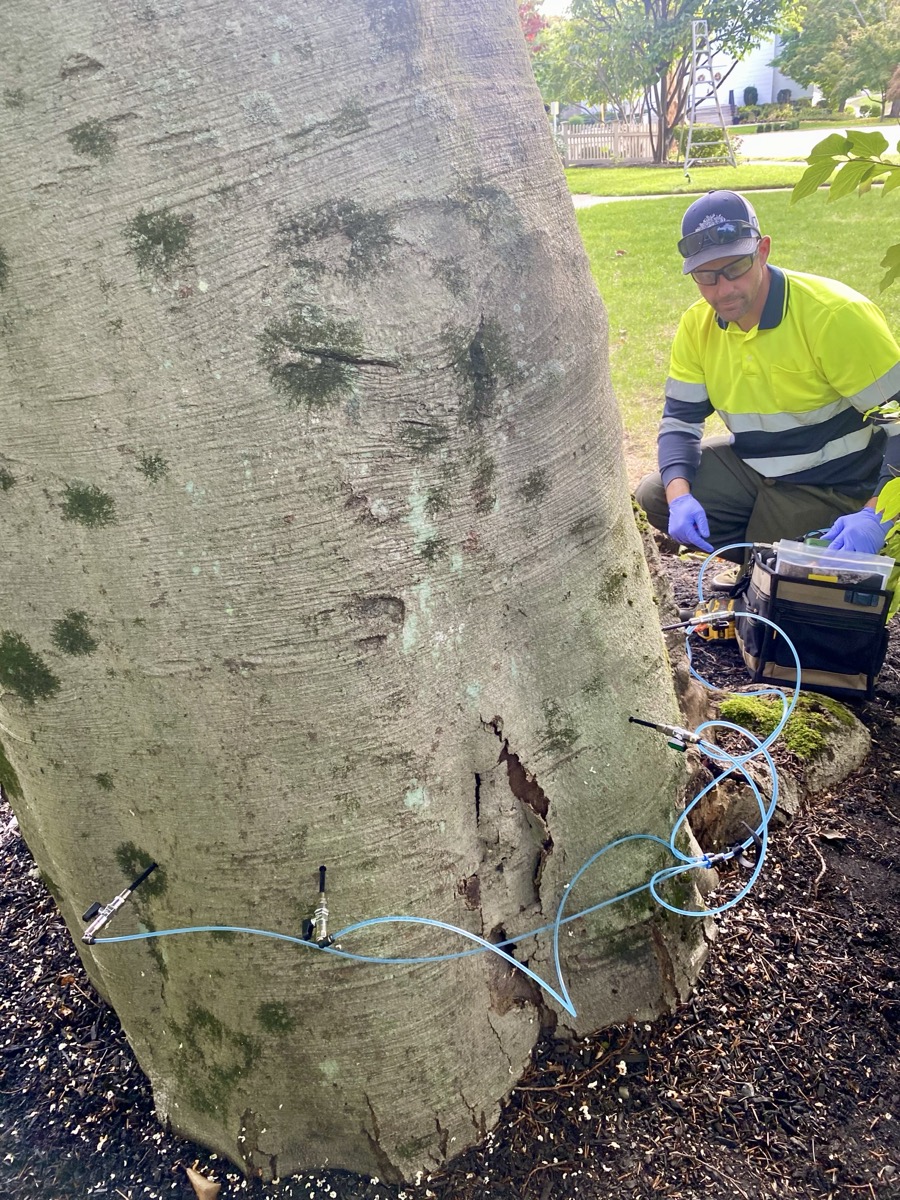
**Step 3: Integrated Pest Management Implementation** We prioritize non-chemical tactics per IPM. Prune deadwood from white pines in Bradley Woods using ANSI A300 pruning standards, reducing pest habitats. Apply horticultural oils for winter moth eggs on Norway maples in Glad Tidings Plain. For soil care, our deep root injectors deliver fertilizer 12-18 inches below surface, bypassing compacted topsoil in South Hingham. Trunk injections use low-pressure systems (20-100 PSI) for even distribution, treating 30-50 feet of canopy height.
**Step 4: Treatment Execution with Safety Protocols** Safety comes first. Our team wears PPE, uses secured lift platforms for heights over 20 feet, and establishes 50-foot exclusion zones near historic homes in Hingham Centre. In Crow Point, we coordinate with abutters to avoid drift during foliar sprays. Equipment includes calibrated sprayers for precise Bt dosing (0.5-1 lb/acre) and TreeHelp injectors for adelgid control. Post-treatment, we apply bio-stimulants to boost microbial activity in your sandy loams.
**Step 5: Monitoring and Follow-Up** We revisit quarterly, using drone imagery for canopy analysis in dense World's End groves. Adjust programs based on efficacy—e.g., re-inject white oaks if oak wilt appears. Annual reports track metrics like leaf density and growth rates, ensuring compliance with Hingham's tree ordinance.
Techniques shine in Hingham specifics. Crown reductions on European beeches in Hingham Harbor reduce wind sail by 30%, using suppression cuts to maintain form. Soil injections in Liberty Plain incorporate mycorrhizae to enhance white pine drought tolerance amid coastal droughts.
Homeowner tips: Water deeply (1-2 inches/week) during July dry spells to support our fertilization. Avoid staking young street trees in South Hingham, as it weakens trunks. Our process yields 20-40% vigor improvements, per resistograph data.
From Cohasset to Weymouth borders, Southeast Arborist's Hingham process protects your investment with science-backed care. Call 508-369-5009 to start your assessment today.
Common Plant Health Care Projects in Hingham Neighborhoods
In Hingham's diverse neighborhoods, Southeast Arborist tackles plant health care projects matched to local tree pressures and historic contexts.
**Hingham Centre and Main Street** Structural pruning on young American elm replacements addresses co-dominant leaders, preventing failures over colonial streets. Hazard assessments on mature red oaks near Old Ship Church identify decay; we remove deadwood and inject against oak decline.
**Hingham Harbor and Crow Point** Storm prep crown reductions on white pines mitigate nor'easter risks, thinning by 25% while preserving harbor views. Spongy moth treatments protect lindens, using targeted sprays to avoid bay contamination.
**West Hingham and South Hingham** Deep root fertilization revives chlorotic Norway maples in developments, injecting iron chelates into compacted soils. White pine deadwood removal in preserved canopies prevents branch drop on lawns.
**World's End and Liberty Plain** Hemlock woolly adelgid management in Olmsted groves employs systemic injections, preserving allees. Sugar maple verticillium treatments include trunk flares excavations to improve drainage.
**Glad Tidings Plain and Queen Anne's Corner** Winter moth control on European beeches via egg-banding and oils. White oak soil care combats compaction from foot traffic, with radial fertilization patterns.
**Bradley Woods** Emerald ash borer prophylactics on remnant ashes, plus beech scale monitoring. Common across all: IPM scouting for early pest detection.
These projects follow ANSI A300, with before-after photos for transparency. In Hingham's upscale areas, our work sustains property values—healthy trees add 10-15% to appraisals.
Plant Health Care Costs in Hingham, MA
Plant health care costs in Hingham MA vary by property size, tree count, and issues, but Southeast Arborist provides transparent pricing for South Shore value.
**Assessment Fees** Initial evaluations start at $250 for properties under 1 acre in Hingham Centre, including soil tests and tree risk reports. Larger estates in World's End add $100 for drone surveys.
**Annual PHC Programs** Custom programs range $800-$3,500/year. Basic (soil care + monitoring) for 5-10 trees in South Hingham: $800. Full IPM with spongy moth sprays and fertilizations for 20+ trees in Crow Point: $2,000+. Trunk injections (emerald ash borer, adelgid) cost $25-40/tree diameter inch, e.g., $500 for a 20-inch red oak in West Hingham.
**Project-Specific Pricing** Deep root fertilization: $150-300/tree, using 2-4 gallons of liquid per white pine in Liberty Plain. Foliar sprays for winter moth: $400/acre in Glad Tidings Plain. Crown cleaning: $200-600 for European beeches in Queen Anne's Corner.
**Factors Influencing Costs** Tree size/species: Larger white oaks near Old Ship Church incur access fees ($100+). Neighborhood access: Narrow streets in Hingham Harbor add mobilization ($150). Urgency: Storm-damaged pines in Bradley Woods post-nor'easter: 20% premium. Multi-year contracts save 15-25%, e.g., $1,800/year for Hingham Harbor program vs. $2,200 à la carte.
**Value Proposition** Investing $1,500 annually prevents $5,000+ removals—a 70% ROI. ISA-certified treatments extend tree life 15-30 years, per studies. In upscale Hingham, healthy canopies support premium sales ($50K+ value). Our warranties cover re-treatments if efficacy dips below 80%.
Budget tips: Prioritize high-value trees (oaks over streets). Combine services—fertilize during pest sprays for 10% discounts. Financing via monthly payments available.
Compared to Weymouth or Scituate, Hingham's historic premiums justify pros, but our local base keeps costs 15% below chains. Get a quote at 508-369-5009—transparent, no surprises.
When to Schedule Plant Health Care in Hingham
Timing plant health care in Hingham MA maximizes efficacy against your trees' seasonal stressors.
**Spring (March-May)** Schedule assessments and spongy moth Bt sprays as buds swell—larvae peak mid-May in Hingham Centre. Deep root fertilizations before leaf-out boost red oaks in South Hingham.
**Summer (June-August)** Winter moth and adelgid treatments via injections; coastal humidity spikes fungal risks on white pines in Crow Point. Monitor sugar maples for scorch.
**Fall (September-November)** Soil drenches for hemlocks in World's End; dormant oils for scales on beeches in Bradley Woods. Prune post-frost to avoid oak wilt.
**Winter (December-February)** Hazard evals on white oaks in Hingham Harbor before nor'easters.
**Urgency Signs** Call immediately for: Sudden defoliation (pests), wilting branches (borers), oozing cankers (Dutch elm disease echoes), or leaning trunks post-storm in Liberty Plain.
Annual scheduling in March ensures compliance with Hingham bylaws. Contact 508-369-5009 now for slots.
Frequently Asked Questions About Plant Health Care in Hingham
**What is plant health care in Hingham MA?** Custom programs including pest control, fertilization, and disease treatments for trees like red oaks and white pines, adapted to Hingham's coastal soils and history.
**How do I know if my Hingham trees need PHC?** Look for sparse canopies on sugar maples in West Hingham, webbing on lindens in Queen Anne's Corner, or dieback on white oaks near Old Ship Church. Our free consult confirms.
**Are treatments safe for pets/kids in Crow Point?** Yes—IPM uses low-toxicity options like Bt, with 48-hour re-entry intervals. We notify neighbors in dense Hingham Harbor.
**How effective are trunk injections for emerald ash borer?** 95% mortality reduction for 2 years; ideal for remnant ashes near Norwell.
**What's the difference from general tree care?** PHC prevents issues via science; we follow ANSI A300, unlike trimmers.
**Do you serve World's End properties?** Absolutely—coordinated with Trustees for Olmsted groves.
**How long until I see results on Norway maples in South Hingham?** Fertilization shows greener leaves by July; pest control in 4-6 weeks.
**Can PHC help storm-prone white pines in Glad Tidings Plain?** Yes—reductions and deadwood removal cut failure risk 40%.
Call 508-369-5009 for answers.
Plant Health Care Throughout Hingham
Southeast Arborist provides plant health care across Hingham neighborhoods: Hingham Centre's historic elms, Hingham Harbor's salty lindens, West Hingham's maples, South Hingham's pines, Crow Point's crowns, World's End's groves, Liberty Plain's soils, Glad Tidings Plain's beeches, Queen Anne's Corner oaks, and Bradley Woods hazards.
We extend to nearby Cohasset, Norwell, Weymouth, Scituate, Rockland. From Plymouth/Cohasset base, response times under 24 hours.
Protect your Hingham trees—call ISA Certified Arborists at 508-369-5009 for tailored PHC.