
# Professional Plant Health Care in Sandwich, Massachusetts
As a homeowner in Sandwich, Massachusetts, you rely on your trees to define your property's character, provide shade, and enhance curb appeal in this historic Cape Cod town. But with Sandwich's unique blend of coastal winds, sandy soils, and dense pine-oak forests, your pitch pines, red oaks, and American beeches face constant threats from pests, diseases, and environmental stress. That's where professional plant health care (PHC) from Southeast Arborist, LLC comes in. Our ISA Certified Arborists deliver tailored PHC programs across Sandwich, MA, addressing everything from winter moth infestations on your oaks to pine bark beetle damage in Forestdale.
Sandwich, the oldest town on Cape Cod with a population of around 21,000 in Barnstable County, features extensive conservation lands like Sandy Neck and Shawme-Crowell State Forest. These areas amplify local tree challenges: heritage trees in Sandwich Village demand preservation pruning to meet ANSI A300 standards, while salt spray from Scorton Creek stresses Atlantic white cedars. Our plant health care services in Sandwich MA use integrated pest management (IPM), deep root fertilization, and trunk injections to restore vigor without harmful chemicals.
Why choose Southeast Arborist for plant health care in Sandwich? We're based in Plymouth and Cohasset, serving the South Shore with a focus on safety protocols that include traffic control, personal protective equipment, and aerial lift certifications. Our custom PHC programs start with a thorough site assessment, identifying issues like hemlock woolly adelgid on eastern red cedars or emerald ash borer threats. We treat spongy moth and winter moth outbreaks—common in East Sandwich's pitch pine stands—using targeted applications that minimize impact on beneficial insects.
Practical advice for Sandwich homeowners: Inspect your black oaks and scrub oaks now for defoliation from winter moths, which peak in spring. Look for webbing on sassafras leaves signaling spongy moths. Early intervention prevents canopy loss, preserving your property's value amid Sandwich's rising real estate market. Our deep root fertilization combats nutrient deficiencies in the town's acidic, sandy soils, delivering micronutrients directly to roots via soil probes.
In Sandwich's neighborhoods—from Spring Hill's residential lots to the historic village center—PHC isn't optional; it's essential for wildfire risk reduction near state forests and heritage tree preservation tied to the town's glass-making legacy. Trees around Shawme Pond, some dating to the 19th century, require cabling and disease management to withstand storms from Cape Cod Bay.
Southeast Arborist follows ANSI A300 pruning standards for all work, ensuring structural integrity. Our trunk injection systems for emerald ash borer provide two-year protection, ideal for Sandwich's scattered ash populations. Call our ISA Certified team at 508-369-5009 to schedule a free consultation for plant health care in Sandwich MA. Protect your investment in this irreplaceable landscape today.
Why Sandwich Properties Need Plant Health Care
Sandwich, MA's landscape—shaped by 400 years of settlement—demands specialized plant health care to combat site-specific stressors. Your property in Sandwich Village might feature towering American beeches shading historic homes from the glass-making era, while Forestdale's second-growth pitch pine forests grew on former military land. Coastal exposure at Sandy Neck and Scorton Creek Area introduces salt-laden winds that scorch eastern red cedar needles, and acidic, well-drained sandy soils limit nutrient uptake for red oaks and black oaks.
Common tree species like white pine and black cherry thrive here but suffer from pine bark beetles, which bore into weakened pitch pines during dry summers. Barnstable County's temperate maritime climate—mild winters averaging 30°F and humid summers—fuels fungal diseases like anthracnose on sassafras. Winter moth caterpillars defoliate oaks in East Sandwich, reducing photosynthesis by up to 70% if untreated. Spongy moths target black cherry and scrub oak, creating webbed tents that spread via wind from nearby Bourne.
Heritage tree preservation in Sandwich Village requires PHC to protect 18th-century specimens near Hoxie House or the Dexter Grist Mill. These oaks and beeches face root compaction from foot traffic and construction, addressed through deep root fertilization that injects iron, magnesium, and phosphorus into the drip line. In Spring Hill, residential lawns host Atlantic white cedar hedges battered by nor'easters; our soil care programs amend pH imbalances, boosting resilience.
Wildfire risk escalates in Shawme-Crowell State Forest-adjacent properties, where dense pitch pine understories accumulate dead needles. PHC includes thinning to reduce fuel loads, following Massachusetts Forest Fire Control guidelines. Salt damage at Sandy Neck manifests as needle browning on white pines—treatable with foliar sprays and windbreak pruning.
Emerald ash borer, though less common, threatens isolated ashes near Mashpee borders; trunk injections deliver imidacloprid systemically. Hemlock woolly adelgids infest eastern hemlocks (related to local cedars), causing needle drop visible in Scorton Creek Area conservation trails. IPM scouting detects these early: Check your pitch pines for pitch tubes from bark beetles, a sign of drought stress exacerbated by Sandwich's 45-inch annual rainfall concentrated in bursts.
Climate data from nearby Hyannis shows increasing storm intensity, with Category 1 hurricanes like Bob in 1991 toppling trees. Your black oaks need cabling to prevent failure onto Route 6A. Soil tests reveal low nitrogen in Forestdale's former farmland, corrected via our liquid fertilization reaching 12-18 inches deep.
Homeowners gain practical value: Monitor for winter moth frass (droppings) under oaks in March; early BTK bacterial sprays halt outbreaks. Thin lower pitch pine branches to 10 feet in wildfire zones, improving access for firefighting. Southeast Arborist's ISA Certified Arborists use diagnostic tools like resistographs to assess decay in heritage beeches without invasive sampling.
Without PHC, your trees lose 20-30% vigor annually, dropping property values by thousands in Sandwich's median $600,000 market. Invest in plant health care Sandwich MA to sustain this human-forest legacy.
Our Plant Health Care Process in Sandwich
Southeast Arborist delivers plant health care in Sandwich MA through a structured, science-based process tailored to your property's trees. Step one: Initial consultation and assessment. Our ISA Certified Arborists arrive with soil probes, anemometers for wind mapping, and digital calipers. In Sandwich Village, we map heritage oaks' root zones around historic foundations, noting compaction from Route 130 traffic.
We conduct a full diagnostic: Visual inspection for winter moth egg masses on twigs, resistograph drilling for internal decay in American beeches, and soil auger samples revealing pH 4.5-5.5 common in Sandy Neck's glacial outwash. Drones survey tall pitch pines in East Sandwich, identifying spongy moth defoliation from 100 feet up.
Step two: Customized PHC program design. Using IPM principles per ISA BMPs, we prioritize cultural, mechanical, biological, and chemical controls. For your Forestdale pitch pines threatened by bark beetles, we recommend deep root fertilization first—our hydro-injection rigs pump 500 gallons of nutrient slurry per acre, targeting mycorrhizal zones depleted by sandy soils.
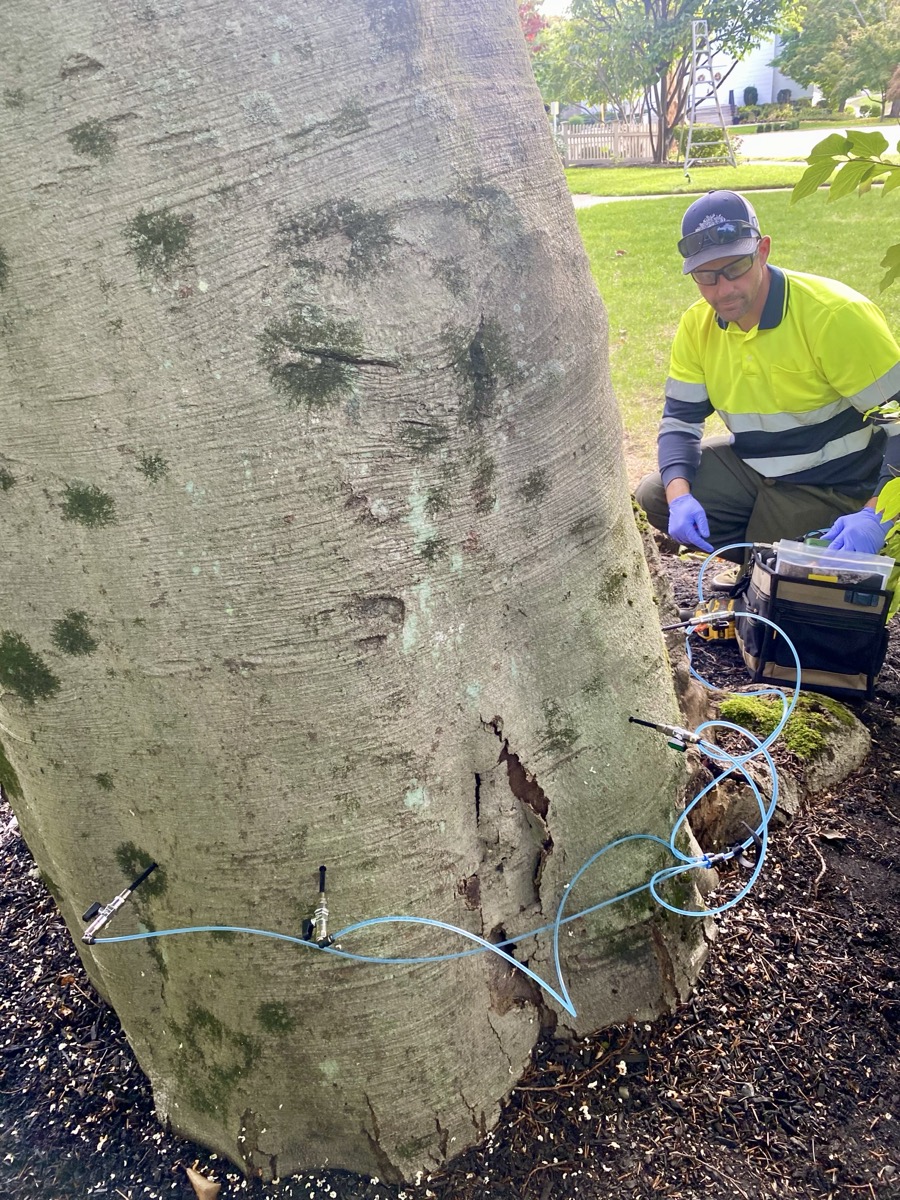
Trunk injections follow for high-risk pests. Our TreeAge system injects emamectin benzoate into red oaks for emerald ash borer or hemlock woolly adelgid on Atlantic white cedars. In Scorton Creek Area, we space injection sites every 6 inches on the trunk, achieving 100% canopy distribution within weeks. Equipment includes low-pressure injectors (20 PSI) to avoid wounding, compliant with ANSI A300.
Step three: Implementation with safety protocols. Crews don harnesses, hard hats, and use bucket trucks with outriggers stabilized on Sandwich's uneven terrain. For spongy moth in Spring Hill black cherry trees, we apply BTK aerial sprays via mist blowers, timed for egg hatch in May. Deep root fertilization uses grid patterns: 2-foot spacing in drip lines, verified by GPS for repeat treatments.
Soil care includes aeration with verticutters to alleviate compaction near Shawme Pond, followed by compost topdressing rich in organic matter. Disease management for beech bark disease involves sanitation pruning—removing blistered branches per ANSI standards—and phosphite trunk injections to boost defenses.
Step four: Monitoring and follow-up. We install data loggers on high-value trees like Sandwich Village beeches, tracking moisture and growth via dendrometers. Quarterly reports detail metrics: 25% diameter increase post-fertilization, 90% winter moth control. Adjustments address new threats, like salt stress on white pines from Cape Cod Bay gales—rinsed with freshwater applications.
Our techniques leverage Cape-specific adaptations: Wind reduction pruning shears lower branches on Sandy Neck scrub oaks at 45-degree angles to promote closure. All chemicals are EPA-labeled for ornamentals, with buffer zones near wetlands like Scorton Creek.
Practical tip: Document your trees' health pre-treatment with photos; our apps integrate this for progress tracking. Safety first: We secure work zones with cones and flaggers on busy Jarves Street.
This process restores your trees' health, preventing removal costs averaging $2,000 per mature pitch pine. Contact Southeast Arborist at 508-369-5009 for plant health care in Sandwich MA.
Common Plant Health Care Projects in Sandwich Neighborhoods
Sandwich neighborhoods each present distinct PHC needs, drawing on local tree species and conditions. In Sandwich Village, heritage tree care dominates: Preservation pruning and cabling for 200-year-old red oaks near the Sandwich Glass Museum. We inject phosphites against neonectria canker, common in American beeches shading Liberty Street homes.
East Sandwich properties focus on pitch pine thinning amid wildfire risks near Route 6A. Our crews remove ladder fuels—low scrub oak branches—reducing flame heights by 50%. Winter moth treatments protect black cherry ornamentals, using mating disruption pheromones.
Forestdale's second-growth forests on former Camp Edwards land require pine bark beetle management. Deep root fertilization bolsters white pines stressed by dry sandy soils, with sanitation removals of infested pitch pines hauled to biomass facilities.
Sandy Neck-adjacent lots battle salt and wind: Foliar calcium sprays revive Atlantic white cedar hedges, while shear pruning creates windbreaks from sassafras. PHC programs monitor erosion on dunes, stabilizing roots with mycorrhizal inoculants.
Scorton Creek Area conservation properties need hemlock woolly adelgid control on eastern red cedars bordering trails. Trunk injections and horticultural oil smother crawlers, preserving riparian buffers.
Spring Hill residential developments call for comprehensive IPM: Spongy moth suppression on black oaks via BTK, plus emerald ash borer scouting near new builds. Soil injections correct nitrogen deficiencies in lawns hosting young beeches.
Across neighborhoods, common projects include storm recovery—post-nor'easter cabling of oaks—and fire mitigation near Shawme Pond. In Sandwich Village, we coordinate with historical commissions for ANSI-compliant work on glassworks-era trees.
Practical advice: In East Sandwich, prune pitch pines in dormant season (December-February) to avoid beetle attraction. Forestdale homeowners, test soil pH annually; amend with lime if below 5.0 for oaks.
Southeast Arborist's ISA experts handle these with precision, serving from Plymouth to Barnstable. Schedule via 508-369-5009.
Plant Health Care Costs in Sandwich, MA
Plant health care costs in Sandwich MA vary by property size, tree condition, and treatment scope, but deliver strong ROI through longevity. A basic assessment for a Sandwich Village half-acre lot with five heritage oaks runs $250-$400, including soil tests and pest scouting. Custom PHC programs start at $800 annually for 10-15 trees, covering four quarterly visits.
Deep root fertilization—key for sandy soils—costs $15-$25 per tree diameter inch (e.g., $300 for a 12-inch pitch pine in Forestdale). This yields 20-40% growth boost, averting $1,500 removal fees. Trunk injections for winter moth or emerald ash borer: $20-$40 per inch, with two-year efficacy saving repeat sprays.
Spongy moth treatments via BTK average $0.50-$1 per tree height foot ($400 for 40-foot East Sandwich white pines). IPM reduces chemical use by 50%, cutting long-term costs. Hemlock woolly adelgid management on Scorton Creek cedars: $500-$800 per program, including monitoring.
Factors influencing pricing: Neighborhood access (higher in Sandy Neck for crane needs), tree count (volume discounts over 20), and urgency (expedited post-storm adds 20%). Spring Hill lots with young black oaks pay less ($10/inch fertilization) than Village beeches needing cabling ($50/inch plus $200 anchors).
Value proposition: Untreated oaks lose 30% value from defoliation; PHC preserves $50,000+ in landscape equity. Tax deductions apply for conservation easements near Shawme Pond. Multi-year contracts save 15-20%.
Compare: DIY fertilizers yield poor results in Sandwich's low-CEC soils; pros use calibrated injectors. Our ISA certification ensures compliance, avoiding fines.
Budget tip: Prioritize high-value trees—cable Village red oaks first. Transparent quotes from Southeast Arborist detail breakdowns. Call 508-369-5009 for your Sandwich PHC estimate.
When to Schedule Plant Health Care in Sandwich
Timing plant health care in Sandwich MA maximizes efficacy against seasonal threats. Schedule deep root fertilization in early spring (March-April) or fall (September-October), when roots absorb best amid 50°F soils. Avoid summer droughts stressing pitch pines.
Winter moth treatments target egg hatch: Scout March-April in East Sandwich oaks; apply BTK by May 1. Spongy moths need pheromone traps in June, sprays by mid-July for Forestdale black cherry.
Emerald ash borer injections occur May-June or August-September, syncing with larval cycles. Hemlock woolly adelgid: Dormant oil in February for Scorton Creek cedars, injections post-bud break.
Urgency signs: 20% canopy thinning on Village beeches (neonectria), pitch tubes on Sandy Neck pitch pines (beetles), or salt scorch on Spring Hill white pines post-storm. Act within 2 weeks to halt spread.
Annual programs align with Sandwich's climate: Pruning December-March dormant season. Monitor post-nor'easter for cabling.
Tip: Use our app for reminders. Call 508-369-5009 now for spring slots.
Frequently Asked Questions About Plant Health Care in Sandwich
**What is plant health care in Sandwich MA?** PHC encompasses proactive tree maintenance: pest control, fertilization, and disease treatment tailored to Sandwich's pitch pines and oaks. Our IPM avoids blanket sprays.
**How do I know if my Sandwich trees need PHC?** Look for defoliation (winter moth on red oaks), bark cracks (beetles in Forestdale pines), or wilting (salt in Sandy Neck). Free assessments confirm.
**Are your treatments safe for Sandwich pets and kids?** Yes, IPM minimizes chemicals. BTK for spongy moths biodegrades in days; injections stay inside trees.
**How long until I see results from PHC?** Fertilization greens up in 4-6 weeks; pest injections reduce damage in 2-4 weeks on Village beeches.
**Does PHC prevent tree removal in Sandwich?** Often—80% success restoring stressed pitch pines, saving $2,000+ per tree.
**What's the difference between PHC and regular pruning?** PHC is holistic: soil, pests, roots. Pruning follows ANSI A300 as part of it.
**Can you handle heritage trees in Sandwich Village?** Absolutely; we coordinate with historical societies for beeches near Hoxie House.
**How often should I schedule PHC in Sandwich?** Quarterly monitoring, annual treatments for high-risk areas like Shawme Pond.
Plant Health Care Throughout Sandwich
Southeast Arborist provides plant health care across Sandwich neighborhoods: Sandwich Village heritage care, East Sandwich pine thinning, Forestdale beetle control, Sandy Neck salt management, Scorton Creek adelgid treatments, Spring Hill IPM. We extend to Bourne, Barnstable, Mashpee, Plymouth from our Plymouth/Cohasset base.
ISA Certified, ANSI-compliant, safe. Call 508-369-5009 for service in Sandwich, MA 02563.