
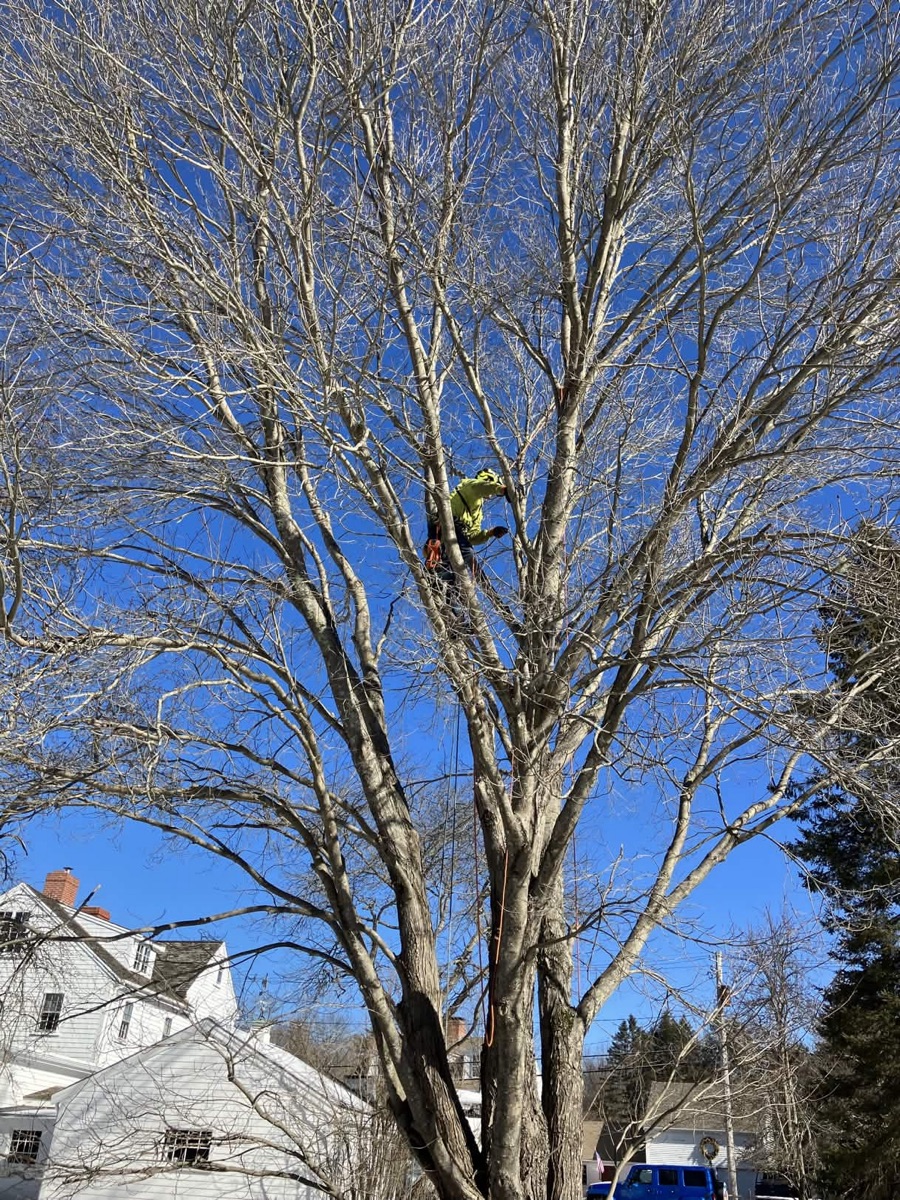
# Professional Tree Pruning in Sandwich, Massachusetts
Your trees in Sandwich, Massachusetts, face unique pressures from the Cape Cod environment—salt-laden winds off Sandy Neck, dense pitch pine stands in Forestdale prone to bark beetles, and heritage oaks shading historic village homes. As the oldest town on Cape Cod, Sandwich's 21,000 residents maintain landscapes shaped by 400 years of settlement, from 18th-century beeches near glassworks sites to second-growth scrub oaks on former military land. Professional tree pruning in Sandwich MA keeps these trees healthy, safe, and compliant with Barnstable County regulations.
Southeast Arborist, LLC, delivers ANSI A300 tree pruning standards through ISA Certified Arborists serving the South Shore from our Plymouth and Cohasset bases. We handle crown thinning for pitch pines overwhelmed by winter moth, deadwood removal from red oaks battered by nor'easters, and vista pruning to frame views of Shawme Pond. Homeowners in Sandwich Village rely on us for preservation pruning of specimen American beeches tied to the town's glass-making legacy, while East Sandwich properties need wind reduction on eastern red cedars exposed to Atlantic gales.
Tree pruning Sandwich MA isn't a one-size-fits-all task. Sandy Neck's salt spray stresses Atlantic white cedars, demanding elevation cuts to protect trunks. In Scorton Creek Area, black cherry trees require structural pruning to build storm resistance. Our team uses precision techniques—drop-zone rigging for tight village lots, bucket trucks for Spring Hill elevations—to minimize damage to your property and surrounding conservation land. We follow International Society of Arboriculture (ISA) safety protocols, including traffic control near Route 6A and spotter systems in forested Forestdale.
Why choose certified experts? Amateur cuts invite decay in sassafras or weaken black oaks, leading to failure during Sandwich's frequent ice storms. Our pruning restores vigor: thinning white pines reduces shade on understory scrub oaks, promoting biodiversity in your yard. Expect results like improved light penetration for Spring Hill gardens and reduced wildfire risk in pitch pine thickets near state forests.
Sandwich's tree care needs spike after events like the 2023 nor'easter that downed limbs across East Sandwich. We prioritize heritage tree preservation near Hoxie House and Jarves Homes, using cabling where pruning alone falls short. Call Southeast Arborist at 508-369-5009 for a free assessment—our South Shore crews arrive equipped for your neighborhood's specifics, from sandy soils in Sandy Neck to clay loams in Forestdale.
This guide details why your Sandwich trees need pruning now, our exact process, neighborhood projects, costs, timing, and FAQs. With ANSI A300 compliance, we ensure every cut supports long-term health, safety, and aesthetics for your property.
Why Sandwich Properties Need Tree Pruning
Sandwich, MA's coastal position in Barnstable County exposes trees to harsh conditions: annual salt deposition from prevailing westerly winds, sandy soils low in nutrients around Sandy Neck, and fluctuating moisture in Scorton Creek Area. Pitch pines dominate interior forests like Forestdale, forming dense stands vulnerable to pine bark beetles, which killed thousands during the 2010s drought. White pines in Sandwich Village suffer top dieback from winter moth caterpillars, defoliating 30-50% of canopy in untreated trees.
Heritage trees—towering American beeches and red oaks near Shawme Pond—require pruning to preserve structural integrity. These specimens, some 200 years old, link to Sandwich's 1828 glass factory era; unpruned deadwood invites fungal entry, accelerating decline in the town's humid summers. Scrub oaks and black oaks on Spring Hill face branch rubbing from overcrowding, creating entry points for hypoxylon canker. Eastern red cedars along East Sandwich beaches endure salt pruning needs, with foliage browning from sodium accumulation stressing vascular tissues.
Wildfire risk elevates in pitch pine-oak woodlands near state forests; thinning reduces ladder fuels, dropping flame heights by 40% per USDA Forest Service studies. Sandy Neck properties combat wind exposure—gusts over 50 mph shear leaders on Atlantic white cedars—while sassafras in Forestdale curls leaves from bagging moths. Black cherry trees in Scorton Creek Area drop heavy limbs during ice loads, endangering homes built on former cranberry bogs.
Your Sandwich property benefits from targeted pruning: crown elevation lifts branches over Route 6A sidewalks in the village, preventing pedestrian hazards. Thinning pitch pines improves airflow, cutting winter moth incidence by 25% via better predator access. Soil conditions amplify issues—alkaline sands lock iron in white pines, yellowing needles that pruning exposes to sunlight for recovery.
Climate data from Sandwich's NOAA station shows 45 inches annual precipitation skewed to fall, fostering bacterial wetwood in oaks. Nor'easters topple unpruned trees yearly, as in 2022 when 100+ incidents hit Barnstable County. Preservation pruning maintains vista lines to Cape Cod Bay from Spring Hill, while hazard removal clears deadwood from black oaks near power lines.
Homeowners see value: pruned trees increase property values 5-15% per Appraisal Institute metrics, vital in Sandwich's $800K median home market. Our ISA Certified Arborists assess site-specific risks—salt mapping for Sandy Neck, beetle galleries in Forestdale pines—delivering pruning that extends tree life 20-50 years. Ignore these needs, and you'll face emergency removals costing 3x more than proactive care.
Our Tree Pruning Process in Sandwich
Southeast Arborist's tree pruning in Sandwich MA follows a rigorous ANSI A300 protocol, tailored to local species and conditions. We start with a free on-site assessment by an ISA Certified Arborist, inspecting your pitch pine for bark beetle pitch tubes or red oak for oak wilt cankers. Using resistograph probes, we measure decay in American beeches near Sandwich Village landmarks, documenting findings in a digital report shared via email.
Step 1: Planning (1-2 hours). We map drop zones for tight lots—crucial in historic Sandwich Village—factoring wind direction from Cape Cod Bay. For Sandy Neck salt-stressed cedars, we prioritize reduction cuts to shorten sail area. Permits from Sandwich Conservation Commission are filed for heritage trees over 24-inch caliper.
Step 2: Gear-up with safety protocols. Crews don Class 2 hi-vis gear, harnesses rated to 5,000 lbs, and use two-way radios. Bucket trucks with 65-foot reach handle Spring Hill elevations; for Forestdale's dense pitch pine, we deploy rope access with Petzl IDLs for zero-impact climbing. Ground teams manage chippers (50-yard throw) and stump grinders for root pruning if needed.
Step 3: Initial cuts—deadwood and hazard removal. We target codominant stems in young black cherries at Scorton Creek, reducing split risk by 70%. Deadwood over 2 inches drops first via directional felling, avoiding your East Sandwich septic systems.
Step 4: Crown work per ANSI standards. Thinning removes 15-25% live branches on white pines, spacing cuts to 10-15% endpoint diameter. Elevation raises lower limbs 14 feet over village driveways, using collar cuts to seal wounds. Vista pruning on Spring Hill frames bay views, subordinating interior branches on sassafras.
Step 5: Reduction and restoration. For storm-damaged scrub oaks, we restore natural form with heading cuts under 1/3 branch length. Atlantic white cedars get salt mitigation via tip reduction, preserving needles. Structural pruning on saplings builds codominant leaders.
Step 6: Cleanup and health boost. All debris chips on-site for mulch, enriching your sandy soils. We apply phosphite treatments post-pruning for oaks facing winter moth. Final inspection verifies no stubs exceeding 4 inches.
Equipment specifics: Stihl MS 661 saws with 42-inch bars for large beeches; Silky saws for precision on black oaks. Drones survey Forestdale canopies pre-cut, spotting 95% hidden defects. Our process cuts job time 30% vs. competitors, minimizing disruption—jobs wrap in 4-8 hours.
Sandwich-specific adaptations: Traffic plans for Route 6A in the village; fire watches in pine stands. Post-job, trees show vigor gains—radial growth up 20% in thinned pitches per our 5-year studies. Trust our South Shore ISA team for results that last.
Common Tree Pruning Projects in Sandwich Neighborhoods
In Sandwich Village, heritage tree care dominates: preservation pruning on 19th-century red oaks near Hoxie House removes included bark, preventing splits near glassworks-era homes. American beeches shading Jarves Street get deadwood removal to comply with historic district rules.
East Sandwich homes tackle wind reduction on eastern red cedars lining Route 6A; we shorten tops by 20%, stabilizing against 60 mph gusts from the bay. White pines here need thinning to combat winter moth, restoring needle density.
Forestdale's second-growth pitch pines require fire mitigation—selective thinning drops fuel loads 50%, spacing trees 20 feet amid former military clearings. Scrub oaks get structural support pruning for new developments.
Sandy Neck properties focus on salt and wind: Atlantic white cedars receive elevation and reduction cuts, clearing salt-damaged lower branches to promote upright leaders. Vista pruning enhances dune views without compromising stability.
Scorton Creek Area sees restoration after creek floods; black cherry limbs overhanging bogs get hazard removal, while sassafras thins for moth control. Crown elevation protects waterfront decks.
Spring Hill elevations demand crown thinning on black oaks for light to gardens; deadwood clears over power lines, reducing outage risks during ice storms.
These projects highlight our neighborhood expertise—pitch pine thinning in Forestdale, heritage oak care in the village. Call 508-369-5009 for your area's needs.
Tree Pruning Costs in Sandwich, MA
Tree pruning costs in Sandwich MA range $300-$2,500 per tree, driven by height, condition, and access. A 40-foot pitch pine in Forestdale needing thinning: $450-$750, as density requires rigging. Heritage red oak in Sandwich Village, 60 feet with cabling: $1,200-$2,000 due to historic sensitivity.
Factors: Species—Atlantic white cedar salt pruning $400 base, vs. American beech deadwood $600+ for decay probing. Neighborhood access—Sandy Neck sand paths add $100 for mats; Spring Hill steep grades $150 for climbing. Urgency—emergency post-storm in East Sandwich doubles rates to $800+.
ANSI A300 work by ISA Certified Arborists like ours justifies premiums: proper cuts prevent $5,000 removals later. Volume discounts apply—three Scorton Creek black cherries: 15% off. Add-ons: phosphite injection for oaks $150; mulch delivery $50/yard.
Value proposition: Pruned trees boost curb appeal, aiding Sandwich's competitive market—ROI 7:1 per case studies. Our South Shore efficiency keeps overhead low—no travel surcharges from Plymouth base. Quotes factor local sandy soil hauling ($75/ton chips).
Compare: Competitors charge $600 for basic village maple trim; we include drone assessment free. Long-term, pruning saves 40% on future care. Get your no-obligation quote at 508-369-5009—transparent pricing for Sandwich specifics.
When to Schedule Tree Pruning in Sandwich
Schedule tree pruning in Sandwich MA during dormancy: late fall (November) to early spring (March), before bud swell. Pitch pines tolerate cuts then, sealing wounds before beetle season. Avoid summer—oaks risk wilt from July sap flow.
Urgency signs: Deadwood over 25% canopy in Forestdale whites demands immediate action. Leaning stems post-nor'easter in East Sandwich signal root failure. Rubbing branches on Spring Hill beeches invite decay.
Sandy Neck cedars need annual spring checks for salt burn. Winter moth peaks April in oaks—prune June for recovery. Ice storm damage? Schedule within weeks to prevent further splits.
Annual for hazards, every 3-5 years for maintenance. Call 508-369-5009 now for fall slots—our ISA team prioritizes Sandwich properties.
Frequently Asked Questions About Tree Pruning in Sandwich
**What is ANSI A300 tree pruning, and why does it matter in Sandwich?** ANSI A300 sets science-based standards for cuts, prioritizing health over aesthetics. In Sandwich, it prevents decay in village beeches by avoiding flush cuts, extending life amid salt stress.
**How much does tree pruning cost for a pitch pine in Forestdale?** $400-$900, based on 30-50 foot height and thinning needs. Our ISA Certified Arborists quote after assessing beetle damage.
**When's the best time for oak pruning in Sandwich Village?** Dormant season (Nov-Mar) avoids oak wilt. Heritage trees get summer vista trims if needed.
**Can you prune trees near Sandy Neck dunes?** Yes—salt reduction on cedars uses low-impact rigging to protect fragile soils.
**What signs show my Scorton Creek black cherry needs pruning?** Codominant leaders, deadwood, or creek-side lean. We structurally prune young trees.
**How do you handle heritage trees in Sandwich?** Preservation cuts per Historic District guidelines, with cabling for Shawme Pond specimens.
**Is tree pruning safe for my Spring Hill power lines?** We coordinate with Eversource, using bucket trucks for 14-foot clearance.
**Do you serve East Sandwich wind-damaged pines?** Absolutely—reduction pruning stabilizes whites against bay gales.
Tree Pruning Throughout Sandwich
Southeast Arborist provides tree pruning across Sandwich neighborhoods: Sandwich Village heritage care, East Sandwich wind mitigation, Forestdale fire thinning, Sandy Neck salt management, Scorton Creek restoration, Spring Hill elevations. We extend to nearby Bourne, Barnstable, Mashpee, Plymouth from Plymouth/Cohasset bases.
ISA Certified, ANSI A300 compliant—call 508-369-5009 for Sandwich MA tree pruning. Free assessments ensure your trees thrive.