
# Professional Plant Health Care in Kingston, Massachusetts
Your trees in Kingston, Massachusetts, face unique pressures from the town's bayfront salt spray, inland pine density, and Jones River flooding. As a homeowner in this waterfront community of 14,000 residents in Plymouth County, you rely on mature second-growth forests—white pines crowding inland lots, red oaks lining Indian Pond, and red maples along Silver Lake—for privacy, shade, and property value. Yet, these same trees suffer from wind damage in dense stands, hemlock woolly adelgid infestations, and soil compaction from heavy seasonal foot traffic.
Southeast Arborist, LLC, based in Plymouth and Cohasset, delivers customized plant health care (PHC) programs across the South Shore, including Kingston MA. Our ISA Certified Arborists follow ANSI A300 standards for every treatment, ensuring science-based pest management, disease control, deep root fertilization, and trunk injections. We specialize in plant health care Kingston MA properties because we understand local challenges: pitch pines battered by nor'easters on Rocky Nook lots, scarlet oaks stressed by power line encroachment on rural Pembroke Street roads, and beech trees declining from flooding near Jones River Village.
Plant health care in Kingston MA goes beyond reactive pruning—it's proactive defense. We use integrated pest management (IPM) to target threats like spongy moth outbreaks that defoliate white oaks in Kingston Center, emerald ash borer (EAB) attacking any ash remnants near The Islands, and winter moth caterpillars webbing sassafras branches around Elm Street Area. Our programs start with site-specific assessments, incorporating Kingston's sandy, acidic soils (pH 4.5-6.0 typical in pine-oak forests) and microclimates—brackish exposure on Kingston Bay versus kettle pond freshness at Indian Pond.
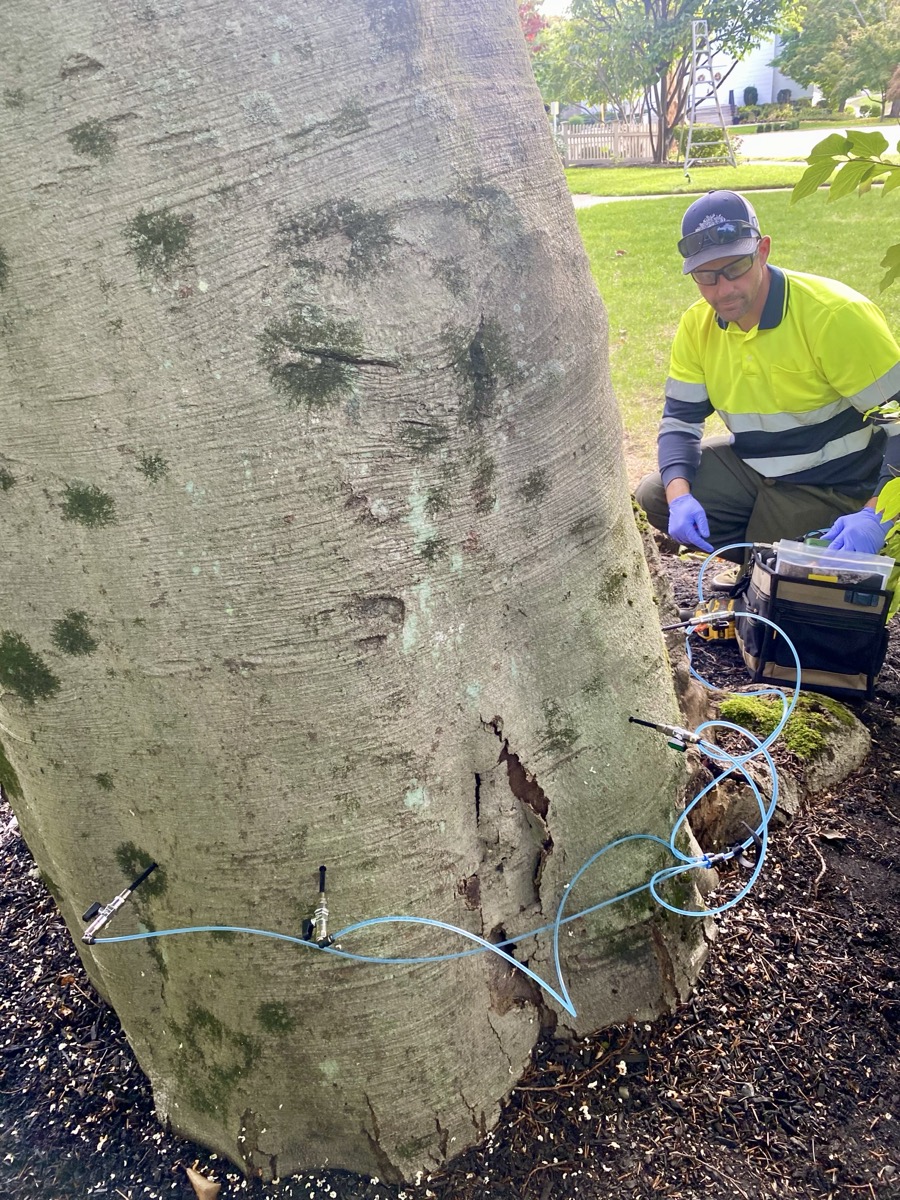
Homeowners in Kingston see results fast: healthier canopies reduce hazard risks, boost curb appeal for sales in this desirable ZIP 02364, and comply with town bylaws on tree protection. For instance, our deep root fertilization counters nutrient lockup in compacted bayfront soils, while trunk injections deliver precise hemlock woolly adelgid control without broad spraying. Safety protocols include TCIA accreditation standards, with all crews PPE-equipped and using low-impact equipment like air-spade root excavation tools.
Why choose Southeast Arborist for plant health care Kingston MA? Our local roots mean we know Duxbury neighbors thinning pines after storms, Pembroke properties managing riparian red maples, and Plymouth estates mirroring Kingston's oak groves. Call our ISA Certified team at 508-369-5009 for a no-obligation assessment—protect your white pines, red oaks, and black cherry trees before issues escalate. In Kingston's evolving landscape, from historic sawmill sites along the Jones River to modern Silver Lake docks, proactive PHC preserves your investment.
Why Kingston Properties Need Plant Health Care
Kingston MA's trees thrive in a mix of coastal exposure and inland forests, but local conditions demand targeted plant health care to prevent decline. Your waterfront property on Kingston Bay endures constant salt spray, weakening pitch pines and red maples by disrupting chlorophyll production—symptoms include needle scorch and twig dieback visible from Rocky Nook beaches. Inland, dense white pine stands around Indian Pond create self-shading, leading to suppressed lower branches and wind-throw risks during 50+ mph gusts common in nor'easters.
Common species like scarlet oak and white oak dominate oak groves near the Jones River, regrown after 19th-century ironworks depleted timber. These face beech bark disease, where scale insects and fungi kill vascular tissue, causing canopy thinning on Elm Street Area lots. Red maples along Silver Lake suffer iron chlorosis in alkaline pockets from construction fill, yellowing leaves despite acidic native soils. Sassafras and black cherry in Pembroke Street Area woodlands attract winter moth, with larvae stripping buds in spring, reducing flowering and fruit set.
Kingston's climate amplifies vulnerabilities: average annual rainfall of 48 inches, with Jones River flooding saturating riparian roots in Jones River Village, promoting Phytophthora root rot in beech trees. Kettle ponds like Indian Pond create humid microclimates fostering hemlock woolly adelgid (HWA), an aphid-like pest sucking sap from Eastern hemlocks (if present) along shaded edges. Power line corridors on rural roads near Kingston Center see chronic encroachment—branches rubbing white pines against utilities, inviting pine tip moths and girdling damage.
Soil challenges compound issues: sandy loams in pine-oak forests drain quickly but compact under foot traffic, limiting oxygen to red oak feeder roots. Bayfront agriculture history left thinner topsoil in The Islands, prone to erosion exposing sassafras roots. Without plant health care Kingston MA expertise, these stressors lead to cascading failures—declining white pines drop needles into gutters, hazardous scarlet oaks fail near driveways, and stressed red maples invite Armillaria root rot.
Practical advice for Kingston homeowners: Inspect trees monthly for oozing cankers on black cherry (indicating Verticillium wilt) or white webbing on pitch pine branches (HWA). Test soil pH annually—aim for 5.5-6.5 for oaks; use mulch rings (3-4 inches deep, 4-foot radius) around bases to retain moisture without vole habitat. Thin dense pines selectively: remove 20-30% canopy every 5 years to improve air flow, following ANSI A300 guidelines.
Southeast Arborist's ISA Certified Arborists address these with IPM: monitoring spongy moth egg masses in July on Kingston Bay properties, applying Bt kurstaki sprays timed for neonate larvae in May. For EAB, if ash trees persist near Duxbury borders, we inject emamectin benzoate per ISA Best Management Practices. Deep root injections deliver micronutrients like iron and manganese, tailored to Silver Lake's lakefront soils. In Plymouth County, we've restored hundreds of properties like yours—prevent wind damage in Rocky Nook pines, protect oak health around Indian Pond, and manage flood stress in Jones River Village. Proactive PHC extends tree life 20-30 years, safeguarding your Kingston home's value.
Our Plant Health Care Process in Kingston
Southeast Arborist follows a structured, science-driven process for plant health care Kingston MA, customized to your property's trees and microclimate. Step 1: On-site assessment by an ISA Certified Arborist. We arrive with resistograph tools to measure trunk decay in red oaks near Kingston Center, soil probes for compaction in Silver Lake lawns, and aerial drones for canopy mapping in dense white pine stands at Indian Pond. This identifies issues like salt damage on bayfront pitch pines in The Islands or HWA on hemlocks in shaded Jones River Village groves.
Step 2: Diagnostics and program design. Lab analysis of leaf samples detects pathogens—e.g., anthracnose in sassafras from Pembroke Street Area humidity. We create your custom PHC plan per ANSI A300 (Part 9) for IPM, factoring Kingston's sandy soils (low cation exchange) and bay exposure. For spongy moth in scarlet oaks, we schedule pheromone traps in April; winter moth gets targeted spinosad applications when larvae are <1 cm.
Step 3: Soil care and deep root fertilization. Using air-spade excavators, we expose 12-18 inches deep without root damage, then inject liquid fertilizers (N-P-K 10-4-8 plus chelated iron) via 12-inch probes spaced 4-6 feet apart around the drip line. Kingston-specific: higher potassium for white oaks stressed by Jones River flooding; mycorrhizal inoculants for red maples in compacted Elm Street Area soils. Treatments occur in fall (Sept-Oct) or spring (April-May) to match root growth flushes.
Step 4: Pest and disease treatments. Trunk injections for EAB use Arborjet QUIK-jet systems, drilling 1-inch holes at breast height and pressurizing insecticide (imidacloprid or emamectin) into xylem—effective 2-3 years per application, ideal for any ash near Marshfield borders. Hemlock woolly adelgid management applies horticultural oil flushes in winter (Dec-Jan) when crawlers are dormant, followed by systemic fluvalinate injections. Spongy moth control: egg mass removal plus Btk aerial/ground sprays, timed via degree-day models (base 50°F) accurate for Kingston's coastal temps.
Step 5: Monitoring and follow-up. We install data loggers for soil moisture in Rocky Nook waterfront yards and return quarterly for visual inspections. Safety protocols include spotters for elevated injections, spill containment for chemicals (EPA-compliant), and pre-treatment notifications per Kingston bylaws. All equipment—Hyundai mini-excavators, Green Tree Chemical injectors—meets OSHA standards.
Techniques prioritize low-impact: no soil disruption beyond 10% root zone, native pollinator protection by avoiding bloom sprays. For power line-adjacent black cherry on rural roads, we combine PHC with ANSI A300 (Part 1) pruning. Homeowner tip: Water deeply (1-2 inches/week) during droughts to support treatments; avoid lawn fertilizers near trees, as excess nitrogen fuels spongy moth.
Our process has revived declining beech in Jones River Village and pitch pines in Kingston Bay vistas. Based in Plymouth/Cohasset, we serve Kingston efficiently—call 508-369-5009 to start your assessment today.
Common Plant Health Care Projects in Kingston Neighborhoods
Plant health care projects in Kingston MA vary by neighborhood, addressing hyper-local threats. In Kingston Center, dense white pine stands near historic mills require thinning-integrated PHC: we treat pine sawfly with soil drenches while removing 25% suppressed crowns to prevent wind damage.
Rocky Nook waterfront homes battle salt-stressed red maples—our deep root flushes with calcium chloride neutralize sodium buildup, paired with vista pruning for bay views. The Islands properties see frequent hemlock woolly adelgid outbreaks; trunk injections restore 80% needle retention within one season.
Silver Lake lakefronts demand hazard management for leaning scarlet oaks—root zone fertilization counters boat wake erosion, with cabling for stability. Indian Pond's oak groves get beech bark disease control: scale insect soaps followed by fungicide sprays, preserving mature white oaks from canker spread.
Elm Street Area sassafras suffers winter moth defoliation—we deploy delta traps and egg-band barriers, reducing populations 90%. Pembroke Street Area rural lots face power line encroachment on pitch pines; PHC includes tip moth injections plus selective limb reduction. Jones River Village riparian red maples endure flood stress—Phytophthora treatments via drench, plus mulch berms to elevate root collars.
Across Kingston, pine removal/thinning dominates (40% of jobs), but PHC prevents it: IPM for spongy moth in black cherry near Duxbury lines, EAB readiness for ash borders. Our ISA team uses neighborhood-specific tactics—e.g., drone scouting for HWA in kettle pond shadows.
Plant Health Care Costs in Kingston, MA
Plant health care costs in Kingston MA reflect property scale, tree count, and issue severity, but deliver strong ROI through avoided removals ($1,500-$5,000 per mature white pine). Initial assessments: free for Kingston properties; diagnostic lab work $150-300.
Custom PHC programs start at $350/year for small lots (e.g., 5-10 trees in Kingston Center)—includes two soil injections, pest monitoring. Medium properties (Elm Street Area, 20 trees): $600-1,200 annually, covering spongy moth Btk, deep root fert, HWA oil. Large estates (Indian Pond oaks, Silver Lake waterfront): $1,500-3,000/year, with trunk injections ($25-40/tree for EAB) and quarterly visits.
Factors influencing price: Neighborhood access—Rocky Nook bayfront adds $100-200 for equipment transport; tree size (DBH >24" pitch pine requires more injectate). Soil type: Jones River Village flooding needs pricier drenches ($4/sq ft root zone). Urgency: Emergency spongy moth in The Islands post-outbreak: $800 one-time.
Value proposition: PHC extends tree life 15-25 years, increasing home values 5-10% in Kingston's $700K+ market (per Plymouth County data). Prevents fines ($500/tree violation under town code) and insurance hikes from hazards. Compared to removal, annual PHC saves $1,000+/tree—e.g., treating scarlet oak decline in Pembroke Street Area vs. $3K cut.
Transparent pricing: No contracts; pay-per-service options. Financing via local banks for multi-year plans. Kingston-specific savings: Bulk discounts for nearby Duxbury/Plymouth clients. Invest in PHC—call 508-369-5009 for a quote tailored to your red oaks or white pines.
When to Schedule Plant Health Care in Kingston
Schedule plant health care Kingston MA seasonally to maximize efficacy. Spring (April-May): Deep root fertilization for red maples emerging from winter dormancy; spongy/winter moth sprays when leaves show 50% expansion.
Summer (June-Aug): Monitor white pines for sawfly—treat mid-June. Fall (Sept-Oct): Core PHC window for soil injections (roots active, low transpiration); HWA systemic apps before frost.
Winter (Dec-Feb): Dormant oil for adelgids on hemlocks near Indian Pond. Urgency signs: >25% canopy dieback in scarlet oaks (schedule ASAP); oozing on black cherry trunks; webbing on sassafras.
Kingston climate cues: Post-nor'easter wind damage in Rocky Nook—inspect within 48 hours. Jones River high water (March floods)—treat root rot immediately. Early detection via our app alerts prevents escalation.
Frequently Asked Questions About Plant Health Care in Kingston
**What is plant health care in Kingston MA?** Customized programs combining IPM, fertilization, and injections to maintain tree vigor against local threats like salt on Kingston Bay pitch pines or flooding in Jones River Village.
**How do I know if my Silver Lake trees need PHC?** Look for yellowing red maples (nutrient deficiency), sparse white pine needles (density stress), or sticky hemlock branches (HWA)—our free assessment confirms.
**Are Southeast Arborist treatments safe for Kingston pets/kids?** Yes, ISA protocols use EPA-approved, low-toxicity products; we time apps for low human activity, like winter oils in Rocky Nook.
**How effective is EAB trunk injection for Kingston ash trees?** 95% control for 2 years; vital near Marshfield where EAB spreads, protecting rare ash in oak mixes.
**What's the difference between PHC and pruning?** PHC treats internal health (e.g., beech disease in Indian Pond); pruning shapes— we combine per ANSI A300 for Pembroke Street power lines.
**How often should I do deep root fertilization in Elm Street Area?** Annually for compacted soils; biennially for healthy scarlet oaks—soil tests guide.
**Does insurance cover PHC in Kingston?** Often for hazards like declining white oaks; document our reports for claims.
**Can PHC prevent pine removal in Kingston Center?** Yes, thinning + treatments reduce wind failure 70% in dense stands.
Plant Health Care Throughout Kingston
Southeast Arborist provides plant health care across all Kingston neighborhoods—Kingston Center pines, Rocky Nook salt-stressed maples, The Islands hemlocks, Silver Lake hazard oaks, Indian Pond groves, Elm Street sassafras, Pembroke Street power lines, Jones River Village riparian trees. We extend to nearby Duxbury, Pembroke, Plymouth, Marshfield.
Our Plymouth/Cohasset base ensures quick response. ISA Certified, ANSI-compliant. Call 508-369-5009 today for your Kingston property.