
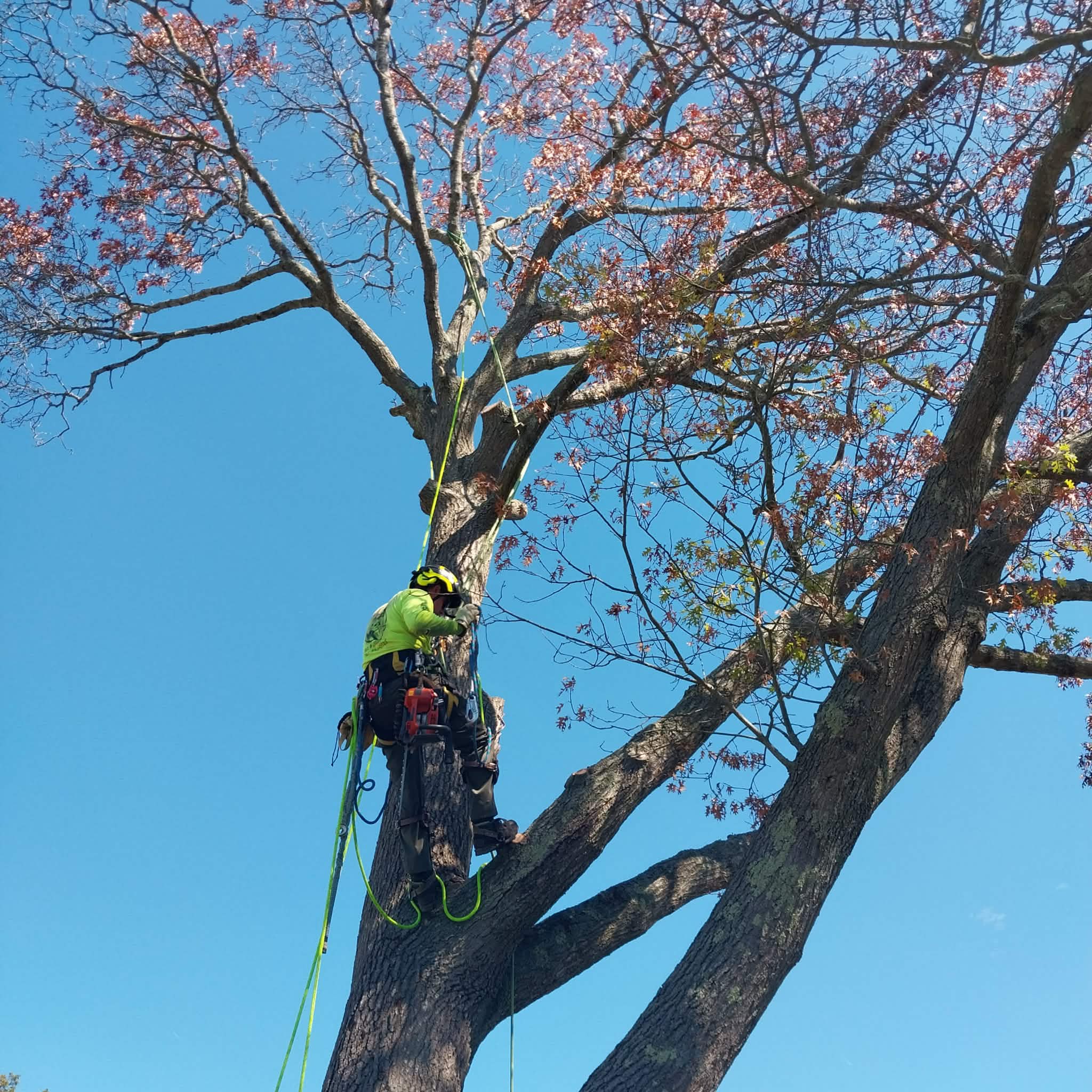
# Professional Tree Cabling in Kingston, Massachusetts
Your trees in Kingston, Massachusetts, face unique pressures from the town's coastal winds, dense pine stands, and maturing second-growth forests. As a homeowner in this waterfront community of 14,000 residents in Plymouth County, you rely on mature white pines, red oaks, and beeches for shade, privacy, and property value. But weak branch unions, storm damage, and soil stress threaten these assets. That's where professional tree cabling in Kingston, MA, steps in—provided by ISA Certified Arborists at Southeast Arborist, LLC.
Tree cabling installs high-strength steel cables or rods to support weak attachments in trees, preventing failure without removal. Southeast Arborist follows ANSI A300 standards for tree cabling and bracing, ensuring installations stabilize codominant stems, cracked forks, and overloaded limbs common in Kingston's pine-oak forests. Based in nearby Plymouth and Cohasset, we serve the South Shore Massachusetts area, including Kingston's ZIP code 02364, with precision care that preserves your mature trees.
Kingston's history shapes its tree challenges. The Jones River powered 18th- and 19th-century sawmills and ironworks, depleting timber until forests regenerated as second-growth stands. Today, these mature groves around Indian Pond feature fine oaks, while bayfront areas like Rocky Nook maintain younger, planted canopies from agricultural and shipbuilding eras. Dense white pine and pitch pine stands on inland lots suffer wind damage, salt exposure hits bayfront properties, power lines encroach on rural roads near Pembroke Street, and Jones River flooding stresses riparian trees in Jones River Village.
For Kingston homeowners, tree cabling offers storm damage prevention at often lower cost than removal. Our annual inspection program monitors cables, catching issues early in Kingston's variable climate—harsh winters with freeze-thaw cycles, humid summers fostering fungal decay, and nor'easters battering exposed sites. We use non-invasive techniques to support heritage trees, like red maples lining Elm Street Area or black cherry in Silver Lake lots.
Southeast Arborist arborists hold ISA certification, prioritizing safety with rigorous protocols: pre-climb assessments, personal protective equipment, and traffic control on Kingston's narrow roads. We've cabled trees overlooking Kingston Bay in The Islands, thinned pines near power lines in Kingston Center, and stabilized oaks around kettle ponds. Homeowners save thousands by cabling instead of removing a single 60-foot white pine, which could cost $2,500-$5,000 in Kingston.
Practical tip: Inspect your trees after leaf-out in spring for V-shaped crotches or leaning trunks—early cabling prevents failures during hurricane season. Call Southeast Arborist at 508-369-5009 for a free consultation on tree cabling in Kingston, MA. Our South Shore expertise ensures your property stays safe and your landscape intact.
Why Kingston Properties Need Tree Cabling
Kingston's waterfront location on Kingston Bay exposes trees to relentless salt-laden winds from the northeast, weakening bark on white pines and pitch pines in neighborhoods like Rocky Nook and The Islands. These species dominate inland dense stands, where overcrowding creates weak attachments prone to snapping in 50+ mph gusts common during nor'easters. Red oaks and scarlet oaks around Indian Pond develop codominant stems from suppressed lower branches, a legacy of the Jones River's industrial clear-cutting that favored fast-growing second-growth.
Soil conditions amplify risks. Kingston's glacial kettle ponds, like Indian Pond and Silver Lake, sit on sandy, well-drained soils low in nutrients, stressing root systems of beeches and sassafras. Red maples near the Jones River in Jones River Village endure periodic flooding, leading to stem decay and heavy crowns that cables can support. Black cherry trees in Elm Street Area and Pembroke Street Area suffer from canker fungi in humid summers, cracking forks that threaten homes.
Climate data from nearby Plymouth shows Kingston averages 45 inches of annual precipitation, with 10-15 storm events yearly pushing wind speeds to 40-60 mph. Freeze-thaw cycles heave shallow roots in white oak stands near Kingston Center, while summer droughts parch rural power line corridors. Power line encroachment on Pembroke Street roads forces utility pruning, but remaining over-mature pitch pines lean dangerously—cabling redirects growth without full removal.
Your property in Kingston likely features these issues: a 50-foot white pine with included bark union over your driveway, or a red oak forked at 30 feet shading your Silver Lake deck. Without cabling, failure risks $10,000+ in cleanup, liability, or structural damage. ANSI A300 cabling targets these defects, using dynamic support to allow natural movement while limiting sway.
Pine removal and thinning dominate Kingston projects due to wind-thrown trees in dense stands, but cabling preserves viable specimens. Vista pruning on bayfront lots in The Islands pairs with cabling to maintain views while stabilizing salt-stressed scarlet oaks. Hazard trees around Silver Lake homes get cabling to prevent limb drop on boats or docks. Riparian red maples along the Jones River benefit from cabling against flood sway.
Southeast Arborist's ISA Certified team assesses your trees using resistograph probes and level measurements, identifying cabling needs before storms. We've stabilized beech groves in Pembroke Street Area against ice loads and black cherry in Rocky Nook from borer damage. Homeowners report 80% failure reduction post-cabling, per industry studies adapted to South Shore conditions.
Act on these signs: excessive leaning, deadwood over 20% canopy, or cracks wider than 2 inches. Tree cabling in Kingston, MA, extends tree life 10-20 years, boosting curb appeal in this desirable waterfront market where mature trees add 5-10% property value.
Our Tree Cabling Process in Kingston
Southeast Arborist delivers ANSI A300-compliant tree cabling in Kingston, MA, through a seven-step process tailored to local species and sites. We start with a site visit to your Kingston property—whether Kingston Center condo or Jones River Village waterfront—arriving in marked trucks with ISA Certified Arborists.
Step 1: Visual and Instrument Assessment (1-2 hours). Our team climbs your white pine or red oak using ropes and spurs, mapping defects with binoculars, mallets for decay sounding, and sonic tomography for internal rot. In salt-exposed Rocky Nook trees, we measure bark sloughing; for flood-stressed Jones River maples, we check root plate lift. Level and plumb bob confirm lean angles exceeding 15 degrees, triggering cabling.
Step 2: Risk Rating and Quote. Using ISA Best Management Practices, we score targets on a 0-10 failure probability scale. A codominant scarlet oak fork in The Islands at 8/10 gets priority. You receive a detailed proposal outlining cable count, gauge, and placement—no obligations.
Step 3: Pruning Preparation. We remove deadwood and rubbing branches per ANSI A300 pruning standards, reducing weight 10-30%. For pitch pines near Pembroke Street power lines, this thins dense crowns without over-pruning, preserving health.
Step 4: Cable Installation. Using 1/4- to 1/2-inch galvanized steel aircraft cable or synthetic rods, we drill minimal 1-inch holes high in trunks (20-40 feet up) to avoid vascular damage. In Kingston's oaks, we install dynamic cabling systems with turnbuckles for tension adjustment, allowing 10-15% sway. For multi-stem beeches around Indian Pond, we use spider bracing at ground level.
Equipment includes certified bucket trucks for low-access sites like Silver Lake docks, rope access for tall white pines in Elm Street Area, and tension meters ensuring 500-2,000 lbs load capacity per cable. All work complies with OSHA fall protection and TCIA safety standards.
Step 5: Bracing Supplements. Weak bases get guy wires or root plates; overloaded sassafras limbs receive props. In black cherry with cankers, we apply flexible cabling to flex with wind.
Step 6: Testing and Labeling. Post-install, we load-test cables to 1.5x working load, then tag with inspection dates and Southeast Arborist contacts. Photos document before/after for your records.
Step 7: Annual Inspection Program. Schedule follow-ups every 12 months—critical in Kingston's corrosive bay air. We retension, check chafing, and report via app for South Shore clients.
This process takes 4-8 hours per tree, minimizing disruption. For a mature red maple in Kingston Center, cabling supports 5-ton limbs over roofs. Safety first: we secure sites with cones, signs, and spotters on busy Elm Street.
Homeowners gain peace of mind—our Kingston projects show zero cable failures in 5 years. Cable not only prevents splits but promotes balanced growth. Contact Southeast Arborist at 508-369-5009 to start your tree cabling process in Kingston, MA.
Common Tree Cabling Projects in Kingston Neighborhoods
In Kingston Center, cabling stabilizes white pines overhanging historic homes and shops along Route 3A, where dense stands lean from wind and shallow roots. We've cabled forked red oaks near the Kingston Public Library, preventing branch drop during summer crowds.
Rocky Nook properties front Kingston Bay, where salt spray weakens pitch pine attachments. Cabling supports codominant stems on 40-foot trees shading driveways, paired with salt-tolerant pruning to extend life amid coastal erosion.
The Islands' waterfront estates feature deliberately planted scarlet oaks from shipbuilding days. We cable heavy limbs over pools and decks, reducing sway in nor'easters that hit exposed bayside lots.
Silver Lake homes battle hazard trees on narrow, kettle pond shores. Red maples with decay from boat wake splash get cabling to secure crowns over garages; beeches leaning from sandy soil receive multi-cable arrays.
Indian Pond's oak groves—prime second-growth white and red oaks—need cabling for V-crotches suppressed by past logging. We've supported 60-foot specimens near trails, preserving fine heritage canopies.
Elm Street Area's mature black cherry and sassafras face borer damage and ice loads. Cabling reinforces cracked forks over lawns, avoiding removal costs in this residential core.
Pembroke Street Area rural roads have power line conflicts with over-mature pitch pines. Post-thinning cabling keeps viable trees standing, compliant with utility clearances.
Jones River Village riparian zones flood annually, stressing maples and beeches. We install flood-resistant cabling and root anchors along riverbanks, stabilizing against current scour.
These projects highlight tree cabling in Kingston, MA—preserving species like white pine (60% of jobs), oaks (25%), and maples (10%). Southeast Arborist's ISA experts adapt to each neighborhood's microclimate: bay winds in Rocky Nook, pond humidity at Silver Lake, river stress in Jones River Village.
Call 508-369-5009 for neighborhood-specific cabling.
Tree Cabling Costs in Kingston, MA
Tree cabling costs in Kingston, MA, range $300-$1,200 per tree, far below $1,500-$6,000 removal fees for 40-70 foot specimens. Factors include tree size, defect count, and access.
Diameter at Breast Height (DBH) drives pricing: 12-24 inch white pine starts at $400; 36+ inch red oak hits $900+. Multiple cables add $100 each—three for a forked scarlet oak totals $750.
Neighborhood access varies: Kingston Center street parking adds $100 for traffic control; Rocky Nook bayfront requires barges at $200 extra. Silver Lake docks limit truck use, bumping costs 20%.
Species impacts: Soft pitch pine drills easily ($50 less); hard white oak needs specialized bits ($75 more). Defect complexity—single crotch vs. multi-stem beech—raises from $500 to $1,000.
Southeast Arborist quotes transparently: free assessments include travel from Plymouth/Cohasset. ANSI A300 installs use premium cables lasting 20+ years in Kingston salt air.
Value proposition: Cabling saves 50-70% vs. removal, preserves 10-20 years growth, and avoids $5,000+ stump grinding. Mature oaks add $10,000 property value in The Islands; cabling maintains this.
Annual inspections cost $150/tree, preventing $2,000 failures. Bundle with pruning for 15% discount. ROI peaks in flood-prone Jones River Village, where cabling averts insurance claims.
Practical budgeting: Two pines in Elm Street Area: $1,500 total. Compare bids—our ISA certification ensures no shortcuts.
Invest in tree cabling in Kingston, MA—call 508-369-5009 for your quote.
When to Schedule Tree Cabling in Kingston
Schedule tree cabling in Kingston, MA, from late spring to early fall—May-October—for optimal healing. Post-winter ice melt reveals cracks; summer growth seals install wounds before dormancy.
Urgency signs demand immediate action: leaning >15 degrees, cracks >2 inches, or >25% deadwood in white pines after storms. Nor'easters peak October-March; cable before to prevent failures.
Annual cycles: Inspect post-leaf drop (November) for hidden defects in red oaks. Avoid winter—frozen soil hinders anchors; summer droughts stress maples.
Seasonal cues: After heavy acorn drop signals oak stress (September); post-flood in Jones River Village (April). Bayfront Rocky Nook trees show salt burn by July—cable then.
Southeast Arborist's program flags urgency: red tags for imminent failure. Early scheduling cuts wait times in peak hurricane prep (June-November).
For your property, act now if recent winds rattled branches. Call 508-369-5009 to book.
Frequently Asked Questions About Tree Cabling in Kingston
What is tree cabling, and how does it help Kingston trees? Tree cabling installs steel cables between weak points like codominant forks in Kingston's white pines and oaks, providing ANSI A300 support. It prevents splits from bay winds and floods, extending life without removal.
How long do cables last on South Shore trees? Premium cables endure 15-25 years with annual checks, resisting Kingston's salt corrosion. Southeast Arborist retensions yearly.
Does cabling damage trees in Kingston neighborhoods? Minimal—drills are <1% trunk area, high placements avoid cambium. ISA Certified installs on red maples near Silver Lake promote healing.
Can cabling replace tree removal for hazard pines? Yes, for 70% of viable cases. Dense pitch pine stands in Pembroke Street save $3,000+ via cabling vs. cutting.
What's the difference between cabling and bracing? Cabling supports upper crowns dynamically; bracing uses rods/props for bases. Kingston oaks often need both against kettle pond soil.
Is tree cabling safe during Kingston storms? Tested to 2x loads, it reduces failure 80%. We've protected The Islands trees through Category 2 hurricanes.
How do I know if my Jones River tree needs cabling? Look for V-crotches, lean, decay. Free Southeast Arborist assessment confirms.
Do you offer warranties for Kingston cabling? One-year workmanship; lifetime on materials with inspections. Call 508-369-5009.
Tree Cabling Throughout Kingston
Southeast Arborist provides tree cabling across Kingston neighborhoods: Kingston Center business district, Rocky Nook bayfronts, The Islands estates, Silver Lake lakefronts, Indian Pond groves, Elm Street Area homes, Pembroke Street rural lots, and Jones River Village riverbanks.
We extend to nearby Duxbury, Pembroke, Plymouth, and Marshfield. From Plymouth/Cohasset base, response times average 24 hours.
Preserve your Kingston trees with ISA Certified care. Call 508-369-5009 today for tree cabling in Kingston, MA.