
# Professional Plant Health Care in Fall River, Massachusetts
As a homeowner in Fall River, Massachusetts, you rely on your mature shade trees to cool your property during humid summers and shield your home from winter winds sweeping across Mount Hope Bay. But with the city's hillside terrain, aging urban canopy, and invasive pests like emerald ash borer threatening green ash trees, maintaining tree health demands more than occasional pruning. That's where professional plant health care in Fall River, MA, steps in. Southeast Arborist, LLC, your local ISA Certified Arborists based in Plymouth and Cohasset, delivers customized plant health care programs tailored to Bristol County's unique conditions.
Fall River's 94,000 residents live amid a mix of dense industrial history and preserved natural areas like the Watuppa Ponds watershed. Your trees—red oaks in The Highlands, Norway maples lining South End streets, or white pines near Steep Brook—face hilltop wind exposure, compacted urban soils, and strict watershed regulations. Our plant health care services address these head-on with integrated pest management (IPM), deep root fertilization, trunk injections, and disease treatments, all following ANSI A300 standards for tree care.
Why choose Southeast Arborist for plant health care Fall River MA homeowners need? Our ISA certification ensures every treatment uses science-backed methods, from spongy moth suppression on red maples to hemlock woolly adelgid control for white pines bordering Watuppa Ponds. We prioritize safety with rigorous protocols, including steep-terrain access equipment that navigates Fall River's challenging slopes without damaging your landscape.
Consider the 1938 hurricane's legacy: it devastated hilltop canopies above the bay, leaving aging infrastructure like century-old silver maples in Maplewood that now battle decay and pests. Without proactive plant health care, these trees risk failure, endangering your home and neighborhood. Our programs extend tree lifespans, boost property values, and comply with local ordinances in neighborhoods from Flint Village to Globe Village.
Plant health care Fall River MA isn't a one-size-fits-all spray; it's a diagnostic-driven strategy. We start with soil tests revealing nutrient deficiencies in your clay-heavy Bristol County soils, then apply targeted solutions like macro-infusion trunk injections for emerald ash borer in green ash trees. Homeowners in the North End report healthier foliage after our winter moth treatments, while Watuppa Ponds Area properties maintain compliance through low-impact methods.
Southeast Arborist serves the South Shore, including Fall River's diverse neighborhoods, with a phone call away at 508-369-5009. Whether your London plane in the city center shows anthracnose symptoms or your honey locust in Steep Brook needs root feeding, our experts provide results you see in stronger branches and vibrant leaves. Investing in plant health care Fall River MA protects your landscape investment amid rising storm risks from Mount Hope Bay. Contact us today to schedule a consultation and safeguard your trees.
Why Fall River Properties Need Plant Health Care
Fall River's topography and history create specific tree health challenges that demand targeted plant health care Fall River MA services. Perched on hillsides above Mount Hope Bay in Bristol County, your property endures relentless coastal winds, especially on exposed hilltops in The Highlands and North End. These gusts stress red oaks and white oaks, common in older residential areas, leading to branch breakage and root exposure on steep slopes.
Aging urban street trees form much of Fall River's canopy, planted during the 19th-century textile boom. Norway maples and silver maples in South End and Maplewood, now over 100 years old, suffer from girdling roots in compacted soils and decay from poor air circulation in dense neighborhoods. Without plant health care, these trees develop cankers and weaken, posing hazards during nor'easters that funnel up the bay.
Emerald ash borer has decimated green ash trees across Fall River since its detection in nearby New Bedford. In Flint Village and Globe Village, where ashes line streets, larvae bore into trunks, disrupting water flow and causing dieback. Our trunk injection treatments deliver imidacloprid directly to the vascular system, saving ashes that show D-shaped exit holes or canopy thinning—early signs you can spot on your property.
Steep terrain limits equipment access, exacerbating issues like soil erosion around American beech roots in Watuppa Ponds Area. These beeches, thriving in the watershed's moist conditions, face beech bark disease from scale insects and fungi, turning leaves prematurely brown. Plant health care Fall River MA includes low-volume soil injections to boost resistance without heavy machinery.
Watuppa watershed regulations, in place since the 1870s, restrict chemical use near ponds, requiring IPM approaches for pests like spongy moth on red maples. These moths defoliate trees in Steep Brook, weakening them against drought in Fall River's sandy-loam soils with low organic matter. Deep root fertilization counters this by injecting nitrogen, phosphorus, and micronutrients precisely where roots absorb them.
Local climate amplifies vulnerabilities: humid summers foster fungal diseases like anthracnose on London planes in the city core, while harsh freezes damage honey locust bark. White pines near Swansea borders succumb to white pine weevil, visible as wilting leaders. The 1938 hurricane stripped hilltop canopies, and today's aging replacements repeat the cycle without intervention.
Your Fall River trees also compete in urban settings with road salt buildup, stressing silver maples in Globe Village. Compacted soils from hillside development reduce oxygen to roots, stunting white oaks in The Highlands. Regular plant health care Fall River MA monitors via aerial inspections and resistograph testing detects internal decay before it shows externally.
Nearby towns like Somerset and Taunton share these issues, but Fall River's bay exposure and industrial legacy make proactive care essential. Homeowners ignoring signs like leaf scorch on red maples or adelgid wool on hemlocks risk costly removals. Southeast Arborist's ISA Certified team uses soil augers to sample your site's pH—often acidic in Bristol County—and amends with lime for optimal uptake.
Practical advice: Inspect your trees monthly for webbing (winter moth) or frass (ash borer). In Watuppa areas, avoid broadleaf herbicides to stay compliant. Our plant health care programs prevent escalation, preserving Fall River's mature forest legacy while enhancing your property's resilience.
Our Plant Health Care Process in Fall River
Southeast Arborist's plant health care process in Fall River follows a systematic, ISA-certified approach, ensuring every step meets ANSI A300 standards. We begin with a site-specific assessment tailored to your property's hillside location and tree species.
First, our ISA Certified Arborists conduct a visual inspection, climbing trees in The Highlands with low-impact ropes to evaluate Norway maples for verticillium wilt—evident in wilting branches on one side. We use resistographs to probe wood density without scarring bark, identifying decay in red oaks exposed to Mount Hope Bay winds. Drone imagery maps canopy health across larger Watuppa Ponds Area lots, spotting emerald ash borer hotspots in green ashes.
Soil analysis follows, using core samples from your steep terrain. Fall River's clay-loam often lacks calcium and potassium, starving white pines. We test pH (typically 5.5-6.5) and recommend deep root fertilization via soil probes inserted 8-12 inches, delivering liquid nutrients like 10-20-10 NPK formulas directly to the root zone. This avoids surface runoff, critical near regulated watersheds.
For pests, we deploy integrated pest management, starting with monitoring. Spongy moth traps in Maplewood detect egg masses on silver maples; if thresholds hit, we apply Bacillus thuringiensis (Bt) via high-reach sprayers, targeting caterpillars without harming bees. Winter moth in South End gets similar BT treatments in early spring, timed for hatch on red maples.
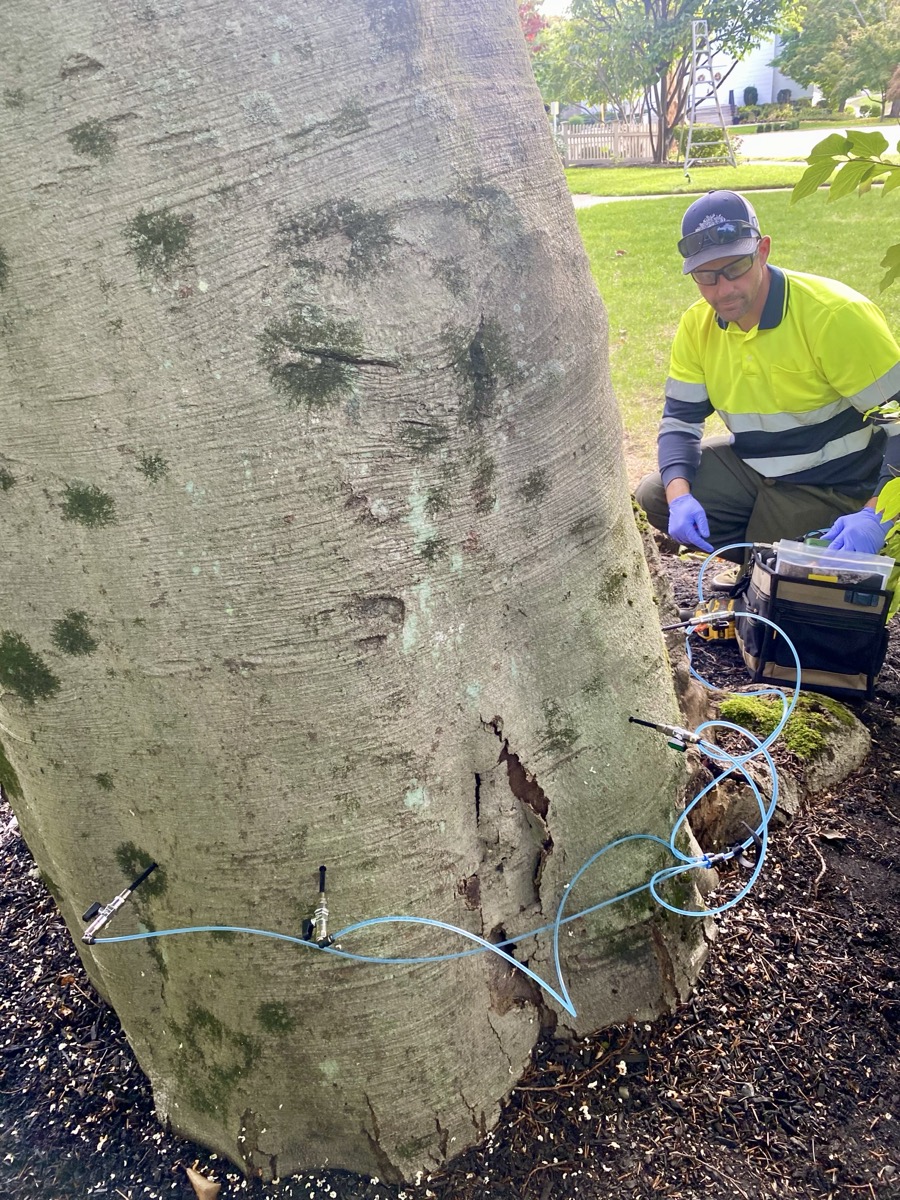
Trunk injections form our precision tool for emerald ash borer in Flint Village ashes. Using QUIK-jet macro-infusion systems, we drill 1-inch spaced holes at breast height and inject bidrin or emamectin benzoate under low pressure (20 PSI), reaching the canopy in days. This method bypasses leaves, reducing drift on windy hilltops.
Hemlock woolly adelgid management for white pines near Steep Brook involves soil drenches of imidacloprid around the drip line, absorbed by roots over months. We follow label rates strictly, complying with Bristol County guidelines.
Disease treatments target specifics: anthracnose on London planes in Globe Village receives propiconazole injections, injected via multi-port capsules for systemic uptake. Beech bark disease in North End American beeches gets horticultural oil to smother scales, followed by fungicide.
Safety protocols define our work: all technicians wear PPE, and we use terrain vehicles for Steep Brook access, securing drop zones with spotters. Post-treatment, we apply bio-stimulants like seaweed extracts to enhance root vigor in nutrient-poor soils.
Monitoring closes the loop: we install data loggers on high-value trees, tracking moisture and growth. Annual reports detail metrics like leaf chlorophyll levels via SPAD meters, proving ROI for your plant health care Fall River MA investment.
Custom programs scale to your needs—a single honey locust in the North End or an estate in Watuppa. We integrate with pruning, removing diseased limbs per ANSI A300 to improve air flow. Homeowners get practical tips: mulch 3 inches deep around bases, avoiding trunks, to retain moisture in dry summers.
This process has saved hundreds of Fall River trees, from post-storm damaged white oaks to pest-ravaged maples. Call Southeast Arborist at 508-369-5009 to start your assessment today.
Common Plant Health Care Projects in Fall River Neighborhoods
Plant health care projects in Fall River vary by neighborhood, reflecting local tree populations and site conditions. In The Highlands, homeowners call us for Norway maple maintenance—century-old specimens battle sooty mold from aphids. We apply dormant oil sprays and deep root feeds, restoring vigor to these hilltop giants exposed to bay winds.
Maplewood's silver maples, prone to storm damage from shallow roots on slopes, receive cabling and emerald ash borer-adjacent treatments, though maples face tar spot fungus. Our IPM includes copper fungicides via trunk injection, preventing leaf drop that litters historic streets.
South End streets lined with red maples need spongy moth suppression; egg masses inflate populations yearly. We treat with Bt from aerial lifts, protecting these shade providers near the city's textile mill landmarks.
Flint Village green ashes succumb fastest to emerald ash borer—thinning canopies signal urgency. Trunk injections here save 80% of trees, paired with soil care to combat compacted urban dirt.
Globe Village London planes fight sycamore anthracnose, worsened by humid bay air. Spring injections halt spore spread, keeping urban plazas vibrant.
Steep Brook's white pines and honey locusts require hemlock woolly adelgid analogs—adelgids hit nearby hemlocks—and weevil control via systemic insecticides. Steep access demands our lightweight gear.
North End red oaks show oak wilt risks from root grafts in dense plantings; we inject propiconazole and prune to break connections.
Watuppa Ponds Area projects emphasize regulation compliance: American beech treatments use organic phosphites for bark disease, avoiding pond runoff. White pine weevil gets minimized sprays.
Common across neighborhoods: post-nor'easter response, fertilizing wind-stressed trees. Lot clearing for new builds in wooded parcels involves preservation plans, saving mature oaks amid removals.
Your neighborhood's project starts with a free consult—call 508-369-5009.
Plant Health Care Costs in Fall River, MA
Plant health care costs in Fall River, MA, depend on factors like tree size, pest severity, and site access, but deliver clear value. A basic assessment for your Highlands red oak runs $150-$250, including soil tests and visual diagnostics—essential before any treatment.
Deep root fertilization for a 30-inch Norway maple in Maplewood costs $200-$400 per tree, covering 50 probe injections across the root plate. This beats granular apps, which 70% of Fall River soils fail to absorb due to clay compaction.
Emerald ash borer trunk injections for Flint Village green ashes range $12-$18 per inch of diameter—$360-$540 for a 30-inch tree. Annual repeat protects against reinfestation, far cheaper than $2,000+ removal.
Spongy moth or winter moth treatments in South End cover 1-acre lots at $300-$600, using targeted Bt. Neighborhood programs drop per-tree costs via group rates.
Hemlock woolly adelgid soil drenches near Steep Brook cost $250-$450 for white pines, with two-year residual.
Custom programs bundle services: quarterly monitoring plus bi-annual feeds for a Watuppa property average $800-$1,500 yearly, saving 20% over à la carte.
Access premiums apply—10-20% more for North End steep slopes—but our equipment minimizes this.
Value proposition: Healthy trees add 10-20% to home values in Bristol County, per appraisals. Avoided removals save thousands; one saved 50-year oak offsets years of care.
Factors influencing price: Tree count (discounts over 5), travel from Plymouth base, and urgency (storm response adds 25%).
ROI shows in metrics: Post-treatment, leaves gain 25% more chlorophyll, branches 15% denser. Compared to Somerset or Taunton, Fall River's wind exposure justifies investment.
Budget tip: Start with high-value trees near structures. Contact Southeast Arborist at 508-369-5009 for a precise quote.
When to Schedule Plant Health Care in Fall River
Timing plant health care in Fall River maximizes effectiveness amid your coastal climate. Schedule deep root fertilization in early spring (March-April) or fall (September-October), when roots grow actively but leaves aren't stressing the system. Avoid summer droughts that lock in nutrients.
Emerald ash borer injections work best May-June, targeting larvae before they pupate in green ashes. Spot D-shaped holes or epicormic shoots now—don't wait.
Spongy moth treatments hit April-May for Bt, as caterpillars emerge on red maples. Winter moth needs March sprays in South End.
Hemlock woolly adelgid drenches go October-November, before egg hatch near Watuppa.
Disease like anthracnose on London planes requires dormant-season (February) fungicide prep.
Urgency signs: 25% canopy dieback, leaning trunks from hilltop winds, or frass piles demand immediate response—call within 48 hours post-storm.
Annual programs align with Fall River's cycle: assessments post-winter, treatments pre-summer.
Nearby Dartmouth properties follow suit. Dial 508-369-5009 to book seasonally.
Frequently Asked Questions About Plant Health Care in Fall River
What is plant health care in Fall River, MA? Plant health care Fall River MA involves diagnostic, preventive, and therapeutic services for trees, including pest control, fertilization, and disease management, customized for local species like Norway maples and green ashes.
How do I know if my Fall River trees need plant health care? Look for thinning canopies in red oaks, woolly masses on white pines, or basal sprouts on ashes—hallmarks of emerald ash borer. Soil tests confirm nutrient gaps common in Bristol County.
Are your treatments safe for Fall River's Watuppa watershed? Yes, we use IPM with low-drift methods like trunk injections, complying with 1870s-era protections. No broad applications near ponds.
How long do emerald ash borer injections last on my Flint Village trees? Two years per treatment, with 90% efficacy when applied early. Re-inject based on scouting.
What's the difference between spraying and injections for spongy moth? Injections or BT target pests systemically; sprays risk drift on windy hilltops. We prioritize injections for safety.
Can plant health care save my 100-year-old Highlands silver maple? Often yes—root feeding and cabling address decline from decay. Resistograph guides decisions.
Do you offer plant health care for nearby towns like Somerset? Absolutely, our South Shore coverage includes Swansea, Dartmouth, New Bedford, and Taunton.
How much time does a treatment take on steep Fall River properties? 2-4 hours per tree, using lightweight gear for slopes. Minimal disruption.
Call 508-369-5009 with questions.
Plant Health Care Throughout Fall River
Southeast Arborist provides plant health care across Fall River neighborhoods: The Highlands' mature oaks, Maplewood's maples, South End streets, Flint Village ashes, Globe Village planes, Steep Brook pines, North End beeches, and Watuppa Ponds forests.
We extend to Somerset, Swansea, Dartmouth, New Bedford, and Taunton from our Plymouth/Cohasset base.
ISA Certified, ANSI A300-compliant, safe for your hillside home. Call 508-369-5009 for Fall River plant health care today.