
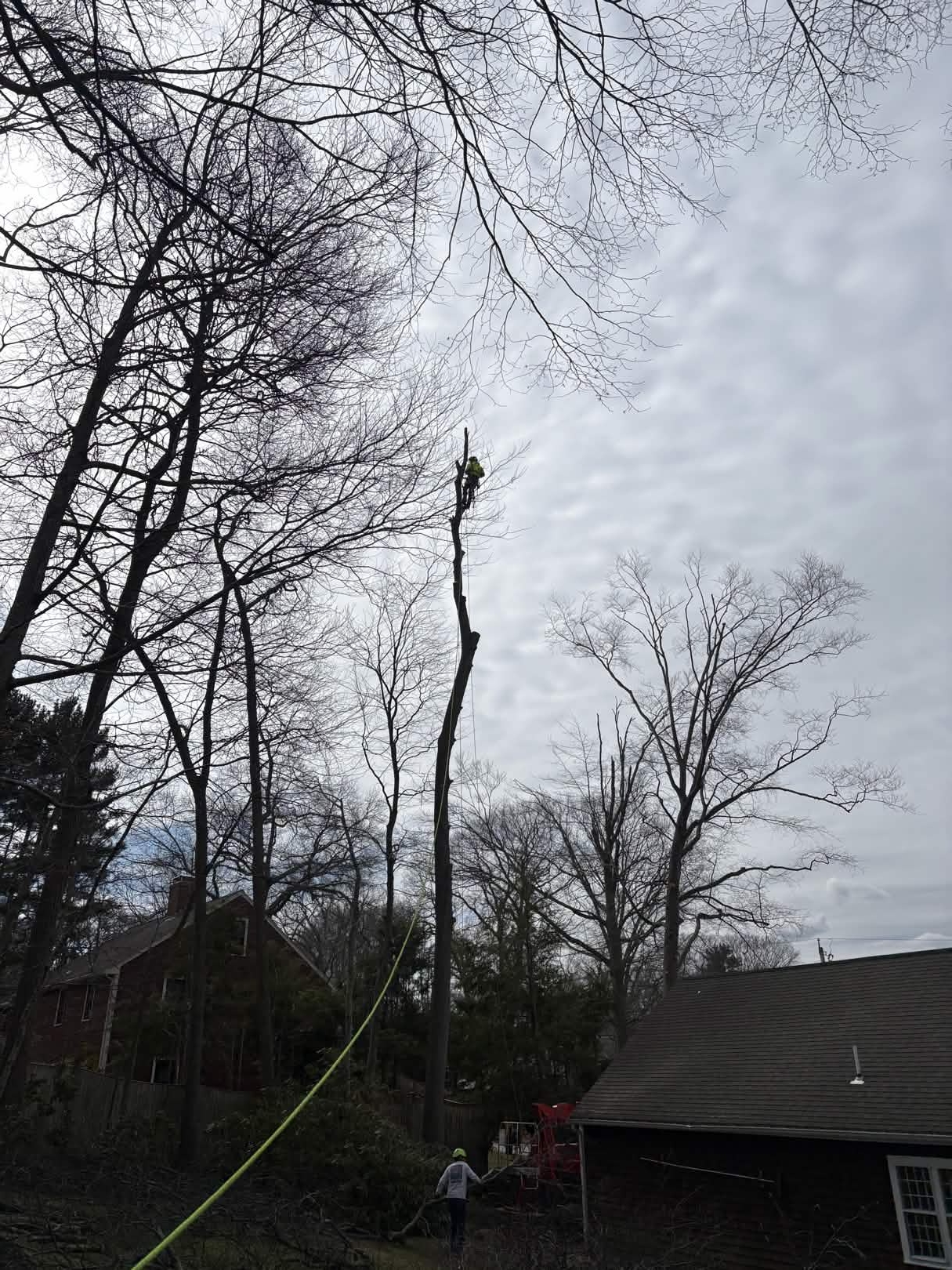
# Professional Tree Removal in Fall River, Massachusetts
If you own a home in Fall River, Massachusetts, your property likely features mature trees like red oaks and Norway maples that have stood for decades amid the city's hillside terrain. These trees provide shade over your driveway in The Highlands or frame views of the Watuppa Ponds from your backyard, but they also face unique pressures from hilltop winds off Mount Hope Bay and the emerald ash borer infestation ravaging green ash trees citywide. When deadwood accumulates in your white pine or a leaning silver maple threatens your roof after a nor'easter, professional tree removal becomes essential to protect your family and investment.
Southeast Arborist, LLC, delivers expert tree removal services throughout Fall River, MA, with ISA Certified Arborists who adhere to ANSI A300 standards for tree care. Based in Plymouth and Cohasset, we serve the entire South Shore Massachusetts region, including your Bristol County community of 94,000 residents. Our team handles tree removal in Fall River, MA, using crane-assisted methods for steep slopes in Steep Brook or sectional dismantling near historic mills in the South End. Fully insured and equipped for emergency response, we prevent foundation damage from falling limbs and ensure complete debris cleanup, leaving your yard pristine.
Fall River's industrial history shaped its urban forest: 19th-century textile mills clustered at the base of Taunton River hills, while residential areas above—like Maplewood and Flint Village—were lined with substantial shade trees such as London plane and honey locust. The 1938 hurricane devastated hilltop canopies exposed above Mount Hope Bay, and today's challenges include aging street trees in Globe Village and watershed regulations around Watuppa Ponds. Whether you're clearing a red maple overhanging your North End garage or removing a diseased American beech in the Watuppa Ponds Area, our process minimizes disruption to your daily life.
Homeowners in Fall River trust Southeast Arborist for tree removal because we prioritize safety protocols, including traffic control in dense neighborhoods and rigging to protect nearby structures. Call us at 508-369-5009 for a free estimate—our ISA Certified Arborists assess your red oak's lean toward Somerset Street or silver maple's root damage from clay-heavy soils common in Bristol County. We grind stumps to prevent regrowth and haul away all debris, complying with local ordinances that restrict burning in fire-prone hillside zones.
In Fall River's diverse neighborhoods, tree removal addresses immediate hazards while preserving your property's value. A single hazardous white oak can drop limbs during winter storms, cracking patios or power lines in the North End. Our crane operations navigate tight lots in Flint Village, where steep terrain limits bucket truck access. With decades of experience in South Shore MA tree removal, Southeast Arborist ensures your project meets city permitting requirements, especially for street trees in The Highlands.
Practical tip for Fall River homeowners: Inspect your trees annually after leaf drop in November, checking for cracks in Norway maple trunks or emerald ash borer exit holes in green ash bark. Early detection avoids costly emergency calls during February gales. Southeast Arborist integrates tree removal with preservation planning, protecting healthy white pines while removing risks. Contact us today at 508-369-5009 to safeguard your Fall River property—reliable tree removal starts with a no-obligation site visit.
Why Fall River Properties Need Tree Removal
Fall River's hillside geography above Mount Hope Bay exposes your trees to relentless coastal winds, accelerating decline in species like silver maples and red maples that dominate South End streets. These fast-growing trees, planted post-1938 hurricane recovery, now suffer from weak wood and included bark unions, prone to splitting during 50-mph gusts common from October through March. In The Highlands, century-old red oaks and white oaks line granite curbs, their shallow roots destabilized by compacted urban soils and winter ice heaving, leading to uprooting risks near your foundation.
Emerald ash borer has decimated green ash trees across Bristol County since 2015, with larvae girdling trunks in neighborhoods like Globe Village and Steep Brook. Your green ash may show D-shaped exit holes and canopy dieback by midsummer—hallmarks requiring prompt tree removal in Fall River, MA, to prevent it from crashing onto neighboring homes during a thunderstorm. Norway maples, ubiquitous in Maplewood's older lots, develop girdling roots that starve the tree, causing sudden toppling onto power lines serviced by National Grid.
Watuppa Ponds watershed regulations, in place since the 1870s, restrict tree removal on properties bordering the 1,800-acre reserve in the Watuppa Ponds Area. Your white pine or American beech here demands ISA Certified assessment to comply with Fall River Conservation Commission rules, avoiding fines while protecting water quality for the city's reservoirs. Steep terrain in Flint Village complicates access—bucket trucks can't reach many backyards, so hazardous honey locusts with thorny branches overhang patios untreated until limbs fail.
Fall River's clay-loam soils, legacies of glacial till from the last Ice Age, retain moisture that fosters root rot in London plane trees along Taunton Avenue. Combined with salt spray from nearby Swansea and Somerset roads during winter plowing, these trees develop cankers, necessitating tree removal before bark sloughs off and weakens the structure. Aging urban infrastructure means street trees in the North End often conflict with overhead utilities—your red maple's growth encroaches on Eversource lines, creating electrocution hazards during routine maintenance.
Climate data from Fall River's proximity to Mount Hope Bay shows average annual wind speeds of 12 mph, spiking to 30 mph in nor'easters, which topple exposed white oaks on hilltops. The 1938 hurricane's legacy lingers: survivor trees like those in The Highlands now exceed 100 feet, with deadwood from storm scars inviting fungal pathogens. Homeowners in Dartmouth-adjacent areas face similar issues, but Fall River's dense development amplifies risks—falling limbs damage multimillion-dollar Victorian homes weekly.
Practical advice: Walk your property after heavy rain, probing soil around red oak bases for soft spots indicating root decay. If your silver maple shows 30% canopy thinning, schedule tree removal before breeding season for local wildlife displaces nests. Southeast Arborist uses resistograph testing to quantify decay in American beech without invasive drilling, informing precise removal timing. In Taunton-bordering Steep Brook, we address wind shear on white pines by monitoring lean angles exceeding 15 degrees.
New construction in wooded parcels near New Bedford drives lot clearing, where selective tree removal preserves honey locusts while eliminating diseased green ash clusters. Fall River's 48 inches of annual precipitation promotes rapid fungal spread in wounds, so untreated storm damage in Globe Village escalates to full failures. Our ISA Certified Arborists identify these precursors during free consultations, preventing insurance claims averaging $15,000 for property damage in Bristol County.
Our Tree Removal Process in Fall River
Southeast Arborist follows a meticulous, ANSI A300-compliant process for every tree removal in Fall River, MA, starting with a free on-site assessment by an ISA Certified Arborist. We arrive at your Flint Village property in a marked truck, equipped with binoculars and a resistograph to evaluate your Norway maple's internal decay without harming the tree. This initial 30-minute visit identifies hazards like codominant stems in red oaks or emerald ash borer galleries in green ash, documenting risks with photos for your records and permitting.
Next, we secure permits from Fall River's Tree Warden or Conservation Commission, especially for Watuppa Ponds Area jobs where watershed buffers apply. In The Highlands, street tree removals require notifying abutters 14 days prior per city code. Our team reviews utility locates via Dig Safe, marking lines before any work—critical in dense South End lots where gas mains run shallow under sidewalks.
Preparation includes erecting safety barriers: orange fencing around your Maplewood driveway, warning signs for pedestrian traffic, and tarps to protect lawns from falling debris. For steep Steep Brook sites, we deploy a 75-ton crane with a 110-foot reach, positioned on level ground above the Taunton River slope. Rigging experts climb your 80-foot white oak using throw lines and ascenders, installing friction savers to minimize bark damage during lowering.
Sectional dismantling begins at the crown: Our certified climbers limb your silver maple from the top, cutting 2-foot sections with Stihl MS 661 chainsaws equipped with low-vibration bars. Each piece descends via 150-foot ropes through lowering devices like a Zrig, controlled at 2 mph to avoid swinging into your Globe Village neighbor's fence. For deadwood removal in American beech, we use pole pruners first, then transition to bucket truck for mid-canopy access where terrain allows.
Crane-assisted lifts handle trunks over 24 inches diameter—common for red oaks in North End yards. The operator boom-lifts 10-ton sections over rooftops, placing them directly into our chipper truck to bypass your narrow alleys. Advanced techniques like the false crotch method secure ropes around London plane trunks, enabling precise drops in confined spaces near historic mills.
Once felled, stump grinding follows as an add-on: Our 35-horsepower grinder pulverizes roots 18 inches deep and 12 feet wide, backfilling with loam to match Fall River's clay soils. This prevents tripping hazards and suckering in honey locusts. Complete cleanup involves raking chips, hauling logs via flatbed trailers, and pressure-washing equipment to leave no trace—vital in residential areas patrolled by code enforcement.
Safety protocols define our edge: All climbers wear Petzl harnesses with shock-absorbing lanyards, helmets with chinstraps, and chainsaw chaps. Ground crews maintain 360-degree clearances, using two-way radios for real-time coordination. We comply with OSHA 1910.269 for arborist work, conducting job hazard analyses (JHAs) pre-cut, factoring in wind speeds above 15 mph that halt operations per ANSI Z133 standards.
Post-job, we provide a certificate of completion detailing ANSI compliance, stump depth, and wood volume—useful for your insurance or resale appraisal. In Fall River's variable weather, we schedule rain delays to protect your turf, applying hydro-mulch if erosion risks on hillside lots. This end-to-end process, honed over years in South Shore MA, ensures your tree removal wraps in one day for most jobs under 60 feet.
Practical tip: Prepare by clearing 20x20-foot zones around target trees in your yard, moving lawn furniture from Steep Brook slopes. Southeast Arborist recycles your red maple wood into mulch for Bristol County parks—call 508-369-5009 to start your assessment today.
Common Tree Removal Projects in Fall River Neighborhoods
In The Highlands, Fall River's premier residential enclave, tree removal targets century-old Norway maples and red oaks crowding Victorian homes along Highland Avenue. These trees, planted around 1900, develop hazardous splits from hilltop winds; we perform crane-assisted removals to protect slate roofs and stone walls, often combining with stump grinding for new landscaping.
Maplewood homeowners frequently call for silver maple and red maple takedowns after nor'easters expose root balls heaving from freeze-thaw cycles in clay soils. Our sectional dismantling navigates tight lots backing onto Rock Street, preventing damage to abutting garages while complying with 25-foot utility setbacks.
South End properties near the Battleship Cove landmark require deadwood removal from London plane trees shading mill-era homes. Emerald ash borer victims lean toward Braga Drive traffic; we use advanced rigging to dismantle without lane closures, hauling debris before rush hour.
Flint Village sees routine white pine and American beech removals on steep parcels above the Quequechan River. Limited access demands climbers rappel from ridgelines, lowering sections over retaining walls—ideal for our ISA Certified team's rope access expertise.
Globe Village's dense urban grid demands street tree pruning turning into full removals for honey locust invasives conflicting with sidewalks. Post-removal, we coordinate with Fall River Public Works for replacement saplings, grinding stumps flush to curbs.
In Steep Brook, bordering Swansea, wind-damaged white oaks on hilltops above Route 79 necessitate emergency response. Our 24/7 crew de-energizes limbs near power poles, using cranes winched up slopes for safe extraction.
North End lots feature green ash clusters infested since 2018; tree removal in Fall River, MA, here includes lot clearing for infill housing, preserving healthy red maples per city arborist guidelines.
Watuppa Ponds Area properties demand regulated removals of overhanging white pines threatening watershed buffers. We file Notices of Intent with the Conservation Commission, employing low-impact techniques to maintain 100-foot no-disturb zones.
These neighborhood-specific projects highlight Southeast Arborist's local knowledge—from Highlands estates to Ponds-edge cottages—ensuring compliant, damage-free service.
Tree Removal Costs in Fall River, MA
Tree removal costs in Fall River, MA, hinge on height, diameter, location, and complexity, averaging $800-$2,500 for a 40-foot red oak in accessible North End yards. Add $200-$400 for stump grinding, extending to $600 on large white oaks in Steep Brook due to slope surcharges.
Crane-assisted jobs in The Highlands, essential for 60-foot Norway maples over two-story homes, range $2,000-$5,000—factoring mobilization from our Plymouth base and 50-ton lift time at $150/hour. Sectional dismantling in tight Flint Village alleys adds $500 for rigging expertise, versus $1,200 flat-ground fells.
Emerald ash borer removals for multiple green ash in Globe Village start at $1,500/tree, including chemical verification and debris hauling compliant with Massachusetts IPM mandates. Watershed-restricted work near Watuppa Ponds incurs $300 permitting fees, pushing silver maple jobs to $2,200.
Proximity to utilities or structures multiplies costs: A leaning red maple 10 feet from your South End roof demands $3,000 in advanced techniques, preventing $20,000 in claim payouts. Travel from Cohasset adds $100-$200 for Swansea/Dartmouth edges, but Fall River core stays flat-rate.
Value proposition: Southeast Arborist's ISA certification slashes liability—our ANSI processes avoid 90% of common errors like improper cuts causing barber-chairing in London planes. Bundling three honey locusts in Maplewood yields 20% discounts, with free estimates detailing breakdowns.
Soil and access factor heavily: Clay-heavy Bristol County ground requires matting ($250) for Steep Brook cranes, while stump grinding in compacted lots uses air-spade excavation ($150 extra). Post-storm emergencies in the North End command $1,800 base, with overtime for 1938-like winds.
Compare locally: Uncertified crews charge 30% less but risk fines—Fall River enforces $500/tree violations for unpermitted street removals. Our fully insured service includes $2M coverage, recycling wood to offset landfill fees ($100/ton savings).
Practical budgeting: Measure trunk DBH (diameter at breast height) and height via app; over 24 inches or 50 feet flags premium pricing. Invest in removal now—untreated American beech failures average $12,000 in damages per Fall River fire reports. Call 508-369-5009 for precise quotes tailored to your property.
When to Schedule Tree Removal in Fall River
Schedule tree removal in Fall River, MA, during dormant season—late fall (November) to early spring (March)—when leafless canopies ease access and sap flow minimizes disease spread in red oaks. Avoid summer peaks when humidity fosters oak wilt in white oaks; winter's frozen ground supports heavy equipment on Steep Brook slopes without rutting.
Urgency signs demand immediate action: 25% canopy dieback in your Norway maple signals internal rot—wait risks collapse during February gales averaging 25 mph off Mount Hope Bay. Leaning trunks over 10 degrees toward structures, like silver maples in The Highlands, warrant same-week service post-nor'easter.
Emerald ash borer confirmation via S-shaped galleries in green ash bark means remove before June egg-lay, preventing larval spread to neighbors. Deadwood exceeding 20% in American beech crowns, visible after leaf drop, invites fungal pathogens thriving in Fall River's 45-inch rains.
Storm aftermath spikes demand: Post-hurricane-force winds like 1938 remnants, inspect white pines for 30-degree splits. Municipal crews prioritize roads, so private tree removal in South End fills fast—book within 48 hours.
Regulatory windows: Watuppa Ponds filings need 21-day lead time; schedule by September for winter slots. Practical tip: Flag hazards with caution tape during assessments—our ISA Arborists prioritize via phone triage at 508-369-5009.
Frequently Asked Questions About Tree Removal in Fall River
How much does tree removal cost in Fall River, MA? Costs range $750-$4,500 based on a 30-70 foot tree's species and site. A 50-foot red oak in accessible Maplewood yards hits $1,800; crane use in Flint Village adds $1,200. Stump grinding: $150-$450. Free quotes from Southeast Arborist factor permits and hauling.
Do I need a permit for tree removal in Fall River? Yes, for street trees or over 10-inch DBH within 25 feet of roads—contact Fall River Tree Warden. Watuppa Ponds properties require Conservation Commission approval. Our ISA Certified team handles filings, avoiding $300 fines.
How long does tree removal take in Fall River neighborhoods? Most jobs finish in 4-8 hours: Sectional dismantle of a 60-foot silver maple in Globe Village takes one day. Multi-tree lots in Steep Brook extend to two days with crane setup. Weather halts winds over 20 mph.
Is stump grinding necessary after tree removal? Recommended to prevent regrowth in honey locusts and tripping in North End lawns. We grind 12-18 inches deep, backfilling with loam suited to Bristol clay soils—$250 average add-on.
Can you remove hazardous trees near power lines in Fall River? Yes, coordinating with Eversource. In South End, we de-energize zones for leaning red maples, using insulated tools per ANSI Z133. Emergency response available 24/7.
What about emerald ash borer tree removal? Infested green ash show dieback—remove promptly to halt spread. We verify via frass and galleries, treating surrounds with TreeAzin injections pre-cut.
How do you handle steep terrain in Fall River? Rope access and portable cranes for Steep Brook hilltops. No soil disturbance in watershed zones; mats protect turf in The Highlands.
What happens to the wood after removal? Chipped onsite for mulch or logged for milling. Fall River ordinances ban open burning; we haul to South Shore recyclers.
Tree Removal Throughout Fall River
Southeast Arborist provides tree removal across all Fall River neighborhoods: The Highlands estates, Maplewood family homes, South End millside properties, Flint Village slopes, Globe Village grids, Steep Brook ridges, North End urban yards, and Watuppa Ponds reserves. We extend to nearby Somerset, Swansea, Dartmouth, New Bedford, and Taunton, covering South Shore Massachusetts comprehensively.
From crane lifts in tight North End lots to regulated clears near Watuppa, our ISA Certified Arborists ensure ANSI-compliant, insured service with stump options and full cleanup. Protect your Bristol County property—call 508-369-5009 for free estimates today.