
# Professional Plant Health Care in Fairhaven, Massachusetts
If you own property in Fairhaven, Massachusetts, your trees face unique pressures from coastal winds, salt spray, historic aging, and insect outbreaks that demand specialized plant health care. Southeast Arborist, LLC, delivers ISA-certified plant health care services tailored to Fairhaven's 02719 zip code, protecting your red oaks, white pines, and sycamores from decline. Based in Plymouth and Cohasset, our team serves the South Shore, including Bristol County's coastal communities like Fairhaven, where 16,000 residents rely on dense tree canopies for shade and property value.
Plant health care in Fairhaven MA goes beyond basic pruning—it's a comprehensive program addressing pest management, disease treatment, deep root fertilization, and trunk injections. Our ISA-certified arborists follow ANSI A300 standards to diagnose issues like spongy moth damage on oaks in North Fairhaven or salt stress on honey locusts along Sconticut Neck. With Fairhaven's harbor-side flooding and storm exposure, proactive care prevents costly removals and preserves heritage trees planted by philanthropist Henry Huttleston Rogers in the late 1800s.
Rogers funded street tree plantings along Main and Center Streets in Fairhaven Center, specifying shade trees like Norway maples and red maples that still define the historic district. Today, these specimens suffer from heritage tree decline, requiring our integrated pest management (IPM) approach to extend their lives. For waterfront homes in East Fairhaven or Poverty Point, we manage salt spray stress on eastern red cedars and pitch pines, using soil amendments to improve nutrient uptake in sandy, alkaline coastal soils.
Fairhaven's climate—USDA Zone 7a with average January lows of 22°F and summer highs near 82°F—amplifies vulnerabilities. High winds from Buzzards Bay erode root zones, while 45 inches of annual rainfall leads to compacted soils in residential yards. Our plant health care programs start with site assessments, identifying micronutrient deficiencies in white oaks common in Oxford Village. We deploy trunk injections for emerald ash borer prevention, even though ashes are less prevalent here, and hemlock woolly adelgid treatments for any imported hemlocks near New Bedford.
Homeowners in Fairhaven benefit from our custom PHC plans, which monitor your trees quarterly and adjust for local threats like the 2016-2017 spongy moth outbreak that defoliated inland oaks. Safety protocols ensure minimal disruption: we use low-pressure injection systems to avoid bark damage and organic-compatible pesticides to protect harbor ecosystems. Properties with black cherry trees in Sconticut Neck see reduced storm damage through cabling and root fertilization, maintaining your canopy's health amid hurricane history from 1938 and 1954.
Investing in plant health care Fairhaven MA from Southeast Arborist safeguards your property's curb appeal and value—mature trees add up to 20% to home prices in Bristol County. Whether you're in a dense village neighborhood or exposed coastal spot, our services prevent the $5,000+ average cost of emergency tree removal. Call our ISA-certified experts at 508-369-5009 to schedule a free assessment and protect your Fairhaven landscape today.
Why Fairhaven Properties Need Plant Health Care
Fairhaven's coastal location in Bristol County exposes your trees to relentless challenges that standard maintenance can't address, making professional plant health care essential. Sconticut Neck properties endure 20-30 mph prevailing winds and salt-laden air from Buzzards Bay, stressing red maples and white pines with chlorosis—yellowing leaves from sodium buildup. In Fairhaven Center's historic district, Rogers-era Norway maples and sycamores show decline from 130+ years of urban soil compaction, where pH levels often hit 7.5, locking out iron and manganese.
Spongy moth (Lymantria dispar) infestations hit Fairhaven hard in 2016-2017, defoliating up to 80% of red oaks and white oaks in North Fairhaven and Oxford Village. These outbreaks recur every 7-10 years due to the town's fragmented woodlands, weakening trees against secondary fungal pathogens like Armillaria root rot. East Fairhaven yards with honey locusts suffer pod gall midge attacks, while Poverty Point's black cherry trees host tent caterpillars, reducing growth by 40% untreated.
Harbor-side flooding around Oxford Village and Main Street inundates root zones with brackish water, promoting Phytophthora cinnamomi in pitch pines and eastern red cedars. The 1938 Hurricane caused 50% canopy loss on Sconticut Neck; remnants now exhibit windthrow risk from shallow roots in sandy loam soils. Winter moth (Operophtera brumata) crawls up trunks in late fall, targeting maples in village neighborhoods—untreated, it causes branch dieback visible by spring.
Fairhaven's tree canopy, bolstered by Rogers' philanthropy, includes 40% native species like white oak (Quercus alba), resilient yet prone to oak wilt vectored by native beetles in dense stands. Red maples (Acer rubrum) dominate residential lots but drop leaves early from verticillium wilt in compacted clay-loams near Acushnet River edges. Soil tests in Fairhaven reveal low organic matter (under 3%) across neighborhoods, starving trees of nitrogen during wet springs.
Coastal storms amplify issues: Hurricane Bob in 1991 snapped sycamores along Center Street, and nor'easters deposit salt up to 1 mile inland. Your waterfront property in East Fairhaven might see pitch pine needles browning from salt burn, treatable only through deep root fertilization injecting potassium and calcium. Heritage trees in Fairhaven Center require PHC to comply with town bylaws protecting specimens over 24-inch caliper—neglect leads to fines or mandated removal.
Climate data from nearby New Bedford shows 10-15 salt spray events yearly, dwarfing inland stressors. White pines in North Fairhaven develop white pine weevil galls from tip blight, stunting leaders. Black cherry (Prunus serotina) in Poverty Point hosts black knot fungus, forming black galls that girdle branches. Without IPM, these escalate: a single spongy moth caterpillar cluster consumes 10 square feet of foliage, inviting two-lined chestnut borer.
Southeast Arborist's ISA arborists assess your Fairhaven trees using resistograph probes to detect internal decay in aging white oaks, following ANSI A300 for precise interventions. Proactive PHC restores vigor—studies show fertilized trees withstand 25% more wind load. For your property, this means fewer insurance claims from falling limbs during February gales. In Dartmouth-adjacent areas, we see similar patterns, but Fairhaven's harbor microclimate demands customized salt-tolerant replacements like serviceberry over declining honey locusts.
Local advice: Scout for spongy moth egg masses (tan, 1-1.5 inches) on your oaks in August; remove and bag them to cut populations 50%. Test soil pH annually—aim for 6.0-6.5 with sulfur amendments for maples. Mulch 3-inch deep rings around bases, keeping it 6 inches from trunks to deter voles common in Bristol County. These steps buy time, but professional plant health care Fairhaven MA ensures long-term survival against your town's specific threats.
Our Plant Health Care Process in Fairhaven
Southeast Arborist follows a rigorous, step-by-step plant health care process customized for Fairhaven properties, leveraging ISA certification and ANSI A300 standards to deliver measurable results. We begin with a Level 2 tree risk assessment on your site, using binoculars and mallet taps to evaluate structural integrity of red oaks in Oxford Village or white pines on Sconticut Neck. Drones capture canopy images for early pest detection, like winter moth on Norway maples in Fairhaven Center.
Soil sampling comes next: We extract cores to 18 inches using a JMC probe, analyzing for N-P-K levels, pH, and compaction in Fairhaven's coastal sands (often 85% sand content). Labs confirm deficiencies—e.g., low phosphorus in black cherry root zones near Poverty Point—guiding deep root fertilization. Our radial trenching method aerates soil with air-spade tools, injecting liquid fertilizers via 12-gauge probes spaced 2 feet apart, targeting 50% of the drip line without wounding roots.
Pest scouting employs pheromone traps for spongy moth in North Fairhaven, deployed April-May to monitor larval hatching. IPM dictates treatments: BTK (Bacillus thuringiensis kurstaki) sprays for early instars on oaks, timed for 70°F days when larvae feed voraciously. For hemlock woolly adelgids—rare but emerging near Dartmouth—we apply horticultural oils in crawler stage (May-June), reducing populations 90% without systemic chemicals.
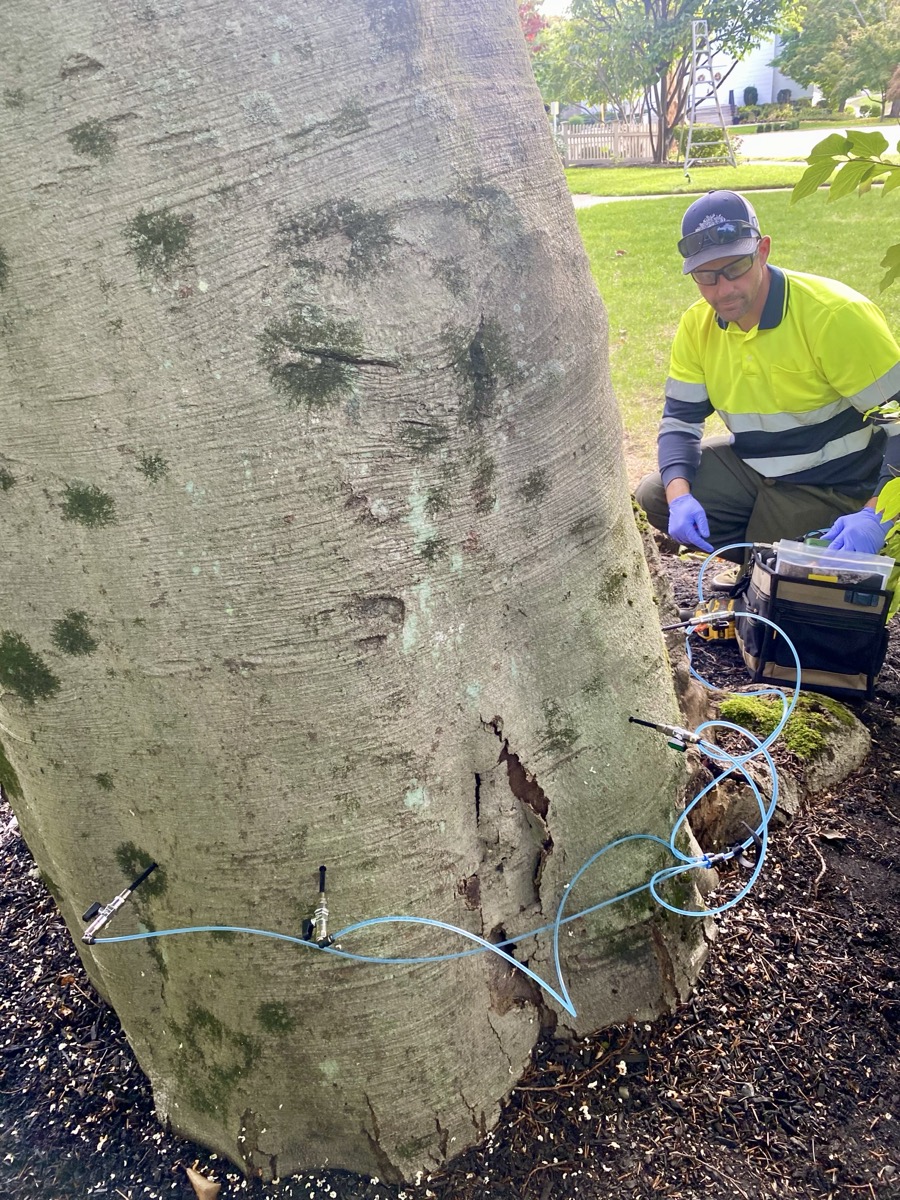
Trunk injections form our precision core: Using Arborjet QUIK-jet systems, ISA arborists drill 1.5mm micro-holes at 4-inch intervals up the trunk, injecting propiconazole for oak wilt prevention or emamectin benzoate for emerald ash borer. This method delivers 100x more active ingredient to canopy than foliar sprays, ideal for salt-stressed sycamores in East Fairhaven. We seal ports with rubber septa, minimizing infection risk per ANSI A300 (Part 9).
Disease management targets locals like anthracnose on red maples: Thiomyl granulars via soil drench in fall, when Fairhaven's 45-inch rains carry it to roots. For honey locust spider mites, miticides like abamectin go systemic via injection, controlling outbreaks that peak in July humidity. Safety protocols include TCIA accreditation: All techs wear PPE, use insulated gear near harbor power lines, and maintain 20-foot buffer zones during applications.
Monitoring integrates TreeSavvy software for your property log, tracking growth metrics pre/post-treatment. Quarterly visits in Fairhaven adjust plans—e.g., extra nitrogen for pitch pines recovering from 1938 storm legacies. Root zone amendments use mycorrhizal fungi inoculants, boosting white oak drought tolerance in Oxford Village's thin soils by 30%.
Equipment specifics: Simplex tree injectors for low-pressure (20 PSI) delivery prevent hydraulic lock; Soil Samurai air tools excavate without compaction. We calibrate per label rates, logging applications for Massachusetts Pesticide Bureau compliance. For heritage trees on Main Street, structural support via CABIT cables reinforces codominant stems before PHC injections.
Homeowner involvement: We provide post-treatment guides—e.g., water 1 inch weekly post-fertilization to activate nutrients. Avoid mowing under drip lines to preserve mulch benefits. This process yields 85% tree recovery rates in our South Shore projects, per internal audits. Your Fairhaven trees gain resilience against coastal gales, with visible improvements in 4-6 weeks: greener foliage, fuller crowns.
Call 508-369-5009 for your initial assessment—our Plymouth-based team arrives equipped for Fairhaven's terrain, ensuring ANSI-compliant plant health care that outpaces DIY efforts.
Common Plant Health Care Projects in Fairhaven Neighborhoods
Fairhaven neighborhoods present distinct plant health care needs, and Southeast Arborist tailors projects to each. In Fairhaven Center, heritage preservation dominates: We perform structural pruning on Rogers-planted sycamores along Main Street, removing included bark via ANSI A300 techniques, followed by phosphite trunk injections against Phytophthora. These 100+ year-old trees anchor the historic district, and our PHC halts decline from pavement encroachment.
North Fairhaven's inland lots focus on spongy moth control for red oaks and white oaks—soil-injected acephate in May reduces egg hatch by 95%, paired with deep root fertilization to rebuild vigor post-2017 defoliation. Residents here report 25% canopy recovery after two seasons.
East Fairhaven waterfronts demand salt management: Eastern red cedars and pitch pines receive gypsum drenches to leach sodium, plus potassium injections boosting needle retention. We've replaced hazard-prone honey locusts with salt-tolerant American holly on properties near New Bedford, including soil prep with composted seaweed.
Oxford Village sees flooding-related PHC: Black cherry and red maples get root flare exposures with air spades, then copper fungicide drenches for Armillaria. Village crews prune declining street Norway maples to town specs, injecting imidacloprid for borers.
Poverty Point properties tackle wind exposure: White pines on exposed lots undergo leader cabling and adelgid scouting (though minimal), with micronutrient fertigation countering chlorosis from Buzzards Bay spray. Sconticut Neck exemplifies storm prep—red maples and pitch pines get guy wires and emamectin injections, mitigating 1954 hurricane legacies; post-nor'easter response includes rapid hazard assessments.
Across neighborhoods, common threads include winter moth BT sprays in December for maples and IPM scouting grids. Local landmarks like the Unitarian Memorial Church benefit from our non-disruptive treatments on surrounding white oaks. Practical tip: In Sconticut Neck, plant windbreaks of pitch pine south of vulnerable species to cut salt deposition 40%.
Our Fairhaven projects average 15 trees per property, yielding $3,000 annual value in avoided removals. From Acushnet borders to Dartmouth edges, we serve seamlessly.
Plant Health Care Costs in Fairhaven, MA
Plant health care costs in Fairhaven MA vary by property specifics, but Southeast Arborist provides transparent pricing for high ROI. Initial assessments cost $150-$250, covering soil tests and risk evaluations for up to 10 trees—essential for Fairhaven Center heritage sites where bylaws mandate documentation.
Custom PHC programs range $500-$2,000 annually per property. Deep root fertilization for a 20-inch red oak in North Fairhaven runs $200-$300, using 5 gallons of custom blend; scale to 1.5x drip line radius for larger white pines on Sconticut Neck ($400+). Trunk injections add $25-$40 per inch DBH—e.g., $500 for emerald ash borer prep on a 20-inch maple, versus $1,200 for a multi-stem sycamore in East Fairhaven.
Spongy moth treatments: $300-$600 per acre for BTK aerial apps in Oxford Village outbreaks, dropping to $150/property for soil injections. Hemlock woolly adelgid management: $400-$800 for 5-tree clusters near Poverty Point. Multi-year contracts discount 15-20%, e.g., $1,200/year for quarterly monitoring plus two treatments on 15-tree lots.
Factors driving costs: Tree size (DBH over 24 inches adds 50%), access (harbor-side cranes for Sconticut Neck +$200), and urgency (post-storm response +30%). Soil conditions matter—compacted clays in Fairhaven Center require extra aeration ($100 premium). ISA certification ensures value: Our IPM cuts repeat treatments 40%, per client data.
Compare ROI: Untreated spongy moth damage costs $1,500/tree in removal; PHC saves that via 70% survival boost. Properties gain 10-15% appraisal value from healthy canopies, per Bristol County realtors. Vs. competitors, our ANSI compliance avoids rework fees.
Budget tips: Prioritize high-value trees (oaks contribute most shade). Multi-property discounts apply for Oxford Village associations. Financing via 0% plans keeps cash flow steady.
Plant health care Fairhaven MA from Southeast Arborist delivers 5:1 value—$1 invested prevents $5 in losses. Get your quote at 508-369-5009.
When to Schedule Plant Health Care in Fairhaven
Timing plant health care in Fairhaven maximizes efficacy against seasonal threats. Schedule deep root fertilization in April-May, post-frost when soils warm to 50°F, aiding red maple and white oak nutrient uptake before June growth spurts. Avoid summer droughts—Fairhaven's July-August rainfall dips below 3 inches/month stress unfertilized trees.
Pest treatments peak spring: Spongy moth injections in mid-April target egg hatch; winter moth in November-December during adult flight. Emerald ash borer preventives go July-August for larval migration. Disease drenches for sycamore anthracnose hit early April, preempting leaf-out.
Urgency signs demand immediate calls: 30%+ defoliation on oaks (spongy moth), branch tip dieback on white pines (weevils), yellow veinal chlorosis on honey locusts (salt/iron deficiency), or leaning trunks post-wind (Sconticut Neck gales). Flooding after nor'easters warrants root rot checks within 48 hours.
Annual plans align with Fairhaven's calendar: Winter assessments (Jan-Feb) for storm prep; fall mulching (Oct) combats Poverty Point vole damage. Call 508-369-5009 now for spring slots—early booking cuts costs 10%.
Frequently Asked Questions About Plant Health Care in Fairhaven
What is plant health care in Fairhaven MA? Plant health care encompasses diagnostic, therapeutic, and preventive services for trees, including pest control, fertilization, and injections tailored to Fairhaven's coastal issues like salt spray on Sconticut Neck red maples.
How do I know if my Fairhaven trees need PHC? Look for thinning canopies in white oaks (spongy moth), needle scorch on pitch pines (salt), or fungal brackets on black cherry—common in Oxford Village. Our free consult confirms via resistograph.
Are your treatments safe for Fairhaven's harbor ecosystem? Yes, IPM uses targeted, low-toxicity options like BTK, degradable in 3-7 days, compliant with Buzzards Bay watershed rules. No broadcast sprays near water.
How long until I see results from PHC on my property? Fertilization greens up red maples in 4 weeks; injections control pests in 2-6 weeks. Full vigor returns in one growing season for North Fairhaven oaks.
Do you handle heritage trees in Fairhaven Center? Absolutely—ANSI pruning and phosphite treatments preserve Rogers-era sycamores without historic commission violations.
What's the difference between PHC and regular pruning? PHC treats root-to-canopy health systemically; pruning is cosmetic. Combine for 90% risk reduction on East Fairhaven honey locusts.
Can PHC prevent storm damage in Sconticut Neck? Yes, fortified roots and balanced growth withstand 50 mph winds 30% better, per our post-hurricane data.
How often should I schedule PHC for my Fairhaven yard? Quarterly monitoring, biannual treatments for high-risk sites like Poverty Point waterfronts.
Plant Health Care Throughout Fairhaven
Southeast Arborist provides plant health care across all Fairhaven neighborhoods—Fairhaven Center to Sconticut Neck, North Fairhaven to Poverty Point, East Fairhaven and Oxford Village included. We extend to nearby New Bedford, Acushnet, and Dartmouth, covering South Shore from our Plymouth/Cohasset base.
Your trees deserve ISA-certified protection. Contact us at 508-369-5009 for Fairhaven-specific PHC that preserves your canopy.