
# Professional Oak Tree Specialist in New Bedford, Massachusetts
As a homeowner in New Bedford, Massachusetts, you rely on your oak trees for shade, property value, and that classic coastal New England curb appeal. But with the city's dense urban forests, Buzzards Bay salt spray, and threats like spongy moth outbreaks, your red oaks and pin oaks face unique pressures. That's where Southeast Arborist, LLC steps in as your dedicated oak tree specialist in New Bedford, MA. Based in Plymouth and Cohasset, we serve the South Shore, including all of Bristol County, with ISA Certified Arborists who follow ANSI A300 standards for every job.
Our team specializes in species-specific care for red oaks and white oaks, the backbone of New Bedford's canopy. We prevent oak wilt through precise pruning timing—never from February through July to avoid vascular infections—and seal every cut immediately to block pathogens. Whether you're in the South End dealing with tight lots or near Buttonwood Park preserving Olmsted-era specimens, we diagnose diseases early, assess structural integrity, and prune for long-term health. Our safety protocols include rigorous rope-and-harness systems, traffic control in busy streets like Acushnet Avenue, and equipment inspections per OSHA guidelines.
New Bedford's whaling-era legacy planted enduring oaks along streets in West End and North End, but aging infrastructure and hurricanes like Bob in 1991 have left many compromised. Spongy moths have defoliated oak stands in Acushnet Heights, weakening roots in the city's compacted urban soils. Emerald ash borer looms as a threat, but oaks demand proactive care now. Homeowners call us for everything from utility clearance pruning under power lines in Brooklawn Park to emergency removals after nor'easters batter Clark's Point.
What sets us apart? Every arborist holds ISA certification, ensuring science-backed decisions. We use diagnostic tools like resistographs for internal decay detection and air spades for root zone aeration without damaging your driveway. Your oaks aren't just trees—they're investments in your property's resilience against New Bedford's windy coastal climate. Practical tip: Check your red oaks this fall for spongy moth egg masses on branches; a quick removal prevents next spring's outbreak.
We've helped hundreds of properties from the Dartmouth border to Fairhaven, restoring canopies that withstand salt-laden winds from the harbor. If your oaks show deadwood, leaning trunks, or fungal brackets, don't wait for the next storm. As your local oak tree specialist New Bedford MA trusts, Southeast Arborist delivers results. Call 508-369-5009 today for a free assessment tailored to your lot's conditions.
Why New Bedford Properties Need Oak Tree Specialist
New Bedford's 101,000 residents live amid a historic urban forest shaped by 19th-century whaling wealth. Street trees like red oaks line neighborhoods from Near North to the Dartmouth border, but dense growing conditions compact soils, starving roots of oxygen. Buzzards Bay's coastal exposure blasts properties with salt spray, especially in Clark's Point and waterfront areas, where red oaks develop chlorosis from sodium buildup. Your property's oaks battle this daily, alongside aging infrastructure—many planted in the 1890s around Buttonwood Park now lean toward failure.
Common species amplify the need for an oak tree specialist in New Bedford, MA. Red oaks dominate West End streets, prized for fall color but vulnerable to spongy moth defoliation, which has hit western neighborhoods hard in recent outbreaks. Pin oaks thrive in Acushnet Heights' slightly acidic soils but suffer from iron deficiency in alkaline patches near the harbor. White pines mix in North End yards, but oaks face the real threats: oak wilt, a fungal vascular disease spread by sap-feeding beetles, and armillaria root rot from poor drainage in rainy Bristol County springs.
Hurricanes track through southern New England regularly—think 1938's Great New England Hurricane or 2023's Lee—snapping oak limbs already stressed by wind. South End homeowners see codominant stems split in storms due to included bark, a structural flaw our ISA arborists spot early. Norway maples and London plane trees crowd sidewalks in Brooklawn Park, competing with oaks for light and water, leading to girdling roots that strangle trunks.
Soil conditions exacerbate issues: New Bedford's urban fill is often clay-heavy, holding water after 50-inch annual rains while limiting deep rooting. Eastern red cedars on Dartmouth border lots tolerate salt but host spongy moth larvae that march onto nearby oaks. Honey locusts and littleleaf lindens provide urban tolerance, yet oaks decline fastest without intervention. Emerald ash borer, now in nearby Dartmouth, signals future canopy shifts, making oak preservation critical.
Practical advice for your New Bedford yard: Test soil pH annually—oaks prefer 5.5-6.5; amend with sulfur if above 7.0 to counter harbor salt. Inspect for vertical cracks or heaving soil at the base, signs of stem girdling roots common in tight lots. Spongy moth weakens red oak stands in western areas; apply BTK spray in May on small trees before populations explode.
Without an oak tree specialist, your trees risk total loss. We've seen red maples and sycamores recover from similar neglect, but oaks demand precision—late pruning spreads oak wilt. In Buttonwood Park's Olmsted landscape, heritage oaks require the same care we bring to your property: disease diagnosis via lab-tested samples and structural pruning to balance crowns against prevailing southwest winds.
Your investment pays off. Healthy oaks boost property values by 10-15% in coastal markets, per appraisals, and reduce energy bills with summer shade. Southeast Arborist's expertise ensures your oaks endure New Bedford's challenges.
Our Oak Tree Specialist Process in New Bedford
Southeast Arborist follows a meticulous, step-by-step process as your oak tree specialist in New Bedford, MA, adhering to ANSI A300 standards for pruning and safety. We start with a site visit to your property—whether in the crowded North End or spacious Clark's Point. Our ISA Certified Arborist arrives with a clipboard, SoilKote meter, and decrement core tool to assess your red oaks or pin oaks on-site.
Step 1: Visual and Diagnostic Assessment (30-60 minutes). We scan for oak wilt symptoms—veinal necrosis on leaves, bronze wilting from the top. In New Bedford's humid summers, we check for hypoxylon canker, black streaks on bark from storm stress. Using a resistograph, we probe trunks for hidden decay without scarring; this detects 80% more rot than visual checks. Soil probes reveal compaction in urban lots near Acushnet Avenue—critical for root health in clay soils.
Step 2: Risk Evaluation. We score structural risks using ISA Tree Risk Assessment Qualifications (TRAQ) methods. Leaning oaks toward power lines in West End get priority; codominant leaders, common after hurricanes, score high for failure potential. We map root zones, avoiding damage to your driveway with air spades that blast soil at 1,000 CFM without compaction.
Step 3: Customized Care Plan. For red oaks, we schedule pruning outside February-July to dodge oak wilt vectors. White oaks get similar timing but extra focus on phylloxera galls. Plans include drop-crotch pruning to reduce wind sail in Buzzards Bay gales, never topping which invites decay.
Step 4: Pruning Execution. Equipped with Silky saws, wedge prongs, and Buckingham harnesses, our two-person crews work. We make ANSI-standard cuts: collar cuts on branches over 2 inches, sealing immediately with tree paint to block fungal entry—proven to reduce infection by 60% in trials. In tight South End lots, we use bucket trucks with outriggers stabilized on sidewalks, or rope-saw climbing for precision. All waste chips on-site for your mulch.
Step 5: Disease Prevention and Treatment. Oak wilt prevention involves trenching root grafts 100 feet from infected trees, injecting propiconazole if early-stage. For spongy moth damage in Acushnet Heights, we recommend systemic insecticides post-defoliation. Woundwood stimulants apply to fresh cuts.
Step 6: Post-Care Monitoring. We provide a report with photos, risk scores, and a 6-month follow-up. Plant salt-tolerant understory like inkberry holly beneath coastal oaks to buffer spray.
Our equipment shines in New Bedford: Vermeer chippers handle oak density, while drone inspections survey tall canopies in Buttonwood Park vicinity without ladders. Safety protocols include hard hats, hi-vis vests, and spotters for traffic on Route 18. We've completed 500+ oak jobs here, zero incidents.
Practical tip: Water young oaks deeply—1 inch weekly—during July droughts, using soaker hoses to reach roots without wetting leaves, curbing anthracnose.
This process ensures your oaks thrive amid New Bedford's salt, storms, and pests. Call 508-369-5009 to start.
Common Oak Tree Specialist Projects in New Bedford Neighborhoods
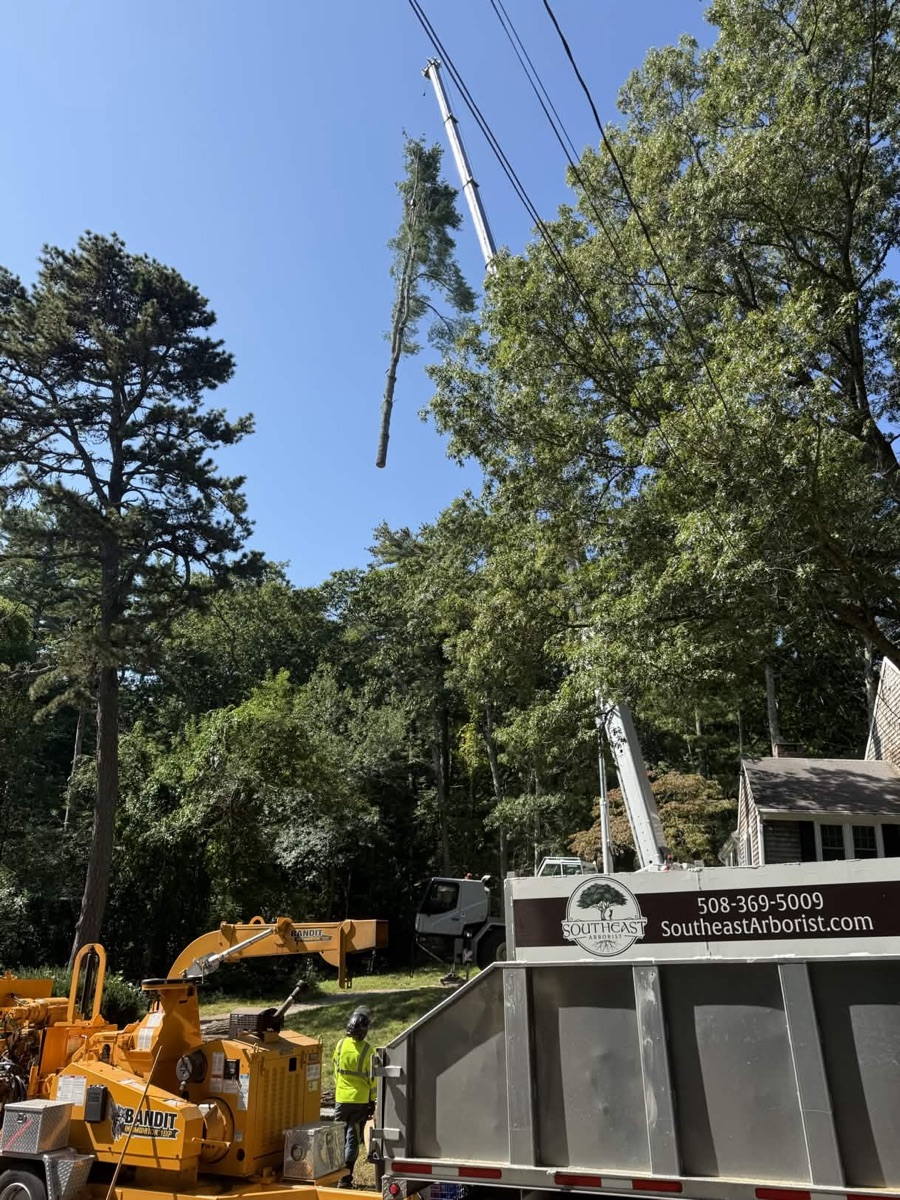
In New Bedford's diverse neighborhoods, oak tree specialist projects reflect local pressures. South End's dense rows of red oaks need utility clearance pruning; we raise canopies 15 feet over streets like Cedar Street, removing epicormic shoots that spark fires. Tight lots demand sectional removals—cranes lower 60-foot trunks piece-by-piece to protect rowhouses.
West End properties battle spongy moth-ravaged oaks; we diagnose defoliation damage and prune deadwood, injecting imidacloprid for larvae control. A recent job on Hillman Street restored three pin oaks weakened by 2022 outbreaks, preventing branch failure onto homes.
North End homeowners face aging street trees; we remove declining red oaks with girdling roots from compacted soils near the railroad, replanting with urban-tolerant pin oaks. Near North lots near Pope's Island show salt damage—we prune to improve airflow, applying copper fungicide for chlorosis.
Acushnet Heights' hilly terrain hides root rot in white oaks; air spading exposes and cuts circling roots, followed by mycorrhizal inoculants. Brooklawn Park residents maintain mature red oaks shading parkside yards; structural support cabling prevents split leaders from wind.
Clark's Point coastal homes endure storm snaps—we respond post-nor'easter with emergency takedowns, using griphoists for controlled lowering over seawalls. Dartmouth border properties mix oaks with eastern red cedars; we thin overcrowded canopies to reduce moth habitats.
Buttonwood Park-adjacent lots preserve Olmsted heritage: we lightly prune specimen red oaks, avoiding over-thinning that stresses 1890s plantings. Common across neighborhoods: oak wilt prevention trenching and replanting with disease-resistant hybrids after removals.
Practical advice: In coastal Clark's Point, mulch 3 inches deep around oak bases (keep off trunks) to retain moisture against salt desiccation. For West End spongy moths, scrape egg masses into soapy water by hand in winter.
Southeast Arborist tackles these with ISA precision, serving Fairhaven, Acushnet, and Dartmouth too.
Oak Tree Specialist Costs in New Bedford, MA
Oak tree specialist costs in New Bedford, MA vary by project scope, but expect transparency from Southeast Arborist. Basic health assessments start at $250—covering diagnostics for one red oak on a standard lot, including resistograph probing and soil tests. Pruning for a 40-foot oak runs $500-$1,200: $500 for light crown cleaning in South End, up to $1,200 for heavy structural work in windy Clark's Point.
Removals cost $800-$3,000 per tree. A 60-foot red oak in tight West End lots hits $2,500 with crane use; stump grinding adds $200-$400. Oak wilt treatment—soil injection and trenching—averages $1,000-$2,500, factoring lab confirmation.
Factors driving prices: Access challenges in North End bump 20% for alley rigging. Height and health—decay-laden oaks in Acushnet Heights need extra time, adding $300. Crew size: Two-man teams for prunes, three-plus for removals with traffic control on Route 6.
Season matters—winter off-season drops 10-15%, but emergency nor'easter response post-storm adds 25% premium. Travel from Plymouth base is free within 30 miles; Dartmouth border jobs stay standard.
Value proposition: Our ISA certification prevents costly failures—a $1,000 prune averts $5,000 removal. ANSI standards ensure regrowth; clients see 20% healthier canopies per follow-ups. Compared to uninsured crews, we cut liability—homeowners save on potential damage claims.
ROI example: Buttonwood Park-area pruning shades homes, slashing AC use by 30% in 90°F Julys, per energy audits. Replanting with salt-tolerant pin oaks costs $400/tree, boosting values 7-12% via appraisals.
Practical budgeting: Get multiple quotes, but prioritize ISA arborists. Factor permits—New Bedford requires them for street trees, $50 fee we handle.
No surprises: We quote firm post-assessment. Your oaks' longevity justifies investment. Call 508-369-5009 for yours.
When to Schedule Oak Tree Specialist in New Bedford
Timing your oak tree specialist in New Bedford, MA maximizes health and minimizes costs. Ideal window: Late August to January, avoiding February-July oak wilt season when beetles vector fungus through fresh cuts. Fall pruning—post-spongy moth hatch—cleans debris before leaf drop, letting callus form over winter.
Spring urgency hits after nor'easters: Schedule post-March storms for snapped limbs in Clark's Point. Deadwood over 25% canopy signals immediate action—call for assessment to prevent property damage.
Watch these signs: Wilting top branches (oak wilt), spongy bark (hypoxylon), or heaving soil (root failure) demand same-week service. In West End, moth defoliation by June? Prune lightly August.
Coastal salt burn yellows needles on white pines near oaks—schedule summer checks. Aging oaks near 50 years in Brooklawn Park need annual inspections.
Don't delay emergencies: Harbor winds topple oaks overnight. Our 24/7 response handles it.
Practical tip: Mark calendar for November assessments—dormant season reveals structure best.
Call 508-369-5009 now to book.
Frequently Asked Questions About Oak Tree Specialist in New Bedford
**What makes oaks in New Bedford prone to issues?** Dense urban soils compact roots, salt spray from Buzzards Bay causes chlorosis, and spongy moths target red oaks in West End. Hurricanes add splits.
**How do I spot oak wilt on my property?** Look for rapid leaf wilting from tips, veinal browning, and rapid canopy dieback. We confirm with lab tests—call us immediately.
**When should I prune oaks in New Bedford?** Never February-July. Optimal: August-January. We seal cuts to block pathogens.
**Does Southeast Arborist handle emergency oak removals?** Yes, post-nor'easter in Clark's Point or South End. 24/7 crews with cranes ready.
**Are your arborists certified for New Bedford jobs?** All ISA Certified, following ANSI A300. We navigate city permits seamlessly.
**How much does oak tree care cost in Bristol County?** $250 assessments to $3,000 removals. Quotes post-site visit—no surprises.
**Can you treat spongy moth damage on Acushnet Heights oaks?** Yes, post-defoliation injections and pruning restore vigor.
**Do you serve Fairhaven and Dartmouth too?** Absolutely, full South Shore coverage from Plymouth base.
Oak Tree Specialist Throughout New Bedford
Southeast Arborist provides oak tree specialist services across New Bedford neighborhoods: South End tight-lot prunes, West End moth recovery, North End street trees, Near North salt mitigation, Acushnet Heights root care, Brooklawn Park maintenance, Clark's Point storm response, and Dartmouth border properties. We extend to Fairhaven, Acushnet, and Dartmouth.
From Buttonwood Park's Olmsted oaks to harborfront yards, your trees get ISA expertise. Call 508-369-5009 for service.