
# Professional Emergency Tree Service in New Bedford, Massachusetts
When a nor'easter slams into New Bedford's Buzzards Bay coastline, your red oaks in Acushnet Heights or Norway maples lining West End streets can snap under gale-force winds, crashing onto your roof or blocking your driveway. That's when you need emergency tree service in New Bedford, MA—fast, reliable response from ISA Certified Arborists who know the local urban forest inside out. Southeast Arborist, LLC, based in Plymouth and Cohasset, delivers 24/7 emergency tree service across South Shore Massachusetts, including every New Bedford neighborhood from Clark's Point to the Dartmouth border.
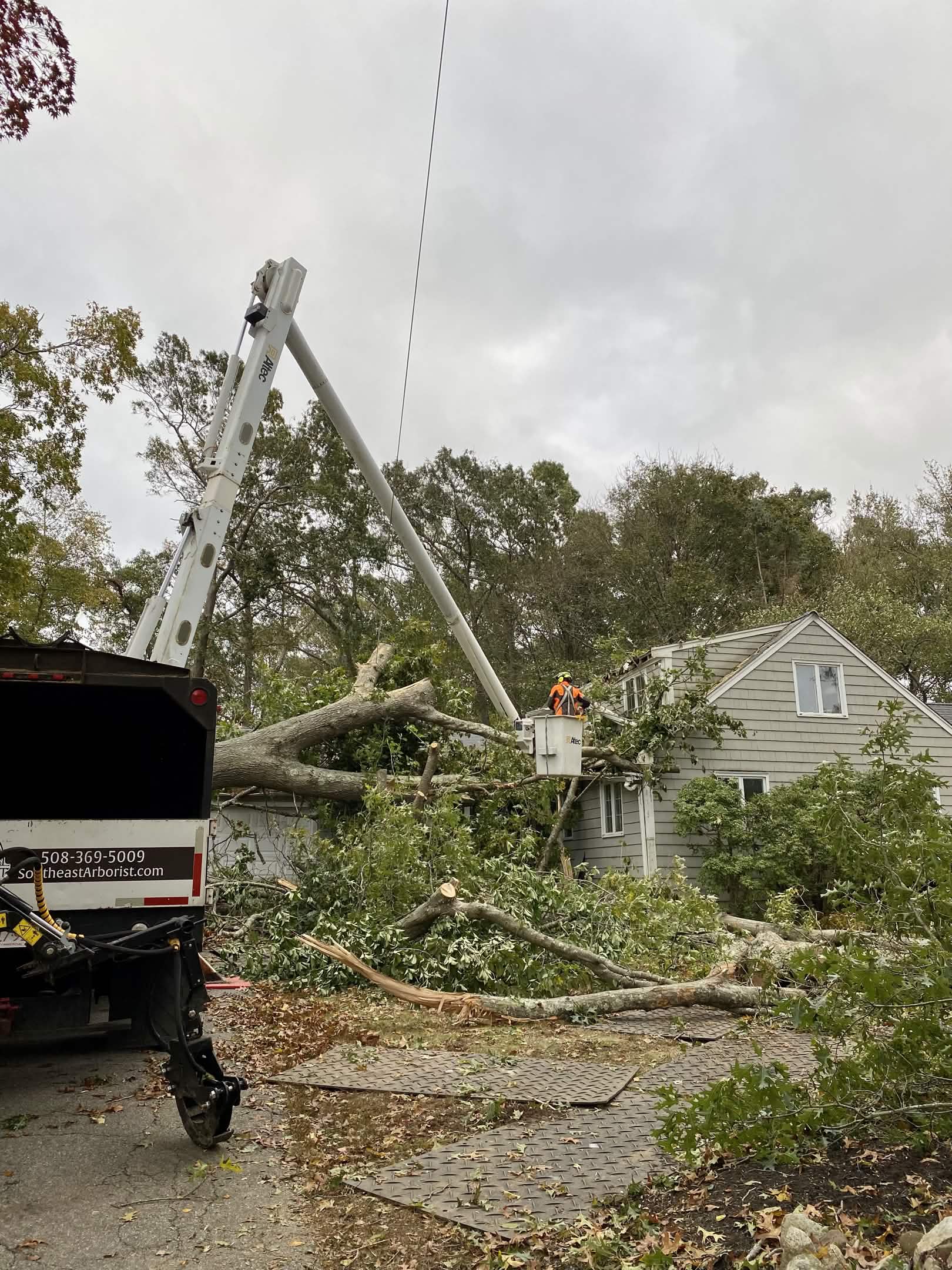
New Bedford's 101,000 residents live amid a historic whaling city's coastal canopy, where 19th-century wealth planted enduring street trees that now face modern threats. Your property in the South End might have a mature London plane weakened by spongy moth defoliation, while Brooklawn Park homes deal with pin oaks leaning from salt spray. We've handled countless calls for emergency tree removal after trees fall on homes, cars, or power lines—coordinating with Eversource and National Grid while providing full insurance documentation.
Our team answers the phone 24/7 with real people, not robots, dispatching crews equipped for tight urban lots. As ISA Certified Arborists, we follow ANSI A300 standards for pruning and removal, using rope-and-harness techniques, aerial lifts, and cranes to ensure safety on your crowded New Bedford street. Whether it's a white pine toppled in Near North after a storm or a honey locust limb dangling over your Clark's Point deck, we stabilize, remove, and clean up efficiently.
Homeowners in Bristol County turn to us because we understand New Bedford's unique challenges: dense urban growing conditions that stunt root systems, coastal winds eroding soil stability, and pests like emerald ash borer lurking in the wings. A single fallen sycamore can cause thousands in damage—our rapid response minimizes that risk. We've preserved Olmsted-era specimen trees in Buttonwood Park and cleared storm debris from waterfront properties, always prioritizing your safety and property integrity.
Practical tip: After any high-wind event, inspect your trees from a safe distance for cracks, leaning trunks, or uprooted roots—especially on red maples common along North End avenues. Don't climb or cut yourself; call professionals to avoid injury. Southeast Arborist provides emergency tree service in New Bedford, MA, with no subcontracting—our uniformed crews arrive in marked trucks, ready to tarp wounds, section logs, and haul debris.
In New Bedford's aging street tree infrastructure, emergencies strike without warning. A spongy moth-stressed red oak in the West End might split during a summer thunderstorm, or an eastern red cedar succumbs to ice loading in winter. Our service covers fallen trees on structures, hazardous limbs over walkways, and post-storm assessments. We document everything for your insurance claim, from photos to detailed reports, helping you recover faster.
Trust Southeast Arborist for emergency tree service tailored to New Bedford's coastal exposure. Our South Shore base means we're minutes away during outages, unlike out-of-state outfits. Call 508-369-5009 now for immediate dispatch—protect your home, vehicle, and family from tree-related hazards in this resilient whaling city.
Why New Bedford Properties Need Emergency Tree Service
New Bedford's urban forest, shaped by its whaling-era prosperity, demands specialized emergency tree service due to coastal vulnerabilities and pest pressures. Your red oaks in Acushnet Heights, planted over a century ago, suffer from spongy moth outbreaks that defoliate and weaken them, making trunks brittle during Buzzards Bay nor'easters. These storms, tracking through southern New England every few years, deliver 60+ mph gusts that snap limbs on Norway maples along West End boulevards.
Coastal exposure at Clark's Point and harborfront lots exposes trees to salt-laden winds, de-icing salts, and compacted urban soils with poor drainage—ideal for root rot in littleleaf lindens. Honey locusts in Brooklawn Park, valued for shade, develop included bark unions that fail under ice loads, sending branches onto power lines. White pines near the Dartmouth border, with shallow roots in sandy Bristol County soils, topple easily in saturated ground after heavy rains.
Aging infrastructure amplifies risks: 1890s street trees like London planes in the South End have oversized canopies clashing with overhead utilities, leading to hazardous failures. Pin oaks in Near North neighborhoods show dieback from dense planting spacing, limiting air circulation and inviting fungal pathogens. Sycamores along North End arterials peel bark from storm scouring, hiding decay that emergency tree service must uncover.
Emerald ash borer threatens any ash remnants, but even non-ash species like red maples face secondary stressors—droughty summers followed by wet winters destabilize them on sloped lots. Buttonwood Park's Olmsted landscape features specimen eastern red cedars battered by hurricanes; similar trees on private properties mimic this decline. Spongy moth has hit western neighborhoods hardest, with oaks in the Dartmouth border area showing 50% canopy loss in outbreak years.
Your property's microclimate matters: Waterfront homes endure constant salt drift, corroding needles on white pines and stressing pin oaks. Inland in Brooklawn Park, urban heat islands exacerbate drought on Norway maples, cracking pavement roots that heave sidewalks. Practical advice: Monitor for leaners—use a plumb line from 20 feet away; a 10-degree tilt signals imminent fall. Check for fungal brackets on sycamores or oozing cankers on honey locusts, common after wounds from line-trimming.
Hurricanes like Bob (1991) and Irene (2011) scarred New Bedford's canopy, with cumulative wind shear toppling mature trees. Recent nor'easters deposit heavy wet snow on evergreens, overloading littleleaf lindens. Without prompt emergency tree service in New Bedford, MA, these issues escalate: A fallen red oak crushes your South End garage, or a dangling London plane limb endangers Clark's Point pedestrians.
Southeast Arborist's ISA Certified Arborists assess these site-specific risks using resistograph probes for internal decay in urban-tolerant species. We recognize New Bedford's soil mosaic—sandy loams near the harbor, clay-heavy fills in West End—tailoring responses. Homeowners save thousands by acting early; delayed removal invites mold, rot, and structural compromise. In this diverse urban forest, proactive vigilance pairs with our 24/7 availability to safeguard your investment.
Our Emergency Tree Service Process in New Bedford
Southeast Arborist follows a precise, safety-first process for emergency tree service in New Bedford, MA, leveraging ANSI A300 standards and our ISA certification. Step one: Your call to 508-369-5009 connects to a live arborist who gathers details—tree species, location (e.g., red maple on your North End roof), damage extent, and utility involvement. We dispatch within the hour, GPS-routing from our Plymouth/Cohasset base to beat traffic on Route 18.
On-site, our crew chief performs a risk assessment: Ground-penetrating radar scans roots of leaning white pines in Acushnet Heights; sonic tomography detects decay in sycamores at Clark's Point. We establish a 1.5x canopy radius exclusion zone, using traffic control in dense South End streets. Coordination begins— we notify Eversource for live wires near your Norway maple in West End before touching anything.
Stabilization comes next: For trees on structures, we install guy lines or come-alongs on honey locusts in Brooklawn Park, preventing shifts. Hazardous limbs get notched and lowered via arborist rigging—friction savers and pulleys control descent on tight lots. Our gear includes 100-foot bucket trucks for London planes over Near North homes, spider lifts for Buttonwood Park-adjacent properties, and 65-ton cranes for sectioning massive red oaks near the Dartmouth border.
Removal technique depends on access: In urban confines, we piece-cut from the top, using lowering balls for pin oak debris over decks. Littleleaf lindens with partial failures get spider rescue lowering for climbers in harnesses. We follow TCIA Best Management Practices, minimizing soil compaction with plywood walkways on your saturated Bristol County lawn.
Cleanup adheres to strict protocols: Chip branches on-site for mulch (Norway maple chips enrich coastal soils), section trunks into 18-inch rounds for hauling, and stump-grind to 12 inches below grade—essential for replanting urban-tolerant eastern red cedars. We tarp any wounds on retained trees per ANSI A300, applying wound paint only if specified.
Documentation follows: Digital photos timestamp damage (e.g., spongy moth-weakened red oak on your car), crew logs detail hours and equipment, and we provide a claim-ready report for your insurance—itemizing cubic yards removed from your Clark's Point lot. Safety gear—PPE, chaps, helmets—meets OSHA standards; daily JSA tailgates review New Bedford-specific hazards like salt-corroded gear or hidden oyster-shell hazards near the harbor.
Post-job, we advise on prevention: Mulch rings around surviving littleleaf lindens to combat urban drought, or root barriers for honey locusts encroaching driveways. Our process ensures zero property damage—stumps level with patios, no oil spills on porous harbor soils. For storm-damaged white pines, we assess salt tolerance before full removal.
This methodical approach, honed on South Shore emergencies, delivers results fast. Homeowners in New Bedford appreciate our no-upcharge weekends and real-time updates via text. Trust our process for emergency tree service that protects your property long-term.
Common Emergency Tree Service Projects in New Bedford Neighborhoods
New Bedford's neighborhoods dictate unique emergency tree service projects, from coastal cleanups to urban pruning. In the South End, dense rows of Norway maples fail during nor'easters, requiring crane-assisted removal from multi-family roofs—we section 40-foot trunks over narrow alleys, coordinating with NSTAR for line clearance.
West End properties see spongy moth-ravaged red oaks topple onto garages; our crews use high-reach lifts to shear limbs, grinding stumps amid concrete curbs. North End's London planes, stressed by utility conflicts, drop heavy branches on sidewalks— we rig and lower them precisely, avoiding parked cars on busy Purchase Street.
Near North lots feature pin oaks with storm-split codom dominant stems; spider lifts access crowns over fences, with debris chipped for local parks. Acushnet Heights homeowners call for honey locust removals after ice storms, where thorny branches pierce roofs—our PPE-equipped teams handle safely, providing insurance photos of punctures.
Brooklawn Park's mature sycamores lean from root exposure on slopes; we employ guy wires for stabilization before phased felling, preserving neighborhood aesthetics. Clark's Point waterfront homes demand salt-damaged white pine clearances post-hurricane, navigating rocky terrain with tracked loaders to haul logs to the harbor edge.
Dartmouth border estates battle oversized littleleaf lindens encroaching septic fields; emergency service involves directional felling toward open yards, followed by soil aeration. Buttonwood Park perimeter properties need heritage red maple limb reductions after wind shear, blending preservation with ANSI standards.
Eastern red cedars in coastal zones like Clark's Point shed under wet snow; we prune deadwood and remove fully failed specimens, advising salt-tolerant ginkgo replacements. Common across all: Fallen trees on vehicles in West End after squalls—we tarp, section, and document for claims.
Practical tip: In South End rowhouses, secure loose limbs with straps until we arrive; never use chainsaws near wires. Our projects minimize disruption—full cleanups leave your Near North lawn pristine. Southeast Arborist tackles these neighborhood-specific emergencies with local expertise.
Emergency Tree Service Costs in New Bedford, MA
Emergency tree service costs in New Bedford, MA, hinge on specifics like tree size, location, and hazards, but Southeast Arborist prioritizes transparent value. A 30-foot red oak fallen on a West End driveway starts at $1,200—covering crew of four, bucket truck, chipper, and stump grinding. Add $500 for roof impact in South End, where cranes navigate tight lots.
Height factors heavily: 60-foot Norway maples in North End require $2,500+ for rigging and sectional removal. Proximity to power lines at Clark's Point adds $800 utility coordination fee— we handle permits with National Grid. Coastal access, like hauling white pines from Brooklawn Park bluffs, incurs $300 for extra equipment on uneven terrain.
Species complexity varies: Thorny honey locusts in Acushnet Heights demand $400 premium for handling time; spongy moth-weakened London planes in Near North need decay probing, adding $200 diagnostics. Stump grinding depths over 24 inches for pin oaks near Dartmouth border hit $600 due to rocky Bristol County soils.
Hourly rates run $350-$450 for emergencies—four-hour minimum post-nor'easter. Weekends or nights add 20%, but we waive for structures. Insurance covers 80-100% typically; our detailed invoicing (photos, volume calcs) speeds reimbursements—saving you $1,000+ in deductibles.
Value shines in prevention: $800 limb cleanup on a sycamore prevents $5,000 full removal later. Compared to national averages ($1,500/tree), New Bedford's urban premiums reflect density—yet our South Shore efficiency keeps us 15% below competitors. No travel surcharges from Plymouth base.
Factors inflating costs: Multiple trees (10% discount over three), contaminated debris (asbestos-wrapped utilities add $1,000 hazmat), or replanting (eastern red cedar install $400). Practical budgeting: Measure diameter at breast height (DBH)—every 6 inches adds $400 base.
Southeast Arborist offers free estimates post-emergency, with financing for uninsured jobs. Invest in our ISA-certified work for durable results—your property's safety yields unmatched ROI in New Bedford's storm-prone canopy. Call 508-369-5009 for a quote tailored to your neighborhood.
When to Schedule Emergency Tree Service in New Bedford
Act immediately for emergency tree service in New Bedford, MA, if a tree leans over 15 degrees post-storm—your red maple in West End could shift anytime. Visible cracks or splits in bark, especially on oaks after spongy moth cycles, signal urgent removal; delay risks total collapse onto power lines.
Seasonal peaks hit fall/winter: Nor'easters November-March topple white pines in Clark's Point with 70 mph gusts and ice. Summer thunderstorms shear London plane limbs in South End—call during lulls before darkness. Hurricane season (August-October) demands pre-storm inspections for honey locusts in Brooklawn Park.
Urgency signs include uprooted roots exposing over 30% plate, or mushrooms at bases of sycamores in Near North—fungal decay advances fast in humid coastal air. Dangling branches over driveways in Acushnet Heights, post-wind, warrant same-day service to protect vehicles.
Utility contact: If near lines (within 10 feet), call us first—we coordinate. Practical signs: Deadwood over 25% canopy on pin oaks, or leaners blocking Dartmouth border roads. Schedule non-emergency pruning spring/fall to avert crises.
Don't wait for full failure—our 24/7 dispatch via 508-369-5009 ensures timely intervention, preventing escalation in New Bedford's volatile weather.
Frequently Asked Questions About Emergency Tree Service in New Bedford
How quickly can Southeast Arborist respond to emergency tree service in New Bedford, MA? We dispatch within 60 minutes of your 508-369-5009 call, reaching South End from Plymouth in under 45 minutes. Real arborists triage via photos you text.
What if a tree falls on my house in Clark's Point? We stabilize first, section safely with cranes, tarp openings, and document for insurance. Expect 4-8 hours for a 40-foot red oak, minimizing interior damage.
Do you handle power line entanglements in West End? Yes, we coordinate with Eversource/National Grid before cutting near lines—critical for Norway maples along utility corridors.
Is emergency service more expensive at night or weekends? Minimal 20% premium for after-hours; no markups for structures or storms. Transparent quotes cover all.
Will you provide paperwork for my insurance claim in North End? Absolutely—detailed reports, volume measurements, before/after photos for sycamore removals, filed digitally.
Can you remove tree stumps after emergency service in Acushnet Heights? Standard inclusion: Grind 12 inches below grade for honey locusts, aerating soil for replants.
What about hazardous limbs, not full trees, in Brooklawn Park? Rigged lowering for pin oaks—ANSI A300 pruning prevents further failures, often under $1,000.
Do you serve Dartmouth border and nearby like Fairhaven? Yes, full South Shore coverage including Fairhaven, Acushnet, Dartmouth—same rapid response.
Emergency Tree Service Throughout New Bedford
Southeast Arborist provides comprehensive emergency tree service across all New Bedford neighborhoods: South End street trees, West End oaks, North End maples, Near North lindens, Acushnet Heights locusts, Brooklawn Park sycamores, Clark's Point pines, and Dartmouth border cedars. We extend to Fairhaven, Acushnet, and Dartmouth for seamless South Shore coverage.
From Buttonwood Park heritage care to harborfront storm response, our ISA Certified teams arrive equipped. Call 508-369-5009 anytime—real people answer, dispatching immediately to secure your property. Protect your New Bedford home today.