
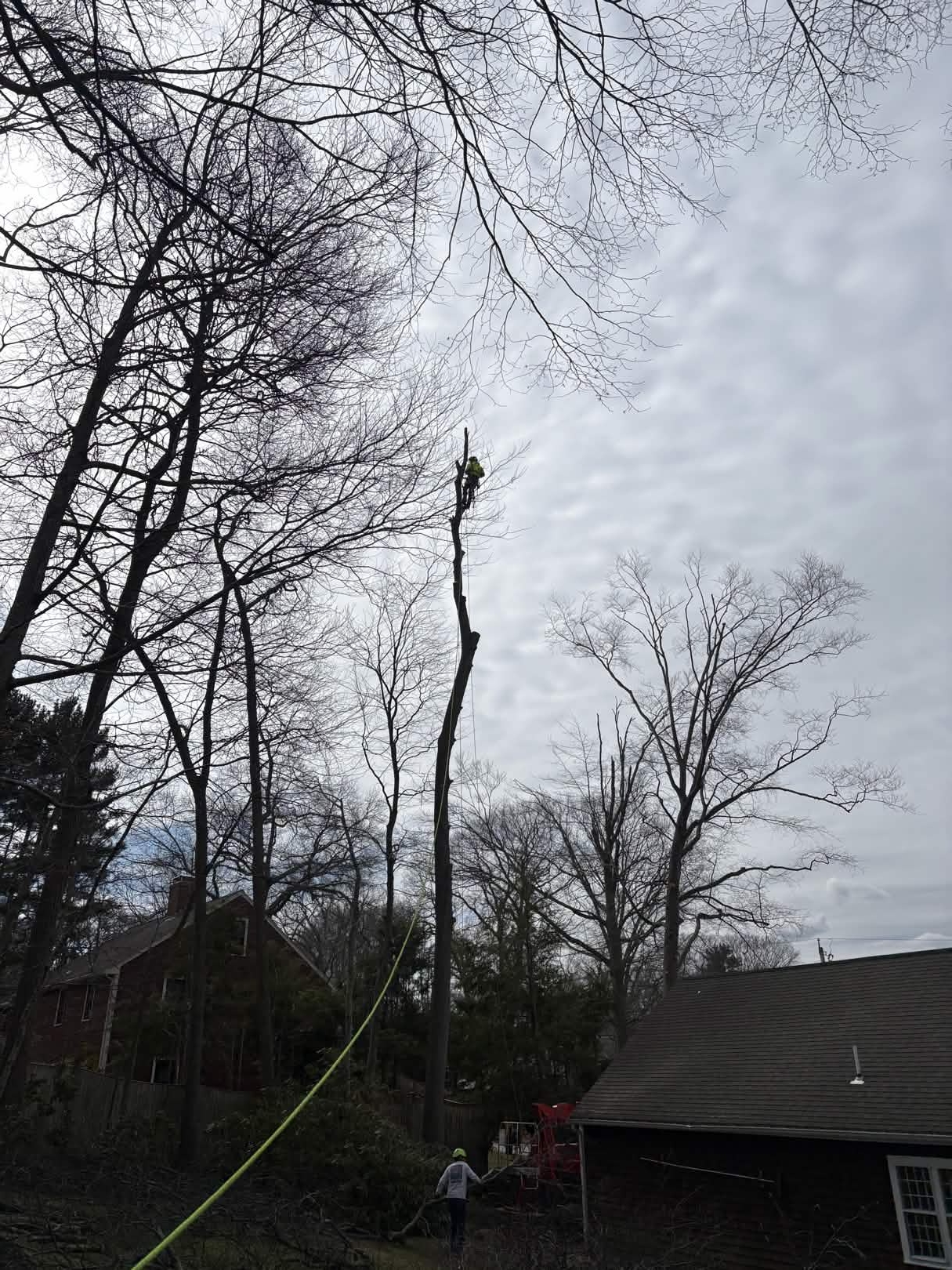
# Professional Tree Removal in New Bedford, Massachusetts
If you're a homeowner in New Bedford, MA 02740, facing a leaning red oak in your West End yard or a dying Norway maple crowding your South End driveway, you need tree removal services that prioritize safety and precision. Southeast Arborist, LLC, your South Shore Massachusetts tree care experts based in Plymouth and Cohasset, delivers exactly that. As ISA Certified Arborists, we handle tree removal in New Bedford with crane-assisted techniques, advanced rigging, and full insurance coverage to protect your Bristol County property.
New Bedford's historic whaling legacy shaped its urban forest, funding 19th-century street trees and the Olmsted-designed Buttonwood Park with its 1890s specimen trees. But today's coastal canopy faces relentless pressures: Buzzards Bay winds, salt spray from the harbor, dense urban soils, and pests like spongy moths defoliating oaks in Acushnet Heights. Whether it's emergency removal after a nor'easter hits Clark's Point or routine takedown of a hazardous London plane near utility lines in the North End, our team follows ANSI A300 standards for every job.
We specialize in tree removal New Bedford MA homeowners rely on, using sectional dismantling to navigate tight lots in Brooklawn Park or crane mats to avoid damaging foundations on the Dartmouth border. Our free estimates come straight from certified pros—no pushy sales, just honest assessments via 508-369-5009. Homeowners in Fairhaven, Acushnet, and Dartmouth call us for the same reliable service, knowing we haul away all debris and offer stump grinding add-ons.
Picture this: Your white pine succumbs to coastal storm damage along the waterfront, roots exposed from eroded soils. Without prompt tree removal, it risks falling on your roof during the next gale. Southeast Arborist prevents that with safety protocols including traffic control, spotters, and protective barriers. We've removed thousands of trees across South Shore MA, from pin oaks weakened by spongy moths in Near North to sycamores declining in the urban heat of the city center.
Our process starts with a site visit to assess hazards like root rot in clay-heavy Bristol County soils or emerald ash borer threats lurking in ash-adjacent stands. We then deploy bucket trucks for low-risk jobs or 75-ton cranes for tall eastern red cedars on sloped Clark's Point lots. Every removal includes complete cleanup, leaving your property pristine. Don't wait for a tree to damage your home—our ISA certification ensures compliance with New Bedford's strict permitting through the Conservation Commission.
In a city of 101,000 where aging street trees demand constant management, choosing the right tree removal service matters. Southeast Arborist stands out with decades of local experience, serving neighborhoods from the South End's dense rows to Buttonwood Park's heritage landscape. We educate you on why your honey locust is failing—often poor drainage in compacted urban soils—and provide replanting advice with salt-tolerant species like littleleaf linden.
Ready to secure your New Bedford property? Call Southeast Arborist at 508-369-5009 for your free tree removal estimate today. We make complex jobs straightforward, turning potential disasters into peace of mind.
Why New Bedford Properties Need Tree Removal
New Bedford's diverse urban forest, rooted in its whaling-era prosperity, now contends with unique challenges that make tree removal essential for homeowners. Coastal exposure to Buzzards Bay delivers salt-laden winds that stress species like red maples and white pines, causing branch dieback and root decline in waterfront neighborhoods such as Clark's Point. Dense urban growing conditions in the South End compact soils around honey locusts and pin oaks, limiting oxygen to roots and promoting decay fungi.
Aging street tree infrastructure plagues the West End and North End, where Norway maples planted decades ago now lean toward power lines or sidewalks. Spongy moth outbreaks have weakened red oak stands in western areas like Acushnet Heights and the Dartmouth border, defoliating canopies and inviting secondary infections. The emerging emerald ash borer threat, already confirmed in nearby Bristol County towns, endangers any ash trees interspersed with London planes and sycamores.
Your New Bedford property's trees endure every major hurricane tracking through southern New England—think the 1938 Great New England Hurricane or recent nor'easters that topple eastern red cedars along the harbor. Cumulative storm damage shows in twisted trunks and hollowed interiors, especially on properties near Fairhaven where wind shear snaps littleleaf lindens. Buttonwood Park exemplifies preservation needs; its Olmsted specimen trees require vigilant removal of declining limbs to protect visitors and infrastructure.
Soil conditions exacerbate issues: Bristol County's clay-loam mixes drain poorly, leading to girdling roots on street trees in Brooklawn Park and Near North. Homeowners notice leaning trunks after heavy rains, a sign your red oak's anchor roots have rotted from prolonged saturation. Urban heat islands amplify drought stress on sycamores, causing leaf scorch and bark splitting that invites borers.
Practical advice for spotting trouble: Inspect your trees annually for codominant stems—common in fast-growing Norway maples—which split under ice loads typical of New Bedford winters. Check for spongy moth egg masses on oaks in Acushnet Heights; persistent defoliation halves tree vigor within two seasons. Coastal salt damage appears as browning needles on white pines in Clark's Point—flush with fresh water post-storm to buy time, but plan removal if more than 30% canopy loss occurs.
In the North End's tight lots, overgrown honey locusts drop thorny debris, posing slip hazards and scratching vehicles. Pin oaks near the Acushnet River suffer iron chlorosis from alkaline soils, yellowing leaves signal irreversible decline. Eastern red cedars on Dartmouth border slopes become fire hazards in dry spells, their resinous wood fueling rapid spread.
Southeast Arborist's ISA Certified Arborists diagnose these precisely during free consultations. We use resistograph probes to measure internal decay in London planes without unnecessary cutting, adhering to ANSI A300 for hazard assessments. Homeowners avoid fines by removing unpermitted street trees before they damage city utilities—our team coordinates with New Bedford's Tree Warden.
Without timely tree removal New Bedford MA properties risk foundation cracks from heaving roots in frozen clay soils or roof punctures from falling limbs during 50-mph gusts. In Buttonwood Park's shadow, heritage trees teach lessons: Preserve healthy ones, remove hazards promptly. Your urban forest thrives when declining trees like spongy moth-ravaged red oaks make way for resilient replacements.
Call 508-369-5009 to evaluate your trees—early intervention saves thousands in damage repairs.
Our Tree Removal Process in New Bedford
Southeast Arborist follows a meticulous, safety-first tree removal process tailored to New Bedford's coastal urban challenges. As ISA Certified Arborists serving South Shore MA from our Plymouth/Cohasset base, we start with your free estimate call to 508-369-5009. Our arborist visits your property—whether a tight West End lot or Clark's Point slope—to conduct a visual hazard assessment per ANSI A300 standards.
Step 1: Pre-job planning. We review New Bedford Conservation Commission permits for street-adjacent trees in the South End or North End, notifying utilities for line clearance. Drones survey tall red oaks in Acushnet Heights, mapping branch unions prone to spongy moth failure. We select equipment: bucket trucks for accessible Norway maples in Brooklawn Park, or 75-ton cranes with 140-foot reach for waterfront white pines near the harbor.
Step 2: Site preparation. Our crew arrives in marked trucks, erects protective barriers around your foundation in Near North homes, and deploys crane mats on soft Dartmouth border soils to prevent ruts. Traffic control signs manage flow in busy Clark's Point, while spotters monitor for power lines common in the West End.
Step 3: Rigging and sectional dismantling. For hazardous trees like leaning London planes, we install high-friction saddles and friction savers on basal ties anchored to healthy limbs. Climbers ascend using spike-free techniques on sycamores to preserve bark integrity during cuts. We limb from the top down, lowering 50-pound sections via 150-foot ropes with whalers for control—critical for pin oaks over garages in the North End.
Crane-assisted removals shine in complex jobs: The boom lifts entire tops of honey locusts in Buttonwood Park proximity, placing them precisely to avoid fencing. For dead eastern red cedars on slopes, we use port-a-wraps to brake descents, preventing rolls into neighbors' yards.
Step 4: Trunk felling and stump handling. After sectional work, we notch and bore the trunk base, felling into pre-cleared zones. Stump grinding add-on follows: Our 27-inch grinder pulverizes roots to 18 inches deep, backfilling with loam suited to Bristol County soils—essential for replanting littleleaf lindens.
Step 5: Debris management. We chip branches on-site for mulch (your option) or haul full loads to licensed facilities. Cleanup includes raking your lawn, pressure-washing patios, and restoring mulch beds around remaining red maples.
Safety protocols define us: All climbers wear ANSI-rated harnesses, hardhats, and chainsaw chaps; daily JSA meetings cover wind limits (under 20 mph for crane ops). Fully insured with $5M liability, we prevent property damage—recall the nor'easter that downed a 60-foot white pine in Fairhaven; our rigging saved the homeowner's roof.
Techniques adapt to New Bedford specifics: In salt-exposed Clark's Point, we cut salt-damaged sycamores low to minimize stump sprouting. Urban tight-spaces in the South End demand piece-by-piece lowering over fences, using lowering balls for zero ground impact.
Post-job, we provide a report with photos, species ID (e.g., your declining pin oak's pH sensitivity), and replant recs like salt-tolerant eastern red cedar hybrids. This process ensures tree removal New Bedford MA residents trust—efficient, damage-free, and compliant.
Our equipment fleet includes Vermeer chippers, Bandit whole-tree processors, and Skytrak telehandlers for stump wood stacking. Years serving Acushnet and Dartmouth honed our edge on coastal rigging.
Experience the difference: Schedule via 508-369-5009 for tree removal that safeguards your home.
Common Tree Removal Projects in New Bedford Neighborhoods
New Bedford's neighborhoods each present distinct tree removal needs, and Southeast Arborist tackles them with local expertise. In the South End's dense rows, we remove declining Norway maples encroaching on sidewalks—crane-free sectional work navigates 10-foot setbacks from homes.
West End properties often require hazardous red oak takedowns; spongy moth defoliation leaves trunks brittle, risking collapse onto power lines. Our rigging lowers sections over multi-car driveways, with stump grinding to reclaim space for urban gardens.
North End street trees like London planes suffer girdling roots in compacted clay— we coordinate with the city's Tree Warden for permitted removals, preventing pavement upheavals. Tight lots demand advanced felling wedges to direct falls away from triple-deckers.
Near North sees frequent honey locust removals; thorns and weak wood fail under ice storms. We use bucket trucks for utility-adjacent jobs, hauling debris to avoid street clutter.
Acushnet Heights' oak-heavy canopy battles spongy moths—we've removed dozens of weakened red oaks post-outbreak, their hollow stems confirmed via tomography. Crane mats protect lawns during hauls to the curb.
Brooklawn Park homeowners call for pin oak and red maple clearances; urban heat stresses them, leading to branch drops on playgrounds. Our process includes replanting advice for disease-resistant cultivars.
Clark's Point's coastal frontline demands white pine and sycamore removals battered by salt spray and nor'easters. Sloped lots get specialized anchoring to control slides, protecting harbor views.
Dartmouth border farms and homes feature overgrown eastern red cedars—fire-prone and shading crops. We fell them whole-tree style, grinding stumps to enable pasture expansion.
Buttonwood Park's fringe requires heritage tree limb removals; Olmsted specimens like littleleaf lindens get surgical pruning, full takedowns only for irreparable decay.
Nearby Fairhaven mirrors Clark's Point with storm-damaged London planes; Acushnet's rural edges need multi-stemmed maples cleared for fields. Dartmouth lots host emerald ash borer scouts—we preemptively remove ash interlopers.
These projects highlight tree removal New Bedford MA's variety: From emergency nor'easter cleanups in the North End to proactive street tree swaps in the West End.
Our ISA certification ensures every job meets New Bedford codes. Contact 508-369-5009 for neighborhood-specific service.
Tree Removal Costs in New Bedford, MA
Tree removal costs in New Bedford, MA vary by factors unique to your property, but Southeast Arborist provides transparent pricing with free estimates at 508-369-5009. Base rates start at $500 for small (under 30 feet) dead eastern red cedars on open Dartmouth border lots, climbing to $3,000+ for 80-foot crane-assisted red oaks in tight South End backyards.
Key pricing drivers: Tree size and species—Norway maples with dense wood take 20% longer than soft white pines, adding $200-500. Height demands cranes for Clark's Point sycamores over 50 feet ($1,000-2,000 surcharge), while bucket trucks suffice for Near North honey locusts ($300 fee).
Location matters: Urban access in the North End hikes costs 15% for traffic control and permits; coastal slopes in Clark's Point add rigging time ($400+). Proximity to utilities in West End properties requires spotters ($150/hour minimum).
Condition influences: Diseased pin oaks weakened by spongy moths fragment easily, saving $300 vs. healthy London planes needing precision cuts. Hazardous leans—like post-nor'easter red maples in Brooklawn Park—command 25% premiums for urgency.
Add-ons build value: Stump grinding ($200-400, based on diameter) prevents regrowth in Bristol clay; full hauling ($300-600) skips your dumpster rental. Debris chipping for mulch is free on larger jobs.
Compare our value: Uncertified crews risk $10K+ in foundation damage from poor rigging—our $5M insurance and ANSI A300 adherence eliminate that. A $2,500 Acushnet Heights oak removal includes cleanup that rivals $4,000 from low-bid outfits.
Seasonal dips: Off-peak winter jobs (post-leaf drop) save 10-15% on littleleaf lindens, as cranes navigate bare canopies faster. Bundle with pruning for 20% discounts on multi-tree North End projects.
ROI shines long-term: Removing a declining sycamore averts $5K roof repairs after gales. Replant with salt-tolerant species like improved red maples, boosting curb appeal 15% per appraisals.
Get your custom quote—call 508-369-5009. We beat vague estimates with line-item breakdowns, ensuring tree removal New Bedford MA fits your budget without cutting corners.
When to Schedule Tree Removal in New Bedford
Timing tree removal in New Bedford maximizes safety and cost savings amid your coastal climate. Schedule dormant season work—late fall to early spring (November-March)—when leafless red oaks and Norway maples allow clear crane swings over South End homes, reducing rates 10-20%.
Urgency signs demand immediate action: Leaning trunks post-nor'easter, like white pines in Clark's Point shifted 20 degrees, risk imminent failure—call 508-369-5009 for same-week response. Cracks in London plane bark wider than your thumb signal structural split.
Spongy moth-defoliated oaks in Acushnet Heights showing bare crowns by June warrant summer removal before storms exploit weakness. Emerald ash borer D-shaped exit holes near Dartmouth border mean quarantine-level priority.
Mushroom shelves at red maple bases indicate root rot thriving in wet Bristol soils—remove before fruiting season spreads spores. Dead tops on sycamores (over 25% canopy loss) predict widowmaker drops.
Practical tip: After leaf-out in May, assess honey locusts for dieback; if branches snap easily, book before July heat stresses them further. Avoid peak summer for non-emergencies—high humidity slows cuts on pin oaks.
Winter's frozen ground eases crane mats on West End lawns, ideal for eastern red cedars. Buttonwood Park-area jobs align with city pruning cycles (April-October).
Don't delay hazards—prompt tree removal New Bedford MA prevents disasters. Our ISA arborists guide your timing.
Frequently Asked Questions About Tree Removal in New Bedford
**How much does tree removal cost in New Bedford, MA?** Costs range $500-$5,000 based on height, access, and crane needs. A 40-foot Norway maple in the North End runs $1,200-1,800; add $300 for stump grinding. Free quotes at 508-369-5009 factor your specifics.
**Do I need a permit for tree removal in New Bedford?** Yes, for street trees or those over 6 inches DBH near wetlands—common in Clark's Point. We handle Conservation Commission filings for South End properties.
**How long does tree removal take in New Bedford neighborhoods?** Small jobs like West End honey locusts finish in 2-4 hours; crane removals for Acushnet Heights red oaks take 1-2 days. Weather and access dictate.
**Is Southeast Arborist insured for tree removal New Bedford MA?** Fully, with $5M liability and workers' comp. Our ISA certification and ANSI A300 protocols protect your Brooklawn Park home.
**What happens to the debris after tree removal?** We chip on-site or haul to facilities. Near North clients often keep mulch for gardens; full removal ensures zero mess.
**Can you remove trees near power lines in the Dartmouth border?** Yes, coordinating with Eversource. North End utility clearances use insulated tools and spotters for safe London plane takedowns.
**When is the best time for tree removal in coastal New Bedford?** Dormant winter for cost savings; emergencies anytime, like post-storm white pines in Clark's Point.
**Do you offer stump grinding with tree removal?** Absolutely, $200-400 add-on. Grinds pin oaks to 18 inches in Fairhaven soils, prepping for replants.
Tree Removal Throughout New Bedford
Southeast Arborist provides tree removal across all New Bedford neighborhoods: South End's urban density, West End's aging streets, North End utilities, Near North hazards, Acushnet Heights oaks, Brooklawn Park lawns, Clark's Point coasts, and Dartmouth border properties. We extend to Fairhaven, Acushnet, and Dartmouth for seamless South Shore MA service.
From Buttonwood Park preservation to harbor storm response, our ISA Certified Arborists use crane-assisted methods for your red oaks, Norway maples, and more. Call 508-369-5009 for free estimates—protect your Bristol County home today.