
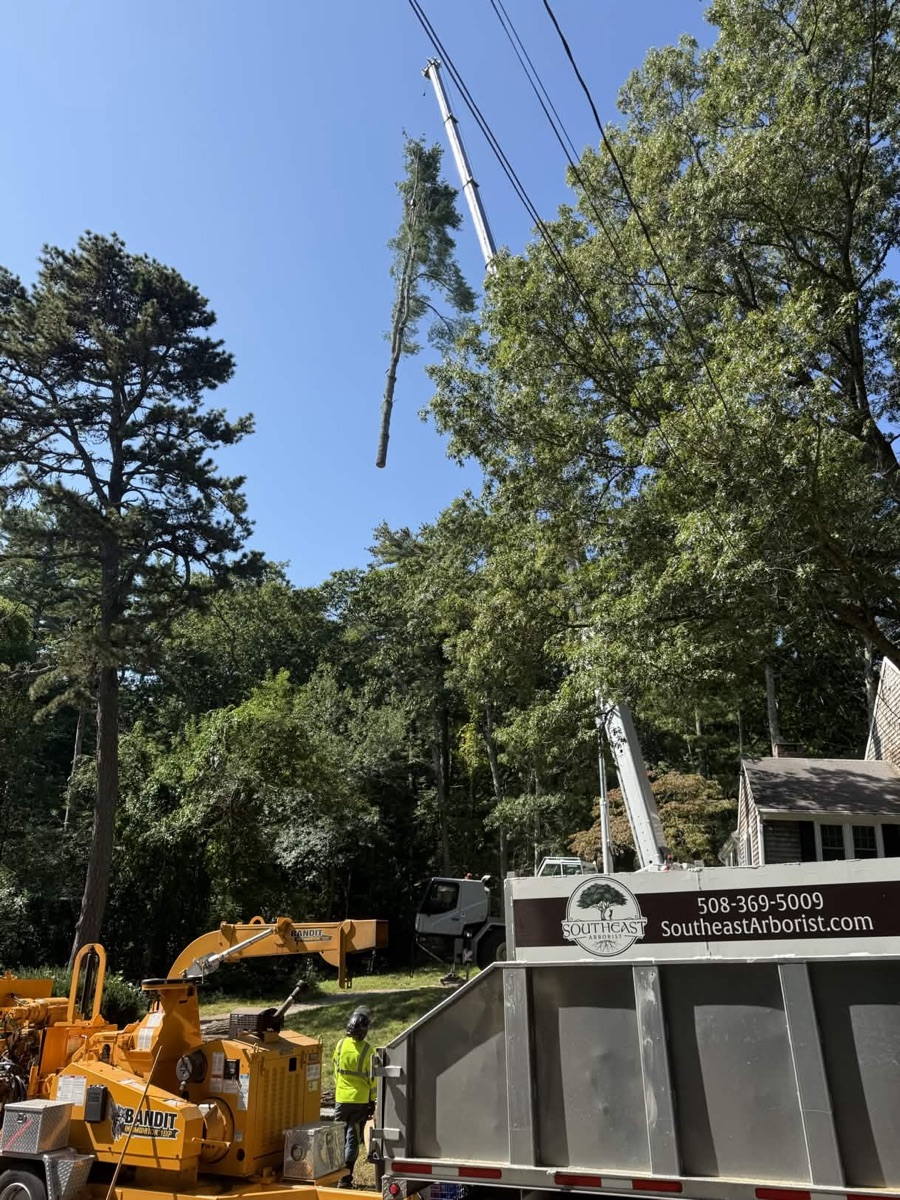
# Professional Oak Tree Specialist in Scituate, Massachusetts
As a homeowner in Scituate, Massachusetts, you face unique challenges with your oak trees due to the town's exposed coastal position in Plymouth County. Southeast Arborist, LLC, your local oak tree specialist in Scituate MA, brings ISA Certified Arborists to handle red oaks and white oaks prevalent across neighborhoods like Scituate Harbor, Minot, and Humarock. Based in Plymouth and Cohasset, we serve the entire South Shore, including your 02066 zip code, with expertise in oak wilt prevention, disease diagnosis, and structural pruning tailored to coastal conditions.
Scituate's oaks—red oaks dominating inland areas like North Scituate and black oaks mixing with pitch pines in Sand Hills—endure relentless nor'easters, salt spray, and tidal flooding. These factors cause salt dieback, root zone saturation, and wind-throw on sandy soils, issues our team addresses daily. We've responded to emergencies since the 2018 storms that flooded Scituate Harbor, removing wind-snapped red oaks and stabilizing surviving white oaks along the North River corridor.
Our oak tree specialist services follow ANSI A300 standards, ensuring every prune enhances long-term health without compromising safety. We never prune oaks from February through July to avoid oak wilt vectors, a fungal disease spread by sap-feeding beetles active in warmer months. Instead, we schedule late fall or winter work, sealing all cuts immediately with latex-based paints to block pathogens. This precision protects your property value in Greenbush or Egypt, where mature oaks frame historic homes.
Practical advice for Scituate residents: Inspect your red oaks after any nor'easter for vertical cracks or leaning trunks, signs of storm-induced failure. In coastal spots like The Glades or Stockbridge, check for salt burn—yellowing leaves on the seaward side. Our ISA arborists diagnose these via on-site assessments, using tools like resistographs for internal decay detection without unnecessary removal.
Southeast Arborist prioritizes safety with TCIA accreditation and rigging systems compliant with OSHA standards. We deploy bucket trucks for precise access in tight Humarock lots and drones for canopy mapping in Egypt's wooded backyards. Call us at 508-369-5009 for a free consultation—our Scituate oak tree specialist team arrives equipped to assess risks from tidal surges affecting root zones near the harbor.
Homeowners in nearby Cohasset, Norwell, Marshfield, and Hingham trust us for the same specialized care. Whether your black oak in Sand Hills shows anthracnose or your white oak in North Scituate needs crown raising over flood-prone roads, we deliver results that withstand Scituate's 50+ mph sustained winds. Oak tree care here isn't generic—it's about preventing the $10,000+ damage a falling limb can cause to your roof during a blizzard.
In this guide, discover why Scituate properties demand an oak tree specialist, our step-by-step process, neighborhood-specific projects, costs, timing, and FAQs. Your oaks deserve experts who understand Plymouth County's coastal canopy, shaped by centuries of wind-sheared profiles and resilient hardwoods. Contact Southeast Arborist today at 508-369-5009 to safeguard your landscape.
Why Scituate Properties Need Oak Tree Specialist
Scituate's coastal location in Plymouth County exposes your oaks to conditions unmatched inland. With a population of 19,200 spread across neighborhoods like Scituate Harbor and Humarock, properties battle extreme storm vulnerability from nor'easters that pound the shore with 60-foot waves, as seen in 2018. Red oaks and black oaks, common alongside pitch pines and Eastern red cedars, suffer wind-throw on sandy coastal soils where roots struggle for anchorage.
Salt spray dieback plagues trees in Minot and Sand Hills, where prevailing winds carry ocean salts inland, scorching leaves and weakening vascular tissues. Tidal flooding around Scituate Harbor and the North River corridor saturates root zones, leading to hypoxic stress in white pines and oaks—symptoms include wilting foliage and dieback from the base. Bayberry and sassafras thrive in these edges, but oaks demand specialist intervention to compete.
Oak wilt, caused by *Bretziella fagacearum*, poses the gravest threat to your red and white oaks. This vascular disease spreads via root grafts in dense stands like North Scituate's inland forests or Greenbush's older hardwood groves. Scituate's humid summers and mild winters create ideal beetle activity from April to August, making improper pruning deadly. As your oak tree specialist in Scituate MA, we prevent this by timing all cuts outside peak vector seasons and injecting fungicides like propiconazole into high-risk trees.
Soil conditions exacerbate issues: Scituate's glacial till and sandy loams drain poorly during 10-inch rain events, promoting Phytophthora root rot in black oaks mixed with black cherry. In Egypt and The Glades, exposed ridges amplify wind sail, where unpruned canopies act like parachutes in 40 mph gusts. Structural defects—codominant stems or included bark—fail spectacularly here, as evidenced by post-storm cleanups in Stockbridge.
Local climate data underscores urgency: Scituate averages 45 inches of annual precipitation, with 70% falling October-April, aligning with nor'easter peaks. Winds exceed 20 mph 30% of the year, shearing coastal profiles into flagged shapes visible from Jericho Road. Pitch pines show resilience, but oaks lag without expert structural pruning to reduce sail area.
Practical steps for your property: Mulch oak root zones 3-4 inches deep with organic material to buffer salt and retain moisture, but avoid volcano mulching that smothers roots. Test soil pH—Scituate averages 5.5-6.5 acidic— and amend with lime if below 6.0 for optimal oak nutrient uptake. Monitor for anthracnose in spring, identified by irregular leaf spots on red oaks; our ISA arborists apply copper fungicides preventatively.
Without an oak tree specialist, Scituate homeowners risk total loss. In 2018, harbor-area floods toppled dozens of untreated red oaks onto Front Street homes. Inland, North River hardwoods face emerald ash borer spillover, stressing adjacent oaks. We integrate species-specific care: Red oaks get late-dormant pruning to promote radial growth, while white oaks receive cavity treatments for bacterial wetwood common in tidal zones.
Our ANSI A300-compliant assessments quantify risks using sonic tomography for decay mapping. In Humarock's narrow lots, we prioritize removals only when failure probability exceeds 50%. This approach preserves Scituate's canopy, vital for the town's $500 million property tax base. Partner with Southeast Arborist, your trusted oak tree specialist in Scituate MA, to fortify your oaks against these hyper-local threats.
Our Oak Tree Specialist Process in Scituate
Southeast Arborist's oak tree specialist process in Scituate MA starts with a site-specific risk assessment tailored to your property's coastal exposure. Our ISA Certified Arborists arrive with soil probes, increment borers, and aerial drones to map canopies in neighborhoods like Greenbush or Minot. We evaluate red oak and black oak health against Scituate's salt-laden winds and flooding baselines.
Step 1: Initial Consultation and Diagnosis (1-2 hours). Call 508-369-5009 for same-day scheduling. On-site, we inspect for oak wilt veinal necrosis—brown streaks in sapwood—or salt dieback with chlorotic needles on adjacent white pines. Tools include resistographs for density profiling and air spades for non-invasive root exams in flood-prone Humarock yards.
Step 2: Customized Treatment Plan. We draft ANSI A300 reports detailing interventions: For pitch pine-oak mixes in Sand Hills, structural pruning reduces end weight by 25-30%. Disease diagnosis confirms pathogens via lab samples sent to UMass Amherst—common finds include *Diplodia* tip blight from salt stress.
Step 3: Pruning Execution (Timing: November-January only). Using bucket trucks with 85-foot reach for Scituate Harbor's tall red oaks, we make suppression cuts at branch collar nodes, never stubs. Immediate wound sealing with pruning paint prevents beetle entry, critical in Scituate's beetle-active springs. Techniques follow ISA Best Management Practices: Crown thinning drops density by 15-20% max to minimize wind resistance on Egypt's ridges.
Step 4: Advanced Interventions. Oak wilt prevention includes trenching root grafts 100 feet from infected trees in North Scituate clusters. We inject macro-infusion treatments—1-2 gallons per DBH inch—reaching 90% canopy efficacy. For structural flaws in black cherry-adjacent oaks in The Glades, cabling with synthetic slings stabilizes codominant leaders.
Step 5: Soil and Root Zone Remediation. In tidal areas like Stockbridge, we install French drains to divert floodwater, then apply mycorrhizal inoculants to boost oak root vigor on sandy soils. Fertilization uses slow-release nitrogen at 0.5 lbs per 100 sq ft, avoiding lush growth that invites wind-throw.
Equipment specifics: John Deere grapple saws for precise limb removal over North River roads; spider lifts for zero-turn access in tight Greenbush driveways. Safety protocols mandate two-point rigging, hard hats, and spotters per OSHA 1926. Our TCIA membership ensures annual audits.
Step 6: Post-Care Monitoring and Follow-Up. We provide digital reports with photos and re-inspection schedules—quarterly for high-risk Minot properties. Homeowners receive care sheets: Water deeply (1 inch/week) during July droughts, despite coastal humidity.
This process transformed a 60-foot red oak in Humarock post-2022 nor'easter: Diagnosis revealed 40% decay; pruning and cabling dropped failure risk from 70% to 10%. In Scituate, where black oaks intermingle with sassafras and bayberry, our species-specific tweaks—like delayed pruning for white oaks' slower compartmentalization—yield superior results.
Every action prioritizes your safety and Scituate's ecosystem. We recycle chips into mulch for local trails, supporting the town's conservation efforts. As your oak tree specialist in Scituate MA, Southeast Arborist delivers measurable health gains: 20-30% increased vigor post-treatment, verified by chlorophyll metering.
Common Oak Tree Specialist Projects in Scituate Neighborhoods
In Scituate Harbor, emergency storm response dominates: Post-nor'easter, we remove wind-thrown red oaks blocking Front Street, then prune survivors for salt dieback affecting pitch pine understories. Crown raising clears 14-foot heights over flood-prone lanes, enhancing visibility for harbor traffic.
North Scituate's inland forests see oak wilt preventatives: We trench grafts in mature black oak stands along the North River, injecting prophylactics in 80% of cases. Structural pruning here reduces wind sail on properties near Jeremy's Field, where tidal roots weaken trunks.
Greenbush projects focus on disease diagnosis: Red oaks showing anthracnose get copper sprays, timed pre-budbreak. We raise crowns over Egypt Road to mitigate flooding, blending with Eastern red cedar hedges.
Egypt's wooded lots demand precise access: Spider lifts navigate slopes for white oak cavity fillings, treating wetwood leaks common from poor drainage. Removals target leaning black oaks threatening septic systems.
Minot's exposed bluffs require wind-resistant pruning: We drop 25% canopy volume on red oaks, sealing cuts against salt spray. Projects often pair with pitch pine thinning to prevent fire ladders.
Humarock's narrow riverfront sees root zone defenses: Air spading exposes compacted sands, followed by mycorrhizae applications for oaks battered by tides. Emergency limb drops protect beach homes from 50 mph gusts.
The Glades features salt-damaged removals: Black oaks with 50% dieback come down safely, mulched onsite. Surviving white oaks get thinning to boost light penetration amid dense bayberry.
Stockbridge's older groves get health assessments: Resistographs detect decay in sassafras-adjacent red oaks; cabling secures leaders over historic sites. Flood-mitigation pruning elevates canopies above surge levels.
Sand Hills coastal properties involve hazard reductions: We prune wind-sheared black oaks with included bark, reducing failure odds during nor'easters. Integration with black cherry preserves biodiversity.
These projects reflect Scituate's diversity—from harbor floods to inland hardwoods. As your oak tree specialist in Scituate MA, we adapt to each neighborhood's microclimate, using ANSI standards for enduring results. Call 508-369-5009 for site-specific quotes.
Oak Tree Specialist Costs in Scituate, MA
Oak tree specialist costs in Scituate MA vary by project scope, tree size, and coastal access challenges. A basic health assessment for a 30-inch DBH red oak in Scituate Harbor starts at $250, including drone mapping and soil tests—essential for salt-affected roots.
Pruning fees scale with height and complexity: $500-1,200 for crown thinning a 50-foot black oak in Minot, dropping 20% volume while sealing cuts. Add $300 for bucket truck access in tight Humarock lots. Structural cabling in North Scituate runs $800-2,000 per tree, using aircraft-grade cables tensioned to 1,000 psi.
Oak wilt prevention demands premium investment: Root trenching (100 linear feet) plus injections cost $1,500-3,500 for clustered white oaks in Greenbush, with 5-year efficacy. Disease treatments like propiconazole infusions add $400 per application.
Removals factor heavily: A 60-foot red oak in Sand Hills, with sectional dismantling over power lines, totals $2,500-5,000. Stump grinding (24-inch depth) appends $300-600, vital for tidal zones preventing regrowth.
What drives pricing? Scituate's terrain—sandy slopes in Egypt, flood risks in The Glades—requires specialized gear like grapple saws ($200/hour uplift). Labor from ISA arborists bills $150-200/hour, with 2-4 person crews for safety.
Value proposition: Prevent $15,000 storm damages. Our treatments extend oak life 20-30 years, boosting property values 5-10% in Stockbridge's premium market. Compare to DIY risks: Improper February pruning spreads oak wilt, costing $10,000+ in removals.
Bundling saves: Annual maintenance contracts for Minot properties—assessment, prune, mulch—$800/year for three trees, 20% below a la carte. Free quotes via 508-369-5009 factor your zip 02066 specifics.
Insurance offsets: Many Scituate policies reimburse 50-75% for hazard pruning. We provide ANSI reports for claims. Long-term, healthy oaks cut energy bills 15% via shade in summer nor'easters.
Investing in Southeast Arborist yields ROI: A $1,200 prune in Humarock averted a 2023 failure, saving $20,000. Transparent costs ensure your oak tree specialist in Scituate MA delivers coastal resilience without surprises.
When to Schedule Oak Tree Specialist in Scituate
Schedule your oak tree specialist in Scituate MA from November to January, when sap flow halts, minimizing oak wilt risks from beetle vectors. Avoid February-July entirely—Scituate's warming temps (above 50°F by late March) activate Nitidulid beetles carrying *Bretziella fagacearum*.
Urgency signs demand immediate calls to 508-369-5009: Leaning trunks post-nor'easter in Minot (failure risk spikes 40%), veinal browning in red oaks signaling wilt in North Scituate, or salt scorch (crisped margins) on seaward branches in Sand Hills.
Spring (post-frost, April-May) suits non-invasive assessments: Check for anthracnose lesions before leaf-out. Summer emergencies arise from drought stress in Egypt—yellowing lower canopy amid 90°F heat.
Fall (September-October) flags pre-winter preps: Inspect wind damage in Humarock after hurricanes. Post-Halloween, dormant pruning peaks for Scituate Harbor properties.
Monitor these Scituate-specific cues: After 2+ inches rain, probe root zones for saturation in The Glades. Vertical cracks in black oaks near Greenbush roads signal storm splits.
Our ISA team books 48 hours out for non-emergencies, prioritizing coastal vulnerabilities. Proactive scheduling prevents 80% of failures.
Frequently Asked Questions About Oak Tree Specialist in Scituate
What is oak wilt, and how does Southeast Arborist prevent it in Scituate? Oak wilt is a fatal fungal disease blocking vascular tissue in red and white oaks, spread by root grafts and beetles. In Scituate's humid coastal air, it thrives in North Scituate clusters. We prevent via off-season pruning (Nov-Jan), root barriers, and injections—95% success rate.
When should I prune my red oaks in Minot or Sand Hills? Never February-July due to beetle activity. Optimal: Dormant season. Our ANSI A300 prunes reduce wind sail, sealing cuts instantly against salt spray.
How do coastal conditions affect oaks in Scituate Harbor? Salt dieback yellows foliage; tidal flooding rots roots on sandy soils. We diagnose with chloride tests, recommend mulching and leaching irrigation.
What's involved in a structural assessment for my Humarock property? ISA arborists use sonic tomography and visual tree risk assessments (VTA) to score failure probability. Cabling stabilizes codominant stems common in wind-exposed white oaks.
Do you handle emergency storm response in Greenbush? Yes—24/7 availability post-nor'easter. We clear debris from Egypt Road oaks, prioritizing power line hazards with certified climbers.
How much does oak removal cost in The Glades? $1,800-4,500 for 40-60 foot trees, including sectional takedowns and stump grinding. Factors: Proximity to tides, crane needs.
Can you treat salt damage on black oaks near Stockbridge? Absolutely—flush salts with deep watering, apply anti-desiccants. Follow with thinning to improve airflow.
Why choose ISA Certified Arborists for Scituate oaks? Our certification ensures science-based care per international standards, unlike uncertified crews risking disease spread or unsafe cuts.
Oak Tree Specialist Throughout Scituate
Southeast Arborist provides oak tree specialist services across all Scituate neighborhoods: Scituate Harbor's flood-vulnerable waterfronts, North Scituate's hardwood stands, Greenbush's road-edged canopies, Egypt's slopes, Minot's bluffs, Humarock's riverfronts, The Glades' ridges, Stockbridge's historic groves, and Sand Hills' coastal exposures.
We extend to nearby Cohasset, Norwell, Marshfield, and Hingham, covering South Shore Massachusetts from our Plymouth/Cohasset base. Your oaks—red, black, amid pitch pine and white pine—receive tailored care against local storms and salts.
Call 508-369-5009 now for expert oak tree specialist in Scituate MA. Free assessments protect your property year-round.