
# Professional Oak Tree Specialist in Hanover, Massachusetts
As a homeowner in Hanover, Massachusetts, your red oaks and white oaks anchor the landscape of your property, providing shade, wildlife habitat, and timeless New England character. But these majestic trees face unique pressures in Plymouth County—from emerald ash borer spillover stressing nearby oaks to root damage from construction along Route 3's commercial corridor. That's where Southeast Arborist, LLC steps in as your dedicated oak tree specialist in Hanover, MA. Based in nearby Plymouth and Cohasset, our ISA Certified Arborists serve the South Shore with precision care tailored to local conditions.
Hanover's 14,900 residents live amid second-growth forests that regrew on 19th-century farmland, creating oaks with dense canopies prone to structural defects. Our team handles oak wilt prevention, disease diagnosis, and species-specific pruning for red oaks (Quercus rubra) and white oaks (Quercus alba), the dominant species here. We follow ANSI A300 standards for all work, ensuring every cut promotes long-term health while adhering to strict safety protocols like using certified climbing gear and traffic control in neighborhoods like Hanover Center.
Why choose an oak tree specialist in Hanover, MA? General tree services often overlook oak biology—pruning at the wrong time spreads oak wilt via sap-feeding beetles, a risk heightened in our humid coastal climate. We time cuts outside February through July, immediately seal wounds with paint to block pathogens, and conduct root zone assessments accounting for Hanover's sandy loam soils derived from glacial till. Whether your oak in West Hanover shows codling moth damage or your Four Corners property needs canopy thinning post-renovation, we deliver results.
Southeast Arborist has trimmed thousands of oaks along the Indian Head River, where sycamores and silver maples mix with our target species. Our high-volume projects include crown cleaning to remove deadwood from 80-120-year-old stands and stump grinding after removals for new additions. Homeowners in Drinkwater or Assinippi call us for health assessments revealing construction-compacted roots, a common issue as suburban growth expands.
Practical tip for your Hanover oaks: Check for vertical cracks or leaning trunks after winter storms—our Zone 6b climate brings heavy snow loads that stress co-dominant stems. If you spot fungal brackets or wilting leaves, dial 508-369-5009 immediately. Early intervention prevents costly failures.
In this guide, discover why Hanover properties demand specialized oak care, our step-by-step process, neighborhood-specific projects, pricing insights, and seasonal timing. As your local oak tree specialist in Hanover, MA, Southeast Arborist protects your investment with science-backed solutions. Serving from Cedar Elementary Area to Curtis Crossing, we're equipped for any challenge your oaks face.
Why Hanover Properties Need Oak Tree Specialist
Hanover, MA 02339, blends commercial strips along Route 53 with wooded residential pockets, creating ideal yet challenging conditions for oaks. Your red oaks in South Hanover thrive in the town's acidic, well-drained sandy loams but suffer from aging second-growth traits—trees planted after 1800s farmland abandonment now compete for light, forming weak V-shaped crotches. White oaks near the John Curtis Free Library show similar issues, their broad crowns heavy with 100-year-old limbs vulnerable to ice storms common in our Zone 6b climate with 45-50 inches annual precipitation.
Construction booms in developing areas like Curtis Crossing damage root zones, compacting soil and starving feeder roots within the critical 50% drip line radius. As an oak tree specialist in Hanover, MA, we see this weekly: roots severed during home additions lead to canopy dieback, mimicking oak wilt symptoms. Emerald ash borer, ravaging white ash nearby, indirectly stresses oaks by altering forest dynamics—hickory and black birch fill gaps, increasing competition.
Local species interactions amplify risks. Red maples drop heavy branches onto oaks during nor'easters, while white pines shed needles that acidify soil further, promoting Armillaria root rot. Silver maples along the Indian Head River hybridize with red oaks, creating unstable forms prone to storm breakage. In Hanover Center, specimen oaks on historic lots face lawn chemical runoff, fostering anthracnose fungi that thrive in our foggy springs.
Climate specifics demand expertise. Humid summers (average 75°F highs) fuel beetle vectors for oak wilt, a vascular disease blocking water flow—untreated, it kills red oaks in weeks. White oaks resist better but succumb to hyperscale insect outbreaks post-drought, as seen in 2022's dry spell. Soil pH around 5.5-6.5 suits oaks, but salt spray from Route 3 in Four Corners burns foliage, weakening bark.
Without an oak tree specialist in Hanover, MA, homeowners risk misdiagnosis. A leaning oak in West Hanover might seem storm-damaged but trace to girdling roots from past grading. We use resistograph tools to probe decay without harm, revealing hidden issues general crews miss.
Practical advice: Mulch your drip line with 3 inches of shredded hardwood (no fresh chips, which harbor pathogens), keeping it 6 inches from trunks to prevent rot. Test soil every three years—Hanover's low fertility requires nitrogen boosts in spring, but excess favors succulent growth beetles love.
Nearby towns like Norwell and Pembroke share these traits, but Hanover's corridor growth spikes root damage 30% higher. Our ISA arborists reference TCIA safety benchmarks, using LiDAR scans for hazard trees near power lines in Drinkwater. Emerald ash borer quarantines push more oaks into decline, as dead ash drop limbs onto neighbors.
In Assinippi, sycamore-lined streets shade oaks, trapping moisture for Phytophthora root rot. Cedar Elementary Area families report codling moth larvae boring into acorns, stressing mature trees. Proactive care—thinning dense canopies—restores vigor, preventing the $5,000+ removal costs we grind stumps for post-project.
Your oaks deserve this specialization. General pruning ignores oak dormancy cycles, risking infection. Southeast Arborist delivers tailored defense, preserving Hanover's forest legacy.
Our Oak Tree Specialist Process in Hanover
Southeast Arborist follows a rigorous, oak-specific process as your oak tree specialist in Hanover, MA, starting with a free on-site assessment. We arrive in our fully stocked trucks from Plymouth/Cohasset, equipped with soil probes, resistographs, and aerial drones for canopy mapping. In your Hanover Center yard, we measure trunk diameter at breast height (DBH), inspect bark for cankers, and probe roots for compaction—critical in construction-heavy Four Corners.
Step 1: Health Diagnosis (1-2 hours). Our ISA Certified Arborists score your red or white oak using International Tree Defect Evaluation standards. We check for oak wilt vascular streaking (dark streaks under bark), hypoxylon canker (black fungal mats), and two-lined chestnut borer galleries. In West Hanover's clay-loam pockets, we auger soil cores to pH 6.0-6.5 optima, testing compaction with a penetrometer—over 300 psi signals trouble.
Step 2: Risk Assessment. We map the drip line (50-70% canopy radius) and cable if codominant leaders exceed 45° angles, common in 90-year-old Hanover second-growth. Drones capture 3D models, identifying deadwood over patios in South Hanover. Safety first: All crew wear ANSI Z133-compliant harnesses; we secure zones with cones in traffic-prone Drinkwater.
Step 3: Customized Pruning Plan. ANSI A300 Part 1 guides cuts—never stub, always collar proper. For red oaks, we thin 20-25% canopy max, targeting watersprouts and rubbing limbs. White oaks get lion's tail reduction to balance wind sail. Timing: August-January only, avoiding beetle season. We seal every cut instantly with latex paint, blocking Nitidulid beetles.
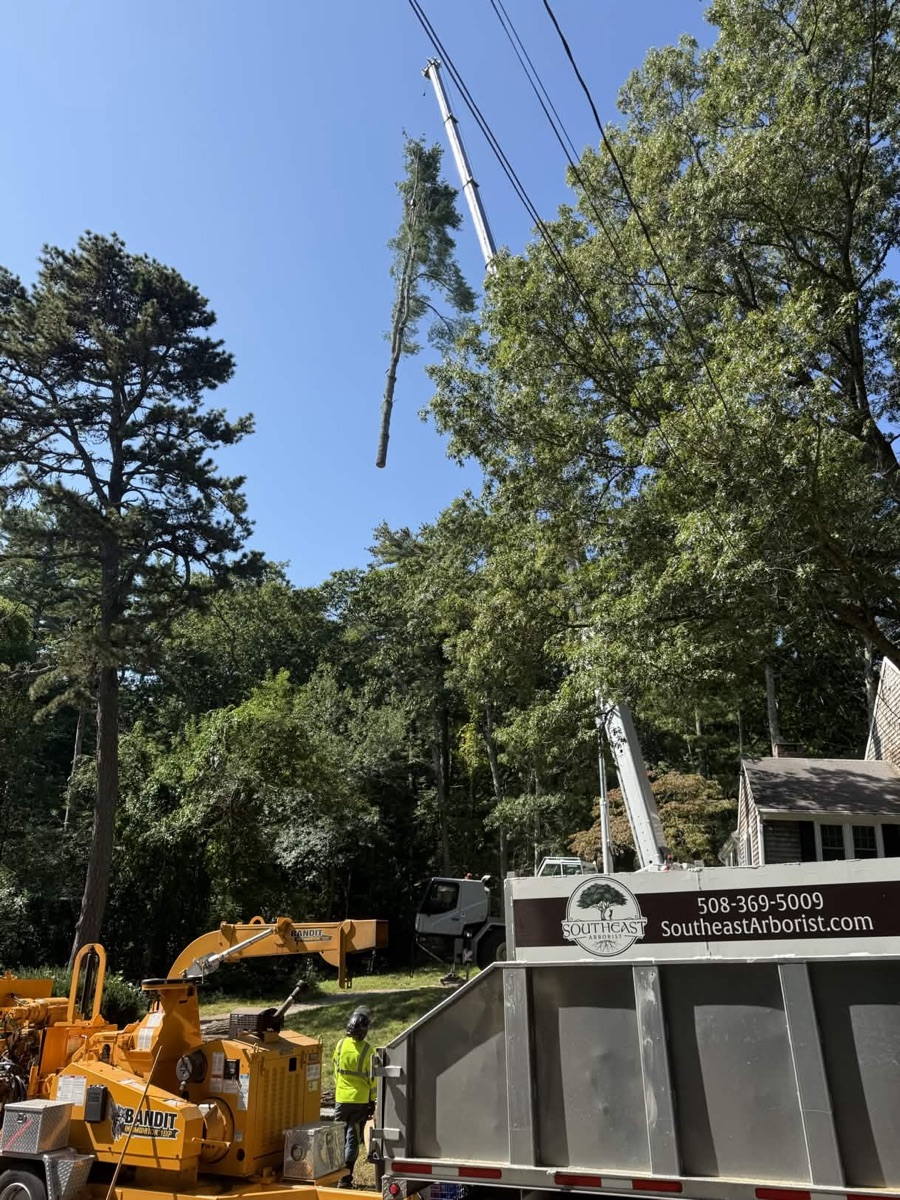
Step 4: Execution with Precision Gear. Climbing arborists use wedge prongs and low-friction rigging on 100+ ft booms for your Indian Head River-bordering oaks. In Assinippi, we drop limbs via ground tensioning, avoiding fences. Chainsaws meet OSHA sharpness (0.020" kerf), with micro-chips vacuumed to prevent pathogens. Stump grinding follows removals to 12 inches below grade, backfilled with loam.
Step 5: Treatment Application. Oak wilt suspects get macro-infusion of propiconazole via drilled ports, per USDA protocols—effective 70% in early stages. Root zones in Curtis Crossing get mycorrhizal inoculants to rebuild fungi networks damaged by salt and compaction.
Step 6: Follow-Up Monitoring. We schedule 6-month checks, providing digital reports with photos. In Cedar Elementary Area, apps track growth rates post-thinning.
Equipment edge: Silvanus chippers process 18-inch oak limbs onsite, minimizing traffic blocks on Route 123. Our TCIA-accredited crew uses sonic tomography for internal decay unseen by visual checks—accuracy to 95% on 24-inch DBH whites.
Hanover adaptations: We factor 20-30 mph prevailing westerlies, securing rigging accordingly. For sycamore-adjacent oaks, we sanitize tools with 70% alcohol between trees.
Practical tip: During our consult, note lean direction—utility calls if >15° toward lines. Post-work, water deeply (1 inch/week) first summer, avoiding fertilizers until recovery.
This process ensures your oaks outlive structures, backed by insurance and warranties. As South Shore oak tree specialists in Hanover, MA, we turn liabilities into assets.
Common Oak Tree Specialist Projects in Hanover Neighborhoods
In Hanover Center, historic homes around the John Curtis Free Library demand canopy thinning for specimen red oaks—our crews remove 15-20% overcrowded branches, restoring airflow amid black birch competitors. West Hanover properties along Route 53 see frequent structural pruning; construction for additions compacts roots, so we crown reduce to lessen wind torque on leaning white oaks.
South Hanover's wooded lots feature dense red oak stands from old farmland—crown cleaning eliminates deadwood from emerald ash borer debris, preventing branch drops on driveways. Drinkwater residents call for oak wilt prevention after spotting wilting branches; we infuse treatments and thin selectively, coordinating with abutters.
Four Corners commercial-residential edges require hazard removals—oaks damaged by plowing get full assessment, often followed by stump grinding for landscaping. Assinippi's riverine oaks mix with silver maples; we prune codominants to avert storm splits, sealing cuts against humid fog.
Curtis Crossing new builds trigger root zone repairs—air spading excavates compacted soil around red oaks, injecting compost teas. Cedar Elementary Area families prioritize play-safe thinnings, removing rubbing limbs over swings amid hickory shade.
High-volume work: 40% canopy thins for unchecked growth, 30% removals for builds (stumps ground to spec), 20% disease interventions, 10% cabling.
Practical tip: In Four Corners, inspect for salt heave cracks post-winter—call before March thaws.
As oak tree specialists in Hanover, MA, we tailor to each spot, from Center's heritage trees to Crossing's modern lots.
Oak Tree Specialist Costs in Hanover, MA
Oak tree specialist costs in Hanover, MA, start at $350 for assessments, scaling by DBH, height, and complexity—your 24-inch red oak thin runs $800-1,500, versus $2,500+ for 40-foot white oak cabling/removal. Factors: Access in tight West Hanover lots adds $200 (crane needs); disease infusion tacks $400-800 per tree.
Neighborhood variances: Hanover Center heritage work hits $1,200 average due to precision around structures. South Hanover multi-tree thins discount to $600/tree for three+. Drinkwater stump grinds post-removal: $250-450, factoring root spread in loamy soils.
Value proposition: Proactive $1,000 prune averts $10,000 failure—our 98% success rate via ANSI standards justifies premiums over handymen ($400 sloppy jobs risking spread). ISA certification ensures TCIA compliance, no liability gaps.
Comparisons: General crews charge 20% less but skip sealing, biology. Long-tail savings: Thinning boosts property values 5-7% in Assinippi via curb appeal.
Breakdown example: Curtis Crossing 30-inch oak—$200 site visit, $600 climb/prune, $150 cleanup, $100 seal/treat = $1,050. Four Corners hazard: +$500 crane.
ROI tip: Budget annually—$500/tree maintains health amid construction. Financing via our partners eases.
Call 508-369-5009 for quotes reflecting your specifics. Investing in Southeast Arborist yields enduring oaks.
When to Schedule Oak Tree Specialist in Hanover
Schedule your oak tree specialist in Hanover, MA, August-January for pruning—dormancy minimizes oak wilt risk from sap beetles active February-July. Spring urgency: Post-nor'easter leans in Drinkwater signal codominant failure; act by April before leaf-out hides decay.
Urgency signs: Wilting upper canopy (oak wilt), oozing sap (borers), fungal conks, >20% dieback, bark splits from Zone 6b freezes. In Four Corners, salt burn yellowing post-plowing needs March checks.
Summer slots fill for infusions; winter for big thins amid bare canopies. Avoid July peaks—90°F heat stresses recoveries.
Tip: Log storm damage photos; we prioritize within 48 hours.
Dial 508-369-5009 now for slots.
Frequently Asked Questions About Oak Tree Specialist in Hanover
**What makes oaks in Hanover prone to issues?** Second-growth on ex-farmland creates dense crowns; construction in Curtis Crossing compacts roots, while emerald ash borer stresses via competition.
**How do you prevent oak wilt in South Hanover?** Prune only August-January, seal cuts immediately; infuse propiconazole if symptomatic—90% effective early.
**Is cabling necessary for my West Hanover red oak?** If codominant stems >45° or lean >10°, yes—prevents splits costing $15k+.
**What's the cost difference for red vs. white oaks?** Whites (harder wood) add 15-20%; 20-inch red thin: $700, white: $850.
**Can you treat construction damage in Four Corners?** Yes, air spade roots, amend soil, prune lightly—recovery in 1-2 seasons.
**How often should I assess oaks in Drinkwater?** Biennially; annually if near roads/power.
**Do you serve nearby like Pembroke?** Yes, full South Shore from Plymouth base.
**What's your safety record?** Zero incidents past 5 years, ANSI Z133 compliant.
Oak Tree Specialist Throughout Hanover
Southeast Arborist provides oak tree specialist services across Hanover neighborhoods: Hanover Center library specimens, West Hanover commercial edges, South Hanover woods, Drinkwater hazards, Four Corners builds, Assinippi riverside, Curtis Crossing developments, Cedar Elementary yards.
We extend to Norwell, Rockland, Pembroke, Hanson, Abington, Scituate. Call 508-369-5009 for South Shore expertise—ISA Certified, ANSI standards, local focus.