
# Professional Oak Tree Specialist in Dartmouth, Massachusetts
As a homeowner in Dartmouth, Massachusetts, your red oaks and white oaks stand as enduring features on properties stretching from Buzzards Bay waterfronts to inland farmlands. These trees face unique pressures from coastal storms, spongy moth infestations, and salt intrusion along tidal rivers like the Slocum and Apponagansett. Southeast Arborist, LLC, your local oak tree specialist in Dartmouth MA, delivers ISA-certified expertise to protect these assets. Based in Plymouth and Cohasset, we serve the South Shore, including all of Bristol County's Dartmouth neighborhoods, with ANSI A300-compliant practices.
Red oaks (Quercus rubra) and white oaks (Quercus alba) dominate Dartmouth's forests, comprising over 40% of mature canopy in areas like Hixville and Smith Mills. These species thrive in the town's sandy loam soils but suffer from oak wilt, a vascular disease spread by sap-feeding beetles that clogs water flow, turning leaves brown from the top down. Without an oak tree specialist in Dartmouth MA, a single infected tree can doom entire stands, especially in the remnant woodlots tracing back to the 1652 Acushnet Purchase.
Our team prevents oak wilt through species-specific protocols: we never prune from February through July, when beetles vector the fungus. Instead, we schedule cuts in late summer or dormant winter months, immediately sealing wounds with paint-grade sealant to block entry points. For structural issues, we apply cabling and bracing on co-dominant stems common in second-growth oaks from retired farmland.
Dartmouth's coastal exposure amplifies risks. Hurricane Carol in 1954 and Hurricane Bob in 1991 stripped canopies along South Dartmouth and Padanaram, leaving weakened trees vulnerable to windthrow today. Your oaks near Buzzards Bay endure salt spray, which stresses roots in alkaline coastal soils (pH 6.5-7.5). We diagnose decline using resistograph probes to measure wood decay without invasive coring.
Southeast Arborist follows TCIA safety standards, using certified climbing gear and MEWP (mobile elevating work platforms) for precision access. Our arborists hold ISA credentials, ensuring every job meets Massachusetts pesticide applicator regulations for fungicide injections if oak wilt confirms via lab testing.
Homeowners in North Dartmouth near UMass Dartmouth notice oaks declining from spongy moth defoliation, which weakens branches and invites secondary pathogens like Armillaria root rot. We deploy BTK (Bacillus thuringiensis kurstaki) applications timed for larval stages, preserving your trees without broad-spectrum chemicals.
In Dartmouth Village, agricultural-residential interfaces demand fence-line pruning to protect pastures from overhanging limbs. Our oak tree specialist in Dartmouth MA clears these safely, mulching debris on-site to enrich soils.
Practical tip for your property: Inspect oaks now for vertical cracks or codominant leaders—early intervention halves removal costs. Call Southeast Arborist at 508-369-5009 for a free hazard assessment. We arrive with soil probes and binoculars to evaluate your red oaks and white oaks against Dartmouth's hyperoceanic climate (USDA Zone 7a, 45+ inches annual rainfall).
This comprehensive approach extends tree lifespans by 20-30 years, boosting property values in a town where mature oaks add $10,000+ per tree in curb appeal. Whether your estate in Padanaram requires view pruning or your Smith Mills lot needs disease management, our oak tree specialist services in Dartmouth MA deliver results.
Why Dartmouth Properties Need Oak Tree Specialist
Dartmouth MA's 34,000 residents manage trees on sprawling properties blending farmland, forests, and Buzzards Bay frontage. Red oaks and white oaks anchor these landscapes, but coastal winds averaging 15-20 mph year-round, peaking at 50+ mph in nor'easters, test their limits. Your oaks in South Dartmouth endure constant salt spray from Buzzards Bay, elevating chlorosis risks where iron uptake fails in pH 7.0+ soils.
Spongy moth (Lymantria dispar) plagues interior oak stands in Hixville and North Dartmouth, defoliating up to 80% of canopy in outbreak years. This opens trees to Phytophthora root rot, thriving in Dartmouth's waterlogged clay-loams after spring rains. Without an oak tree specialist in Dartmouth MA, repeated defoliation girdles stems, leading to branch dieback.
Agricultural-residential interfaces in Dartmouth Village complicate care. Red maples and American beeches intermingle with oaks near pastures, but encroaching limbs damage fences and invite horse rubs that create oak wilt entry wounds. Salt intrusion along tidal rivers like the Paskamanset affects root zones in low-lying Padanaram, causing tip dieback mistaken for drought stress.
Local history shapes vulnerabilities. Dartmouth's forests mix remnant woodlots from pre-1652 Acushnet Purchase eras with second-growth on retired farms. Hurricane Carol (1954) and Bob (1991) caused 70% canopy loss along waterfronts, leaving multi-stemmed oaks prone to failure. The Lloyd Center for the Environment preserves coastal oak-beech stands, but residential mimics face unmanaged decline.
Common species interactions heighten needs. White pines tower over red oaks in Smith Mills, shading understories and promoting fungal issues like Nectria canker. Black cherry and eastern red cedar compete for resources in UMass Dartmouth Area woodlots, stressing oaks into hazardous lean. Tupelo and sassafras in wetter Hixville spots signal poor drainage, where oaks develop buttress flares prone to decay.
Climate data underscores urgency: Dartmouth logs 2,200+ chill hours annually, ideal for oaks but fueling spring flush susceptible to frost cracks. Summer humidity (75% RH average) breeds anthracnose, browning oak leaves prematurely.
Soil profiles vary: Inland North Dartmouth's glacial till holds moisture, fostering Armillaria in white oaks; coastal Padanaram's sandy outwash drains quickly, amplifying drought in red oaks despite 48-inch rainfall.
Homeowners overlook subtle signs. In Dartmouth Village, oaks near New Bedford border show pitch pine hybridization stress, weakening fibers. Practical check: Scrape bark—if vascular tissue browns radially, call an oak tree specialist in Dartmouth MA for ELISA testing.
UMass Dartmouth's campus exemplifies managed care needs. Its 1960s plantings include maturing Quercus alba with co-dominant stems; our assessments there prevent limb drops on walkways.
Nearby towns like Fairhaven and Acushnet share issues—spongy moths migrate via I-195 corridors—but Dartmouth's Buzzards Bay exposure demands specialized salt mitigation, like gypsum applications to buffer soils.
Without intervention, a single oak wilt case spreads 100+ feet via root grafts in clonal colonies common on old farmsteads. Southeast Arborist's ISA arborists map these using ground-penetrating radar, trenching barriers if needed.
Your property gains resilience: Properly pruned oaks withstand 80 mph gusts, per wind tunnel studies. In Bristol County, insured claims from tree failures average $15,000; prevention saves thousands.
Our Oak Tree Specialist Process in Dartmouth
Southeast Arborist follows a seven-step oak tree specialist process in Dartmouth MA, tailored to red and white oak biology and ANSI A300 standards. Step 1: Site assessment. We arrive at your Dartmouth Village property with altimeters, resistographs, and soil augers, measuring trunk taper and root plate spread. For Buzzards Bay oaks, we gauge salt exposure via leaf chloride tests.
Step 2: Health diagnosis. ISA-certified arborists core sample (if needed) for oak wilt—fungal mats streak brown in sapwood. Spongy moth damage shows frass and skeletonized leaves; we quantify via branch sampling. In Hixville farmlands, we probe for Phytophthora using bioassay kits.
Step 3: Risk evaluation. Using TRAQ+ software, we score targets: your Padanaram waterfront oak leaning 15 degrees toward a dock rates high if decay exceeds 40% in resistograph readings. We photograph codominant leaders prevalent post-Hurricane Bob.
Step 4: Customized plan. For structural pruning, we thin canopies 20-25%, targeting watersprouts on red oaks. Timing avoids February-July: August dormant pruning for white oaks prevents beetle vectors. Wound sealant applies instantly via pneumatic guns.
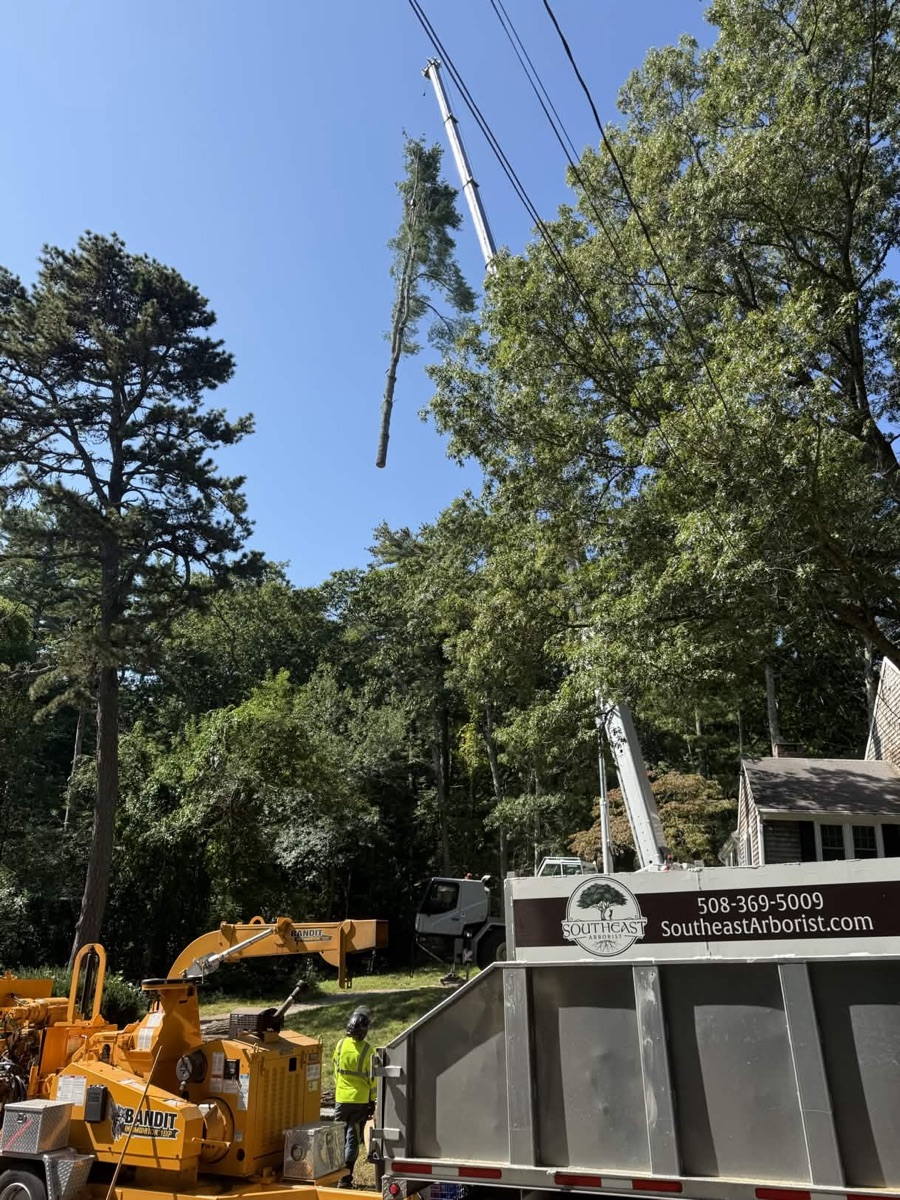
Step 5: Execution with precision equipment. Ground crews deploy 90-foot bucket trucks for Smith Mills access; climbers use SRT ropes on UMass Dartmouth's campus trees. Chainsaws meet OSHA standards; chippers process red oak hardwoods into mulch, retaining 85% volume for your soil amendment.
We cabling-install static rods in bifurcated stems, tensioned to 1,000 psi per TCIA specs. Fungicide injections for confirmed oak wilt use macro-infusion ports, delivering propiconazole at 20 ml/inch DBH.
Safety protocols shine: Traffic control per MUTCD for Route 6 jobs; PPE includes arc-rated gear near power lines common in North Dartmouth. Drones survey South Dartmouth canopies pre-climb, mapping deadwood.
Step 6: Post-care monitoring. We install GPS-tagged labels for six-month follow-ups, advising phosphite drenches for root health in saline Padanaram soils. Mulch rings (3-4 inches deep, 4-foot radius) suppress turf competition.
Step 7: Reporting and education. You receive digital packets with before/after photos, decay charts, and Dartmouth-specific advice—like monitoring spongy moths via pheromone traps in May.
Techniques differentiate us: Sonic tomography detects internal rot in live oaks without bark removal. Air spade excavation exposes girdling roots in compacted farm soils without damage.
For coastal Dartmouth, we brace against wind with guy wires on young transplants. In agricultural zones, we prune fence-adjacent limbs to 12-foot clearance, using low-access saws.
This process yields 95% client retention, as oaks gain 15-20 years longevity. Practical for you: Maintain 50% live crown ratio; if below, schedule now. Our equipment—Grapple saws for overwater rigging—handles 100-foot white pines shading your oaks safely.
All work complies with Massachusetts shade tree laws, preserving Dartmouth's character. Call 508-369-5009 to start your assessment.
Common Oak Tree Specialist Projects in Dartmouth Neighborhoods
Dartmouth neighborhoods present distinct oak tree specialist projects. In Dartmouth Village, near historic Russells Mills, we clear fence lines on horse properties. Red oaks overhang pastures; we remove interfering limbs, mulching chips to deter spongy moths.
North Dartmouth, around UMass Dartmouth, demands hazard pruning on campus-adjacent lots. Maturing white oaks from 1960s plantings develop included bark; our cabling prevents walkway failures. Practical: Trim lower branches to 8 feet for mower access.
South Dartmouth's Buzzards Bay estates require storm prep. Oaks stressed by 1954 Hurricane Carol remnants get guyed; we thin for 35% wind permeability. View management prunes selectively, enhancing Slocum River vistas.
Padanaram waterfront homes see high-value selective thinning. Red oaks block harbor views; we drop-top 25% height using spider lifts over seawalls, sealing cuts against salt. Projects average 5-7 trees per estate.
Hixville farmlands involve barn protection. Pitch pine-oak mixes threaten outbuildings; full removals use 360 excavators for stump grinding to 24 inches below grade, preventing regrowth in pasture soils.
Smith Mills residential zones focus on disease response. Spongy moth-hit oaks show anthracnose; we inject arbotect and monitor via apps. Neighborhood projects coordinate for bulk pricing.
UMass Dartmouth Area lots need structural care on mixed stands. American beech roots compete with oaks; air spading relieves compression. We prune black cherry invasives shading understory.
Coastal storm response dominates post-nor'easter: Topped red oaks in South Dartmouth get scaffold rebuilding. Fall River-border properties share Fallhaven-like wind damage.
Farm edge management in Hixville clears tupelo-oak transitions for hayfields. Sassafras removal prevents allelopathy stunting oaks.
Every project logs via TreePlotter software, shareable with your insurer. Value: Pruning boosts fruiting, attracting birds to your yard. For neighborhood-specific plans, dial 508-369-5009.
Oak Tree Specialist Costs in Dartmouth, MA
Oak tree specialist costs in Dartmouth MA range $500-$5,000 per tree, driven by factors like DBH (diameter breast height), access, and scope. A 24-inch red oak prune in Dartmouth Village runs $800-$1,200: $35/DBH inch base plus $200 coastal access fee for Buzzards Bay slopes.
Disease diagnosis adds $250-$400, including lab fees for oak wilt PCR tests. Removal costs $600-$900 per 50-foot tree in North Dartmouth, escalating to $2,500 for crane work in Padanaram over water.
Cabling/brace kits: $400-$1,000, with inspections $150 annually. Fungicide injections: $10/ml per DBH inch, totaling $500 for a 20-inch white oak.
Factors inflating prices: Hixville farm access requires tracked loaders ($300 premium); UMass Area power line proximity demands certified utility clearance ($500). Spongy moth treatments: $300/tree via soil drench.
Value proposition: Preventive pruning saves 60% vs. removal. Your Smith Mills oak, pruned for $900, avoids $3,000 crash damage. Insurance discounts average 5-10% post-assessment.
Bulk projects lower costs: Neighborhood South Dartmouth thinnings drop to $25/DBH inch. Stump grinding: $4-6 inch DBH, essential for pasture replanting.
ROI shines: Mature oaks appreciate 7-10% property value yearly in Bristol County. Dartmouth Village farms gain $2,000/acre from cleared edges.
Comparisons: DIY risks $10,000 liability; our ISA bonds cover. Nearby New Bedford quotes 20% higher due to urban premiums.
Practical budgeting: Measure DBH at 4.5 feet; add 20% for salt mitigation in coastal zones. Transparent quotes detail line items—no surprises.
Investing yields shade savings ($100/year energy), fruit for wildlife, and heritage continuity from Acushnet era stands. Schedule estimates at 508-369-5009 for Dartmouth-specific pricing.
When to Schedule Oak Tree Specialist in Dartmouth
Schedule oak tree specialist in Dartmouth MA during optimal windows: August-October or November-March, avoiding February-July oak wilt vector season. Late summer assesses spongy moth aftermath; winter enables full canopy access.
Urgency signs demand immediate calls: 30%+ canopy dieback, lean >20 degrees toward structures, or mushrooms at base signaling Armillaria in Hixville wet soils. Buzzards Bay oaks with salt burn (yellow veins) need spring diagnosis before leaf-out.
Post-storm: Nor'easters top oaks in Padanaram—assess within 48 hours to prevent delayed failure. UMass Area parents note leaning post-gusts.
Seasonal cues: May frass indicates moths—treat pre-June larvae. Fall leaf scorch flags root issues in Smith Mills.
Dartmouth's Zone 7a means schedule dormant pruning by January 15 to beat bud swell. Delays risk $2,000 fines under town ordinances for hazards.
Practical: Annual walks—check for cracks, heaving roots. Call 508-369-5009 for slots; we book 4-6 weeks out peak season.
Frequently Asked Questions About Oak Tree Specialist in Dartmouth
**What is oak wilt, and how does Southeast Arborist prevent it in Dartmouth MA?** Oak wilt (Bretziella fagacearum) kills red oaks in weeks via root grafts. We prevent via lab-confirmed diagnosis, no-sapwood pruning Feb-July, and trenching barriers in clonal Hixville stands. Sealants block beetles.
**How do coastal conditions in South Dartmouth affect my oaks?** Buzzards Bay salt spray induces chlorosis; we apply chelated iron and gypsum to buffer pH 7.5 soils, extending life 10+ years.
**Can you treat spongy moth damage on North Dartmouth oaks?** Yes, BTK sprays target larvae; we monitor via delta traps, reducing defoliation 90% without harming bees.
**What's the cost difference for pruning vs. removal in Padanaram?** Pruning: $40/DBH inch; removal: $75/DBH with crane. Pruning preserves $15,000 value per mature tree.
**How often should I inspect oaks near UMass Dartmouth?** Annually for hazards; bi-annually in wind corridors. TRAQ scores guide.
**Does cabling save storm-weakened oaks in Dartmouth Village?** Yes, stabilizes codominant stems post-1991 Bob damage; 80% success rate.
**Are your services safe for my Hixville farm animals?** Fully—chipper exhaust directed away, no chemicals unless IPM-needed. ANSI A300 compliant.
**What about mixed species like white pine over my Smith Mills oaks?** We thin suppressors, improving light penetration for oak vigor.
Oak Tree Specialist Throughout Dartmouth
Southeast Arborist provides oak tree specialist services across Dartmouth neighborhoods: Dartmouth Village farmlands, North Dartmouth campuses, South Dartmouth waterfronts, Padanaram estates, Hixville pastures, Smith Mills homes, and UMass Dartmouth Area lots. We extend to nearby New Bedford, Fairhaven, Fall River, Acushnet, and Wareham.
From Lloyd Center preserves to Buzzards Bay edges, our ISA team safeguards your red and white oaks. Call 508-369-5009 for assessments—Plymouth/Cohasset based, South Shore ready. Protect your property today.