
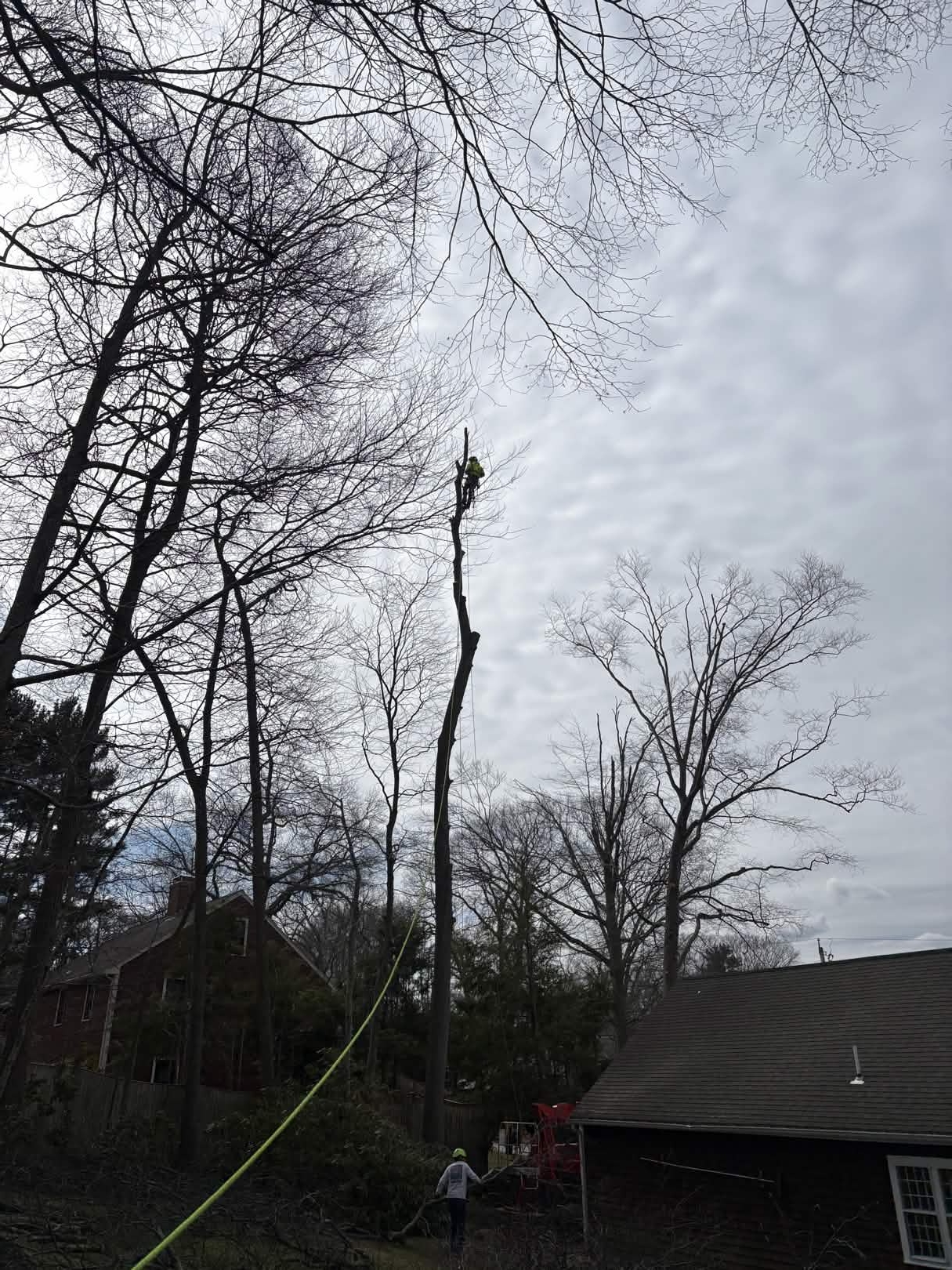
# Professional Tree Removal in Dartmouth, Massachusetts
If you own property in Dartmouth, MA 02714, your trees face unique pressures from Buzzards Bay's coastal winds, spongy moth infestations in oak stands, and the town's mix of farmland, forests, and residential zones. As a homeowner in Dartmouth Village, North Dartmouth, or along the waterfront in Padanaram, you know that red oaks, white pines, and red maples define the landscape but can become hazards when diseased, storm-damaged, or overgrown. That's where Southeast Arborist, LLC steps in—your local ISA Certified Arborists based in Plymouth and Cohasset, serving the South Shore Massachusetts area, including all of Bristol County.
We specialize in safe tree removal in Dartmouth MA, handling everything from dead white oaks threatening your roof in Hixville to hazardous pitch pines along tidal rivers in South Dartmouth. Our team follows ANSI A300 standards for tree risk assessment and removal, using crane-assisted techniques for complex jobs near UMass Dartmouth or waterfront estates. Fully insured and equipped with advanced rigging, we prevent foundation damage and ensure complete debris cleanup, with stump grinding available as an add-on.
Dartmouth's history as part of the 1652 Acushnet Purchase shaped its forests—remnant woodlots in Smith Mills blend with second-growth stands on retired farmland in North Dartmouth. Coastal storms like Hurricane Carol in 1954 and Hurricane Bob in 1991 devastated Buzzards Bay frontage, leaving legacy hazards that still require professional intervention. Today, properties in the UMass Dartmouth Area deal with maturing landscape trees from the 1960s campus build, while the Lloyd Center for the Environment highlights preserved coastal forests vulnerable to salt intrusion.
For tree removal Dartmouth MA residents rely on, we offer free estimates at 508-369-5009. Whether it's selective clearing for views in Padanaram or storm preparation in Dartmouth Village, our ISA Certified Arborists assess your red maples, American beeches, and eastern red cedars with precision. We prioritize your safety and property integrity, dismantling trees section by section to avoid damage to barns, fences, or outbuildings common on Dartmouth's agricultural-residential interfaces.
Homeowners in Fairhaven, New Bedford, Fall River, Acushnet, and Wareham also call us for similar services, but Dartmouth's Buzzards Bay exposure demands our coastal expertise. Spot a leaning black cherry near your home? Overhanging tupelo branches encroaching on pastures? Our crane-assisted removals handle heights and tight spaces other crews can't. We haul away all debris, leaving your lot pristine and ready for replanting.
Practical tip for Dartmouth properties: Inspect your trees annually after leaf-out in spring, checking for spongy moth webbing on oaks or wind cracks from winter gales. If a white pine shows salt burn along Slocum Road, schedule removal before it drops limbs during nor'easters. Southeast Arborist's protocols exceed local regulations, integrating TCIA safety guidelines with Dartmouth's zoning for waterfront and farm clearances.
In this guide, learn why your Dartmouth trees need removal, our step-by-step process, neighborhood-specific projects, costs, timing, and FAQs. Protect your investment—call Southeast Arborist at 508-369-5009 for tree removal in Dartmouth MA today.
Why Dartmouth Properties Need Tree Removal
Dartmouth, MA's 34,000 residents manage sprawling forests, farmland, and Buzzards Bay frontage where coastal storms amplify tree risks. Red oaks and white oaks dominate interior stands near North Dartmouth, but spongy moth damage weakens them, creating failure points over driveways in Smith Mills. White pines along Padanaram's waterfront suffer salt intrusion from tidal rivers, their needles browning and branches dying back, threatening docks and seawalls.
Red maples thrive in moist soils of Hixville's retired farmlands but develop girdling roots that destabilize them near horse barns. American beeches in Dartmouth Village woodlots succumb to beech bark disease, their smooth trunks cracking under wind loads from Buzzards Bay. Black cherry trees along fence lines in agricultural zones drop heavy limbs during fruiting season, endangering pastures. Eastern red cedars crowd field edges in the UMass Dartmouth Area, invading lawns and blocking views.
Tupelo and sassafras in low-lying South Dartmouth areas face root rot from poor drainage exacerbated by Hurricane Bob's 1991 legacy scarring. Pitch pines in sandy soils near the Lloyd Center for the Environment ignite easily in dry spells, posing fire risks to adjacent homes. Dartmouth's climate—mild winters with 45-inch annual rainfall and summer humidity—fosters fungal pathogens like Armillaria root rot in oaks, while 50-60 mph gusts from nor'easters test structural integrity.
Coastal properties in Padanaram endure constant salt spray, stressing white pines and red maples into hazardous leans. Interior oak stands in North Dartmouth battle spongy moth defoliation, reducing vigor and increasing snap risk. Agricultural-residential interfaces in Hixville require fence line clearing where black cherries overhang, damaging posts. UMass Dartmouth's campus trees, planted in the 1960s on former woodland, now mature into hazards needing assessment per ANSI A300 Part 4.
Soil conditions play a key role: Dartmouth's glacial till and sandy loams in Buzzards Bay zones provide shallow rooting for pitch pines and cedars, making them top-heavy. Farmland clays in Smith Mills compact around red maple roots, starving them of oxygen. Homeowners notice signs like canopy dieback, soil heaving at bases, or included bark unions—call Southeast Arborist for on-site evaluation.
Storm exposure defines urgency: Post-Hurricane Carol, waterfront canopies lost 70% in South Dartmouth, leading to invasive regrowth now crowding structures. Current threats include leaning eastern red cedars near barns in Hixville farms, ready to crush outbuildings. Practical advice: After heavy rain, probe bases for mushrooms indicating root rot in tupelos; if bark sloughs off beeches in Dartmouth Village, prioritize removal.
Southeast Arborist's ISA Certified Arborists identify these issues early, preventing claims on your homeowner's insurance. We document risks with photos, adhering to Massachusetts Tree Wardens' guidelines for public-adjacent trees. For your Buzzards Bay property, we mitigate salt-damaged sassafras before they fail. In farmland zones, we clear hazard black cherries without disrupting pastures.
Nearby New Bedford and Fairhaven share oak-spongy moth issues, but Dartmouth's Buzzards Bay winds demand specialized rigging. Don't wait for a limb to crash through your roof—our free estimates reveal hidden dangers in your white oaks or red maples. Call 508-369-5009 for tree removal in Dartmouth MA tailored to these local challenges.
Our Tree Removal Process in Dartmouth
Southeast Arborist delivers tree removal in Dartmouth MA through a meticulous, safety-first process led by ISA Certified Arborists. We start with a free on-site assessment, inspecting your red oak in North Dartmouth for spongy moth damage or white pine in Padanaram for salt burn. Using resistograph tools and visual tree risk assessment (VTA) per ANSI A300, we map defects like codominant stems in American beeches or decay in black cherry trunks.
Step 1: Pre-job planning. We review your property in Hixville or Smith Mills, measuring drop zones near barns or fences. For coastal South Dartmouth jobs, we factor Buzzards Bay winds, securing permits if near tidal zones. Crane-assisted plans go to engineering review for loads over 50 feet, like pitch pines threatening UMass Dartmouth Area roofs.
Step 2: Gear-up and site prep. Our crew arrives in marked trucks with traffic control for Dartmouth Village roads. We tarp sensitive areas—lawns in North Dartmouth, seawalls in Padanaram—to prevent foundation damage. ANSI Z133 safety protocols mandate hard hats, harnesses, and two-way radios; climbers use Petzl systems for rigging.
Step 3: Rigging and sectional dismantling. For hazardous trees like leaning red maples over pastures, we install high-lines and friction devices, lowering 50-100 lb sections precisely. In tight Smith Mills yards, ground crews use port-a-wraps. Crane ops, with Grove 65-ton units, lift entire tops from white oaks near Buzzards Bay homes, avoiding swings.
Step 4: Felling and stump management. Healthy sections get directional fells away from structures; diseased tupelos in South Dartmouth dismantle fully. Stump grinding follows—our 36-inch Vermeer grinders pulverize roots 18 inches deep, backfilling with loam suited to Dartmouth's sandy soils.
Step 5: Cleanup and hauling. We chip branches for mulch (red maple ideal for paths), haul logs via dump trailers, and rake sites spotless. In farmland Hixville, we segregate debris for livestock-safe disposal. Post-job, we walkthrough with you, confirming no damage to your eastern red cedar-adjacent fences.
Equipment highlights: Sky Climber lifts for UMass access, Lewmar winches for sassafras slopes. Techniques adapt to Dartmouth—lowering lines for spongy moth-weakened oaks prevent barber-chair splits. Fully insured up to $5M, we cover workers' comp and liability.
Practical advice: For your Dartmouth property, clear 20-foot drop zones beforehand; mark utilities via Dig Safe. Watch for our blue safety flags signaling active rigging. We integrate drone surveys for tall pitch pines, spotting internal rot pre-climb.
This process minimizes disruption—jobs wrap in one day for cedars under 60 feet, two for crane oaks. Serving Fall River to Wareham, our Dartmouth expertise shines in coastal rigging. Trust Southeast Arborist for ANSI-compliant tree removal in Dartmouth MA—dial 508-369-5009 for your free estimate.
Common Tree Removal Projects in Dartmouth Neighborhoods
Dartmouth neighborhoods present distinct tree removal needs, and Southeast Arborist tailors solutions to each. In Dartmouth Village, we remove dead-end red oaks overhanging historic homes, sectionally dismantling to protect slate roofs amid dense woodlots.
North Dartmouth's residential-agricultural mix sees frequent white pine removals along Route 6, where salt from plows and wind causes decline. Homeowners request fence line clearing of black cherries invading pastures, using low-impact rigging to preserve soil structure.
South Dartmouth waterfront estates demand crane-assisted takedowns of leaning pitch pines post-nor'easters, clearing views to Buzzards Bay without seawall damage. We handle storm-damaged American beeches near docks, hauling debris to avoid tidal fouling.
Padanaram's luxury properties feature selective red maple removals for harbor vistas, blending view management with hazard pruning on retained sassafras. Our ISA arborists assess soil compaction first, preventing erosion on sloped lots.
Hixville farms prioritize barn-threatening eastern red cedars and tupelos, grinding stumps to reclaim pasture edges. We clear fence lines without tractor disruption, common for horse properties bordering forests.
Smith Mills interior stands require spongy moth-hit white oak removals over driveways, with chipper trucks navigating narrow roads. UMass Dartmouth Area projects involve campus hazard assessments—structural pruning or full removal of 1960s-planted red maples crowding parking lots.
Landmarks like the Lloyd Center see preservation-aligned removals, targeting invasives around salt marshes. Practical tip: In Padanaram, thin overstory beeches before fruit drop fouls boats; North Dartmouth farmers, fell hazard cherries pre-calving season.
Our projects restore safety—e.g., a Hixville oak removal prevented barn collapse; South Dartmouth pine clearance opened Bay views. From Acushnet to Fairhaven, Dartmouth's variety keeps us sharp. For your neighborhood's tree removal in Dartmouth MA, call 508-369-5009.
Tree Removal Costs in Dartmouth, MA
Tree removal costs in Dartmouth MA vary by factors like species, size, location, and complexity, but Southeast Arborist provides transparent pricing for South Shore value. Base rates start at $500 for small (under 30 feet) eastern red cedars in open North Dartmouth yards—healthy fells with chip-haul.
Medium red maples (30-50 feet) in Smith Mills average $1,200-$2,500, factoring spongy moth weakness requiring rigging. Tall white oaks (over 60 feet) in Dartmouth Village hit $3,000-$6,000, with crane adds $1,500+ for Buzzards Bay overhangs.
Coastal Padanaram premiums apply to pitch pines near water—$4,000-$8,000 due to wind rigging and erosion control. Stump grinding adds $200-$500 per, deeper for tupelo roots in Hixville clays. Cleanup/hauling included; extras like crane mats for UMass Dartmouth soft soils add $300.
Key factors: Access—tight South Dartmouth alleys bump 20%; hazards like leaning black cherries in farms add 15-30% for safety lines. Species matter: Dense American beech wood slows cuts, raising labor; sassafras oil requires PPE, +10%.
Value proposition: Our ISA certification ensures ANSI A300 compliance, preventing insurance hikes from DIY fails. Free estimates detail breakdowns—no surprises. Compared to New Bedford independents, our $5M insurance and cranes save rework costs.
Practical budgeting: Measure height (laser apps work), note lean toward structures. Dartmouth farms save bundling fence clears; waterfront owners offset with view gains boosting property value 5-10%.
Seasonal dips: Winter jobs 10-20% less due to bare canopies. Financing via partners for Hixville multi-tree farms. Long-term: Post-removal mulch from your red oaks nourishes lawns cheaply.
Southeast Arborist delivers ROI—safe, clean removals protect your Dartmouth investment. Get your quote: 508-369-5009 for tree removal Dartmouth MA.
When to Schedule Tree Removal in Dartmouth
Timing tree removal in Dartmouth MA maximizes safety and cost-efficiency amid local climate patterns. Schedule spring (April-May) post-frost for spongy moth scouting—remove weakened red oaks in North Dartmouth before egg hatch.
Summer (June-August) suits low-risk white pines in Padanaram, but humidity delays healing cuts; prioritize hazardous leans after thunderheads. Fall (September-November) ideal for black cherries in Hixville farms—leaf drop reveals structure, dry ground aids stumps.
Winter (December-March) cheapest for tall pitch pines over South Dartmouth roofs—bare limbs speed rigging, frozen soil supports cranes. Avoid ice storms; post-nor'easter urgency spikes for Buzzards Bay damage.
Urgency signs: Cracks in American beech trunks, heaving soil at red maple bases, dead tops on sassafras from salt. Leaning >15 degrees over structures? Act now—winds amplify failure.
Practical: Monitor after leaf-fall; appraise via phone photo to 508-369-5009. Early scheduling beats rush fees post-storm.
Frequently Asked Questions About Tree Removal in Dartmouth
How do I know if I need tree removal on my Dartmouth property? Inspect for lean, deadwood >20% canopy, or fungal fruiting at base—like Armillaria on Dartmouth Village oaks. ISA arborists use VTA; call us for free check.
Is crane-assisted removal necessary for Buzzards Bay trees? Yes for heights over 50 feet or overhangs, as in Padanaram white pines. Prevents property damage; our Grove cranes handle coastal winds safely.
What about permits for tree removal in Dartmouth MA? We handle Bristol County filings for waterfront or road trees. Farms in Hixville often exempt; UMass-adjacent needs campus coord.
How long does tree removal take in Smith Mills? Small jobs 2-4 hours; crane oaks 1 day. Tight access adds half-day; we minimize disruption.
Do you grind stumps after removal in North Dartmouth? Yes, $200+ add-on pulverizes 18 inches deep, preventing regrowth in sandy soils. Backfill included.
Will removal affect my property value in South Dartmouth? Proper removal enhances it—clears hazards, improves views. Poor jobs deduct; our ANSI work boosts appeal.
Can you remove trees near power lines in Dartmouth? Yes, coordinated with Eversource. Rigging prioritizes lines; safety first per ANSI Z133.
What's the cost difference for hazardous vs. healthy trees? Hazardous (diseased spongy moth oaks) 20-40% more due to sectional work. Free estimates specify.
Tree Removal Throughout Dartmouth
Southeast Arborist provides tree removal across Dartmouth neighborhoods: Dartmouth Village historic hazards, North Dartmouth farm clears, South Dartmouth waterfront, Padanaram views, Hixville pastures, Smith Mills interiors, UMass Dartmouth campus.
We extend to nearby New Bedford, Fairhaven, Fall River, Acushnet, Wareham—your South Shore solution. ISA Certified, fully insured, free estimates.
Protect your Dartmouth MA property—call 508-369-5009 today.