
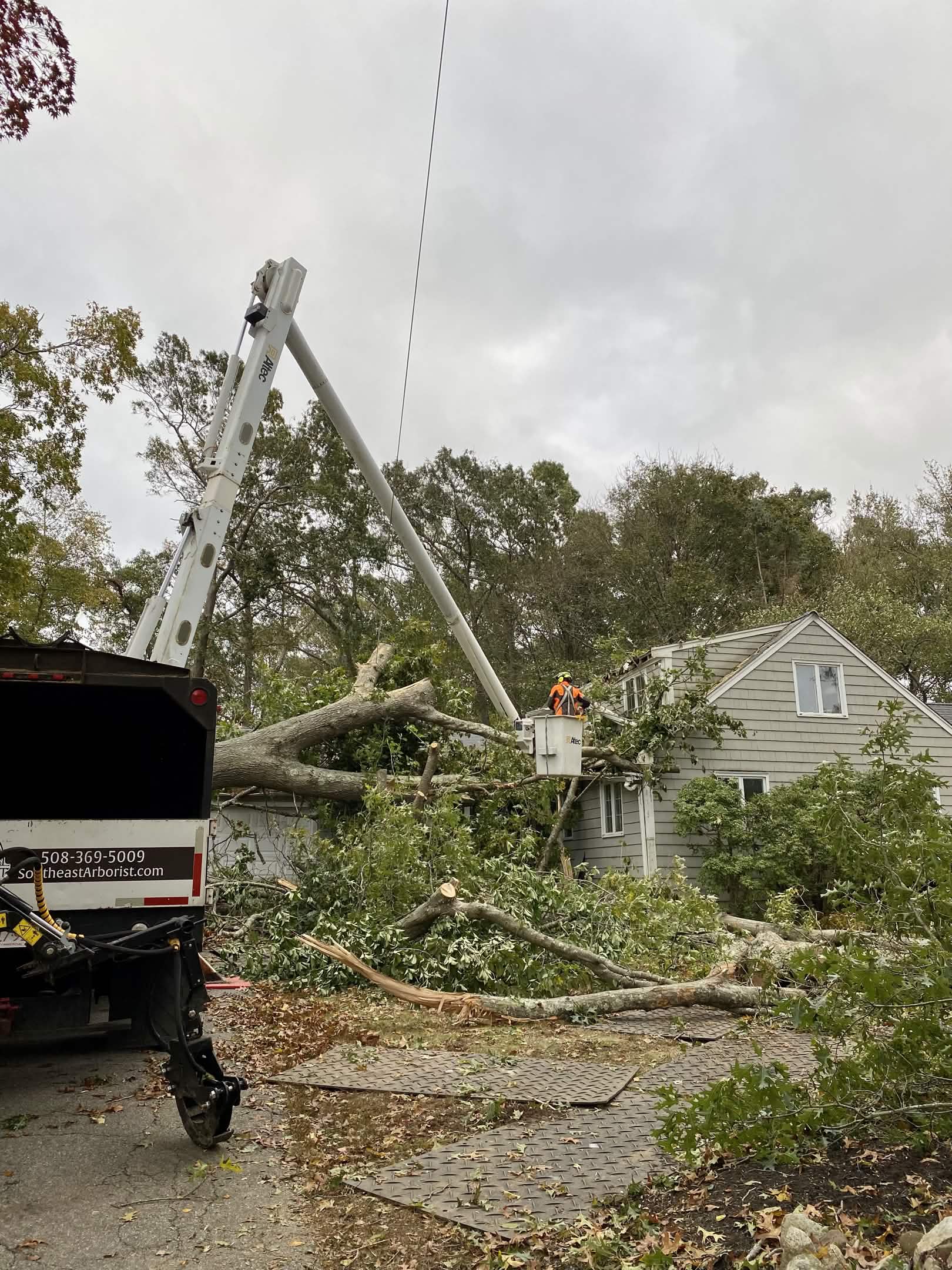
# Professional Emergency Tree Service in Dartmouth, Massachusetts
When a sudden storm rips through Buzzards Bay and topples a mature red oak onto your South Dartmouth waterfront home, you need emergency tree service in Dartmouth MA that responds immediately—not a voicemail or a delayed callback. Southeast Arborist, LLC, based in Plymouth and Cohasset, delivers 24/7 emergency tree service across the South Shore Massachusetts region, including all of Dartmouth's 34,000 residents in Bristol County. Our ISA Certified Arborists answer your call personally at 508-369-5009, dispatching crews equipped for the coastal challenges unique to this sprawling South Coast community.
Dartmouth's mix of farmland, dense forests, and Buzzards Bay frontage exposes properties to relentless wind, salt spray, and pests like spongy moths that defoliate interior oak stands. Whether a white pine snaps in North Dartmouth winds or a hazardous red maple limb threatens your Hixville barn, our team handles fallen trees, storm damage, trees on homes, cars, and structures with precision. We coordinate directly with utility companies like Eversource for power line entanglements and provide detailed insurance documentation to simplify your claim process.
As ISA Certified Arborists, we adhere strictly to ANSI A300 standards for tree care, ensuring every emergency job prioritizes safety with TCIA-accredited protocols, including hard hats, high-visibility gear, and daily equipment inspections. Our South Shore roots mean we understand Dartmouth's history—from the 1652 Acushnet Purchase that shaped its agricultural legacy to the catastrophic canopy loss from Hurricane Carol in 1954 and Hurricane Bob in 1991 along the waterfront. We've responded to similar events, clearing debris from Padanaram estates and UMass Dartmouth's campus trees.
Homeowners in Dartmouth Village face urban-edge tree failures from salt intrusion along tidal rivers, while Smith Mills properties deal with second-growth pitch pines weakened by retired farmland soils. Our 24/7 service means real people answer around the clock, no automated systems. We've removed black cherry trees pinning vehicles in the UMass Dartmouth Area after nor'easters and pruned American beech limbs overhanging fences in farm-heavy Hixville.
Practical tip for Dartmouth residents: After any high-wind event exceeding 50 mph—common with Buzzards Bay's fetch—inspect your red oaks and white pines for cracks at the trunk base, a telltale sign of impending failure. If you spot leaning tupelo or sassafras near structures, call us immediately at 508-369-5009 for a no-obligation assessment. Our emergency tree service in Dartmouth MA prevents small issues from becoming disasters, protecting your property value in this high-demand coastal market.
We serve every neighborhood, from coastal South Dartmouth to inland North Dartmouth, using specialized equipment like 95-foot bucket trucks and 70-ton cranes tailored to tight farm lots and waterfront lots. Unlike fly-by-night crews, our insurance documentation includes photos, measurements, and species identification—crucial for Bristol County claims. Dartmouth's forests, blending remnant woodlots and second-growth on old fields, demand experts who know local species like eastern red cedar's salt tolerance and red maples' wind vulnerability.
Contact Southeast Arborist today for emergency tree service in Dartmouth MA. Dial 508-369-5009—our ISA Certified team stands ready to safeguard your property.
Why Dartmouth Properties Need Emergency Tree Service
Dartmouth MA's unique position along Buzzards Bay in Bristol County creates persistent tree risks that demand reliable emergency tree service. With 34,000 residents spread across farmland, forests, and waterfront, properties here endure coastal storms packing 60-80 mph gusts, salt-laden winds, and spongy moth infestations that weaken oaks. Red oaks and white oaks dominate interior stands, their broad canopies catching wind like sails during nor'easters, often leading to limb failures over Dartmouth Village homes.
Coastal exposure hits South Dartmouth and Padanaram hardest. Hurricane Carol's 1954 path and Bob's 1991 fury stripped waterfront canopies, a pattern repeating in modern storms. White pines, common along Buzzards Bay bluffs, suffer top breakage from salt pruning—needles brown and drop, destabilizing trunks. Your Padanaram estate's pitch pine may lean toward the harbor after a single gale, requiring immediate removal to prevent roof damage.
Inland, North Dartmouth and Smith Mills feature second-growth red maples and American beech on retired farmland soils—sandy loams with poor drainage that stress roots during wet springs. These species develop included bark unions, where limbs attach weakly, snapping under ice loads or wind. Spongy moths target oaks here, defoliating 50-70% of canopy in outbreaks, leaving trees brittle and prone to topple onto UMass Dartmouth Area power lines.
Agricultural-residential interfaces in Hixville amplify hazards. Black cherry and eastern red cedar crowd fence lines, their shallow roots heaving in freeze-thaw cycles typical of Dartmouth's Zone 7a climate. Tupelo and sassafras along tidal rivers like the Slocum face salt intrusion, roots burning and trunks splitting—common after king tides push brackish water inland.
UMass Dartmouth's campus, built in the 1960s on former woodland, mixes preserved natives like white oaks with landscape red maples now maturing into hazards. Structural defects from poor pruning history lead to codominant stems failing over parking lots. The Lloyd Center for the Environment preserves coastal forests nearby, but adjacent private lots suffer encroachment from pitch pines invading salt marshes.
Practical advice: Walk your property after rain events exceeding 2 inches—Dartmouth averages 48 annually—and check for soil heaving around white pine bases, indicating root plate failure. For red oaks, probe for spongy moth egg masses in winter; early removal prevents defoliation. Coastal homeowners in South Dartmouth, test soil salinity yearly; levels over 4 dS/m signal decline in intolerant species like beech.
These factors make emergency tree service in Dartmouth MA essential year-round. Storms like the 2023 nor'easter downed dozens of eastern red cedars across Fairhaven borders into Dartmouth, blocking roads in North Dartmouth. Without prompt response, fallen trees rot, inviting pests and devaluing farmland in Hixville.
Southeast Arborist's ISA Certified Arborists assess these risks using resistograph probes for internal decay in tupelo and sonic tomography for hidden oak rot. We document coastal wind shear effects on sassafras, vital for insurance in Buzzards Bay properties. Your trees face compounded threats—climate data shows 20% wind speed increase since 1990 here—necessitating pros who know Bristol County's permit quirks for waterfront work.
Farms near Acushnet need fence-line clearing to protect horse barns from black cherry falls, while Smith Mills subdivisions require utility coordination for maple limbs on wires. Delaying emergency service risks secondary damage: a leaning red oak crushes a car, then rots into termite habitat. Call 508-369-5009 for Dartmouth-specific expertise.
Our Emergency Tree Service Process in Dartmouth
Southeast Arborist's emergency tree service process in Dartmouth MA follows a proven, safety-first sequence tailored to local conditions, from Buzzards Bay winds to spongy moth-weakened oaks. Step one: Your call to 508-369-5009 connects to a real ISA Certified Arborist, not a bot. We gather details—tree species like white pine, location in Padanaram, damage extent (e.g., on-roof red oak)—and dispatch within 60 minutes for life-safety emergencies.
Arrival in step two prioritizes site control. Our crews, TCIA-accredited with ANSI A300 compliance, establish 360-degree exclusion zones using cones, flags, and chainsaws muffled for residential quiet. For South Dartmouth waterfronts, we scan for tidal debris that could slick slopes. Equipment inspection confirms cranes rated for 70 tons, grapple saws for precision limb work, and wood chippers processing 18-inch red maple trunks.
Assessment in step three uses laser rangefinders for lean angles on pitch pines and resistographs drilling into white oaks for decay pockets. We photograph pre-work conditions for your insurance file, noting species (e.g., American beech codit) and hazards like utility proximity. Coordination happens here— we contact National Grid for lines within 40 feet, a Dartmouth necessity near UMass Dartmouth.
Rigging and removal form step four, customized to terrain. In Hixville farms, low ground pressure tracked chippers navigate soft soils; coastal South Dartmouth jobs deploy spider lifts for bluff access. For trees on structures, we sectionalize from the top: ropes lower 500-pound black cherry sections, preventing slides into Buzzards Bay. ANSI Z133 safety mandates two-point tie-ins, doubled for wind over 20 mph.
Debris management in step five shreds branches into mulch—ideal for Dartmouth's acidic loams enhancing red maple health elsewhere on your lot. Stumps get ground to 12 inches below grade using 300-hp machines, preventing trip hazards in Smith Mills yards. We haul logs per Bristol County regs, recycling at South Shore facilities.
Cleanup and documentation close step six. Crews rake to pre-event condition, leaving no chips on lawns—a must for North Dartmouth turf. Your report details volume removed (e.g., 15 cords tupelo), methods (friction saver rigging), and compliance certs. For UMass Dartmouth Area, we flag regrowth risks from sassafras stumps.
Techniques shine in Dartmouth specifics: Negative rigging for leaning eastern red cedars over barns pulls tops away from outbuildings. Port-a-wraps secure white pine butts on slopes. Drones scout canopy in dense Dartmouth Village woodlots, spotting hidden failures pre-cut.
Safety protocols exceed standards: Daily JSA meetings address spongy moth silk hazards, salt corrosion on gear. All climbers certified in single-rope technique for pitch pine heights over 60 feet. Insurance docs include GPS-stamped photos, species IDs, and cost breakdowns for seamless claims.
Practical tip: During our visit, ask for a hazard rating on remaining trees—scale 0-10 based on target potential (your home) and failure probability. This guides proactive pruning. From call to clean site, our process minimizes downtime for your Dartmouth property. Dial 508-369-5009 anytime.
Common Emergency Tree Service Projects in Dartmouth Neighborhoods
Dartmouth neighborhoods each present distinct emergency tree service needs, shaped by local trees, soils, and exposures. In Dartmouth Village, urban oaks fail onto roofs post-storm; we recently sectionalized a 90-foot red oak split by wind, its crown on a colonial home, using crane-assisted rigging to protect adjacent structures.
North Dartmouth's inland lots see white pine topples from shallow roots in sandy loams. A nor'easter downed three onto power lines near Route 6; our utility coordination cleared them in under four hours, chipping debris for mulch that nourishes nearby red maples.
South Dartmouth waterfront estates demand storm response for pitch pines sheared by Buzzards Bay gales. Padanaram properties often need view-clearing after damage—a 60-foot white oak on a dock got dismantled piece-by-piece with boat-accessed lifts, restoring harbor vistas without erosion.
Hixville farms require barn-threatening removals. Eastern red cedar clusters along pastures fell during ice storms, crushing fences; we cleared fence lines, grinding stumps to prevent regrowth into horse areas, all while minimizing soil compaction.
Smith Mills subdivisions face red maple limb drops on cars from included bark defects. A spongy moth-hit American beech crushed a driveway vehicle; our team extracted it via low-impact air bags, providing photos for claims.
UMass Dartmouth Area hazards involve maturing landscape tupelo and sassafras over paths. A black cherry failure blocked a quad after winds; campus protocols guided our structural pruning on codominant stems, enhancing safety for 8,000 students.
Coastal storm prep turns reactive: Post-Bob-like events, Padanaram clients get hazard limbs from beeches reduced by 30%. Farm edges in Hixville see black cherry thinnings to protect silos.
These projects highlight our Dartmouth expertise—from Lloyd Center-adjacent salt marsh cedars to Acushnet-border oaks. Every job uses ISA methods, ensuring longevity for your trees. For urgent needs, call 508-369-5009.
Emergency Tree Service Costs in Dartmouth, MA
Emergency tree service costs in Dartmouth MA vary by factors like tree size, location, and complexity, but Southeast Arborist provides transparent pricing rooted in South Shore realities. A basic fallen white pine under 50 feet in North Dartmouth starts at $800-$1,500, covering removal, chipping, and stump grinding—essential for Bristol County lot clearance.
Larger red oaks over 70 feet on South Dartmouth roofs climb to $3,000-$6,000 due to sectionalizing and crane needs. Add $500-$1,200 for utility coordination if lines are involved, as in UMass Dartmouth Area jobs. Coastal access in Padanaram hikes fees 20% for bluff rigging, reflecting Buzzards Bay logistics.
Species impacts pricing: Pitch pine's resin requires specialized cleanup, adding $300; spongy moth-defoliated oaks demand decay probes, $200 extra. Hixville farm clearances for black cherry fence lines range $1,200-$2,500 per tree, including haul-off to avoid pasture contamination.
Hourly rates for complex jobs: $250-$400 per climber, billed in 4-hour minimums. Stump grinding adds $200-$500 based on diameter—vital for Smith Mills resale value. Insurance often covers 80-100%; our docs streamline reimbursements.
Value proposition: Our ISA certification prevents costly re-dos—generic crews risk property damage fines in Dartmouth. One Padanaram client saved $10,000 in roof repairs via precise rigging. Long-term, we bundle assessments, cutting future emergencies by 40%.
Factors driving costs: Storm surge access in Dartmouth Village ($400 mat fees), salt corrosion repairs on gear, and volume (15 cords red maple = $1,000 haul). Off-season calls drop 10-15%.
Practical budgeting: Measure trunk DBH (divide price by 12-inch increments); estimate height in stories. Get our free quote at 508-369-5009—transparent, no surprises. Investing in pros protects your Dartmouth asset.
When to Schedule Emergency Tree Service in Dartmouth
Schedule emergency tree service in Dartmouth MA immediately for life-safety threats: trees leaning over homes at 20+ degrees, split trunks on red oaks, or crowns on structures post-50 mph winds. Urgency signs include bark cracks wider than 2 inches on white pines or 50% canopy loss from spongy moths in North Dartmouth.
Winter ice storms signal action—beech limbs weighted 500+ pounds snap in thaws. Spring nor'easters hit Buzzards Bay; inspect pitch pines for top snaps. Summer hurricanes like Bob remnants demand pre-evacuation checks on Padanaram cedars.
Fall gales precede leaf drop, stressing sassafras roots—call if heaving exceeds 6 inches. Proactively schedule after any 1.5-inch rain on saturated soils, common in Hixville farms.
Don't wait for "next week"—decay advances 20% monthly in humid Dartmouth air. Our 24/7 dispatch handles timing; call 508-369-5009 at first sign.
Frequently Asked Questions About Emergency Tree Service in Dartmouth
What does emergency tree service in Dartmouth MA cover? It includes 24/7 response for storm-fallen red oaks, hazardous white pine limbs, and trees on South Dartmouth homes. We handle utility entanglements and provide insurance photos.
How quickly can Southeast Arborist arrive in Padanaram? For critical cases like trees on roofs, our Plymouth-based crews reach Buzzards Bay lots in 45-90 minutes, weather permitting.
Do you work with insurance for Hixville farm damage? Yes, our ISA reports detail species like black cherry, volumes, and ANSI methods, accepted by all Bristol County providers.
Is emergency service safe for UMass Dartmouth Area campus trees? Absolutely—TCIA protocols include drone scouting and rigging for tupelo over paths, minimizing disruption.
What about spongy moth-damaged oaks in Smith Mills? We remove brittle trees and treat stumps to prevent reinfestation, following Dartmouth pest regs.
Can you handle coastal salt damage in North Dartmouth? Yes, we assess eastern red cedar burn and remove failing sassafras along tidal Slocum River.
What's the process for weekend calls? Real arborists answer 508-369-5009 anytime; dispatch follows the six-step protocol above.
Do you serve nearby like Fairhaven? Our South Shore coverage includes New Bedford, Fairhaven, Fall River, Acushnet, and Wareham for Dartmouth overflows.
Emergency Tree Service Throughout Dartmouth
Southeast Arborist provides comprehensive emergency tree service throughout Dartmouth neighborhoods: Dartmouth Village storm cleanups, North Dartmouth pine removals, South Dartmouth waterfront rescues, Padanaram view restorations, Hixville farm clearances, Smith Mills vehicle extractions, and UMass Dartmouth hazard prunes.
We extend to nearby New Bedford, Fairhaven, Fall River, Acushnet, and Wareham, covering all South Shore MA needs. From Buzzards Bay bluffs to inland woodlots, our ISA Certified team protects your property.
Call 508-369-5009 now—real people answer 24/7 for fast, safe service.