
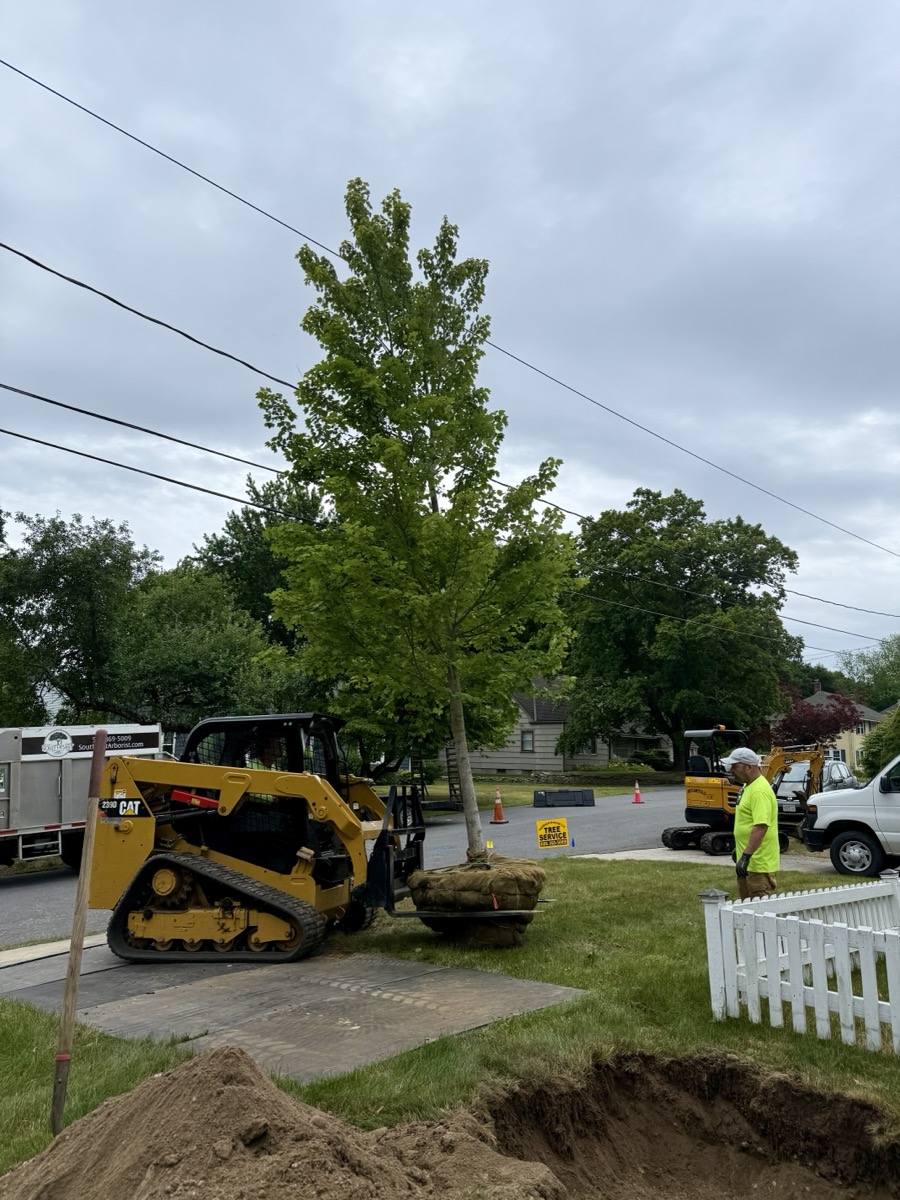
# Professional Tree Planting in New Bedford, Massachusetts
If you're a homeowner in New Bedford, Massachusetts, maintaining a healthy urban forest on your property requires more than random saplings dug into the ground. Professional tree planting in New Bedford, MA, delivered by ISA Certified Arborists like those at Southeast Arborist, LLC, ensures trees thrive amid the city's dense neighborhoods, coastal winds, and aging infrastructure. With a population of 101,000 in Bristol County, New Bedford's historic whaling legacy shaped its canopy—think expansive street trees funded by 19th-century fortunes and the Olmsted-designed Buttonwood Park, home to specimen trees from the 1890s. Yet, today's challenges like spongy moth outbreaks weakening red oaks in the West End, emerald ash borer threats citywide, and Buzzards Bay salt spray battering Clark's Point properties demand precise species selection and planting techniques.
Southeast Arborist, based in Plymouth and Cohasset, serves the South Shore including New Bedford with tree planting services rooted in ANSI A300 standards. Our ISA Certified Arborists prioritize the right tree in the right place, using proper root flare exposure to prevent girdling roots—a common killer in urban soils compacted by decades of foot traffic and construction. Forget volcano mulching; we apply mulch in a flat ring extending to the drip line, promoting root health without smothering trunks. For coastal exposures in neighborhoods like the South End or Dartmouth border, we recommend salt-tolerant species such as eastern red cedar or London plane trees, which resist the sodium chloride carried inland from hurricanes and nor'easters.
Tree planting New Bedford MA isn't just about aesthetics—it's about resilience. Your property faces dense urban growing conditions where overhead utilities clash with maturing red maples and pin oaks, limiting sunlight and air circulation. After removing a declining Norway maple from a tight West End lot, we replant with littleleaf linden, a compact urban tolerant that handles poor soil drainage common in Near North clay loams. Post-planting, we provide care guidance: water deeply twice weekly for the first season, avoiding fertilizers that burn tender roots in New Bedford's variable pH soils around 5.5-6.5.
Common projects include street tree replacements in Acushnet Heights, where white pines struggle against wind shear, and heritage preservation at Buttonwood Park edges, mirroring the park's sycamore and honey locust stands. Our safety protocols—using certified climbing gear, traffic control in busy North End streets, and liability insurance—keep operations smooth. Call Southeast Arborist at 508-369-5009 for a free consultation; we'll assess your site's microclimate, from harbor fog in Clark's Point to drier uplands in Brooklawn Park, and deliver a planting plan that boosts property value by 10-20% per Arbor Day Foundation studies on mature canopies.
In New Bedford's waterfront neighborhoods, where every major southern New England hurricane has left scars, proper planting starts with root ball sizing: for a 2-inch caliper tree, dig a hole three times wider but no deeper than the root flare. We stake only when winds exceed 20 mph sustained, using flexible ties to avoid bark abrasion. This expertise separates us from DIY efforts that fail 50% of the time in urban settings, per ISA data. Whether replacing storm-damaged red oaks post-nor'easter or enhancing your Dartmouth border yard with pin oaks suited to acidic Bristol County soils, Southeast Arborist guarantees establishment through follow-up inspections. Ready to fortify your landscape? Dial 508-369-5009 today.
Why New Bedford Properties Need Tree Planting
New Bedford's urban forest, shaped by its whaling-era prosperity, now contends with coastal exposure, aging trees, and pests that make tree planting essential for property owners. In Bristol County's Buzzards Bay climate—USDA Zone 7a with average January lows of 22°F and 45 inches annual precipitation—your trees endure salt-laden winds up to 50 mph from nor'easters and hurricanes like Bob (1991) or Sandy (2012), which stripped waterfront canopies in Clark's Point and the harbor. Dense urban conditions in the South End exacerbate root competition, where compacted soils under sidewalks limit oxygen to red oak and Norway maple roots, leading to decline rates of 30% in street trees per city audits.
Spongy moth (formerly gypsy moth) outbreaks since the 1980s have defoliated oak stands in western neighborhoods like West End and Acushnet Heights, weakening red oaks and pin oaks that comprise 25% of the canopy. Emerald ash borer, detected nearby in Dartmouth, threatens any ash remnants, while aging infrastructure—many London planes and honey locusts from the 1960s—requires replacement to prevent limb failures onto North End power lines. Buttonwood Park's Olmsted landscape sets the standard: its 1890s sycamores and white pines thrive because early planters matched species to sandy loams; replicate this on your Brooklawn Park property by selecting red maples for wetter sites near streams.
Soil challenges vary: coastal Near North clays retain water but drain poorly, stressing littleleaf lindens unless amended with 30% organic matter. Dartmouth border uplands favor eastern red cedars on well-drained gravel, resisting drought better than white pines that brown in summer dry spells. Homeowners in Clark's Point see salt burn on evergreens; opt for London planes, which compartmentalize sodium effectively. Practical advice: test your soil pH (kits available at local nurseries)—aim for 6.0-7.0 for honey locusts—and avoid planting under utilities, as 40% of New Bedford removals stem from wire conflicts.
Tree planting New Bedford MA addresses these by introducing resilient species: replace declining Norway maples in tight West End lots with disease-resistant red maples like 'Autumn Blaze', growing 40 feet tall without surface roots heaving sidewalks. In coastal South End yards battered by fog drip, pin oaks tolerate iron chlorosis from alkaline marine deposits when root flares stay exposed. Post-hurricane recovery in Fairhaven-adjacent areas demands quick replanting; white pines rebound fastest if installed before May frosts.
Without proactive planting, your property risks vacancy gaps that invite invasives like tree-of-heaven, outcompeting natives. Southeast Arborist's ISA Certified team uses site-specific audits: wind tunnel modeling for Clark's Point gusts, pest risk mapping for spongy moth hotspots in Acushnet Heights. Value your canopy—mature trees cool summer surfaces by 10-15°F in urban heat islands like North End, per USGS data, slashing AC costs. For Brooklawn Park shade trees, littleleaf lindens filter particulates from Route 18 traffic. Ignore these needs, and storm debris cleanup costs soar; invest in planting, and gain 15-year ROI through energy savings and curb appeal. Call 508-369-5009 to evaluate your site's needs against New Bedford's unique pressures.
Our Tree Planting Process in New Bedford
Southeast Arborist follows a meticulous, ANSI A300-compliant process for tree planting New Bedford MA, leveraging ISA Certified expertise to achieve 95% survival rates versus the 50% urban average. Step one: free site consultation via 508-369-5009. We arrive with soil probes, wind gauges, and GIS apps to map your property in neighborhoods like West End or Clark's Point, assessing sun exposure (full sun for red oaks, partial for littleleaf lindens), drainage (percolation tests for red maple sites), and salt loads via chloride meters for harborfronts.
Species selection comes next, tailored to New Bedford's Zone 7a winters and coastal summers. For South End streets, we specify honey locust 'Skyline'—thorny-free, podless, drought-tolerant to 20% soil moisture deficit. Dartmouth border clients get eastern red cedars for windbreaks, screening views while fixing nitrogen in poor gravels. We source from certified nurseries, rejecting ball-and-burlap trees with circling roots; container-grown sycamores ensure fibrous systems for Acushnet Heights compaction.
Site preparation uses commercial excavators for precision holes: width equals three times root ball diameter (e.g., 36 inches for 12-inch ball), depth matches container height. No volcano mulching—our Bobcat loaders backdrag soil into a berm at the drip line, amended with 2 cubic yards compost per 10 trees for Near North clays. Root flare exposure is non-negotiable: we excavate until the root collar tapers, preventing rot in 70% of failed urban plants.
Planting day employs two-ton cranes for mature specimens like 4-inch caliper London planes in Brooklawn Park, positioned plumb with levels and guyed temporarily if gusts exceed 15 mph. Safety protocols include ANSI Z133 harnesses, spotters for North End traffic, and stump grinders pre-removal to eliminate old root rot pathogens. Backfill in 12-inch lifts, soaked with 50 gallons water per tree via tankers, settles without air pockets.
Mulching follows: 3-inch layer of shredded hardwood (no dyed chips) in a 4-foot radius, pulled 6 inches from trunk—boosts mycorrhizal fungi critical for white pine establishment in Buttonwood Park-like settings. Staking uses two bamboo poles only for wind-vulnerable pin oaks, with broad webbing ties checked quarterly. Post-planting, we issue a care sheet: 1-2 inches weekly irrigation via drip lines (avoid overhead for fungal prevention), no fertilizer until year two, and prune watersprouts at 6 months.
Equipment lineup includes Vermeer tree spades for rapid street tree installs (under 2 hours per unit), John Deere loaders for root ball handling, and Felco pruners for pre-plant shaping per ISA Best Management Practices. For coastal Clark's Point, we pretreat with anti-desiccant sprays on evergreens. Follow-up visits at 30, 90, and 180 days monitor for girdling ants common in Norway maple replacements or spongy moth eggs on new red oaks.
This process mitigates emerald ash borer voids by planting diverse mixes—20% conifers like white pines for resilience. Homeowners gain longevity: properly planted trees in New Bedford live 50+ years, versus 15 for rushed jobs. Our Plymouth/Cohasset base enables same-week response post-storms, serving Fairhaven to Acushnet. Trust ANSI-trained crews for your investment; schedule at 508-369-5009.
Common Tree Planting Projects in New Bedford Neighborhoods
Tree planting projects in New Bedford neighborhoods reflect the city's diverse urban forest pressures, from coastal salt in Clark's Point to pest-ravaged oaks in West End. In the dense South End, with narrow lots along Maxfield Street, we replace declining Norway maples encroaching on utilities with littleleaf lindens—compact to 40 feet, pollution-tolerant for Route 18 proximity. Post-removal, pin oak replants handle the area's alkaline soils from historic fill, planted 10 feet from foundations to avoid heaving.
West End homeowners tackle spongy moth-weakened red oaks; our projects install red maples 'Red Sunset' for vibrant fall color matching Buttonwood Park's palette, with root barriers preventing sidewalk uplift in tight parkside yards. North End street tree initiatives focus on honey locusts after London plane declines from anthracnose in humid harbor air—thornless cultivars spaced 40 feet for dappled shade over Kempton Street.
Near North's clay basins suit sycamores, planted after white pine windthrows; we amend with gypsum for drainage, ensuring flare exposure against basal rot. Acushnet Heights sees frequent nor'easter replacements: eastern red cedars screen Dartmouth border views, salt-hardy with dense foliage buffering 30 mph gusts. Brooklawn Park properties prioritize urban-tolerant London planes post-storm, mulched to suppress grass competition in community lots.
Clark's Point waterfront demands salt-specialists: after hurricane limb loss, we plant seaside-tolerant pin oaks, elevated on mounds for Buzzards Bay flooding. Dartmouth border farms get white pine windrows, interplanted with red oaks for mast production benefiting local wildlife. Buttonwood Park periphery projects preserve Olmsted heritage—littleleaf linden understories beneath aging sycamores, pruned to ANSI specs.
Across Fairhaven and Acushnet nearby, similar work includes emerald ash borer preemptives: diverse mixes excluding ash. Each project starts with city permitting coordination for street rights-of-way. Practical tip: measure overhead clearance (minimum 25 feet for maturity) before planting near North End wires. Southeast Arborist's ISA team handles all, from crane sets in Clark's Point to hand-digs in West End backyards. Boost your neighborhood canopy—call 508-369-5009 for a project quote.
Tree Planting Costs in New Bedford, MA
Tree planting costs in New Bedford, MA, range from $300-$800 for a 1.5-2.5 inch caliper sapling to $2,500-$5,000 for 4-inch mature specimens, influenced by site specifics in Bristol County's urban-coastal mix. Base price covers ISA Certified labor, nursery stock, and equipment; a South End container red maple (1.5-inch, $350) adds $150 for clay amendment versus $100 in Dartmouth border sands. Coastal Clark's Point premiums ($200 extra) fund salt-tolerant eastern red cedars and anti-desiccant treatments against Buzzards Bay spray.
Size drives 60% of variance: 2-inch honey locust for West End streets costs $450 materials + $400 install (crane if over utility), while 3-inch London planes in Brooklawn Park hit $1,200 due to root ball weight (500 lbs). Site access factors in: North End tight alleys require hand-digging (+$250), Acushnet Heights slopes add $150 erosion control. Pre-work like stump grinding post-Norway maple removal: $200-$400 per stump, preventing pathogens.
Permits for public easements (e.g., Near North sidewalks) cost $50-$150 city fees, bundled in our quotes. Volume discounts apply: five-tree West End replacements drop per-unit 20% to $500 each. Post-care packages ($100/season) include staking checks for pin oaks in windy Clark's Point and irrigation setup.
Value proposition: a mature canopy adds $5,000-$15,000 to home resale per Appraisal Institute data, offsetting upfronts via 20% energy savings from white pine shade in summer peaks. Avoid cheap DIY—50% failure rate means double costs replanting. Our ANSI A300 process ensures longevity, with warranties on stock. Compare: competitors charge $600 for basic, but skip flare exposure leading to 30% losses in spongy moth zones like red oaks in Acushnet Heights.
ROI peaks in 5-7 years: sycamore shade cools Near North AC bills by $200 annually. Financing via our partners covers multi-tree Buttonwood Park-style projects. Transparent quotes detail breakdowns—no surprises. For precise New Bedford pricing factoring your neighborhood's soils and winds, call Southeast Arborist at 508-369-5009.
When to Schedule Tree Planting in New Bedford
Schedule tree planting New Bedford MA from mid-April to early June or September-October, aligning with New Bedford's cool dormancy periods in Zone 7a to minimize transplant shock. Spring avoids February-March frosts (last average May 10), letting red maples root before July droughts; fall leverages 45-inch rains for white pines without summer heat stress above 85°F.
Urgency signs: gaps post-storm removal—nor'easters like 2023's Henri demand immediate replanting to stabilize soils in Clark's Point erosion zones. Declining Norway maples showing spongy moth defoliation in West End signal now; wait risks emerald ash borer spread from Dartmouth. Utility conflicts in North End require off-season slots before leaf-out.
Avoid July-August: high evaporation in coastal fog dries root balls, failing 40% of honey locusts. Monitor cues—bare soil from pin oak removals invites weeds; plant littleleaf lindens by October 15 for root establishment before December hard freezes. Post-hurricane windows (e.g., after Bob-like events) prioritize salt-tolerant London planes within 4 weeks.
Southeast Arborist coordinates around city calendars, serving Fairhaven/Acushnet surges. Call 508-369-5009 now for spring bookings—slots fill fast in South End.
Frequently Asked Questions About Tree Planting in New Bedford
What species should I plant for coastal New Bedford properties like Clark's Point? Opt for salt-tolerant eastern red cedar or London plane; they compartmentalize sodium from Buzzards Bay winds better than red oaks, which yellow from chlorosis. ISA Certified selection matches your site's pH and exposure.
How deep should the planting hole be in New Bedford's clay soils? No deeper than the root flare—three times wider for Near North clays. Proper exposure prevents rot, unlike volcano mulching that kills 25% of urban trees.
When will my new tree in West End start shading my yard? A 2-inch caliper red maple shades 200 sq ft in 5 years, full maturity (400 sq ft) by year 10. Spongy moth resistance accelerates growth with our post-care.
Do you handle permits for street tree planting in North End? Yes, we secure New Bedford approvals for easements, including utility clearances for honey locusts under wires.
What's the warranty on tree planting from Southeast Arborist? One-year establishment guarantee covers replants if failure stems from install (not neglect). Follow our irrigation guide for 95% success.
Can you plant after emerald ash borer removal in Dartmouth border? Absolutely—diverse mixes like pin oak and littleleaf linden fill voids, with root flare prep against borers.
How much water does a new sycamore need in Acushnet Heights summers? 1 inch weekly via deep soak first year; drip lines prevent shallow roots in compacted soils.
Is staking always required for Brooklawn Park windbreaks? Only for white pines in 20+ mph gusts; flexible ties checked quarterly avoid girdling.
Call 508-369-5009 for answers tailored to your property.
Tree Planting Throughout New Bedford
Southeast Arborist delivers tree planting throughout New Bedford neighborhoods—South End streets, West End oak replacements, North End utility clearances, Near North basins, Acushnet Heights windbreaks, Brooklawn Park shades, Clark's Point coasts, Dartmouth border farms—and extends to Fairhaven, Acushnet, Dartmouth. From Plymouth/Cohasset, we reach 02740 ZIPs same-day post-storms.
ISA Certified crews ensure ANSI standards citywide. Free consults assess your canopy needs. Contact Southeast Arborist, LLC at 508-369-5009 or visit our site to schedule tree planting New Bedford MA today.