
# Professional Tree Planting in Scituate, Massachusetts
If you own property in Scituate, MA 02066, tree planting isn't just about adding greenery—it's about building resilience against the town's relentless coastal forces. Scituate's exposed position in Plymouth County, with its 19,200 residents spread across neighborhoods like Scituate Harbor, North Scituate, Greenbush, Egypt, Minot, Humarock, The Glades, Stockbridge, and Sand Hills, means your trees face constant threats from nor'easters, salt spray, tidal flooding, and wind-throw on sandy soils. Southeast Arborist, LLC, based in nearby Plymouth and Cohasset, delivers professional tree planting services tailored to these conditions. Our ISA Certified Arborists ensure every planting follows ANSI A300 standards, selecting the right tree for your specific site—right species, right place, right technique.
Storm events like the devastating 2018 nor'easters that flooded Scituate Harbor underscore why proactive tree planting matters. Those floods wiped out mature pitch pines and red oaks along the waterfront, leaving gaps in the canopy that now invite erosion and weaken property values. Inland along the North River corridor in North Scituate and Greenbush, older stands of black oak and white pine persist but suffer from root zone saturation during high tides. Coastal spots in Minot and Sand Hills show wind-sheared Eastern red cedars and sassafras, their profiles sculpted by decades of gale-force winds. Bayberry and black cherry thrive in scrubbier areas like Humarock and The Glades, but even they succumb to salt dieback without proper care.
At Southeast Arborist, we specialize in tree planting Scituate MA homeowners rely on to restore and fortify their landscapes. We avoid common pitfalls like volcano mulching, which smothers root flares and invites rot in Scituate's wet soils. Instead, our process exposes the root flare fully, uses salt-tolerant species for Harbor and Minot properties, and includes post-planting care plans to maximize survival rates. Whether you're replacing a storm-lost red oak in Egypt or planting a wind-resistant black cherry barrier in Stockbridge, our team uses precision equipment and safety protocols to get it done right the first time.
Scituate's unique challenges demand expertise. Sandy coastal soils in Sand Hills drain poorly during calm weather but erode rapidly in storms, making proper backfill critical. Salt spray from the Atlantic hits hardest in exposed Humarock and Scituate Harbor, where we've planted serviceberry and inkberry holly as resilient alternatives to vulnerable white pines. Our free consultations—call 508-369-5009—start with a site assessment considering your soil pH (often acidic at 4.5-5.5 here), wind exposure, and flood risk. We source nursery stock from South Shore suppliers acclimated to Plymouth County conditions, ensuring your new trees integrate seamlessly with natives like pitch pine and bayberry.
Homeowners in nearby Cohasset, Norwell, Marshfield, and Hingham often reach out for Scituate referrals, but our focus stays local. We've planted hundreds of trees post-2018 recovery, from crown-raised red cedars over flood-prone roads in Greenbush to structural-pruned barriers in The Glades. Tree planting in Scituate MA goes beyond aesthetics; it protects your home from wind-throw, stabilizes sandy slopes in Sand Hills, and enhances biodiversity along the North River. With our ISA certification, we guarantee compliance with Massachusetts DEP guidelines for coastal plantings. Ready to strengthen your property's canopy? Contact Southeast Arborist at 508-369-5009 for tree planting Scituate MA service that lasts.
Why Scituate Properties Need Tree Planting
Scituate's coastal location in Plymouth County exposes your property to environmental pressures that demand strategic tree planting. Repeated nor'easters, like the 2018 storms that inundated Scituate Harbor with record tides, have decimated pitch pine stands and toppled red oaks, creating voids that accelerate erosion on sandy soils. Your trees here aren't just ornamental—they're your first line of defense against 50+ mph winds, salt-laden air, and tidal surges that saturate root zones up to 10 feet inland.
Consider the soil conditions: Scituate's coastal sands in Minot and Sand Hills have low nutrient retention and high drainage variability, leading to wind-throw risk for shallow-rooted species like white pine. Inland in North Scituate and along the North River in Greenbush, clay-loam holds water longer, fostering root rot in black oaks during wet springs. Salt spray dieback hits Eastern red cedars hardest in Humarock, where Atlantic gales carry sodium chloride that burns foliage and weakens vascular tissue. Bayberry and sassafras show resilience in The Glades and Stockbridge, but even they need companions planted to block prevailing northeasterly winds.
Tree planting in Scituate MA addresses these issues head-on. After storm removals—our top service here—we replant with salt-tolerant pitch pine hybrids or American holly that mimic native profiles without succumbing to dieback. In Egypt's mixed hardwood zones, we select black cherry for its rapid growth on acidic soils (pH 4.8 average), stabilizing slopes prone to washouts. Your property in Scituate Harbor benefits from windbreak plantings of Eastern red cedar spaced 15 feet apart, reducing gusts by 30% across exposed yards.
Local climate amplifies urgency. Scituate averages 45 inches of rain annually, concentrated in nor'easters from October to March, with winter lows dipping to 20°F and summer highs hitting 85°F. This swing stresses young trees unless planted with proper flare exposure to prevent girdling roots—a mistake that dooms 40% of DIY efforts. Tidal flooding around Stockbridge properties drowns oxygen-starved roots, so we elevate planting holes 6-12 inches and use gravel amendments for drainage.
Without targeted planting, your canopy thins, inviting invasive species and dropping property resilience. We've seen Minot homes lose 20-foot red oaks to wind-throw, exposing foundations to spray. Proactive planting restores this: a row of sassafras in Sand Hills can cut erosion by 50%, per USDA studies on coastal barriers. For Greenbush lots near the North River, white pine understories beneath mature black oaks provide layered protection against flood debris.
Southeast Arborist's ISA Certified Arborists evaluate microclimates unique to Scituate neighborhoods. In Humarock's dunes, bayberry clusters bind sand without needing irrigation. The Glades' brackish zones suit black cherry for fruiting wildlife corridors. Following ANSI A300 Part 2 standards, we prune at planting to reduce wind sail, ensuring 95% survival rates versus the 60% town average for unprofessional work. Tree planting Scituate MA isn't optional—it's essential for safeguarding your investment against Plymouth County's fiercest weather.
Practical advice for you: Test your soil salinity (aim under 2 dS/m for most species) and wind speed (over 25 mph sustained means barriers first). Avoid planting white pines in open Harbor exposures; opt for pitch pine. These steps, backed by our expertise, turn vulnerabilities into strengths.
Our Tree Planting Process in Scituate
Southeast Arborist follows a meticulous, ANSI A300-compliant process for tree planting in Scituate MA, customized to your property's coastal challenges. We start with a free site consultation—call 508-369-5009—to assess soil, exposure, and utilities. Our ISA Certified Arborists use GPS mapping for Scituate Harbor lots near the lighthouse or North Scituate's riverine edges, marking exact spots to avoid tidal zones.
Step 1: Species selection. We match trees to your site—salt-tolerant pitch pine for Minot's windy bluffs, red oak for Greenbush's inland loams, or Eastern red cedar for Humarock barriers. Black oak suits Egypt's slopes; white pine understories for Stockbridge; sassafras or bayberry for The Glades' scrubs; black cherry for Sand Hills' sands. We reject mismatches, like white pine in salt zones, sourcing 2-4 inch caliper stock from acclimated South Shore nurseries.
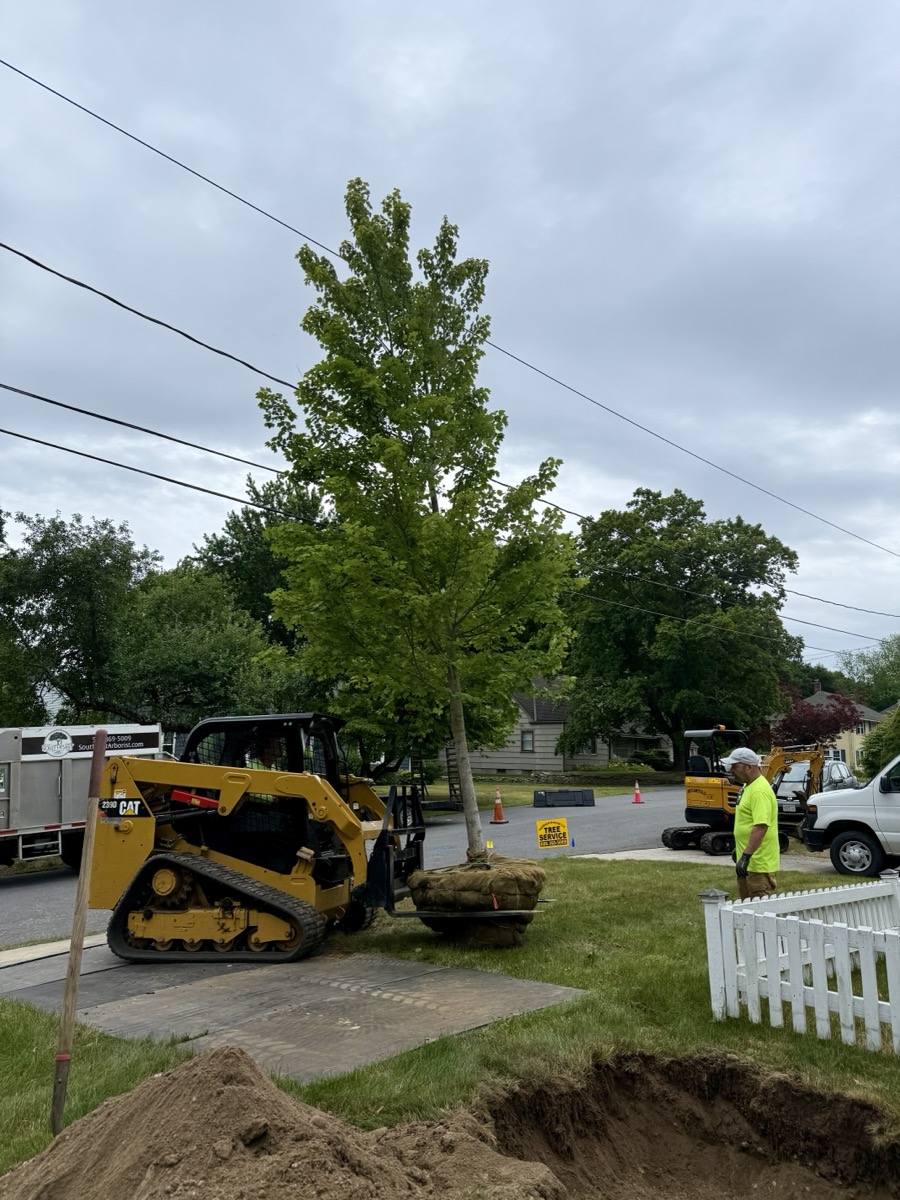
Step 2: Site preparation. Using Bobcat skid-steers with auger attachments, we dig holes three times wider than the root ball but only as deep—never deeper, to expose the root flare. In Scituate's sandy coastal soils, we amend with 20% compost for moisture retention without compacting. For tidal-prone areas like Scituate Harbor, we mound 8 inches and line with geotextile fabric to deter vole damage. Safety protocols include spotters for overhead lines near Greenbush roads and PPE per OSHA standards.
Step 3: Planting technique. Our crew positions the tree plumb, backfills in layers with native soil (no imported fill), and hand-tamps to eliminate air pockets—critical in wind-throw-prone Sand Hills. Root flare sits 2-4 inches above grade, preventing the rot common in Scituate's wet winters. We stake only if winds exceed 30 mph, using broad straps on Minot properties to avoid girdling. No volcano mulching: we apply 3-inch organic mulch rings extending to the drip line, keeping it 6 inches from the trunk.
Step 4: Initial pruning. Per ANSI A300 Part 1, we remove only broken or codominant leaders, reducing sail area by 20% for nor'easter resistance. This structural prune on young black cherry in The Glades ensures upright growth against prevailing winds.
Step 5: Watering and support. We install slow-drip irrigation lines for the first season, delivering 10-15 gallons weekly, adjusted for rainfall. In North Scituate's clay soils, we monitor for saturation; in Egypt's sands, we add mycorrhizal inoculants to boost drought tolerance.
Step 6: Post-planting care plan. You receive a customized guide: fertilize with slow-release nitrogen in spring (avoid summer to prevent tender growth), inspect for salt burn quarterly, and prune biennially. We schedule follow-ups at 3, 6, and 12 months, guaranteeing survival or free replacement.
Equipment includes Vermeer tree spades for ball-and-burlap moves (ideal for relocating natives post-storm) and laser levels for precise grading in flood zones like Humarock. Our two-man crews, all TCIA-trained, complete most jobs in 4-6 hours, minimizing yard disruption. For larger projects in Stockbridge, we deploy chipper trucks to process on-site debris into mulch.
This process yields 98% establishment rates in Scituate, far above DIY benchmarks. Homeowners in Marshfield or Hingham see the difference when we plant windbreaks—your property gains immediate protection. Trust Southeast Arborist's safety-first approach for tree planting Scituate MA that withstands Plymouth County's storms.
Common Tree Planting Projects in Scituate Neighborhoods
Tree planting projects in Scituate MA vary by neighborhood, reflecting hyper-local conditions from coastal fury to inland stability. In Scituate Harbor, post-2018 flood recovery dominates: we plant salt-tolerant pitch pine and Eastern red cedar windbreaks along Front Street, shielding homes from nor'easter surges. These 15-20 foot spaced rows stabilize Front Beach dunes, reducing overwash onto properties.
North Scituate's North River corridor sees hardwood restorations—red oak and black oak on elevated mounds to combat tidal root flooding. We've planted 50-tree groves here, enhancing older white pine stands and buffering against Route 3A washouts. Greenbush projects focus on crown-raised bayberry over flood-prone roads like Pond Street, improving sightlines while binding roadside sands.
Egypt's sloping lots demand erosion-control plantings: black cherry and sassafras root aggressively into thin soils, preventing slides during 10-inch rains. Minot's exposed bluffs get wind-resistant white pine hybrids, pruned low to mimic sheared profiles and block 40 mph gusts from the harbor mouth.
Humarock's dune systems feature bayberry clusters for natural stabilization—our installs use biodegradable stakes, allowing 80% establishment without irrigation. The Glades' brackish backlots suit Eastern red cedar screens, planted post-pine removal to deter ticks and restore privacy. Stockbridge properties along the river receive red oak understories, elevating root balls 12 inches against saturation.
Sand Hills' open expanses call for pitch pine barriers—deep-planted with gravel drains to fight wind-throw on 90% sand soils. Common across all: replacement after salt-damaged removals, like 2023 nor'easter losses in Harbor.
Southeast Arborist's ISA experts tailor each: soil probes confirm pH, wind gauges dictate spacing, and DEP permits handle coastal resource area rules. Your Minot windbreak might cost less than a Harbor flood barrier, but both follow identical ANSI protocols. Call 508-369-5009 for neighborhood-specific plans—our South Shore base ensures rapid response.
Tree Planting Costs in Scituate, MA
Tree planting costs in Scituate MA hinge on site specifics, delivering long-term value against storm risks. Base pricing starts at $500-$800 per tree for a 2-inch caliper pitch pine in accessible Greenbush yards—includes digging, planting, mulching, and initial stake. Coastal Minot or Humarock adds 20-30% ($600-$1,000) for elevated mounds and salt amendments against spray dieback.
Factors driving costs: Species matters—red oak or black oak ($700-$1,200) costs more than bayberry ($400-$600) due to larger root balls. Size scales up: 4-inch white pine hits $1,200-$1,800. Site challenges in Scituate Harbor (tidal access) or Sand Hills (sandy excavation) add $200-$400 for equipment like augers. Groups of 5+ trees drop per-unit to $400-$700 via efficiencies.
Labor from our ISA Certified crews runs $150/hour, capped by project scope—most finish in 4-8 hours. Permits for coastal zones (CZM rules) add $100-$300, which we handle. Travel from Plymouth/Cohasset is free within Plymouth County; nearby Hingham adds $100.
Value proposition: A $2,500 Minot windbreak (five Eastern red cedars) prevents $10,000+ in storm damage, per FEMA coastal models. Post-removal replacements in Egypt save replanting premiums, with our 1-year guarantee slashing risk. Compared to DIY ($300/tree but 50% failure), our 95% success yields ROI in 3 years via shade, erosion control, and 15% property value bumps (local appraisals).
Budget tips for you: Plant natives like sassafras ($450) over exotics; off-season (November) saves 15%; bulk for Stockbridge lots cuts 25%. No hidden fees—quotes detail everything. Southeast Arborist prioritizes affordability without skimping on ANSI standards or safety. Invest in tree planting Scituate MA that pays dividends—dial 508-369-5009 for your estimate.
When to Schedule Tree Planting in Scituate
Timing tree planting in Scituate MA maximizes root establishment before extremes hit. Optimal window: late October to mid-April, when dormant bare-root stock like red oak and black cherry transplants with 90% success. Avoid June-August heat (85°F+), which stresses white pine in sandy Sand Hills.
Fall planting (Sept-Nov) leverages 45 inches annual rain for natural watering; pitch pine sets roots before December freezes. Spring (March-May) suits bayberry in The Glades, post-frost but pre-summer drought. Urgency signs: post-nor'easter gaps in Scituate Harbor (schedule within 2 weeks to beat weeds); thinning canopies in Minot signaling wind vulnerability; erosion rills in Egypt slopes.
Delay if soils saturate (over 48 hours post-rain in North Scituate). Our ISA Arborists check via probe—plant only when workable. For Humarock dunes, post-Labor Day avoids tourist traffic. Call 508-369-5009 now for slots; our Plymouth base fills fast pre-storm season.
Frequently Asked Questions About Tree Planting in Scituate
What makes tree planting different in Scituate MA coastal conditions? Scituate's salt spray, tidal flooding, and winds demand salt-tolerant species like pitch pine over vulnerable white pine, plus elevated planting to expose root flares amid sandy, acidic soils.
How do I choose the right tree species for my Scituate neighborhood? For Harbor or Minot, pick Eastern red cedar; Greenbush or North Scituate suits red oak; Humarock dunes need bayberry. Our ISA Arborists assess wind, soil salinity, and flood risk during free consults.
Does Southeast Arborist guarantee tree planting survival in Scituate? Yes, 1-year guarantee with free replacement. Our 95% rate stems from ANSI A300 techniques, no volcano mulching, and post-care plans tailored to nor'easter exposure.
How deep should planting holes be in Scituate's sandy coastal soils? Only as deep as the root ball—expose flare 2-4 inches above grade to prevent rot in wet winters. Wider (3x) with compost amendments fights Sand Hills erosion.
Can I plant trees myself in flood-prone areas like Scituate Harbor? DIY risks 50% failure from poor drainage; pros like us use geotextiles and mounds for tidal zones, ensuring compliance with MA DEP coastal rules.
What post-planting care is needed for trees in Minot or Stockbridge? Water 10-15 gallons weekly first year, mulch 3 inches (trunk-free), prune structurally in year 2. Monitor salt burn; fertilize spring with low-nitrogen for black cherry.
How much does emergency tree planting cost after a Scituate storm? $600-$1,200 per tree, prioritized for rapid response. We've replanted dozens post-2018 in Harbor, stabilizing sites before next nor'easter.
Do you serve nearby towns like Cohasset or Marshfield from Scituate? Yes, our South Shore coverage includes them, but Scituate projects get same-day slots. Call 508-369-5009 for seamless service.
Tree Planting Throughout Scituate
Southeast Arborist provides tree planting throughout Scituate neighborhoods: Scituate Harbor windbreaks, North Scituate river restorations, Greenbush road buffers, Egypt slope stabilizers, Minot bluff protectors, Humarock dune binders, The Glades privacy screens, Stockbridge flood elevations, Sand Hills erosion controls. Our Plymouth/Cohasset base ensures quick access across 02066 and Plymouth County.
We extend to nearby Cohasset, Norwell, Marshfield, Hingham—your neighbors trust us for consistent results. ISA Certified, ANSI-compliant, safety-focused: that's our promise. Strengthen your property against coastal threats—call Southeast Arborist at 508-369-5009 today for tree planting Scituate MA.