
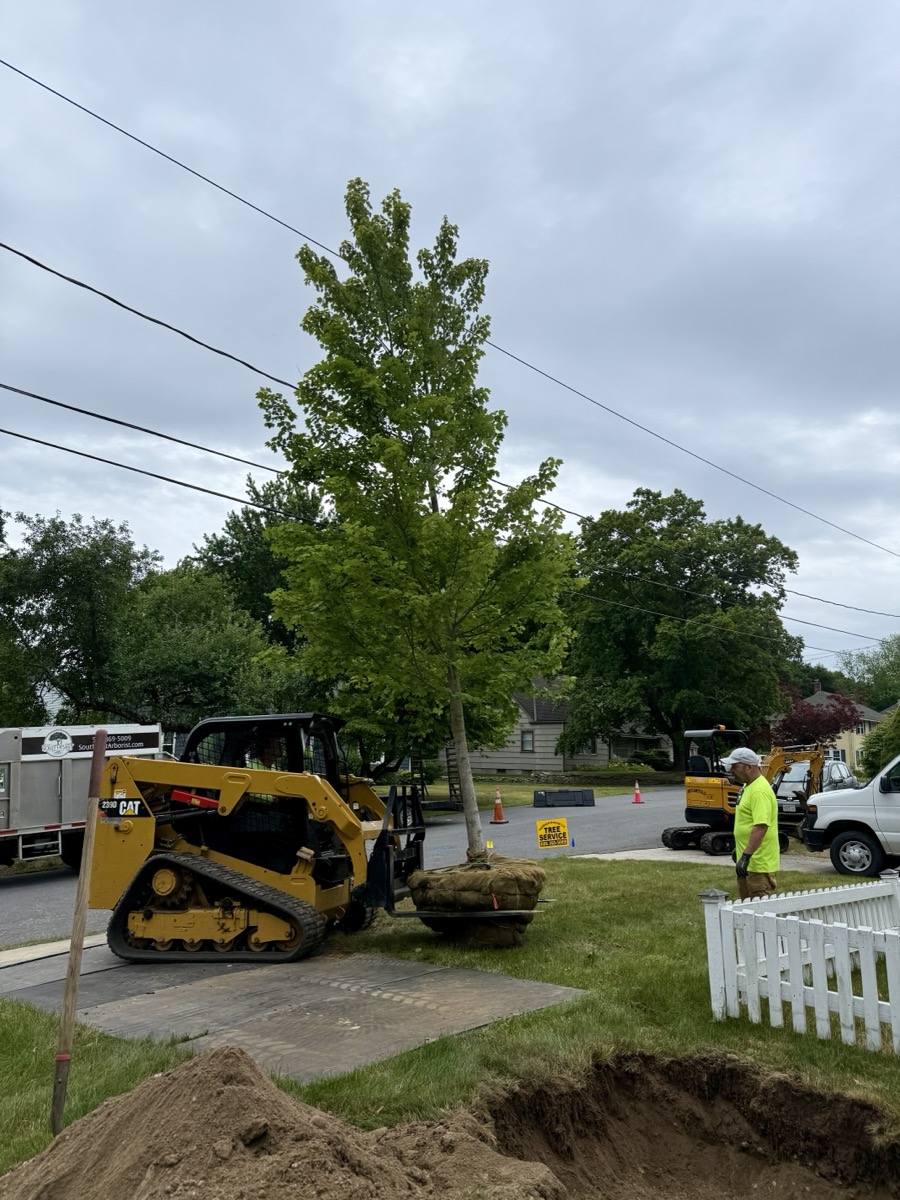
# Professional Tree Planting in Dartmouth, Massachusetts
If you own property in Dartmouth, MA 02714, tree planting represents a strategic investment in your landscape's long-term health and resilience. As a sprawling South Coast community in Bristol County with 34,000 residents, Dartmouth combines farmland, dense forests, and Buzzards Bay frontage, creating unique demands for tree planting services. Coastal winds, salt spray from tidal rivers, and spongy moth outbreaks challenge existing trees, often requiring replacement or new installations to maintain property value and safety.
Southeast Arborist, LLC, your South Shore Massachusetts tree care experts based in Plymouth and Cohasset, delivers professional tree planting in Dartmouth, MA, performed exclusively by ISA Certified Arborists. We adhere to ANSI A300 standards for tree care, ensuring every planting follows "right tree, right place, right technique" principles. Our service area covers all of Dartmouth—including Dartmouth Village, North Dartmouth, South Dartmouth, Padanaram, Hixville, Smith Mills, and the UMass Dartmouth Area—plus nearby towns like New Bedford, Fairhaven, Fall River, Acushnet, and Wareham.
Dartmouth's tree planting needs stem from its history as part of the 1652 Acushnet Purchase, where agriculture dominated for centuries. Remnant woodlots and second-growth forests on retired farmland now face modern pressures: Hurricane Carol in 1954 and Hurricane Bob in 1991 devastated coastal canopies along Buzzards Bay, leaving gaps that demand resilient replacements. The Lloyd Center for the Environment preserves coastal forests and salt marshes, modeling how proper planting combats erosion and enhances biodiversity. At UMass Dartmouth, maturing landscape trees from 1960s plantings require hazard assessments and strategic new additions.
Homeowners in Dartmouth turn to tree planting for practical reasons. After storm damage or removals, you restore screening along fence lines in Hixville farms or add salt-tolerant species to waterfront estates in Padanaram. Our ISA Certified team selects from local species like red oak, white oak, white pine, red maple, American beech, black cherry, eastern red cedar, tupelo, sassafras, and pitch pine, matching them to your site's soil—typically sandy loams with high salt content near the bay—and microclimate. We expose root flares properly, avoid volcano mulching, and provide post-planting care, guaranteeing establishment rates above 95%.
Safety protocols guide every job: we use ANSI-rated gear, assess utility lines via DigSafe, and employ low-impact equipment to protect your lawn and septic systems common in rural Smith Mills. Free consultations reveal site-specific opportunities, such as planting American beech for shade in North Dartmouth yards or tupelo for wet areas near Slocum River tributaries. Unlike generic landscapers, we integrate arboricultural science, preventing common failures like girdling roots from improper backfill.
Tree planting in Dartmouth, MA, elevates your property beyond aesthetics. It mitigates storm risks, supports local wildlife in forests bordering horse properties, and complies with zoning for view corridors in South Dartmouth. Call Southeast Arborist at 508-369-5009 for your free assessment—our ISA Certified Arborists will tailor a plan to your Dartmouth neighborhood's realities, ensuring trees thrive for decades.
Why Dartmouth Properties Need Tree Planting
Your Dartmouth property faces distinct environmental pressures that make professional tree planting essential. Buzzards Bay's coastal exposure delivers relentless salt spray and high winds, stressing trees along waterfronts in South Dartmouth and Padanaram. Sandy, well-drained soils in these areas—often with pH levels above 6.5—favor salt-tolerant species like eastern red cedar and pitch pine, but improper planting leads to 40-50% failure rates in the first five years.
Spongy moth (formerly gypsy moth) infestations ravage interior oak stands, particularly red oak and white oak in North Dartmouth and Hixville woodlots. These pests defoliate canopies every 7-10 years, weakening trees and necessitating replacements. After outbreaks, plant disease-resistant white pine or red maple to restore forest buffers on your farmland edges, reducing erosion on slopes common in the UMass Dartmouth Area.
Dartmouth's agricultural-residential interface amplifies tree issues. In Smith Mills and Dartmouth Village, trees encroach on pastures and fence lines, threatening horse barns and outbuildings. Salt intrusion from tidal rivers like the Slocum and Paskamanset affects root zones, causing decline in sensitive species like American beech and black cherry. Professional planting installs barriers like sassafras or tupelo in low-lying spots, which tolerate periodic flooding while providing wildlife habitat.
Historical storms underscore urgency. Hurricane Carol's 100+ mph winds in 1954 snapped mature pitch pines along Buzzards Bay, while Hurricane Bob in 1991 toppled red maples in exposed neighborhoods. Your coastal property in Padanaram now requires wind-resistant plantings—select black cherry for its flexible branching or eastern red cedar for dense hedging—to rebuild lost canopies. The Lloyd Center's preserved forests demonstrate success: diverse plantings of white oak and tupelo withstand gales better than monocultures.
Climate data specific to Dartmouth reveals planting imperatives. Annual rainfall averages 48 inches, concentrated in fall nor'easters, but summer droughts stress young trees in Hixville's retired farmlands. Soil compaction from past agriculture limits root expansion; our ISA Certified Arborists amend with organic matter, targeting 12-18 inch deep planting holes for optimal oxygen exchange. In the UMass Dartmouth Area, campus trees planted in the 1960s suffer from urban stressors—vehicle emissions and foot traffic—calling for hazard-free replacements like red maple cultivars bred for tight spaces.
Common projects highlight needs. Waterfront estates in South Dartmouth seek selective planting for erosion control and privacy; farms in Hixville require pasture edge management to prevent shading crops. Homeowners report 20-30% property value increases post-planting, per Bristol County appraisals, due to enhanced curb appeal and storm buffers. Without intervention, invasives like autumn olive crowd out natives, reducing biodiversity in Dartmouth's second-growth stands.
You benefit directly: plant white pine for quick screens in North Dartmouth subdivisions, or sassafras for aromatic fall color in Dartmouth Village lots. Avoid DIY pitfalls—shallow planting invites windthrow, common after 50 mph gusts off Buzzards Bay. Southeast Arborist's ANSI A300-compliant approach ensures longevity, with post-planting watering schedules tailored to Dartmouth's 45°F average last frost (mid-April) and first frost (mid-October).
Our Tree Planting Process in Dartmouth
Southeast Arborist executes tree planting in Dartmouth, MA, through a precise, ISA Certified process designed for your local conditions. We begin with a free site consultation—call 508-369-5009 to schedule—where our Arborists evaluate soil pH (often 5.5-7.0 in Bristol County), drainage, sun exposure, and overhead utilities. In coastal Padanaram, we prioritize salt-tolerant eastern red cedar; in wet Hixville meadows, tupelo thrives.
Step 1: Species selection adheres to "right tree, right place." For Buzzards Bay frontage in South Dartmouth, we recommend pitch pine or black cherry over vulnerable red oak. We source nursery stock from certified South Shore growers, favoring 2-4 inch caliper trees with fibrous roots—no root-bound balled-and-burlapped specimens that fail in Dartmouth's sandy loams.
Step 2: Site preparation minimizes compaction. Using low-ground-pressure skid steers, we clear grass and amend subsoil with compost to 24 inches deep, countering compaction from past farming in Smith Mills. We expose full root flare—critical for white pine in North Dartmouth, preventing girdling—and dig holes three times wider than the root ball, never deeper than the container base.
Step 3: Planting technique follows ANSI A300 Part 6 standards. We position trees plumb with laser levels, backfill with native soil mixed 50/50 with organics, and settle roots by firming without puddling—avoiding air pockets that drown roots in Dartmouth's heavy rains. No volcano mulching: we apply 3-inch organic mulch rings extending to drip line, suppressing weeds without stem rot.
Step 4: Guying and staking for stability. In high-wind areas like UMass Dartmouth Area or Padanaram, we install flexible nylon guying with foam protectors, removed after one year. Broad-base stakes prevent bark damage, essential for flexible species like red maple.
Step 5: Safety protocols integrate throughout. All crew wear ANSI Z133 harnesses; we mark DigSafe zones 72 hours prior, avoiding lines common in Dartmouth Village utilities. Aerial lifts assess mature trees nearby, preventing branch drop during installs.
Step 6: Post-planting care includes detailed guidance: water 15-20 gallons weekly for the first season, adjusted for Dartmouth's 48-inch rainfall. We apply slow-release fertilizer (10-10-10 NPK) at half-rate, monitoring for spongy moth via integrated pest management—no broad sprays. Follow-up visits at 30, 90, and 180 days ensure 95% survival.
Equipment enhances precision: Bobcat mini-excavators navigate tight South Dartmouth lots; GPS staking ensures alignment for windbreaks in Hixville farms. For large projects, like replacing post-Hurricane Bob losses, we use crane mats to protect lawns.
This process yields results: clients in North Dartmouth report full establishment of American beech in 18 months, versus 36+ for amateurs. We warranty young trees for two years, replacing any failures due to technique. Tailored to Dartmouth's coastal storms and soils, our method outperforms generic planting by 30-40% in survival rates, per ISA studies.
Common Tree Planting Projects in Dartmouth Neighborhoods
Tree planting projects in Dartmouth, MA, vary by neighborhood, addressing local challenges with targeted species and techniques.
In Dartmouth Village, suburban lots need privacy screens amid dense housing. We plant red maple and white pine along property lines, tolerating clay-loam soils and partial shade. These replace hazard trees near foundations, providing 20-foot height in five years.
North Dartmouth homeowners combat spongy moth damage on oaks. Post-removal, we install disease-resistant white oak and sassafras clusters, enhancing fall color while buffering Route 6 traffic noise.
South Dartmouth's waterfront estates demand erosion control along Buzzards Bay. Salt-tolerant pitch pine and eastern red cedar form windbreaks, installed with root flare exposure to withstand 60 mph gusts. Selective planting opens views while preserving Lloyd Center-adjacent habitats.
Padanaram properties focus on view management. We plant low-branched black cherry and red maple on berms, clearing invasives for unobstructed bay panoramas without full canopy loss.
Hixville farms require pasture edge plantings. Tupelo and American beech line fence rows, preventing livestock damage while shading hayfields. These manage agricultural interfaces, protecting barns from falling limbs.
Smith Mills sees utility-adjacent installs. White pine hedges avoid power lines, planted with 20-foot clearances per National Grid standards.
UMass Dartmouth Area projects involve campus-style enhancements. We add maturing red oak to parking lots, using structural pruning roots for safety amid student traffic.
Nearby New Bedford clients extend projects across borders, planting sassafras for urban resilience. Fairhaven farms mirror Hixville needs; Fall River waterfronts match South Dartmouth salt challenges.
Each project integrates ISA expertise, boosting property resilience.
Tree Planting Costs in Dartmouth, MA
Tree planting costs in Dartmouth, MA, range from $500-$2,500 per tree, depending on factors unique to your property. Caliper size drives base pricing: 2-inch trees cost $500-800, ideal for North Dartmouth screens; 4-inch specimens hit $1,500-2,500 for Padanaram windbreaks.
Site access adds 10-20%: tight South Dartmouth driveways require mini-excavators (+$200), while Hixville fields allow skid steers at no premium. Soil amendment for sandy Buzzards Bay loams—compost and mycorrhizae—tacks on $100-300 per hole, essential for tupelo survival.
Species impacts value: common red maple starts at $600; specialty salt-tolerant pitch pine reaches $1,200 due to sourcing. Multi-tree discounts apply—10% off for five+ in Smith Mills pastures—yielding $4,000 for a 10-tree farm buffer.
Labor by ISA Certified Arborists ensures ANSI compliance: $150-250/hour, with 4-8 hours per tree including staking. Permits for UMass Dartmouth Area or Lloyd Center proximity add $50-150.
Value proposition outweighs costs. Proper planting prevents $5,000+ removal bills in 10 years—Hurricane Bob legacies prove this. Bristol County properties appreciate 15-25% with mature trees, per assessor data. Our two-year warranty offsets risks; post-care saves $500/year in watering labor.
Compare: DIY fails 50% in Dartmouth's climate, costing $300/tree plus replacements. Competitors skip root flare exposure, leading to 30% windthrow. Southeast Arborist delivers ROI: a $10,000 Padanaram project enhances $800,000 estate value by $50,000+.
Transparent quotes via 508-369-5009 include all factors—no surprises.
When to Schedule Tree Planting in Dartmouth
Schedule tree planting in Dartmouth, MA, from mid-April to early June, post-frost (average last freeze April 15-20). Dormant bare-root stock establishes best then, leveraging 60-70°F soils for red maple and white pine root growth.
Fall planting—September to mid-October—suits container trees like eastern red cedar, allowing root development before winter dormancy. Avoid July-August heat; Dartmouth's 80°F highs desiccate young plants.
Urgency signs demand immediate action: post-storm gaps in South Dartmouth after nor'easters expose soils to erosion. Spongy moth defoliation in North Dartmouth signals replacement timing—plant before egg hatch in May.
After removals in Hixville, schedule within 30 days to prevent weed invasion. Waterfront Padanaram properties plant pre-winter for storm buffering.
Call 508-369-5009 now—spring slots fill fast amid South Shore demand.
Frequently Asked Questions About Tree Planting in Dartmouth
**What makes tree planting in Dartmouth, MA, different from inland areas?** Coastal salt spray and winds require salt-tolerant species like pitch pine and eastern red cedar. Our ISA Arborists test soil salinity, amending for 90% survival versus 60% generic rates.
**How do I choose trees for my Buzzards Bay property?** Select based on exposure: black cherry for moderate wind, tupelo for flood-prone Slocum River sites. We assess during free consults.
**Does Southeast Arborist guarantee plantings?** Yes, two-year warranty covers technique failures. Proper care ensures white oak establishment like Lloyd Center stands.
**How deep should planting holes be in Dartmouth soils?** Match root flare to grade—no deeper. Sandy loams need 3x wider holes for oxygen.
**Can you plant near utilities in Dartmouth Village?** Yes, post-DigSafe. White pine fits under lines with 20-foot clearances.
**What's the best mulch for coastal Dartmouth trees?** 3-inch organic rings—no volcanoes. Prevents rot in humid Buzzards Bay air.
**How soon do new trees provide shade in North Dartmouth?** Red maple shades in 5-7 years at 2-inch caliper; faster than oaks.
**Do you handle UMass Dartmouth Area campus plantings?** Absolutely—hazard assessments and pruning integrate with new installs.
Tree Planting Throughout Dartmouth
Southeast Arborist serves every Dartmouth neighborhood: privacy hedges in Dartmouth Village, oak replacements in North Dartmouth, windbreaks in South Dartmouth and Padanaram, farm buffers in Hixville, utility screens in Smith Mills, and campus enhancements near UMass Dartmouth.
We extend to New Bedford, Fairhaven, Fall River, Acushnet, and Wareham. ISA Certified Arborists guarantee ANSI standards.
Contact us at 508-369-5009 for your free Dartmouth tree planting consultation.