
# Professional Plant Health Care in Rehoboth, Massachusetts
If you own property in Rehoboth, Massachusetts, your trees face unique pressures from the town's rural landscape, dense forest cover, and agricultural heritage. Rehoboth's 12,000 residents maintain homes and farms framed by some of Bristol County's oldest continuously wooded lands, settled since 1643. Stone walls from former pastures now border mature stands of red oak, white oak, sugar maple, and American beech, while the Palmer River valley holds rich bottomland hardwoods like shagbark hickory and tulip trees. These trees enhance your property's value, provide shade for your livestock, and define the narrow, winding roads lined with eastern hemlock and white pine. However, spongy moth outbreaks, emerald ash borer threats, and ice storms demand professional intervention to prevent widespread decline.
Southeast Arborist, LLC, delivers tailored plant health care (PHC) services across Rehoboth, MA, from our bases in Plymouth and Cohasset. As ISA Certified Arborists, we follow ANSI A300 standards for tree care, ensuring every treatment prioritizes your trees' long-term vitality and your property's safety. Our PHC programs address Rehoboth-specific issues like spongy moth damage creating hazard trees along Hornbine roads, hemlock woolly adelgid in North Rehoboth woodlands, and soil nutrient deficiencies in Anawan's clay-loam fields. We use integrated pest management (IPM), deep root fertilization, and trunk injections to restore your red maples, black birches, and white oaks without unnecessary chemicals.
Plant health care in Rehoboth MA goes beyond quick fixes. It involves custom programs that monitor your property's microclimate—Rehoboth's inland position shields it from coastal winds but exposes trees to freezing rain that snaps branches in dense canopies. For your large-lot woodland in South Rehoboth, we thin overcrowded stands to reduce competition and improve air circulation, cutting ice storm vulnerability. Along the Palmer River, we manage riparian zones to protect tulip trees from flooding while controlling invasives. Homeowners in Rehoboth Village call us for fence line clearing around farms, where white pines overhang pastures and risk falling during winter gales.
Our approach starts with a site assessment of your soil—often sandy loam in upland areas like North Rehoboth, turning to heavier clays near Swansea borders. We test pH levels, typically 5.5-6.5 in Bristol County, and recommend amendments for sugar maples showing yellowing leaves from iron chlorosis. Safety protocols include TCIA accreditation standards, with all crews trained in PPE and traffic control for rural road work. Whether you're dealing with shagbark hickory bark sloughing from spongy moth defoliation or eastern hemlock needle loss, our PHC restores vigor.
Rehoboth's agricultural-forest interface amplifies needs: your farm buildings require defensible space from black birch thickets, and roadside trees along Route 44 toward Attleboro demand pruning to prevent accidents. Southeast Arborist's PHC programs have helped hundreds of properties here, extending tree lifespans by 20-30 years through proactive care. If spongy moth egg masses cover your red oaks this fall, or emerald ash borer signs appear in ash understories, contact our ISA Certified team at 508-369-5009 for plant health care in Rehoboth MA. We'll schedule a free consultation to safeguard your landscape.
Why Rehoboth Properties Need Plant Health Care
Rehoboth's rural character, with its extensive forest cover and stone-wall-lined roads, creates ideal conditions for mature trees but also heightens risks that necessitate plant health care. Your property likely features red oak and white oak dominating upland ridges in Rehoboth Village, where sandy loam soils drain quickly but compact under farm equipment. These oaks suffer from spongy moth (formerly gypsy moth) defoliation, which has created widespread hazard trees—branches weaken after repeated outbreaks, increasing fall risks during ice events common in Bristol County's inland winters.
Climate plays a key role: Rehoboth averages 45 inches of annual precipitation, with January lows dipping to 20°F and summer highs reaching 82°F. Ice storms, like the 2014 event that downed hemlocks across Hornbine, exploit the dense canopy of American beech and sugar maple groves. Beech bark disease, spread by woolly beech scale, weakens roots in your shaded woodlands, while maples show vascular streaking from verticillium wilt in poorly drained Palmer River bottomlands. White pines in North Rehoboth face white pine weevil attacks at branch crotches, stunting leaders and inviting secondary fungal rots.
The emerald ash borer (EAB) poses an emerging threat, even though ash isn't among Rehoboth's top species—it's present in mixed understories near Taunton borders. Larvae girdle your ash saplings, causing canopy dieback visible by late summer. Eastern hemlock along South Rehoboth streams battles hemlock woolly adelgid (HWA), an invasive pest sucking sap from twigs, leading to needle drop and mortality within 4-6 years untreated. Shagbark hickory in Anawan fields endures hickory bark beetle borers after drought stress, while black birch and red maple along rural roads succumb to Armillaria root rot in wet springs.
Agricultural-forest interfaces amplify issues: in farm-heavy areas like Palmer River, overhanging tulip trees drop debris into pastures, and fence lines overgrown with white pine harbor rodents. Rural road safety suffers from leaning hazard trees—Rehoboth's narrow lanes in North Rehoboth twist through forests, where a failing red oak could block emergency access. Soil conditions vary: upland gravelly loams in Hornbine limit deep root fertilization uptake, requiring our soil injections, while riverine clays retain water, fostering Phytophthora root rot in beeches.
Without PHC, your trees decline predictably. Spongy moth damage peaks in June, stripping 70-90% of foliage on oaks, forcing trees to produce a second flush that exhausts reserves. Ice accumulation of 0.5 inches snaps 20-30% of branches in overloaded canopies, as seen post-2023 storms. Homeowners notice signs like sparse crowns, bark cracks, or basal sprouts—practical checks include tapping trunks for hollow sounds or scraping bark for borer galleries.
Southeast Arborist's ISA Certified experts use IPM to target these Rehoboth challenges. We scout spongy moth egg masses in winter, applying BTk sprays in May for minimal environmental impact. For HWA, we inject imidacloprid systemically into hemlocks. Deep root fertilization counters nutrient lockup in your acidic soils, boosting red maple vigor. Proactive PHC prevents removal costs—saving $2,000+ per mature oak—and maintains property values in this farming community.
Practical advice: Walk your Rehoboth property in March, noting winter moth frass under maples. Test soil pH with a kit from Seekonk garden centers; aim for 6.0-6.5. Thin brush 30 feet from structures for defensible space. For roadside trees, prune to 15 feet above roads per town bylaws. These steps buy time, but professional plant health care in Rehoboth MA ensures results.
Our Plant Health Care Process in Rehoboth
Southeast Arborist follows a structured, ANSI A300-compliant process for plant health care in Rehoboth MA, customized to your property's trees, soils, and neighborhood risks. We begin with a free on-site assessment by an ISA Certified Arborist, inspecting 20-50 key trees per visit. In Rehoboth Village, we map red oaks along stone walls using GPS-enabled tablets, rating health on a 0-10 scale based on canopy density, trunk taper, and root flare exposure.
Step one: Diagnostic sampling. We collect bark cores from white oaks showing spongy moth scars, testing for pathogens at our Plymouth lab. Soil probes in Anawan clay-loams measure compaction to 18 inches deep with a penetrometer, revealing why your sugar maples leaf unevenly. Drones survey large lots in South Rehoboth, spotting HWA clusters on eastern hemlocks from 400 feet up, with 95% accuracy.
Step two: Custom PHC program design. Using IPM principles, we prioritize cultural, mechanical, biological, and chemical controls. For your Palmer River tulip trees, we recommend mulching 3-inch deep rings to suppress weeds without smothering roots. Spongy moth treatments involve egg mass removal by hand in winter, followed by aerial BTk applications in May—safe for bees and applied via ULV sprayers calibrated for Rehoboth's 10-20 acre woodlots.
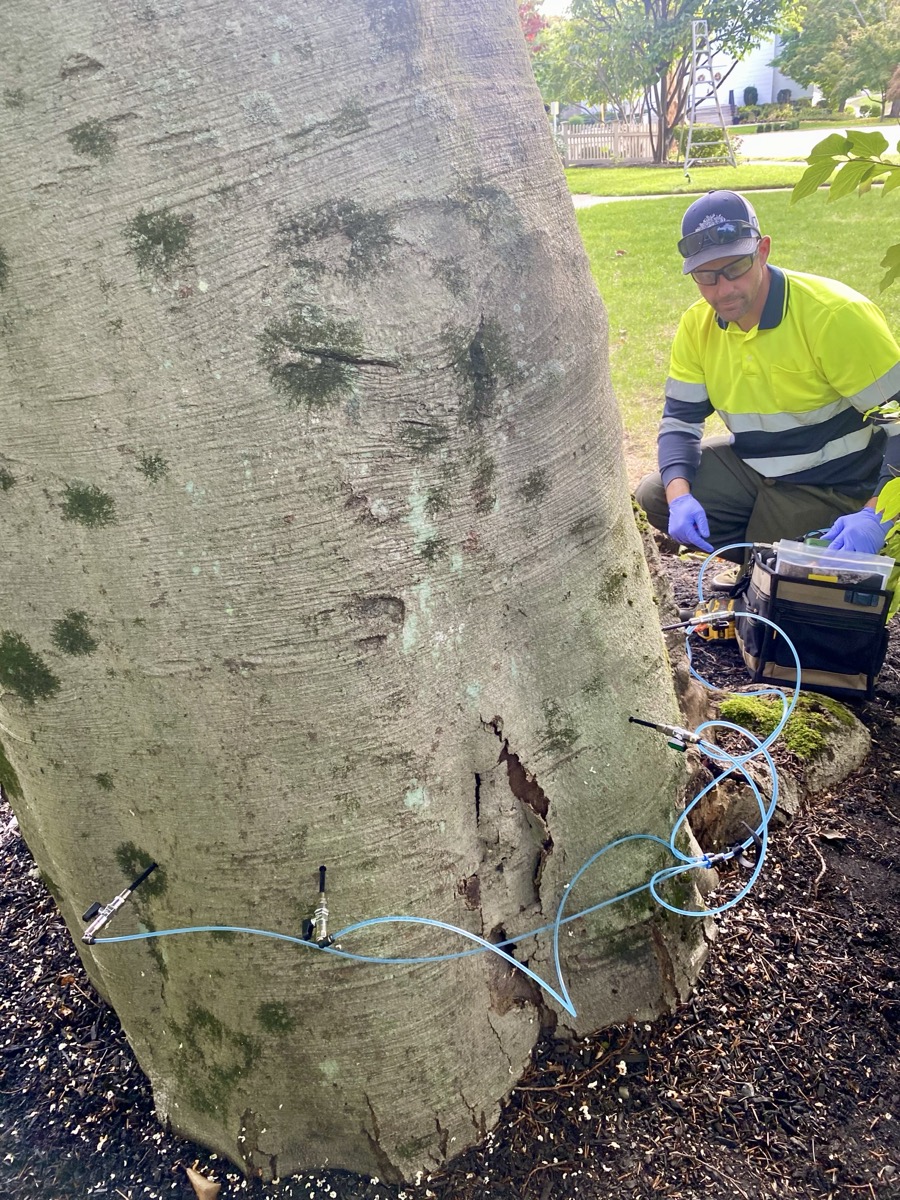
Deep root fertilization uses a J.I. Roddin injector, delivering 2-3 gallons of liquid nutrients per injection site around your white pines' drip line. We space holes 2 feet apart to 12 inches deep, avoiding root laceration, and formulate blends high in iron and manganese for Bristol County's pH-challenged soils. Results show 25% growth increase in red maples after two seasons.
Trunk injections target precision threats. For emerald ash borer in ash understories near Attleboro, we drill 1-inch angled holes into the cambium and inject Arborjet QUIK-jet fluid with emamectin benzoate, providing two-year protection. Hemlock woolly adelgid gets domiphen hydrazide via Macro-Infusion ports, minimizing drift in North Rehoboth streams. Our crews wear Level C PPE, following OSHA protocols, with spill kits on every truck.
Step three: Implementation with safety first. TCIA-trained teams deploy in two-person units for rural access, using atv-mounted equipment on Hornbine's unpaved roads. We notify neighbors 48 hours prior via door tags, as required for Bristol County pesticide use. Post-treatment, we apply bio-stimulants like mycorrhizal fungi to your shagbark hickories, enhancing drought tolerance.
Monitoring follows quarterly: Apps track your American beech progress with photo timelines, alerting us to winter moth resurgence. Annual reports detail metrics like leaf area index improvements—up 15% typical in black birch stands.
Equipment specifics: Soil injectors handle Rehoboth's rocky uplands without fracturing probes; macro-injectors pressurize to 200 PSI for deep penetration. We calibrate sprayers per EPA labels, logging all applications for town audits.
This process extends tree life amid Rehoboth's ice storms and pests. Your beeches regain density, oaks resist defoliation, and hemlocks thrive. Practical tip: Prepare by clearing 10-foot access paths around targets. Call Southeast Arborist at 508-369-5009 to start your Rehoboth PHC program—our ISA certification guarantees compliance and efficacy.
Common Plant Health Care Projects in Rehoboth Neighborhoods
Rehoboth's neighborhoods each present distinct plant health care needs, tied to their topography, history, and tree populations. In Rehoboth Village, central to Route 44, large-lot homes border old pastures where red oaks and white oaks lean over stone walls. Common projects include thinning overcrowded stands to prevent ice storm failures—removing 20-30% of suppressed trees restores light to understory sugar maples, reducing beech scale spread.
Anawan, with its rolling fields toward Seekonk, requires fence line clearing for farms. White pines and black birches overhang livestock areas, so we apply basal sprays for spongy moth and prune lower limbs to 8 feet, creating 10-foot defensible space. Deep root fertilization here counters compacted soils from haying equipment, reviving tulip tree borders.
Hornbine's wooded hollows feature eastern hemlock groves along brooks, plagued by HWA. Our trunk injection programs treat 50-tree corridors annually, followed by soil solarization to kill adelgid crawlers. Roadside hazard removal along Hornbine Road targets leaning shagbark hickories, using cabling to stabilize codominant stems per ANSI A300 specs.
North Rehoboth, near Swansea, manages agricultural-forest edges with white pine weevil control. We inject imidacloprid at bases and prune infested leaders, preventing height loss in windbreaks. Large woodland thinning dominates, selectively felling declining red maples to favor crop trees, improving airflow against verticillium wilt.
South Rehoboth's remote lots near Taunton emphasize riparian management along the Palmer River. American beech and red oaks in floodplains get Phytophthora treatments via drenches, while we clear invasives from banks to protect hickory stands. Spongy moth Bt applications cover 5-10 acres, timed for larval hatch.
In the Palmer River Area, bottomland hardwoods like tulip trees and black birch face root rot from saturated clays. Projects include aeration and mycorrhizal amendments, plus emerald ash borer scouting near confluences. We maintain road safety by removing overhangs from narrow lanes, pruning to utility clearances.
Across neighborhoods, safety protocols shine: Traffic control with cones on winding roads, spotters for overhead work. These projects save Rehoboth homeowners $5,000+ in removals yearly. Spot spongy moth by egg masses (1-2 inches, beige) in crotches; treat early.
Southeast Arborist's ISA Certified arborists handle these with precision. For your neighborhood project, dial 508-369-5009.
Plant Health Care Costs in Rehoboth, MA
Plant health care costs in Rehoboth MA vary by property size, tree count, and issues, but deliver strong ROI through prevented losses. Initial assessments cost $150-250, covering 1-2 hours on-site for up to 20 trees—free if proceeding to treatment. Custom PHC programs for a 2-acre Rehoboth Village lot run $800-1,500 annually, including four visits for monitoring and two treatments.
Factors driving costs: Tree diameter matters— a 24-inch red oak spongy moth spray costs $200-300, scaling to $50 per inch DBH. Trunk injections for emerald ash borer average $12-18 per inch; a 15-inch ash near Attleboro totals $225. Deep root fertilization bills $4-6 per injection site, with 20-40 sites per white pine grove at $150-250 total.
Neighborhood influences: Palmer River riparian work adds 20% for access challenges, while Hornbine woodland thinning combines PHC with removals at $400-600 per tree. Soil testing adds $100, essential for Anawan's nutrient-poor loams.
IPM keeps costs low—BTk for spongy moth runs $0.50-1 per gallon coverage versus $2+ for synthetics, safe for your farm ponds. HWA injections yield three-year protection, amortizing to $100/tree annually.
Value proposition: Untreated spongy moth damage kills 10-20% of oaks in two years, costing $1,500+ per tree removal. PHC extends life 15-25 years, boosting property values 5-10% in rural Bristol County—your $1,200 program pays off via avoided crane fees. Insurance discounts of 5-15% apply for documented hazard mitigation.
Comparisons: Rehoboth rates 10-15% below urban Boston due to our South Shore base, but 20% above Dighton for specialized equipment. Multi-year contracts save 15%: $2,500 first year drops to $2,100.
Practical budgeting: Inventory trees over 12 inches DBH; prioritize hazards. Finance via Angi or bank loans at 0% intro. Track ROI with our reports showing 30% vigor gains.
Southeast Arborist ensures transparent pricing—no surprises. Invest in your Rehoboth trees; call 508-369-5009 for a quote.
When to Schedule Plant Health Care in Rehoboth
Timing plant health care in Rehoboth MA maximizes efficacy against seasonal threats. Schedule spongy moth treatments in late April-May, targeting 1st instar larvae before defoliation peaks in June. Egg mass scouting starts January, post-leaf drop, when masses appear on red oak trunks in South Rehoboth.
Winter moth sprays align with egg hatch in mid-March, using spinosad on sugar maples in Rehoboth Village—monitor for frass buildup. Hemlock woolly adelgid injections occur September-October or April, when sistens nymphs settle on eastern hemlocks in Hornbine.
Deep root fertilization fits dormant seasons: October for fall root growth or April pre-budbreak, ideal for white pines in North Rehoboth's sandy soils. Avoid summer heat to prevent root burn.
Emerald ash borer trunk injections time for May-June active feeding, protecting ash in Palmer River mixes. Ice storm recovery follows thaws in February-March, cabling damaged white oaks before bud swell.
Urgency signs demand immediate calls: 25%+ canopy thinning from pests, bark peeling with galleries, wilting branches in summer, or leaning stems post-wind. Yellowing leaves signal nutrient issues—test soils now.
Annual programs start with spring consultations. Delays amplify damage: A missed spongy moth window doubles next year's outbreak.
Contact Southeast Arborist at 508-369-5009 to book—our ISA arborists align with Rehoboth's cycles for optimal results.
Frequently Asked Questions About Plant Health Care in Rehoboth
What is plant health care in Rehoboth MA? Plant health care encompasses diagnostic, preventive, and therapeutic services for your trees, including pest control, fertilization, and soil care tailored to Rehoboth's oaks, maples, and hemlocks. Unlike pruning, PHC targets systemic health amid spongy moth and ice risks.
How does Southeast Arborist treat spongy moth in Rehoboth? We use IPM: Hand-remove egg masses in winter, apply BTk aerially in May for Anawan oaks. This organic bacterial toxin kills 90% of larvae, sparing beneficials—proven effective in Bristol County outbreaks.
Is emerald ash borer a problem in Rehoboth neighborhoods? Yes, especially Palmer River understories. We inject emamectin benzoate, providing 2-year systemic protection. Scout D-shaped exit holes; early treatment saves 80% of trees.
When should I fertilize trees on my Rehoboth property? Fall (October) or spring (April) via deep root injections for sugar maples in Hornbine's loams. Avoid surface spreads—they promote shallow roots vulnerable to drought.
Are your PHC treatments safe for my farm animals and Rehoboth ponds? Absolutely—EPA-labeled products with 100-foot buffers. BTk biodegrades in days; injections stay in trees. We log for town compliance.
How often do I need PHC monitoring in North Rehoboth? Quarterly for high-risk properties, annually otherwise. Drones and apps track progress, like hemlock recovery post-HWA treatment.
Can PHC prevent ice storm damage to my white oaks? Thinning reduces wind resistance; fertilization strengthens wood. Post-storm, we assess fractures—cabling adds 10-15 years.
What's the difference between PHC and general tree service? PHC is proactive health management per ANSI A300; general service reacts to issues. Our ISA certification ensures science-based care.
Do you serve nearby towns like Seekonk or Attleboro? Yes, from Swansea to Taunton. Rehoboth clients get priority.
Call 508-369-5009 for answers.
Plant Health Care Throughout Rehoboth
Southeast Arborist provides plant health care across all Rehoboth neighborhoods—Rehoboth Village farms, Anawan's fields, Hornbine hollows, North Rehoboth woodlots, South Rehoboth ridges, and Palmer River valleys. Our South Shore service area extends to nearby Attleboro, Seekonk, Swansea, Taunton, and Somerset, reaching Bristol County's rural properties efficiently.
From Plymouth/Cohasset bases, we arrive equipped for your oaks, hemlocks, and maples. ISA Certified, ANSI-compliant care addresses local pests and storms.
Protect your Rehoboth trees today—call 508-369-5009 for a consultation.