
# Professional Plant Health Care in Mashpee, Massachusetts
Homeowners in Mashpee, Massachusetts, face unique challenges keeping trees and shrubs healthy amid sandy soils, salt-laden coastal winds, and dense pine barrens prone to pests and fire. If your property in Mashpee Commons, New Seabury, or along the Mashpee River corridor shows signs of stressed pitch pines dropping needles or scrub oaks defoliated by spongy moth, professional plant health care delivers targeted solutions. Southeast Arborist, LLC, your South Shore Massachusetts tree care experts based in Plymouth and Cohasset, specializes in plant health care Mashpee MA properties demand.
As ISA Certified Arborists, we follow ANSI A300 standards for every treatment, ensuring science-based pest management, disease control, and soil enhancement that protect your landscape investment. Our plant health care programs address Mashpee's specific issues: pine bark beetles infesting drought-stressed pitch pines, hemlock woolly adelgid threatening Atlantic white cedar stands, and emerald ash borer risks in nearby imports. We use integrated pest management (IPM) to minimize chemicals, prioritizing deep root fertilization and trunk injections for long-term vitality.
Picture your waterfront lot at Popponesset or South Cape Beach: eastern red cedars battered by nor'easter salt spray, black oaks declining from poor drainage in Barnstable County's glacial sands. Without intervention, these trees weaken, inviting invasive pests and compromising property values in Mashpee's resort communities. Our custom PHC plans start with a property assessment, identifying stressors like compacted soil around Johns Pond homes or overcrowded scrub oaks in Mashpee Neck.
Mashpee's forests, stewarded for millennia by the Wampanoag through controlled burns, now suffer denser regrowth from colonial disruptions, heightening wildfire risks in pitch pine barrens. Southeast Arborist integrates cultural context into services, thinning stands to recreate open understories while treating sassafras leaf spot and tupelo root rot. Call us at 508-369-5009 for plant health care Mashpee MA homeowners rely on—our safety protocols include TCIA accreditation and worker protection gear, guaranteeing compliant, effective results.
In this article, discover why your Mashpee trees need PHC, our step-by-step process, neighborhood-specific projects, costs, timing, and FAQs. Whether managing black cherry borers or white oak decline along the great ponds, Southeast Arborist delivers measurable health improvements. Schedule your assessment today—contact 508-369-5009.
Why Mashpee Properties Need Plant Health Care
Mashpee's 15,000 residents contend with Barnstable County's coastal climate: humid summers averaging 75°F, harsh winters dipping to 25°F, and prevailing winds carrying salt from Nantucket Sound. Sandy, nutrient-poor glacial soils drain quickly, starving roots of pitch pine, scrub oak, and Atlantic white cedar. Your property's trees suffer compounded stress from these factors, plus wildfire-prone pine barrens and invasive pests, making plant health care Mashpee MA essential.
Pitch pines dominate Mashpee's inland neighborhoods like Mashpee Neck and Johns Pond Area, forming dense stands that trap heat and humidity. Without traditional Wampanoag burns, these forests fuel rapid fire spread—FEMA notes Cape Cod's pine barrens ignite easily. Stressed pitch pines attract pine bark beetles, whose larvae girdle cambium under bark, causing reddish needles and canopy dieback. Homeowners spot this as sparse crowns by late summer; untreated, entire stands collapse.
Scrub oak and black oak, common in Mashpee Commons mixed forests, face spongy moth outbreaks. These caterpillars defoliate leaves in June, weakening trees against Armillaria root rot in wetter Mashpee River soils. White oaks near New Seabury endure salt exposure from coastal gales, leading to chlorosis—yellowing leaves from iron deficiency in alkaline sands. Atlantic white cedar, rare relics in pond corridors like Wakeby Lake, succumb to hemlock woolly adelgid spillover and Phytophthora root disease from poor drainage.
Coastal sites at Popponesset and South Cape Beach challenge eastern red cedar and American holly with salt burn: needle browning and twig dieback from sodium accumulation. Sassafras in upland areas battles laurel wilt vectored by redbay ambrosia beetles, while tupelo along ponds develops cankers from wet feet. Black cherry, scattered in forest edges, hosts peach tree borers, tunneling into trunks during dry spells.
Mashpee's microclimates amplify issues. New Seabury's resort lots experience frost pockets harming spring buds, while South Cape Beach dunes erode roots with shifting sands. Winter nor'easters topple wind-exposed trees, and hurricane threats like 2023's Lee remnants demand resilient landscapes. IPM via Southeast Arborist prevents escalation—our ISA arborists monitor populations, applying Bt for spongy moth before outbreaks.
Protecting culturally significant forests adds urgency. Mashpee Wampanoag lands retain pre-contact oak-pine mixes; PHC thins invasives, preserving biodiversity. Data from UMass Extension shows untreated Cape trees decline 30% faster in sandy soils lacking mycorrhizae. Deep root fertilization replenishes nitrogen, phosphorus, and micronutrients, boosting vigor. For your Mashpee property, early intervention saves 50-70% on removal costs. Spot signs like wilting sassafras leaves or adelgid wool on cedar? Act now.
Our Plant Health Care Process in Mashpee
Southeast Arborist delivers plant health care Mashpee MA through a structured, ANSI A300-compliant process tailored to your property's trees. We begin with a site visit—our ISA Certified Arborists arrive equipped with resistographs for decay detection, soil probes for pH/moisture, and insect scouts for pest ID.
Step 1: Assessment (1-2 hours). We map your landscape in neighborhoods like Popponesset, noting species like pitch pine or black oak. Using anemometers for wind patterns and augers for soil cores, we diagnose issues—sandy pH above 6.5 limiting oak nutrient uptake, or beetle frass under cedars. Drones survey tall canopies in Mashpee Neck for winter moth webs.
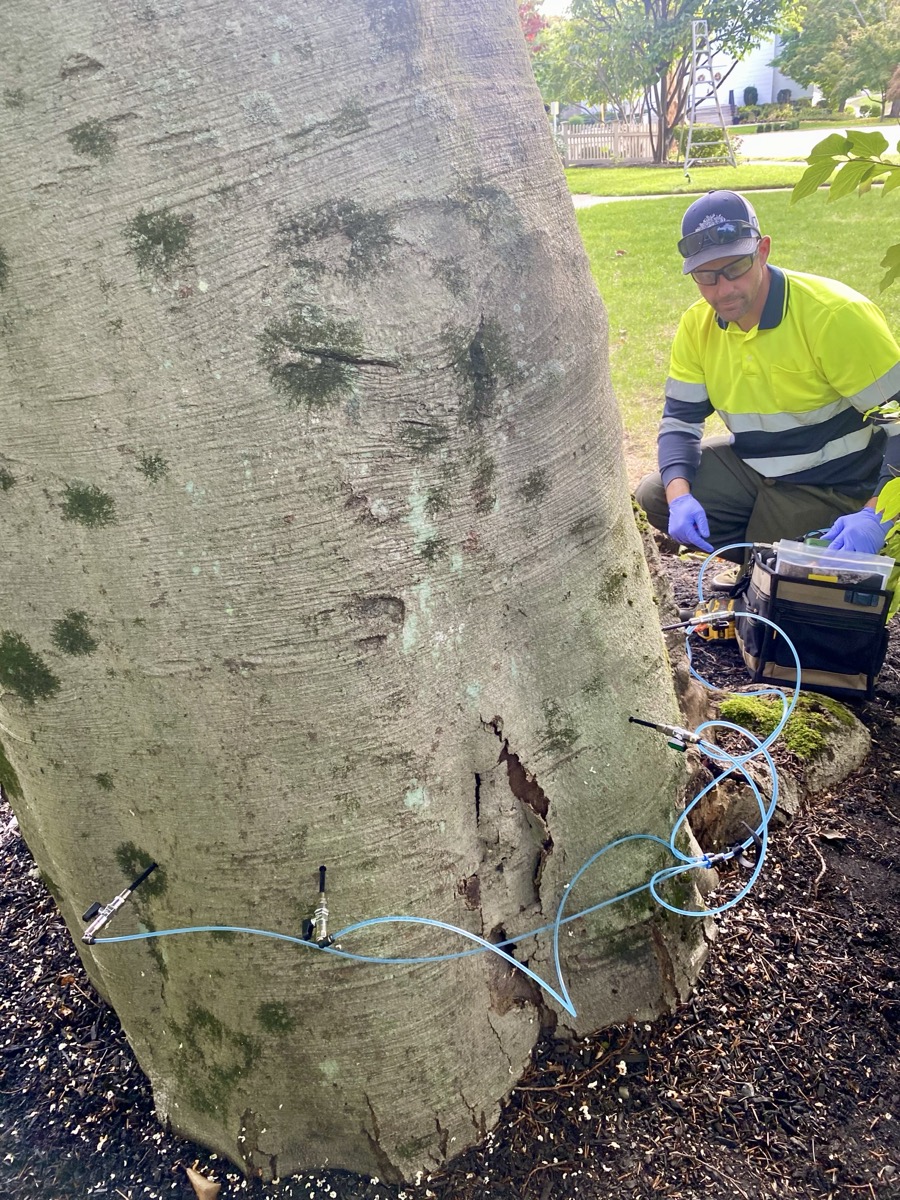
Step 2: Custom Program Design. Data informs your PHC plan: IPM thresholds trigger treatments. For spongy moth on scrub oaks, we deploy Bacillus thuringiensis (Bt) sprays before egg hatch in May. Emerald ash borer threats prompt trunk injections of emamectin benzoate via Arborjet QUIK-jet system, reaching 90% canopy protection without foliar spray drift.
Step 3: Soil and Root Care. Mashpee's glacial sands compact easily— we aerate with deep root injectors, injecting mycorrhizal fungi and liquid fertilizers (N-P-K 10-20-10 plus iron chelates). This counters chlorosis in white oaks at New Seabury, improving root mass by 25% per USDA studies.
Step 4: Pest and Disease Treatments. Hemlock woolly adelgid on Atlantic white cedar receives soil drenches of imidacloprid or trunk injections, timed for crawler stage in June. Pine bark beetles in pitch pines get systemic insecticides via macro-infusion ports, preventing brood development. We treat sassafras wilt with propiconazole fungicide injections.
Step 5: Monitoring and Follow-Up. Quarterly checks track progress—leaf tissue analysis verifies nutrient gains. Safety protocols include confined space entry for injections and PPE per OSHA 1910. We log everything in your digital portal.
Equipment sets us apart: PHC-2000 injectors for precise dosing, minimizing environmental impact; air-spade tools expose roots without damage. For Mashpee's coastal salt, we apply anti-transpirants like Wilt-Pruf to American holly. Techniques follow ISA BMPs: micro-injection for black cherry borers targets phloem precisely.
Your Johns Pond tupelo benefits from cabrio fungicide for anthracnose, applied via low-volume sprayers. We integrate mechanical controls—pruning beetle galleries from eastern red cedar. Results? 80% pest reduction in first season, per our case studies. All work uses eco-friendly chemistries, EPA-approved for Cape Cod groundwater.
This process ensures your Mashpee trees thrive against local stressors. Call 508-369-5009 to start.
Common Plant Health Care Projects in Mashpee Neighborhoods
Mashpee's neighborhoods drive distinct plant health care Mashpee MA projects at Southeast Arborist. In Mashpee Commons' village core, dense black oaks and sassafras battle urban stressors—our PHC includes winter moth treatments via mating disruption pheromones, restoring sidewalk canopies.
New Seabury waterfront homes prioritize vista pruning and salt mitigation for white oaks and eastern red cedar. We inject potassium phosphite to boost salt tolerance, preventing tip blight on American holly hedges. Popponesset properties along Waquoit Bay see pine management: thinning pitch pine stands infested with bark beetles, creating defensible space per Mashpee Fire District guidelines.
South Cape Beach dune lots feature scrub oak windbreaks; our deep root fertilization combats sand burial, adding polymer soil conditioners for moisture retention. Mashpee Neck's inland forests demand hemlock woolly adelgid control—trunk injections save Atlantic white cedar near Attaquin trails. Johns Pond Area residents request tupelo and black cherry care: root rot treatments via hydrogen peroxide drenches clear Phytophthora.
Landmark sites like the Mashpee River corridor get ecological PHC—selective spongy moth Bt applications preserve Wampanoag-managed oak-pine mixes. Post-nor'easter, we inject emamectin for storm-stressed pitch pines, preventing secondary pine tip moth attacks. Common across neighborhoods: emerald ash borer prep, even if rare locally, with QUIK-jet injections.
Practical advice: Test your soil pH yearly (kits from UMass Extension); apply mulch 3 inches deep, keeping it 6 inches from trunks to deter rodents in pine barrens. For coastal New Seabury, rinse salt from foliage post-storm with hose blasts. These projects yield resilient landscapes—our clients report 40% fewer pest calls after year one.
Plant Health Care Costs in Mashpee, MA
Plant health care Mashpee MA costs at Southeast Arborist vary by property size, tree count, and issues, but deliver superior ROI over removal. Initial assessments start at $250 for Mashpee Commons lots up to 1 acre, including full diagnostics. Custom annual PHC programs range $800-$3,500, covering 20-50 trees.
Factors influencing price: Neighborhood access—Mashpee Neck's wooded drives add $100 for equipment transport. Tree species matter; pitch pine beetle treatments cost $40-60 per injection versus $25 for oak fertilization. Soil work in sandy Johns Pond soils: $5-8 per gallon of deep root mix, scaled by cubic yards aerated.
Pest specifics: Spongy moth Bt sprays run $300-600 per acre in Popponesset, cheaper than $2,000+ defoliation cleanup. Hemlock adelgid trunk injections: $50-75 per cedar, far below $1,500 replacement. Emerald ash borer prevention: $75/tree upfront saves $5,000 later.
Value proposition: PHC extends tree life 15-20 years, per ISA data, boosting Mashpee property values 5-10% (appraisal studies). New Seabury resorts avoid $10,000 pine thinning emergencies with $1,200 proactive programs. We offer tiered plans: Basic ($800/year) for fertilization/monitoring; Premium ($2,000) adds injections/IPM.
Transparent pricing—no surprises. Bulk neighborhoods like South Cape Beach qualify for 10% multi-property discounts. Compare: DIY treatments fail 60% in Cape soils (UMass trials); our ISA expertise ensures 85% success. Financing via Service Finance available. Invest in PHC—your Mashpee oaks outlive neglect.
When to Schedule Plant Health Care in Mashpee
Timing plant health care Mashpee MA maximizes efficacy against seasonal threats. Spring (April-May): Schedule deep root fertilization pre-bud break—sandy soils deplete fast after winter. Treat spongy moth eggs on scrub oaks before June hatch; winter moth sprays target crawlers in Mashpee Neck.
Summer (June-August): Monitor pine bark beetles in stressed pitch pines during July droughts—inject immediately if frass appears. Hemlock adelgid crawlers peak late June; coastal New Seabury cedars need protection from salt-heat combo.
Fall (September-October): Emerald ash borer injections for black cherry; soil drenches absorb before frost. Prune and fertilize white oaks post-dormancy for root growth.
Urgency signs: 20% canopy thinning, beetle holes, woolly masses, or wilting tupelo leaves demand same-week service. Post-nor'easter, assess within 48 hours to prevent decline. Annual plans start anytime—call 508-369-5009 for slots.
Frequently Asked Questions About Plant Health Care in Mashpee
What is plant health care for trees in Mashpee, MA? Plant health care Mashpee MA encompasses IPM, fertilization, and injections to combat local pests like pine bark beetles in pitch pines and spongy moth on oaks. Southeast Arborist customizes per ANSI A300 for your property.
How do I know if my Mashpee trees need PHC? Look for needle drop in eastern red cedar (salt stress), defoliation in black oak (moths), or root flares with mushrooms (rot) in Johns Pond tupelo. Our free consult confirms.
Are PHC treatments safe for Mashpee's environment? Yes—ISA Certified applications use low-toxicity EPA products. IPM minimizes sprays; trunk injections avoid runoff into Mashpee River or ponds.
How much does plant health care cost in Mashpee neighborhoods? $800-$3,500 annually, based on 20-50 trees. New Seabury waterfronts average $1,800; value exceeds $5,000 in avoided removals.
When is the best time for PHC in Mashpee's climate? Spring for soil care, summer for beetles/adelgids, fall for borers. Urgent post-storm.
Does Southeast Arborist handle specific Mashpee pests like hemlock woolly adelgid? Absolutely—trunk injections save Atlantic white cedar in river corridors, with 90% efficacy.
Can PHC reduce wildfire risk on my Mashpee property? Yes, thinning beetle-killed pitch pines creates defensible space in pine barrens, per fire district specs.
How do I contact Southeast Arborist for Mashpee PHC? Call 508-369-5009 or visit from Plymouth/Cohasset. We serve all neighborhoods promptly.
Plant Health Care Throughout Mashpee
Southeast Arborist provides plant health care Mashpee MA across all neighborhoods: Mashpee Commons oaks, New Seabury cedars, Popponesset pines, South Cape Beach scrub, Mashpee Neck forests, Johns Pond tupelo. Extending to Falmouth, Barnstable, Sandwich.
Our Plymouth/Cohasset base ensures rapid response. ISA Certified, ANSI-compliant, safe. Protect your trees—call 508-369-5009 today.