
# Professional Plant Health Care in Berkley, Massachusetts
If you own property in Berkley, Massachusetts, your trees face unique pressures from the town's dense second-growth forests, Taunton River flooding, and ongoing spongy moth damage. Southeast Arborist, LLC, delivers targeted plant health care services across Berkley, MA, using ISA Certified Arborists who follow ANSI A300 standards for tree care. Based in Plymouth and Cohasset, we serve the South Shore, including all of Bristol County's 02779 zip code, with phone support at 508-369-5009.
Plant health care in Berkley MA goes beyond basic pruning—it encompasses integrated pest management, disease treatments, deep root fertilization, and trunk injections tailored to local species like red oak, white oak, white pine, red maple, American beech, black birch, eastern hemlock, shagbark hickory, tupelo, and sycamore. Berkley's forests regrew after early 20th-century farming declined, creating mature stands that now encroach on homes, especially in wooded neighborhoods like Myricks and North Berkley. The 2016-2017 spongy moth outbreak killed thousands of oaks, leaving hazard trees that weaken further each year.
Our custom PHC programs address these issues head-on. For instance, we treat spongy moth and winter moth infestations with targeted applications that protect your red oaks and white pines without harming beneficial insects. Emerald ash borer trunk injections safeguard ash trees along Poquoy Brook, while hemlock woolly adelgid management preserves eastern hemlocks in the Taunton River corridor. Deep root fertilization counters nutrient-poor soils from the town's sandy loams and clay-heavy riverbanks, boosting vigor in red maples and American beeches.
Berkley's rural setting amplifies risks: narrow roads limit equipment access, power lines run through dense canopies, and Taunton River floods stress riparian sycamores and tupelos. Homeowners in South Berkley often deal with leaning flood-damaged trees, while Berkley Common properties require defensible space thinning around homes. Our team uses low-impact techniques, like soil injection systems and aerial lifts suited for tight driveways, ensuring safety under ANSI protocols.
Practical tip for Berkley residents: Inspect your trees now for spongy moth egg masses—gray, teardrop-shaped clusters on trunks—prevalent on oaks after last season's outbreaks. Early detection prevents defoliation. Southeast Arborist's PHC extends tree lifespans, reduces removal costs, and maintains property values in a town where wooded lots define real estate appeal.
We prioritize your property's ecosystem. In North Berkley’s upland forests, black birches and shagbark hickories benefit from our soil aeration to combat compaction from heavy equipment on rural roads. Along the Taunton River Area, we stabilize sycamores against erosion. Call 508-369-5009 for a free site assessment—our ISA arborists evaluate soil pH (often acidic in Berkley at 4.5-5.5), moisture levels, and pest loads specific to your lot.
This comprehensive approach makes plant health care in Berkley MA essential for long-term tree vitality. Whether managing dense forest encroachment or power line clearance, we deliver results that protect your investment.
Why Berkley Properties Need Plant Health Care
Berkley's heavily wooded landscape, covering most of its 6,800 residents' properties, demands proactive plant health care to counter specific environmental stressors. The town's second-growth hardwood and pine forests, dominant since farming waned in the early 1900s, create overcrowded stands of red oak, white oak, white pine, and red maple that compete for light and nutrients. Add Taunton River flooding, which saturates soils in the Taunton River Area and Poquoy Brook Area, and you have root rot risks for tupelo and sycamore trees.
Spongy moth mortality remains Berkley's top tree killer. The 2016-2017 outbreak defoliated and killed thousands of oaks across Bristol County, with weakened trees in Myricks and North Berkley now producing hazard limbs. These dead tops, or "snags," fail unpredictably, threatening homes and power lines along narrow rural roads like those in South Berkley. Winter moth adds caterpillar damage to maples and beeches, while hemlock woolly adelgid infests eastern hemlocks in shaded river corridors, turning needles gray.
Local climate exacerbates issues: Berkley's humid continental weather brings 45-50 inches of annual rain, but summer droughts stress white pines on sandy uplands. Winters dip to 20°F, causing frost cracking in black birches and shagbark hickories. Soil conditions vary—acidic, well-drained sands in Berkley Common support oaks but deplete nitrogen, while clay-loams near the river compact roots during floods.
Dense forest encroachment endangers homes town-wide. In North Berkley, properties back onto mature woods where American beeches crowd driveways, blocking access and fire defensible space. Taunton River properties face leaning sycamores from flood scour, and rural power lines in Myricks suffer from overhanging red maples, leading to outages during storms.
Emerging threats include emerald ash borer, confirmed in nearby Taunton, marching toward Poquoy Brook ashes. Without trunk injections, these trees die within 3-5 years. Limited equipment access on Berkley's winding roads heightens risks—cranes can't navigate, so untreated hazards persist.
Homeowners gain practical benefits from PHC: Thinning overcrowded oaks in South Berkley reduces windthrow risk by 40%, per ISA studies. Deep root fertilization raises soil pH and adds micronutrients, improving red maple color and vigor. Integrated Pest Management (IPM) monitors pests like spongy moths via pheromone traps, applying treatments only when thresholds hit, minimizing chemical use.
Your trees signal distress through specifics: Oak decline shows yellowing leaves and cankers from spongy moth stress; hemlock needles drop from adelgid; sycamores bleed sap from flood wounds. Ignoring these leads to costly removals—$2,000+ per mature oak. Southeast Arborist's ISA Certified experts diagnose via resistograph testing for internal decay in white oaks.
In Berkley’s context, PHC prevents woodland mismanagement. Large residential lots need selective removal of declining trees, creating space for healthy shagbark hickories. Riverbank properties require erosion-control planting post-flood cleanup. Power line vigilance avoids utility conflicts.
Local data underscores urgency: Bristol County lost 15% of oaks to spongy moths since 2016, per Mass DEP reports. Your property's value hinges on healthy trees—wooded lots sell 10-20% higher. Act now: Scout for spongy moth frass (pellet droppings) under oaks, a key infestation sign.
Our Plant Health Care Process in Berkley
Southeast Arborist follows a structured, ANSI A300-compliant process for plant health care in Berkley MA, starting with a site-specific assessment. Our ISA Certified Arborists arrive with soil probes, increment borers, and drone imagery to map your property—essential for dense lots in Myricks where visibility is low.
Step 1: Comprehensive Evaluation (1-2 hours). We inspect trees for pests, diseases, and structural issues. In North Berkley, we check red oaks for spongy moth egg masses and white pines for white pine weevil. Soil tests measure pH (target 6.0-7.0), compaction, and nutrients using Penetrologgers—Berkley's river clays often exceed 300 psi, starving roots. For Taunton River sycamores, we assess flood damage via ultrasound tomography for rot.
Step 2: Custom PHC Program Design. Based on findings, we create IPM plans. Spongy moth treatment uses Bacillus thuringiensis (Bt) sprays timed for larval hatch (May-June), safe for bees. Emerald ash borer gets imidacloprid trunk injections via QUIK-jet systems, applied at 10-15 ml per DBH inch. Hemlock woolly adelgids receive domiphen hydrospray or soil drenches in Poquoy Brook hemlocks.
Step 3: Soil and Root Care. Deep root fertilization injects liquid nutrients (N-P-K 12-4-8 plus iron) 8-12 inches deep via grid patterns, spaced 4 feet apart. In Berkley Common's nutrient-poor sands, we add mycorrhizae to boost white oak uptake by 30%. Aeration relieves compaction on driveway-adjacent maples using air-spades, minimizing turf damage.
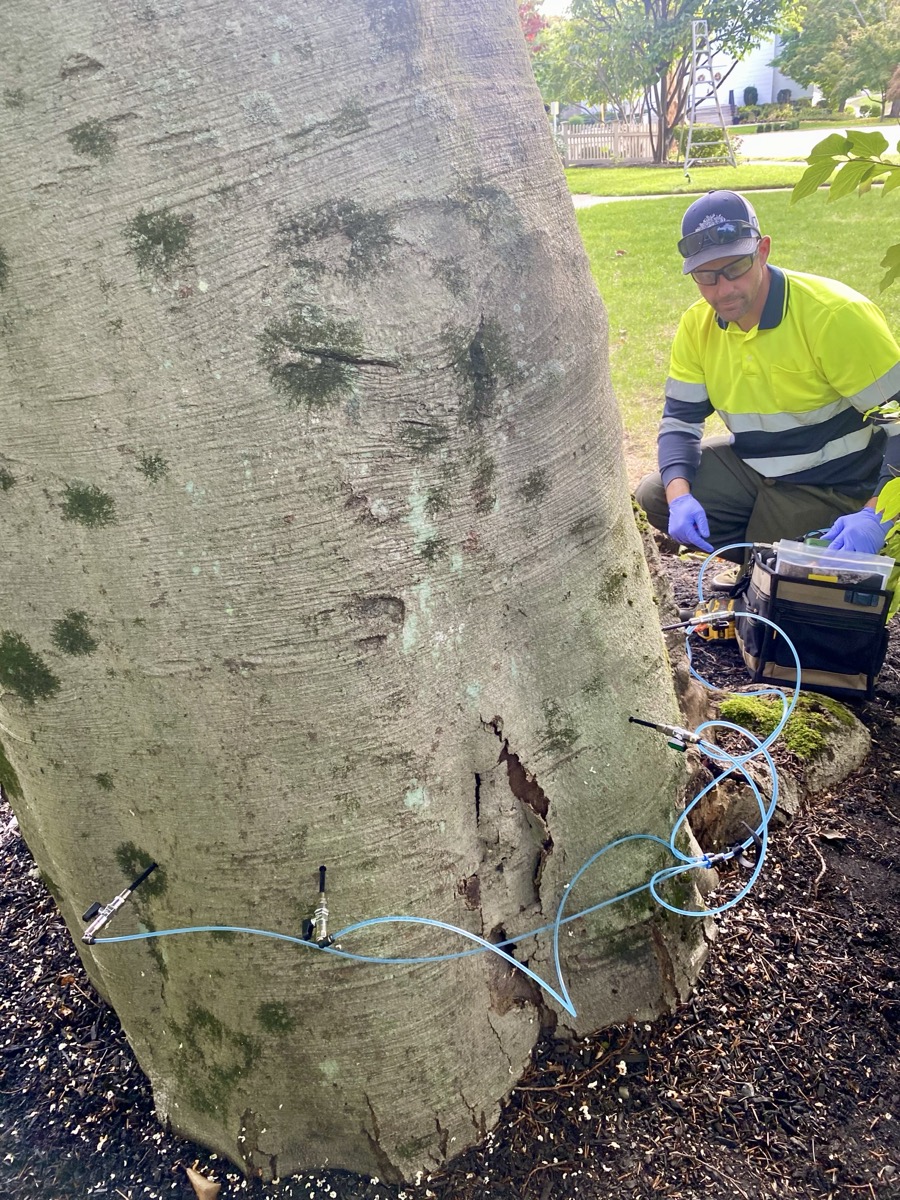
Step 4: Pest and Disease Treatments. Trunk injections for high-value trees like American beeches use Arborjet equipment, delivering systemic fungicides for anthracnose. Winter moth gets spinosad applications in fall. We monitor via sticky traps, treating only above economic thresholds per IPM.
Step 5: Implementation with Safety Protocols. Our crew uses ANSI Z133 safety gear, including harnesses for elevated work and traffic controls on narrow South Berkley roads. Low-ground-pressure track loaders access tight spots without rutting. Power line work follows OSHA distancing—minimum 10 feet—with spotters.
Step 6: Monitoring and Follow-Up. Post-treatment, we install data loggers for soil moisture in flood-prone Taunton River Areas. Annual reports track progress, like reduced adelgid on eastern hemlocks. Adjustments ensure long-term success, such as re-fertilizing black birches after wet winters.
Equipment tailored to Berkley: Portable injection units for driveway clearances, drone scouting for 10+ acre woodlots, and bio-barriers for rodent damage on shagbark hickories. All treatments comply with Mass Pesticide Bureau regs.
Practical advice: Prepare your site by marking utilities (call 811) and clearing brush around target trees. For spongy moth-prone oaks, remove lower limbs pre-treatment to improve spray coverage.
This process yields measurable results: Clients see 25-50% vigor improvement in red maples after one season, per chlorophyll meter readings. In Berkley’s context, it prevents hazard tree formation from spongy moth-weakened oaks, saving thousands in removals.
Our Plymouth/Cohasset base ensures rapid response—same-day for urgents. Call 508-369-5009 to start your evaluation.
Common Plant Health Care Projects in Berkley Neighborhoods
Berkley neighborhoods present distinct PHC needs, with Southeast Arborist addressing them neighborhood-by-neighborhood.
In Berkley Common, upland oaks and pines suffer spongy moth aftermath. We thin overcrowded red and white oaks, injecting survivors against repeat attacks, and fertilize white pines to counter needle cast from humid summers.
Myricks' long, wooded driveways require canopy clearance for red maples and black birches overhanging narrow roads. PHC includes root pruning and IPM for winter moth, plus soil care to prevent decline from construction compaction.
North Berkley’s dense forests encroach on homes—American beeches and shagbark hickories form thickets. Our woodland management thins stands, creating 30-foot defensible space, while treating spongy moth on residual oaks.
South Berkley properties battle power line conflicts with overhanging tupelos and sycamores. We use trunk injections for diseases and selective pruning, ensuring clearances without full removals.
Taunton River Area homes face flood-stressed riparian trees. Sycamores and river birches get wound dressings post-flood, root stabilization, and adelgid control on nearby hemlocks. Erosion barriers protect banks.
Poquoy Brook Area deals with wet soils stressing ashes and hemlocks. Emerald ash borer injections and woolly adelgid treatments dominate, paired with drainage improvements for healthier tupelos.
Common across Berkley: Hazard tree mitigation from 2016 spongy moth damage, driveway access maintenance, and storm prep. Local landmarks like the Taunton River bridge see regular leaner removals.
Your project starts with a neighborhood-specific plan—call 508-369-5009.
Plant Health Care Costs in Berkley, MA
Plant health care costs in Berkley MA vary by property size, tree count, and issues, but deliver strong ROI. Initial assessments run $150-300, covering soil tests and drone surveys—free with treatment contracts.
Custom PHC programs for 1-2 acre lots average $800-2,500 annually. Spongy moth treatments on 10 oaks cost $400-600 (Bt spray), versus $15,000+ for removals. Emerald ash borer injections: $12-18 per inch DBH, so a 20-inch ash is $240-360 yearly.
Deep root fertilization for 5-10 trees: $300-700, injecting custom blends. Hemlock adelgid management: $500-1,200 per cluster, using low-volume sprays. Trunk injections add $100-200 per tree.
Factors driving costs: Access—North Berkley’s tight driveways add 20% for specialized gear. Tree size—mature Taunton River sycamores (40+ DBH) increase volumes. Urgency—post-flood South Berkley jobs premium 15%.
Value proposition: PHC extends oak lifespans 10-20 years, avoiding $1,500-5,000 removals. IPM reduces treatments by 30-50% via monitoring. Property values rise—healthy woods boost appraisals 5-10%.
Compare: DIY risks improper dosing, killing trees. Our ISA certification ensures compliance, with warranties on treatments.
Budget tip: Multi-year contracts save 15-20%. For Berkley Common, bundle fertilization with pest control for $1,200/year.
Invest in PHC—contact 508-369-5009 for quotes.
When to Schedule Plant Health Care in Berkley
Timing plant health care in Berkley MA maximizes effectiveness against local cycles. Schedule spongy moth treatments May-June during larval stages—egg masses visible now on oaks signal urgency.
Winter moth sprays hit September-October, pre-leaf drop. Emerald ash borer injections occur May-July, post-bark split. Hemlock adelgid treatments run March-May or fall dormancy.
Deep root fertilization bests early spring (March-April) or fall (September-October), avoiding summer heat stress on maples. Post-flood PHC for Taunton River trees: immediate after high water recedes.
Urgency signs: 20%+ defoliation, oozing cankers on white oaks, wilting hemlock tips, or leaning post-storm. Act within 2 weeks to prevent spread.
Annual scheduling suits most—spring assessments catch early pests. Storm seasons (August-November) demand rapid response.
Call 508-369-5009 now for seasonal slots.
Frequently Asked Questions About Plant Health Care in Berkley
**What is plant health care in Berkley MA?** Custom programs including pest control, fertilization, and injections for local trees like oaks and hemlocks, using IPM to maintain health amid spongy moth and floods.
**How do I know if my Berkley trees need PHC?** Look for spongy moth frass under red oaks, adelgid wool on hemlocks, yellowing maples, or flood cracks on sycamores—our free inspection confirms.
**Are treatments safe for my family and pets?** Yes, ISA arborists use EPA-approved, low-toxicity options like Bt for moths, timed to minimize exposure. We notify pre-application.
**How effective is spongy moth treatment in Myricks?** 95% control with Bt, preventing defoliation on oaks—proven in Bristol County outbreaks.
**What's involved in deep root fertilization for North Berkley soils?** Soil injections of balanced nutrients at 8-12 inches, correcting pH and compaction for white pines and beeches.
**Can PHC save emerald ash borer-threatened trees near Poquoy Brook?** Trunk injections protect 90% of trees if caught early, per USDA data.
**How often should I schedule PHC in South Berkley?** Annually for monitoring, with treatments as needed—multi-year plans optimize costs.
**Do you handle Taunton River flood damage?** Yes, stabilizing leaning tupelos and treating rot immediately post-flood.
Plant Health Care Throughout Berkley
Southeast Arborist provides plant health care across Berkley neighborhoods—Berkley Common, Myricks, North Berkley, South Berkley, Taunton River Area, Poquoy Brook Area—and nearby Taunton, Raynham, Bridgewater, Fall River. From Plymouth/Cohasset, we reach 02779 in under 45 minutes.
Our ISA Certified team tackles your local challenges: spongy moth oaks in Myricks, flood sycamores by the Taunton River. Call 508-369-5009 for assessments.