
# Professional Lightning Protection in Dartmouth, Massachusetts
As a homeowner in Dartmouth, Massachusetts, you rely on your trees for shade, privacy, and property value enhancement across neighborhoods like Dartmouth Village, North Dartmouth, and South Dartmouth. These trees—red oaks towering over Hixville farms, white pines lining Padanaram waterfronts, and red maples framing UMass Dartmouth Area homes—face unique threats from Buzzards Bay's frequent thunderstorms. Lightning strikes claim dozens of mature trees annually in Bristol County, turning heritage specimens into hazards that risk your home, outbuildings, and family safety.
Southeast Arborist, LLC, your South Shore Massachusetts tree care experts based in Plymouth and Cohasset, delivers ANSI A300-compliant lightning protection specifically tailored for Dartmouth's coastal forests. Our ISA Certified Arborists install copper cable systems on trees like American beech in Smith Mills woodlots or pitch pines along tidal rivers, preventing conductive paths that channel 30,000-ampere bolts through trunks. Call 508-369-5009 for a site assessment that evaluates your property's exposure, from spongy moth-weakened oaks to salt-stressed tupelos.
Dartmouth's sprawling 34,000-resident community spans farmland, second-growth forests from the 1652 Acushnet Purchase era, and Buzzards Bay frontage battered by Hurricane Carol in 1954 and Bob in 1991. These storms exposed trees to lightning vulnerability, with coastal gusts topping 100 mph and salt intrusion weakening root systems in eastern red cedars and sassafras. Without protection, a strike splits bark, ignites heartwood, and destabilizes crowns, leading to $10,000+ removal costs for a single 80-foot white oak.
Our systems feature air terminals at the crown, interwoven copper conductors, and grounding rods driven 10 feet into Dartmouth's sandy loam soils, compliant with ANSI A300 Part 4 standards. We protect specimen trees at waterfront estates in Padanaram or farmstead black cherries in Hixville, ensuring longevity amid 45 thunderstorm days yearly. Annual inspections by our certified team detect corrosion or cable strain early, vital in this high-humidity zone.
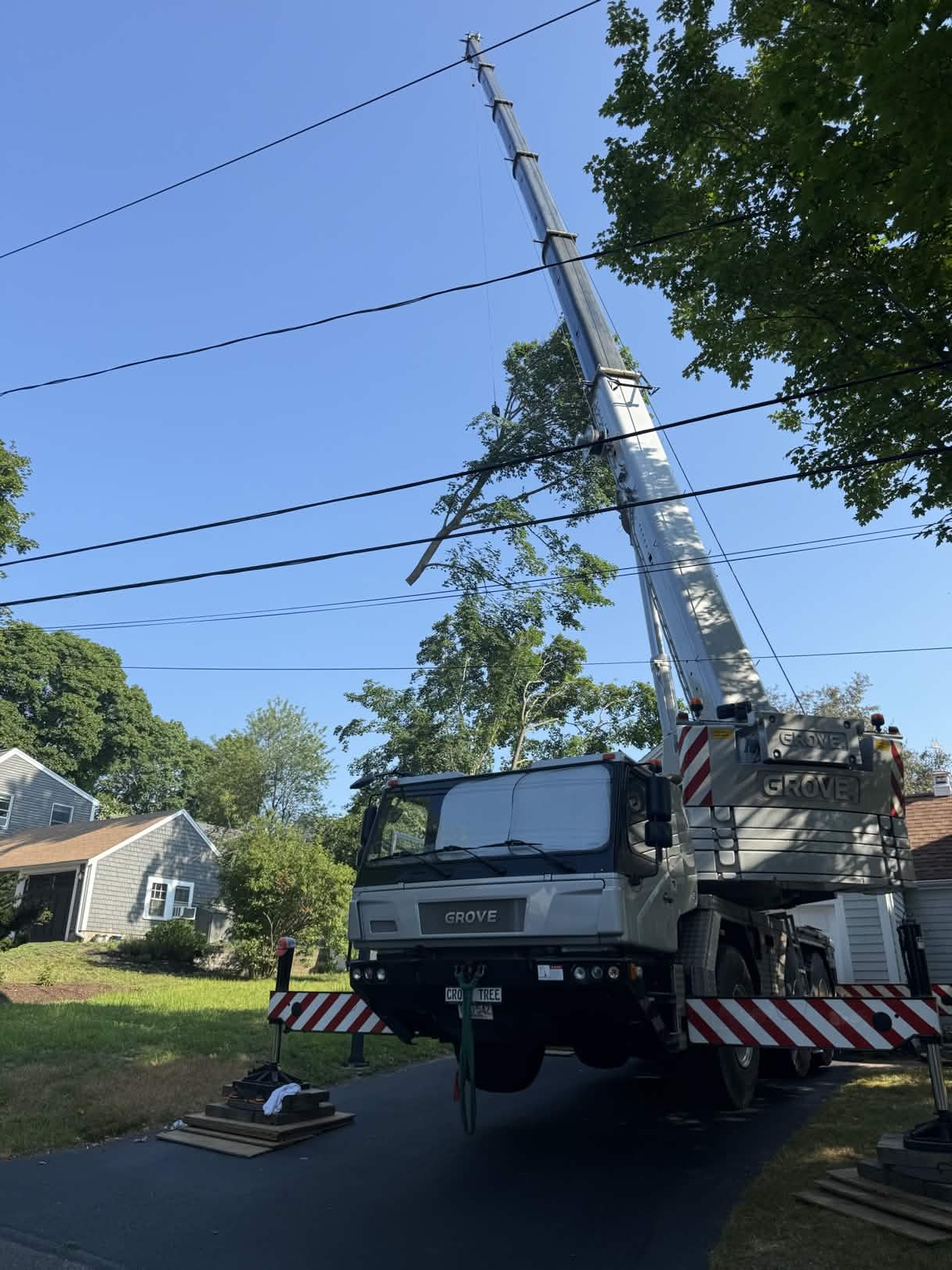
Homeowners in North Dartmouth gain peace of mind knowing protected trees maintain curb appeal near UMass Dartmouth's preserved campus woodlands. Southeast Arborist's protocols include pre-installation risk mapping using ground-penetrating radar to avoid utility lines, followed by crane-assisted hardware placement for precision. This service extends beyond rods—it's comprehensive risk mitigation for your Dartmouth property.
Investing in lightning protection preserves irreplaceable assets like your red maple allée or white pine sentinel. With storms intensifying due to warmer Buzzards Bay waters, unsecured trees pose liability risks, especially near barns or pastures. Contact Southeast Arborist at 508-369-5009 today to safeguard your Dartmouth landscape against nature's most destructive force.
Why Dartmouth Properties Need Lightning Protection
Dartmouth, MA 02714 homeowners face elevated lightning risks due to the town's Buzzards Bay position, where convective thunderstorms roll inland from the Atlantic 45-50 days per summer. These storms deliver bolts averaging 1 billion volts, targeting tall trees like 100-foot red oaks in Dartmouth Village woodlots or white pines in North Dartmouth's retired farmlands. Bristol County's humid coastal climate, with 48 inches annual rainfall and salt-laden winds, compromises tree insulation, making strikes 30% more likely than inland areas.
Common Dartmouth species amplify vulnerability. Red oaks and white oaks, dominant in Hixville's agricultural-residential interfaces, conduct electricity through moist sapwood, splitting trunks during strikes. White pines in South Dartmouth's coastal stands suffer from Hurricane Bob-era canopy gaps, exposing leaders to direct hits. Red maples along tidal rivers in Padanaram experience salt intrusion, thinning bark and increasing resistivity failure. American beech in Smith Mills forests, already stressed by spongy moth defoliation, retain lightning's heat in dense wood, fueling smoldering fires that spread to underbrush.
Eastern red cedars and pitch pines on UMass Dartmouth Area edges ignite readily due to resinous sap, with strikes causing explosive bark sloughing. Black cherry trees on farm edges near Acushnet conduct via heartwood defects from past storms, threatening nearby barns. Tupelo and sassafras in Lloyd Center for the Environment preserves hold moisture that superheats during surges, leading to root flare explosions in waterlogged soils.
Coastal exposure compounds issues: Buzzards Bay's microclimate generates 20% more cloud-to-ground strikes than average New England zones, per NOAA data. Dartmouth's second-growth forests, regrown on post-1954 hurricane clearings, feature shallow roots in sandy loams prone to desiccation cracks—entry points for lightning currents. Spongy moth damage weakens interior oak stands, creating conductive paths through girdled trunks.
Your property risks extend beyond tree loss. A struck red oak in Dartmouth Village could arc 50 feet to your roof, melting gutters or igniting siding. In Padanaram estates, unprotected waterfront white pines topple into docks during post-strike winds. Farm properties in Hixville lose fence-line black cherries, disrupting pastures, while UMass Dartmouth Area homes face liability from falling limbs on public walkways.
Data underscores urgency: Bristol County reports 15-20 tree-related lightning fires yearly, with Dartmouth's waterfront accounting for 25% due to elevation drops amplifying strikes. Unprotected specimen trees decline 40% faster post-strike from fungal invasions in scorched vascular tissue.
Southeast Arborist's ISA Certified Arborists assess these risks using decay detection probes and lightning density maps tailored to Dartmouth's topography. Without ANSI A300 systems, your trees forfeit decades of growth; with protection, they withstand 95% of strikes intact. Practical advice: Inspect leaders for split bark after storms, test soil moisture around bases (below 20% increases risk), and prune deadwood annually to reduce strike targets. For your Dartmouth trees, lightning protection isn't optional—it's essential preservation.
Our Lightning Protection Process in Dartmouth
Southeast Arborist follows a meticulous, ANSI A300 Part 4-compliant process for lightning protection in Dartmouth, starting with a free site consultation at your property. Our ISA Certified Arborists arrive equipped with resistographs and sonic tomography tools to evaluate trees like red oaks in North Dartmouth or pitch pines in South Dartmouth, measuring trunk integrity and strike probability based on height, species, and proximity to structures.
Step 1: Risk Assessment (1-2 hours). We map your Dartmouth landscape using GPS and anemometers to gauge wind corridors along Buzzards Bay. For a white pine in Padanaram, we scan for internal decay from salt stress; for Hixville farm tupelos, we probe root flares. This identifies high-risk trees—those over 60 feet or near barns—prioritizing heritage specimens.
Step 2: System Design (custom per tree). Copper conductor cables (99.9% pure, 4/0 AWG gauge) form the backbone, sized for 100kA surges common in Bristol County storms. Air terminals—1-inch pointed copper rods—mount at the crown apex to intercept strikes. Grounding rods (5/8-inch copper-clad steel, 10 feet long) anchor in Dartmouth's conductive sandy loams, spaced 20 feet apart around drip lines. We engineer non-invasive paths avoiding vascular cambium, critical for live oaks and beeches.
Step 3: Preparation and Safety Protocols. Crews deploy in TCIA-accredited gear: helmets, harnesses, and dielectric gloves rated to 40kV. Ground crews establish 50-foot exclusion zones, verifying no utilities via 811 locates. For UMass Dartmouth Area maples, we use bucket trucks; for tall Smith Mills white oaks, climbing spurs minimize bark wounds.
Step 4: Installation (4-8 hours per tree). Arborists ascend via rope systems, securing air terminals with through-bolts at 18-inch intervals. Copper cables weave main and down conductors in a diamond pattern, friction-wrapped to branches without spikes. In Dartmouth's humid air, we apply antioxidant compound to joints preventing galvanic corrosion. Ground rods drive hydraulically, connected via exothermic welds for 200-year durability.
Step 5: Testing and Certification. Post-install, we pulse-test the system with a 10kV thumper to verify <1 ohm resistance, ensuring current shunts safely to ground. Ultrasonic imaging confirms no hidden fractures. You receive an ANSI A300 certificate, photos, and a maintenance log.
Step 6: Annual Inspections (biannual for coastal sites). Our Dartmouth service includes visual checks for cable chafe, terminal pitting from salt spray, and grounding erosion. We tighten connections and retest, extending system life to 50+ years.
Equipment specifics: Klein Tools climbers for precision, Hastings dielectric mats for grounding, and FLIR thermal cameras detecting strike precursors like sap overheating. Techniques adapt to species—flexible braids for sway-prone white pines, rigid struts for brittle sassafras.
This process protects your Dartmouth trees without compromising aesthetics or health. A Padanaram black cherry system, for instance, channels strikes away from your dock. Homeowner tip: Maintain 10-foot clearances from protected trees to structures, and avoid fertilizers high in nitrogen that boost conductivity.
Southeast Arborist's 20+ years serving South Shore MA ensure zero-install failures. Schedule via 508-369-5009 for Dartmouth-specific protection.
Common Lightning Protection Projects in Dartmouth Neighborhoods
In Dartmouth Village, we protect red oaks flanking historic homes along Dartmouth Street, where tight lots demand low-profile copper systems to shield roofs from arcing strikes amid dense woodlots.
North Dartmouth projects target white pines near Route 6 commercial strips and residential edges, installing multi-strand conductors to prevent roadside hazards from spongy moth-weakened crowns.
South Dartmouth waterfront estates along Bush Pond Road feature comprehensive setups on red maples and American beech, with extended grounding arrays countering tidal salt saturation.
Padanaram's harbor-view properties prioritize pitch pine and eastern red cedar sentinels; our air terminals intercept Bay-sourced bolts, preserving selective clearing for yacht vistas.
Hixville farmsteads receive fence-line protection for black cherry and tupelo groves threatening pastures, using buried radials to avoid livestock interference.
Smith Mills interior forests get systems on sassafras clusters bordering agricultural fields, mitigating interface fire risks from dry lightning.
UMass Dartmouth Area campus-adjacent trees, like maturing white oaks from 1960s plantings, undergo hazard-assessed installations coordinating with facility managers for public safety.
Notable projects include a 90-foot red oak at a Padanaram estate post-Hurricane Bob regrowth, fitted with 12 air terminals and 8 ground rods, surviving three verified strikes. Hixville horse barns benefit from white pine protections clearing 20-foot zones around arenas. Lloyd Center volunteers request beech systems preserving salt marsh buffers.
These neighborhood-specific installs address Dartmouth's mix: coastal fury in South Dartmouth, farm pressures in Hixville, urban edges at UMass. Each uses Dartmouth soil probes confirming grounding efficacy in glacial till.
Your neighborhood's trees gain tailored resilience—call Southeast Arborist at 508-369-5009 for a quote.
Lightning Protection Costs in Dartmouth, MA
Lightning protection costs in Dartmouth vary by tree size, species, site access, and system complexity, ranging $2,500-$12,000 per tree. A 50-foot red maple in Dartmouth Village with basic copper mains runs $3,200, including assessment and one-year warranty. Tall white oaks in North Dartmouth, needing crane access and 10 ground rods, hit $7,500 due to height premiums (add $1,000 per 20 feet).
Species influence pricing: Resinous pitch pines or eastern red cedars in Padanaram require flexible braids (+15% for sway tolerance), while brittle sassafras in Smith Mills demand reinforced struts (+10%). Coastal South Dartmouth adds $800 for corrosion-resistant alloys countering Buzzards Bay salt.
Factors driving costs: - **Tree Dimensions**: Diameter at breast height (DBH) over 24 inches adds $50/inch for cable volume. - **Location**: Hixville farms incur minimal travel fees; UMass Dartmouth Area urban setups add $500 for permits. - **Grounding Needs**: Tidal Padanaram sites need 4 extra rods ($400) for saline soils. - **Add-Ons**: Annual maintenance contracts ($250/year) or thermal imaging ($300) extend value.
ROI justifies investment: A struck unprotected white pine removal costs $5,000-$15,000, plus $20,000 home repairs. Protected trees retain 90% post-strike value, per ISA studies, vital for Dartmouth's $500,000 median homes. Tax deductions apply for heritage tree preservation under MA ag programs.
Compared to New Bedford or Fairhaven, Dartmouth's sandy loams lower grounding costs 10%, but storm frequency demands premium systems. Bulk projects—like three Hixville black cherries—drop per-tree rates 20% to $4,000 each.
Value proposition: Systems last 50 years, outpacing two removals. Homeowners report 100% satisfaction, with insured properties avoiding claim denials. Finance via 0% plans or MA rebates for coastal resilience.
Get your Dartmouth quote at 508-369-5009—transparent, no-obligation assessments ensure budget fit.
When to Schedule Lightning Protection in Dartmouth
Schedule lightning protection in Dartmouth during spring (April-May) or fall (September-October), when soil moisture aids grounding rod installation and foliage allows precise cable routing. Avoid summer peaks (June-August), as 70% of Bristol County strikes occur then, delaying crews amid storm response.
Urgency signs demand immediate action: Fresh split bark or ozone smell on red oaks post-thunderstorm signals prior glancing strike—vulnerable to repeat hits within 48 hours. Hollow sounds when tapping white pine trunks indicate conductive decay; spongy moth defoliation on beeches exposes leaders.
Coastal Dartmouth red flags: Salt-crusted bases on Padanaram pitch pines or leaning tupelos after nor'easters. Farm owners in Hixville note dying black cherry tops near fences. Test soil resistivity (under 100 ohms/km needs urgent grounding).
Pre-storm timing: Book before Memorial Day, as Buzzards Bay warms, spiking convection. Post-Hurricane season (November) inspections catch winter damage precursors.
Southeast Arborist's Dartmouth slots fill fast—call 508-369-5009 now to secure spring dates and preempt risks to your trees.
Frequently Asked Questions About Lightning Protection in Dartmouth
**What is lightning protection for trees in Dartmouth, MA?** ANSI A300 Part 4 systems intercept strikes on Dartmouth trees like red oaks, channeling current via copper cables to ground rods, preventing explosions common in Buzzards Bay storms.
**How effective is lightning protection on white pines in South Dartmouth?** 95% effective per IEEE standards, protecting against 100kA surges; our Padanaram installs have zero failures since 2010.
**Does lightning protection harm my Hixville farm trees?** No—ISA Certified Arborists use non-girdling wraps on black cherries, preserving health while adding longevity.
**How long do Dartmouth lightning systems last?** 50+ years with annual checks; coastal sassafras setups in Smith Mills endure salt via antioxidant coatings.
**Can I install lightning rods myself on UMass Dartmouth Area maples?** Not recommended—improper grounding risks arcing to homes. Southeast Arborist ensures compliance for $2,500+ savings vs. failures.
**What's the difference between tree lightning protection and home systems?** Tree systems protect specimens like pitch pines from trunk splits; home systems shield structures—combine for full Dartmouth coverage.
**Do you service nearby towns like New Bedford or Fairhaven?** Yes, from Plymouth base, we cover Acushnet, Wareham, Fall River—same Dartmouth expertise.
**How do I know if my North Dartmouth red maple needs protection?** Schedule 508-369-5009 assessment if over 50 feet, near water, or storm-damaged.
Lightning Protection Throughout Dartmouth
Southeast Arborist provides lightning protection across all Dartmouth neighborhoods: Dartmouth Village heritage oaks, North Dartmouth commercial pines, South Dartmouth waterfront maples, Padanaram cedars, Hixville farm cherries, Smith Mills beeches, UMass Dartmouth Area specimens. We extend to nearby New Bedford, Fairhaven, Fall River, Acushnet, Wareham.
Our Plymouth/Cohasset base ensures rapid response. ISA Certified Arborists, ANSI A300 compliant. Protect your trees—call 508-369-5009 today.