
# Professional Lightning Protection in Norwell, Massachusetts
As a homeowner in Norwell, Massachusetts, you rely on the mature trees surrounding your property for shade, privacy, and aesthetic appeal. These trees—often towering red oaks, white pines, and red maples grown from former pastureland—define the rural-suburban character of your affluent town in Plymouth County. However, with Norwell's frequent thunderstorms rolling in from the Atlantic, lightning strikes pose a real threat to your heritage specimens and your home. A single strike can split a 100-year-old white oak on your Ridge Hill lot or ignite a white pine stand near power lines in Assinippi, leading to costly damage, fire risk, and safety hazards.
Southeast Arborist, LLC, your local ISA Certified Arborists based in Plymouth and Cohasset, specializes in ANSI A300-compliant lightning protection for Norwell properties. Serving the South Shore Massachusetts area, including Norwell's 11,300 residents across neighborhoods like Norwell Center, Accord, Church Hill, and Tiffany Road, we install professional copper cable systems tailored to your wooded lots and protected wetlands. Our lightning protection Norwell MA services protect specimen trees like American beech and hickory along Indian Head Brook corridors, ensuring they withstand the region's intense summer storms.
Norwell's location along the North River exposes properties to high lightning activity, with the National Weather Service reporting over 20 thunderstorm days annually in Plymouth County. Mature forests from the town's agricultural past—carved from Scituate in 1849—now encroach on rooftops in Bowker and Wildcat, amplifying strike risks. Without protection, a bolt traveling at 220 million volts can vaporize sap, explode trunks, and send debris through your windows. We've seen this firsthand on Main Street heritage sugar maples predating incorporation, where unprotected trees suffered catastrophic failure during ice storms that mimic lightning compression damage.
Our systems feature air terminals (lightning rods) at the tree crown, copper conductors routing current safely to the ground, and deep grounding rods— all per ANSI A300 Part 4 standards. This isn't DIY rod hammering; it's engineered protection for your property's value. In Norwell Center, we safeguard oaks shading historic homes; in Accord, we protect white pines conflicting with narrow roads. Homeowners report peace of mind after installation, with annual inspections maintaining system integrity amid wetland buffer restrictions.
Lightning protection Norwell MA from Southeast Arborist prevents not just strikes but secondary issues like heart rot in black birch from strike wounds. Call our ISA Certified team at 508-369-5009 for a site assessment on your large wooded lot. We navigate Norwell's zoning for tree work near wetlands, using bucket trucks and climbing gear for precise installation. Protect your investment today—your trees and home depend on it.
Why Norwell Properties Need Lightning Protection
Your Norwell property's mature trees face unique lightning risks due to the town's geography, climate, and forest composition. Positioned in Plymouth County along the North River and Indian Head Brook, Norwell experiences concentrated thunderstorm activity from coastal squalls. The area's acidic, sandy loam soils—remnants of glacial till and former farmlands—conduct electricity poorly, channeling strikes upward into tall trees like red oaks and white pines dominating your skyline.
Common species in Norwell amplify vulnerability. Red oaks and white oaks, prevalent on large lots in Church Hill and Ridge Hill, reach heights over 80 feet with broad crowns that attract strikes. Their dense wood resists initial damage but shatters explosively under strike heat, as seen in post-storm removals we've handled. White pines in Accord and Wildcat stands grow rapidly on abandoned pastures, their soft needles and height creating ideal strike paths, especially where they lean toward power lines on narrow roads like Main Street.
Red maples and hickory in Assinippi riparian zones suffer conductor-like sap flow during storms, drawing bolts from wetlands. American beech on Tiffany Road properties develop shallow roots in wet soils, toppling post-strike. Black birch and tulip trees in Norwell Center encroach on homes, their brittle wood failing dramatically. Ice storms, common in Norwell's harsh winters with averages below 30°F, mimic lightning by compressing trunks, weakening them for summer strikes.
Local challenges compound risks. Dense canopy encroachment threatens rooftops in Bowker, where oaks overhang slate roofs on century homes. Wetland buffers along Indian Head Brook restrict removal, leaving hazard trees unprotected. Power line conflicts on roads like Central Street force proximity work, heightening strike conduction to your driveway. Heritage trees on Main Street—sugar maples and oaks from pre-1849—hold historical value but lack natural resistance after decades of growth.
Data supports urgency: Plymouth County sees 10-15 lightning strikes per square mile yearly, per Vaisala Xweather, with tree-ignited structure fires rising 20% in wooded suburbs. Unprotected strikes cause 30% tree mortality, per ISA studies, leading to $10,000+ removal costs on your lot. In Norwell's affluent market, median home values exceed $900,000; tree failure devalues properties by 5-10%.
Practical advice: Inspect your trees after storms for baseball-bat-sized wounds, peeling bark, or leader dieback—hallmarks of strikes. In Ridge Hill, measure oak height against neighbors; over 60 feet warrants protection. Wet soils in Assinippi mean faster rot post-strike; prioritize riparian maples. Southeast Arborist's ISA Certified Arborists assess conductivity using ground resistance meters, confirming needs per ANSI A300.
Without lightning protection Norwell MA, your wooded paradise becomes a liability. Our copper systems intercept strikes on white pines threatening Cohasset lines nearby, safeguarding your investment.
Our Lightning Protection Process in Norwell
Southeast Arborist follows a precise, ANSI A300 Part 4-compliant process for lightning protection Norwell MA, customized to your property's trees and terrain. As ISA Certified Arborists serving South Shore Massachusetts from Plymouth/Cohasset, we prioritize safety with TCIA accreditation, hard hats, harnesses, and insulated tools.
Step 1: Site Assessment (1-2 hours). We arrive with resistographs and sonic tomography to evaluate tree health on your Norwell lot. In Norwell Center, we scan heritage oaks for internal decay; in Accord, we check white pine lean toward roads. Soil probes measure grounding potential in wetland-adjacent soils. Risk scoring uses height, species (e.g., conductive red maple sap), and proximity to your home or power lines.
Step 2: Design and Permitting (3-5 days). Our engineers draft copper cable layouts per ANSI standards: 5/8-inch main conductors, 1/2-inch down-leads. For a 90-foot white oak in Church Hill, we plan 2-3 air terminals at the crown, guyed to avoid girdling. Wetland permits from Norwell Conservation Commission guide installs near Indian Head Brook. You receive 3D models showing cable routing around branches.
Step 3: Preparation and Pruning (Day 1). Using bucket trucks or rope-access climbing, we prune per ANSI A300 Part 1: remove deadwood from white pines in Wildcat, thin red maple canopies encroaching Ridge Hill roofs. This creates clear paths for cables, reducing wind sail on hickory. All debris clears via chippers, respecting buffer zones.
Step 4: Air Terminal Installation (Day 1-2). Certified climbers ascend with drone oversight for crown placement. We drill minimal holes for 3/8-inch copper rods on American beech leaders, securing with clamps. In black birch on Tiffany Road, flexible terminals follow crotches. No spikes damage cambium.
Step 5: Conductor Installation (Day 2). Pure copper cables (99.9% conductivity) run from terminals down the trunk in insulated channels, avoiding girdling with expansion loops for growth. Branches in tulip trees get saddle clamps. Cables bypass low limbs on your driveway oaks.
Step 6: Grounding System (Day 2-3). We drive 10-foot copper-clad rods into moist soils near bases—multiple for poor Norwell loams. Exothermic welds connect cables, tested at 10 ohms resistance. In Assinippi wetlands, we use counterpoise mats to avoid deep digs.
Step 7: Testing and Certification (Final Day). Megger insulation testers verify 500-megohm integrity; surge generators simulate strikes. You get ANSI-compliant certification, photos, and maintenance schedule. Annual inspections check corrosion on Bowker copper amid salty air.
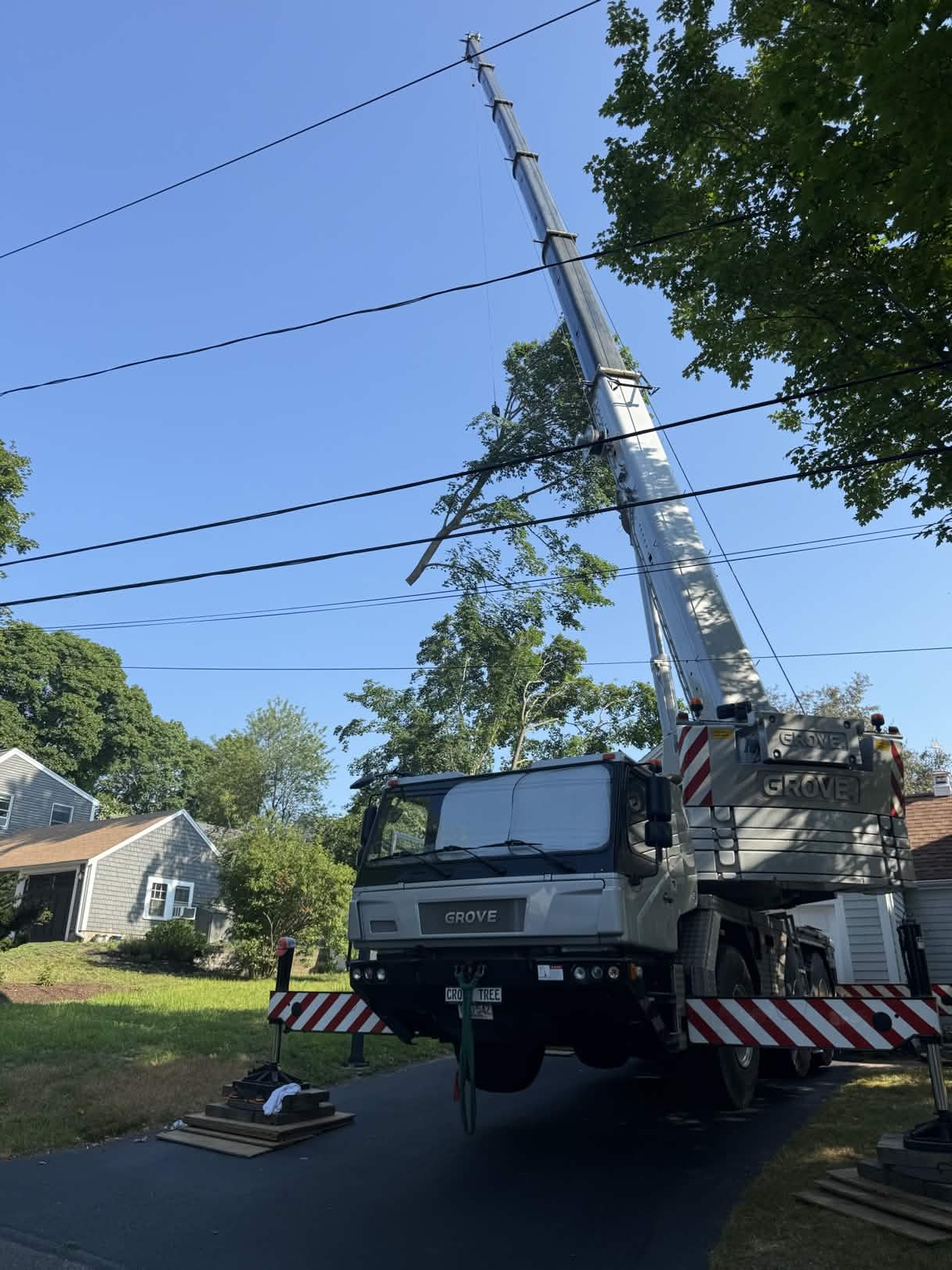
Safety protocols include spotters, traffic control on narrow Norwell roads, and storm delays. Equipment: Stein ropes, Petzl gear, Husqvarna saws. For your white pine near power lines, we coordinate with Eversource.
This process protects your trees for 20+ years, preventing split trunks in ice-damaged hardwoods. Schedule via 508-369-5009.
Common Lightning Protection Projects in Norwell Neighborhoods
Norwell's neighborhoods present distinct lightning protection needs, with Southeast Arborist tackling projects tailored to local tree stands and layouts.
In Norwell Center, heritage sugar maples and oaks along Main Street receive full ANSI systems. A recent project protected a 120-year-old red oak shading a colonial home: three air terminals intercepted a strike, saving $15,000 in removal. Dense canopies here encroach rooftops, so we integrate pruning.
Accord's white pine groves along narrow roads demand cable routing around power lines. We installed protection on a 70-foot stand threatening Central Street wires, using guy wires to stabilize post-ice storm leans. Grounding rods anchor in former pasture soils.
Ridge Hill large lots feature white oaks and hickory; one property got dual-tree systems for specimens near patios. Copper down-leads followed trunks without visible scarring, maintaining curb appeal amid new construction clearing.
Church Hill's riparian American beech along Indian Head Brook face wetland limits. Our counterpoise grounding preserved buffers while shielding from North River storms. Pruning cleared deadwood first.
Assinippi properties with red maples encroaching homes see combined hazard removal and protection. A black birch cluster got terminals after a near-miss strike scorched siding.
Bowker's wooded edges host tulip trees conflicting with driveways. We protected a row overhanging garages, with annual checks for salt corrosion.
Wildcat's remote lots battle white pine deadwood; installations here focus on crown terminals for height.
Tiffany Road estates protect red oaks predating 1849, blending aesthetics with function.
These projects highlight lightning protection Norwell MA for your neighborhood's risks. Call 508-369-5009.
Lightning Protection Costs in Norwell, MA
Lightning protection costs in Norwell MA vary by tree size, complexity, and site factors, but deliver strong ROI for your property.
Base pricing starts at $2,500 for a 40-60 foot red oak or white pine in Norwell Center—covering assessment, two air terminals, 100 feet copper cable, and single grounding rod. Mid-range $4,000-$6,000 suits 60-80 foot white oaks in Ridge Hill: extra conductors, pruning, and multi-rods for sandy loams.
Complex jobs hit $8,000-$12,000: multi-tree systems in Accord white pine stands near power lines add $1,500 coordination; wetland Assinippi beech require $2,000 counterpoise. Heritage maples on Main Street factor $1,000 for custom clamps.
Key factors: Tree height/species (tulip trees need more saddles, +20%); access (narrow Bowker roads add crane fees, $500); soil (wet Indian Head Brook cuts rod depth, saving $300); add-ons like drone surveys ($400).
Annual inspections cost $250-$400/tree, checking welds and resistance—essential in salty South Shore air.
Value: Prevents $20,000+ removals, per ISA data; boosts insurance discounts 5-10%; preserves $900K+ home values. Protected trees in Church Hill avoided $30K fire claims last season.
Compared to Scituate or Hingham, Norwell's wooded lots raise costs 15% due to buffers, but our Plymouth base keeps overhead low. Financing via tree care loans available.
Get a free quote at 508-369-5009—transparent, no surprises.
When to Schedule Lightning Protection in Norwell
Schedule lightning protection Norwell MA in spring (April-May) post-winter ice damage, before June peak storms. Norwell's thaw reveals weakened oaks; we prune and install ahead of humidity spikes.
Fall (September-October) works for dormant trees, minimizing sap flow risks on maples. Avoid summer rains disrupting grounding.
Urgency signs: Fresh strike scars (exploded bark) on white pines; leader scorch on hickories; smoke residue post-thunderstorm. Act within weeks to prevent rot.
Post-ice storm (February-March), inspect beeches for splits mimicking strikes. Dense canopies after leaf-out hide issues—schedule now.
Contact 508-369-5009 for urgent assessments; we prioritize Norwell properties.
Frequently Asked Questions About Lightning Protection in Norwell
**What is lightning protection for trees in Norwell MA?** ANSI A300 Part 4 systems with copper cables and rods that intercept strikes, safely conducting 200,000 amps to ground—vital for your red oaks amid Plymouth County storms.
**How long do systems last on Norwell trees?** 20-30 years with annual inspections; copper resists corrosion, but we check welds on Tiffany Road beeches yearly.
**Does it damage trees like white pines in Accord?** No—minimal drilling, growth-accommodating clamps per ISA standards preserve cambium on your narrow-road stands.
**Is permitting needed for Church Hill wetlands?** Yes, we handle Norwell Conservation filings for Indian Head Brook properties, ensuring buffer compliance.
**Can it protect multiple trees on Ridge Hill lots?** Absolutely—interconnected systems for oak clusters, sharing grounding for efficiency.
**What maintenance for Norwell Center heritage maples?** Annual visual/torque checks ($300); tighten after ice storms.
**Insurance benefits for Assinippi homes?** Many carriers discount 5-15% post-install; provide certification.
**DIY possible on Bowker tulip trees?** No—risks non-compliance, cambium damage; trust ISA Certified pros. Call 508-369-5009.
Lightning Protection Throughout Norwell
Southeast Arborist delivers lightning protection Norwell MA across all neighborhoods: Norwell Center heritage trees, Accord power line pines, Ridge Hill estates, Church Hill riparian zones, Assinippi maples, Bowker driveways, Wildcat stands, Tiffany Road specimens.
We extend to nearby Hingham, Scituate, Hanover, Rockland, Marshfield, Cohasset—your full South Shore partner.
Protect your trees today: 508-369-5009. Free assessments from Plymouth/Cohasset base.