
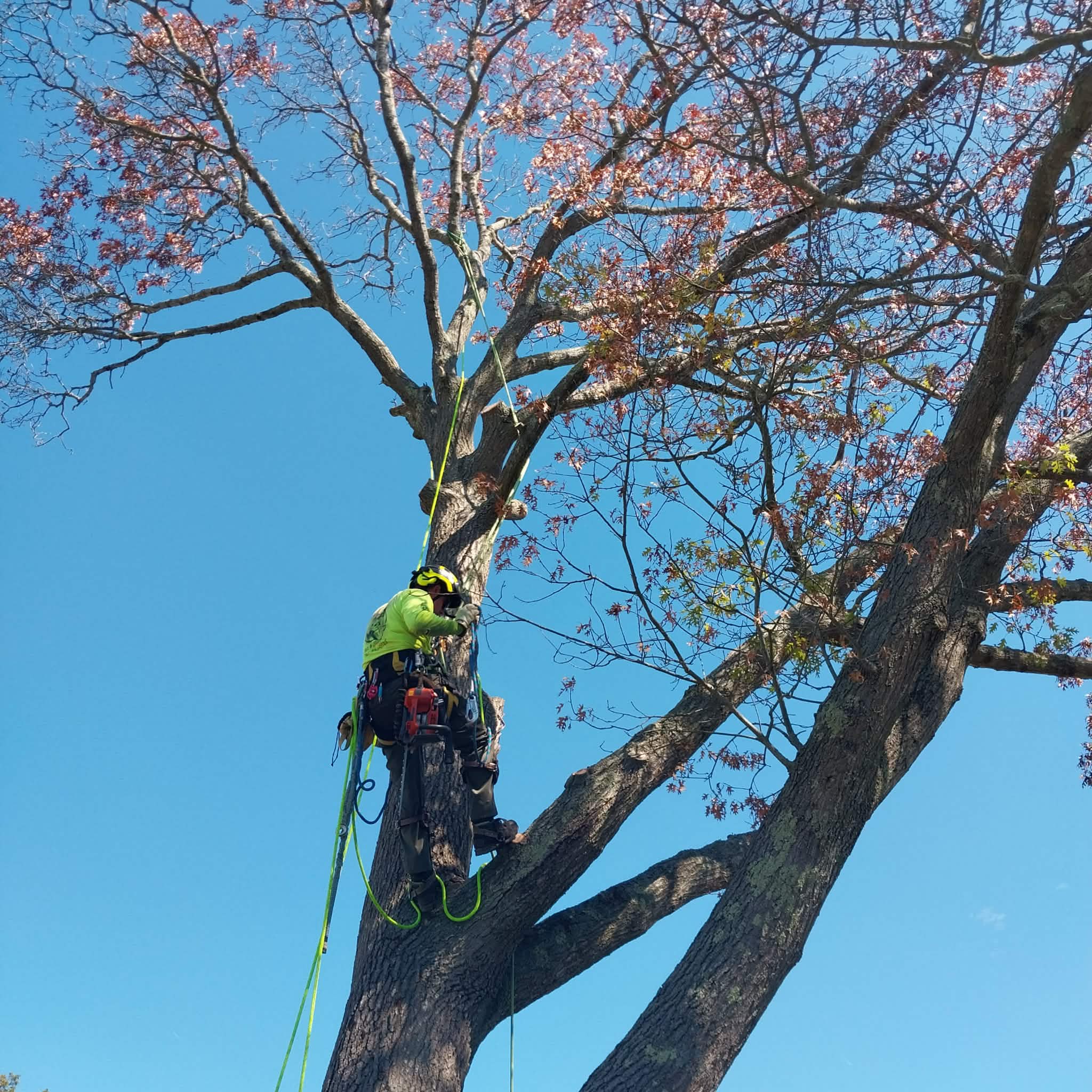
# Professional Tree Cabling in New Bedford, Massachusetts
If you own property in New Bedford, MA 02740, your trees face unique pressures from coastal winds, urban density, and aging infrastructure. Tree cabling in New Bedford MA provides essential structural support to prevent failures in these mature specimens. At Southeast Arborist, LLC, our ISA Certified Arborists install ANSI A300 compliant cabling systems that preserve your red oaks, Norway maples, and London planes without the need for full removal.
New Bedford's historic whaling legacy planted deep roots—literally—in its urban forest. The 19th-century civic improvements funded street trees lining neighborhoods like the South End and West End, while Buttonwood Park's Olmsted design from the 1890s features heritage sycamores and pin oaks still standing today. Yet, Buzzards Bay's salt-laden gales, spongy moth defoliation on oak stands, and the looming emerald ash borer threat weaken these trees. Dense growing conditions in Acushnet Heights and Brooklawn Park limit root expansion, creating codominant stems prone to splitting.
Tree cabling addresses these issues directly. High-strength steel cables or synthetic rods installed in the canopy reduce leverage on weak attachments, allowing your white pines and honey locusts to withstand nor'easters. Unlike bracing, which anchors at the trunk base, cabling focuses on branch unions, making it ideal for New Bedford's tall street trees exposed to 50+ mph sustained winds during storms like the 2023 nor'easter that downed dozens in Clark's Point.
Our team at Southeast Arborist, based in Plymouth and serving the South Shore Massachusetts region including Bristol County, follows rigorous safety protocols. We assess tree health using resistograph testing and visual tree risk assessments (VTA) before any installation. This approach saves homeowners in the North End and Near North from costly removals, often at half the price. For instance, cabling a mature red maple with included bark at a fork costs far less than crane removal on tight urban lots.
Preserving New Bedford's canopy matters. The city's diverse urban forest—red oaks in western neighborhoods, littleleaf lindens along boulevards, eastern red cedars near the Dartmouth border—filters stormwater from impervious surfaces and shades historic homes. Without intervention, storm damage escalates: coastal exposure at the harbor erodes structural integrity, turning your property's asset into a liability.
Southeast Arborist offers annual inspection programs tailored to New Bedford's conditions. Call our ISA Certified Arborists at 508-369-5009 for a free assessment. Whether managing utility clearances in the West End or safeguarding Buttonwood Park-adjacent properties, our tree cabling services extend tree life by decades. Homeowners report peace of mind after installations that held firm through recent hurricanes, proving cabling's value in this wind-swept port city.
Why New Bedford Properties Need Tree Cabling
New Bedford's coastal position in Bristol County exposes your trees to relentless challenges that demand tree cabling services. Buzzards Bay's prevailing southwest winds carry salt spray inland, stressing species like sycamores and London planes in waterfront areas such as Clark's Point. These trees develop V-shaped crotches with included bark—weak unions where bark grows between stems—making them prone to splitting under 40-foot canopies loaded with ice or storm gusts.
Consider red oaks, dominant in western neighborhoods like Acushnet Heights and Brooklawn Park. Spongy moth outbreaks since the 1980s have repeatedly defoliated these stands, reducing photosynthetic capacity and weakening wood. Combined with dense urban soils—compacted from 19th-century development and low in organic matter—roots struggle, shifting weight to upper branches. Tree cabling in New Bedford MA stabilizes these codominant leaders, preventing failures that could damage your roof or nearby vehicles.
Norway maples and red maples line streets in the South End and North End, planted during whaling-era expansions. Aging infrastructure means many exceed 80 years, with decay at branch collars from storm wounds. Emerald ash borer, now advancing from nearby Dartmouth, threatens any ash interplanted, but maples face similar risks from vascular issues. Cabling supports multi-stemmed forms common here, where sidewalk conflicts limit pruning options.
Honey locusts and pin oaks in Buttonwood Park and along Acushnet Avenue tolerate urban stress better but develop epicormic sprouts from repeated topping—a outdated practice still seen. These sprouts create weak attachments; cabling redirects forces away from them. White pines near the Fairhaven border, exposed to full maritime climate, suffer leader dieback from salt and wind, necessitating dynamic cabling to limit sway.
Eastern red cedars and littleleaf lindens at the Dartmouth border endure dry, sandy soils from glacial outwash, leading to leaners with asymmetric crowns. Coastal hurricanes—every major one since 1938 has tracked through southern New England—have scarred the canopy cumulatively. The 1954 Hurricane Carol snapped leaders across the city; recent nor'easters repeat the pattern in low-lying Near North.
Soil conditions exacerbate issues: alkaline pH from shell middens raises iron chlorosis in pin oaks, weakening vascular tissue. Poor drainage in clay-loams of the West End promotes buttress root decay, destabilizing London planes. Without cabling, a single failure risks insurance claims averaging $15,000 in property damage.
Tree cabling preserves heritage value. Buttonwood Park's Olmsted landscape relies on cabling specimen trees dating to 1890s plantings, maintaining the planned vistas. For your property, it averts removal costs—$2,000-$5,000 per tree in tight lots—and retains ecosystem services like intercepting 1,000 gallons of rainwater annually per mature canopy.
ISA Certified Arborists at Southeast Arborist identify risks via level 2 assessments, spotting defects invisible to untrained eyes. Practical advice: Inspect your red oaks post-spongy moth flights in June; if leaves show skeletonization and branches droop, schedule cabling before fall storms. Cabling outperforms propping in New Bedford's dynamic winds, dynamically absorbing motion without rigid restraint.
Our Tree Cabling Process in New Bedford
Southeast Arborist delivers ANSI A300 compliant tree cabling in New Bedford MA through a precise, safety-first process tailored to local conditions. We start with a site-specific risk assessment for your property in neighborhoods like the West End or Clark's Point.
Step 1: Visual Tree Risk Assessment (VTA). Our ISA Certified Arborists evaluate your trees—red oaks, white pines, or honey locusts—for targets (your home, driveway) and defects. We use binoculars and mallets to detect decay, then employ resistographs to core-sample wood density without scarring. In coastal New Bedford, we prioritize salt-weakened London planes and sycamores showing dieback.
Step 2: Aerial Inspection via Rope Access. Climbing with certified gear, we access branch unions 40-60 feet up. Drones supplement for white pines near power lines, identifying codominant stems with >45-degree angles—prime cabling candidates. We measure diameters at insertion points (DIP) per ANSI A300 standards, ensuring cables span 50-75% of the weak fork.
Step 3: Load Calculation and Design. Using software like Tree Risk Assessment Qualification (TRAQ), we model wind loads from Buzzards Bay data—up to 100 mph gusts in nor'easters. For a red maple in Acushnet Heights, we calculate cable tension to counter 20% of leverage, avoiding over-tightening that stresses bark. Synthetic rods replace steel for multi-stem eastern red cedars, flexing with sway.
Step 4: Pruning Preparation. We reduce end-weight on target branches per ANSI A300 pruning specs, removing 15-25% canopy selectively. This lion's tailing avoidance prevents wind sail effects on Norway maples in the South End. All cuts use three-point collars to promote compartmentalization.
Step 5: Cabling Installation. Drilling minimal 1-2 inch holes at 120-degree spacing around unions, we thread 1/4-1/2 inch EIP steel cables or polyester rods. Turnbuckles or come-alongs set initial tension to 5-10% of breaking strength, dynamically tested with pull loads. In Buttonwood Park heritage trees, we use tree-friendly lagging washers to distribute pressure on littleleaf linden bark.
Step 6: Bracing Integration if Needed. For basal defects in pin oaks, we add rod bracing below cables, anchored in sound wood. Guying supplements for leaners near the Dartmouth border, tensioned against ground anchors buried 4 feet in sandy soils.
Step 7: Hardware Markers and Documentation. UV-resistant tags mark installation date; we provide photos, load charts, and a maintenance schedule. Annual inspections check for elongation, corrosion from salt air, or shifting.
Equipment specifics: Petzl harnesses, CMI pulleys, and ArborMaster saws ensure ANSI Z133 safety compliance. Our crews carry spill kits for Buzzards Bay's sensitive wetlands. Post-install, we test sway reduction—often 30-50%—demonstrating stability to you on-site.
Practical tip: After cabling your red oak, mulch roots 3 inches deep (no volcanoes) to boost vigor against spongy moths. This process costs less than removal—save $1,500-$4,000—and extends life 20+ years. Southeast Arborist services all South Shore MA, from Fairhaven to Acushnet. Contact us at 508-369-5009 to start.
Common Tree Cabling Projects in New Bedford Neighborhoods
Tree cabling projects in New Bedford MA vary by neighborhood, addressing local tree species and hazards.
In the South End, dense streets feature Norway maples with storm-damaged crotches from 1938's Great New England Hurricane scars. We cable these for utility clearance, stabilizing forks over sidewalks.
West End red oaks, hit hardest by spongy moths in the 2020s, get dynamic cabling to support defoliated canopies. Tight lots demand rope access, preserving adjacent triple-deckers.
North End London planes along County Street—whaling-era plantings—require cabling at multi-leader unions weakened by salt and compacted soils. We integrate with street tree management for DPW compliance.
Near North properties near the Acushnet River cable pin oaks leaning from floodplain soils, countering wind sway toward homes.
Acushnet Heights honey locusts with epicormic growth from past topping receive end-weight reduction plus cabling, ideal for urban-tolerant species.
Brooklawn Park sycamores show included bark from ice storms; cabling preserves these over park paths, mimicking Buttonwood Park care.
Clark's Point coastal white pines endure gale-force winds; salt-tolerant cabling with synthetic materials prevents leader snaps during nor'easters.
Dartmouth border eastern red cedars and littleleaf lindens get guyed cabling for asymmetric growth on outwash sands.
Common across all: post-nor'easter response, like after 2023's storm, cabling survivors like red maples in Fairhaven-adjacent yards.
Our ISA Certified team handles these, from Buttonwood Park preservation to harbor storm prep. Call 508-369-5009.
Tree Cabling Costs in New Bedford, MA
Tree cabling costs in New Bedford MA range from $350-$1,200 per tree, far below $1,500-$6,000 removal averages on urban lots. Factors drive pricing precisely.
Tree size dominates: A 20-inch DBH red oak in the West End costs $450-$700; a 40-inch Buttonwood Park-era sycamore hits $900-$1,200 due to height and access.
Number of cables: Single union on a honey locust fork adds $300; multi-plane on codominant Norway maples requires 4-6 cables at $75 each, totaling $500+.
Species and condition: Softwood white pines or eastern red cedars drill easier ($50 less), but spongy moth-weakened red oaks need extra assessment ($100 add-on).
Access challenges: Clark's Point waterfronts incur $150 crane fees for aerial work; tight South End alleys use bucket trucks at no extra.
Add-ons like resistograph testing ($150) or annual inspections ($200/year) ensure longevity.
Value proposition: Cabling halves failure risk, per ISA studies, avoiding $10,000+ liability claims. In New Bedford, preserve heritage London planes for $800 versus $4,000 removal, retaining shade value (30% energy savings).
ROI example: A North End property cabling two pin oaks for $1,000 avoided a $12,000 roof repair post-nor'easter.
Southeast Arborist quotes transparently—no surprises. Free estimates factor Bristol County specifics like salt corrosion premiums. Finance options available. Cheaper than neglect: Unaddressed littleleaf lindens fail every storm season.
Practical budgeting: Prioritize trees over targets; cable now, inspect yearly. Call 508-369-5009 for your custom quote—ISA Certified savings await.
When to Schedule Tree Cabling in New Bedford
Schedule tree cabling in New Bedford MA from late spring to early fall—May-October—avoiding frozen soils or leaf-heavy canopies. Post-spongy moth flights in June-July, inspect oaks for weakness before August gales.
Urgency signs: Cracks at branch crotches on red maples; excessive lean (>15 degrees) in white pines; deadwood >25% canopy in London planes. Act pre-nor'easter season (October-March), when 70% failures occur.
Emergencies post-storm: After winds >50 mph, cable salvageable forks on honey locusts to prevent secondary damage.
Annual timing: Early spring for utility prunes; fall for root health checks aiding vigor.
Your property cue: If sycamores show bark splitting or pin oaks heave soil, call now—delays risk hurricanes.
Southeast Arborist prioritizes South Shore MA; 508-369-5009 gets rapid response.
Frequently Asked Questions About Tree Cabling in New Bedford
**What is tree cabling, and how does it help New Bedford trees?** Tree cabling installs flexible supports in canopies per ANSI A300 to limit weak branch movement. In New Bedford, it saves red oaks from spongy moth-weakened splits and white pines from coastal wind shear.
**How long does tree cabling last on my Clark's Point property?** 10-20 years with annual checks; salt accelerates wear, so inspect post-winter. Southeast Arborist tags hardware for easy monitoring.
**Is cabling safer than tree removal in dense neighborhoods like Acushnet Heights?** Yes—reduces risk 40-60% without disrupting urban lots. Crane removal risks power line strikes; cabling preserves your honey locust instantly.
**Will cabling damage my mature London plane?** No, ISA Certified installs use minimal drilling (1-inch holes seal via compartmentalization). We avoid over-tension harming bark.
**How much does tree cabling cost for a red maple in the South End?** $400-$800 based on size; often 30-50% less than removal, factoring utility clearance.
**Can you cable heritage trees near Buttonwood Park?** Absolutely—Olmsted specimens get custom dynamic systems matching historic tolerance.
**What's the difference between cabling and bracing?** Cabling supports upper canopies flexibly; bracing rods stabilize trunks. We combine for pin oaks with basal decay.
**Do you offer inspections for spongy moth-affected oaks in Brooklawn Park?** Yes, free initial VTA; annual program $200/tree prevents failures.
**How soon after a nor'easter can you cable in Near North?** 24-48 hours for stable trees; call 508-369-5009 for triage.
Tree Cabling Throughout New Bedford
Southeast Arborist provides tree cabling across New Bedford neighborhoods: South End street trees, West End oaks, North End maples, Near North riverfronts, Acushnet Heights locusts, Brooklawn Park sycamores, Clark's Point pines, and Dartmouth border cedars. We extend to Fairhaven, Acushnet, Dartmouth.
From Plymouth/Cohasset base, we cover South Shore Massachusetts efficiently. ISA Certified, ANSI A300 compliant.
Protect your trees—call 508-369-5009 today for service.