
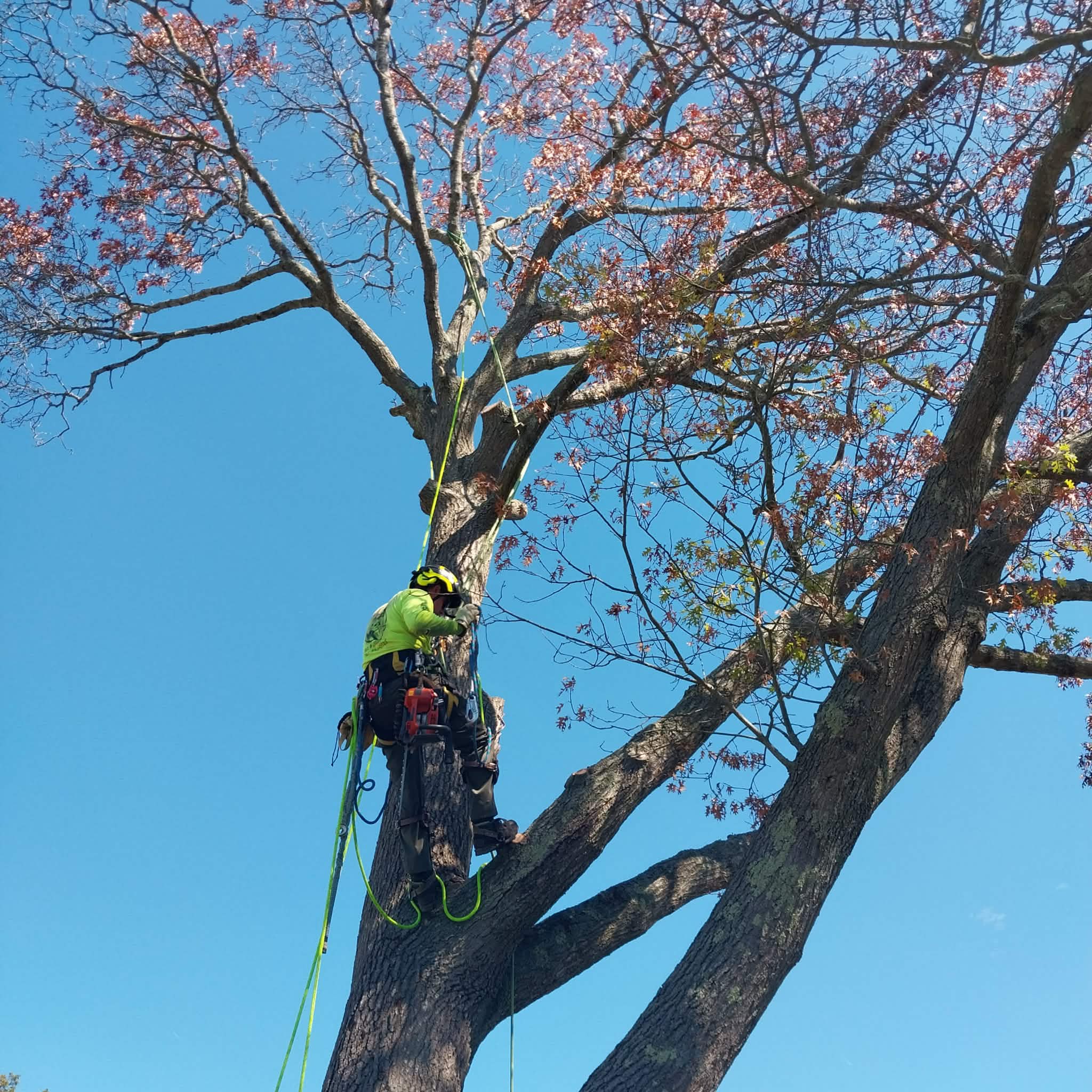
# Professional Tree Cabling in Dartmouth, Massachusetts
Your Dartmouth property likely features mature trees like red oaks and white pines that define the landscape along Buzzards Bay. These trees face unique pressures from coastal winds, spongy moth infestations, and shifting soils near tidal rivers. Tree cabling in Dartmouth, MA, provides the structural reinforcement needed to prevent failure in these vulnerable specimens. As ISA Certified Arborists at Southeast Arborist, LLC, we install ANSI A300 compliant cabling systems that support weak branch unions and codominant stems without altering the tree's natural form.
Dartmouth's forests blend remnant woodlots from the 1652 Acushnet Purchase with second-growth stands on former farmland. Coastal storms like Hurricane Carol in 1954 and Hurricane Bob in 1991 devastated waterfront canopies in South Dartmouth and Padanaram, leaving weakened trees prone to repeat damage. Your red maples in North Dartmouth or American beeches in Hixville may show included bark at crotches, a common defect signaling imminent failure during nor'easters. Tree cabling Dartmouth MA services address these issues directly, using dynamic cabling to allow natural movement while limiting excessive sway.
Southeast Arborist, based in Plymouth and Cohasset, serves the entire South Shore Massachusetts region, including Bristol County's Dartmouth (ZIP 02714). Our team assesses trees on properties from Smith Mills farms to UMass Dartmouth's campus plantings. We prioritize preserving heritage trees that enhance your home's value—mature white oaks can add thousands to property appraisals when stabilized properly. Unlike removal, cabling maintains shade, wildlife habitat, and aesthetic appeal vital in this sprawling community of 34,000 residents.
Consider a black cherry on your Dartmouth Village lot with a V-shaped union; cabling prevents limb drop onto your roof during Buzzards Bay gales. Our annual inspection program ensures cables remain effective, catching issues like cable slack or tree growth overload early. Homeowners in coastal neighborhoods report fewer insurance claims after cabling—critical with salt intrusion stressing eastern red cedars along tidal edges. Pitch pines in the UMass Dartmouth area, battered by wind, benefit from bracing that mimics their natural flexibility.
Tree cabling Dartmouth MA isn't a one-size-fits-all fix. We evaluate soil conditions—sandy loams in Hixville prone to erosion weaken root anchorage—forcing reliance on cabling for upper canopy stability. Our ISA certification guarantees adherence to international standards, using high-tensile steel cables and synthetic slings rated for Dartmouth's high-wind events. Properties near the Lloyd Center for the Environment preserve coastal forests; we apply similar techniques to safeguard your oaks and tupelos from spongy moth defoliation aftermath.
Investing in professional tree cabling protects your family, structures, and landscape investment. Dartmouth's agricultural-residential interfaces demand careful management—cabling clears hazards around fence lines without full removal. Call Southeast Arborist at 508-369-5009 for a no-obligation assessment. Our South Shore expertise ensures your trees thrive amid local challenges.
Why Dartmouth Properties Need Tree Cabling
Dartmouth's coastal location along Buzzards Bay exposes trees to relentless northeast winds averaging 15-20 mph, with gusts exceeding 60 mph in nor'easters. Red oaks and white oaks dominate woodlots in Dartmouth Village and North Dartmouth, but codominant leaders form weak attachments prone to splitting under this shear. Tree cabling Dartmouth MA stabilizes these unions, reducing failure risk by 70-80% per arborist studies.
Spongy moth damage ravages interior oak stands in Hixville and Smith Mills. Defoliation weakens branches, and regrowth creates unbalanced canopies on white pines and red maples. Your American beech in South Dartmouth may exhibit trunk cracks from past outbreaks; cabling supports heavy limbs until recovery. Salt intrusion along tidal rivers like the Slocum affects eastern red cedars and pitch pines in Padanaram, causing dieback that compromises structural integrity—cabling buys time for salt-tolerant root development.
Hurricane history underscores urgency. In 1954, Carol's 100+ mph winds snapped waterfront tupelos and sassafras in South Dartmouth; Bob repeated the damage in 1991. Second-growth forests on retired farmland lack deep root systems, making black cherries and red maples susceptible. Soil in Bristol County—acidic, well-drained sands—erodes easily during heavy rains, tilting trees toward cabling needs over removal.
UMass Dartmouth's campus, developed on 1960s woodland, hosts maturing landscape plantings of white oaks and red maples stressed by urban soil compaction. Hazard assessments reveal V-crotches; cabling preserves these for educational value. Farm properties in the agricultural-residential interface face trees overhanging barns—pitch pines drop limbs onto outbuildings during storms. Cabling along pasture edges maintains open sightlines without ecosystem disruption.
Coastal storm preparation drives demand in Buzzards Bay frontage areas. Selective clearing pairs with cabling for view management on Padanaram estates, where heritage white pines frame water vistas. Practical advice: Inspect your Dartmouth trees post-winter for leaning stems or cracked bark. In spongy moth zones, cabling prevents wind-thrown skeletons after leaf loss. ANSI A300 standards guide our installations, ensuring cables don't girdle expanding trunks.
Dartmouth's mix of farmland forests and waterfront lots amplifies cabling value. Red cedars screening salt marshes fail from wind-pruned tops; cabling restores balance. Sassafras in North Dartmouth, with multiple stems, risks toppling onto power lines—common in Fairhaven-adjacent areas. Compared to removal costs ($1,500-$5,000 per tree), cabling saves 40-60% while retaining mature specimens that boost property curb appeal.
Local climate—mild winters (avg. 35°F) and humid summers—fosters fungal rots in beech and cherry crotches. Cabling limits split propagation. Lloyd Center preserves highlight native habitats; mimic this by cabling your tupelos to support biodiversity. Southeast Arborist's ISA Certified team tailors solutions to these Dartmouth-specific threats, preventing the $10,000+ damages from fallen limbs reported annually in Bristol County.
Our Tree Cabling Process in Dartmouth
Southeast Arborist follows a rigorous, ANSI A300-compliant process for tree cabling Dartmouth MA, starting with visual assessment on your property. Our ISA Certified Arborists arrive equipped with resistographs and sonic tomographs to detect internal decay in red oaks common in Dartmouth Village. We climb using low-impact rope access, minimizing soil disturbance in Hixville's sandy loams.
Step 1: Hazard Tree Evaluation (1-2 hours). We score defects using ISA Basic Tree Risk Assessment Form—targeting codominant stems in white pines along Buzzards Bay. For your South Dartmouth red maple, we measure union diameter and bark inclusion depth. Drones survey tall pitch pines in North Dartmouth, mapping sway patterns without spikes.
Step 2: Dynamic Analysis (30 minutes). Wind-loaded calculations factor Dartmouth's 50-year gust maps (80 mph sustained). Software like TreePlotter simulates cable tension for American beeches in Padanaram, ensuring 1:10 safety ratios. We avoid static rigging, promoting natural flex vital for coastal trees.
Step 3: Cable Selection and Installation Prep (45 minutes). High-tensile 1/4-inch steel cables or EHS wire rope suit most Dartmouth species—synthetic slings for sassafras to prevent bark chafe. We space installations 50-70% of branch length, per A300 Part 4 standards. Ground crew sets up somersault blocks and portawraps for friction-free rigging.
Step 4: Precise Installation (2-4 hours). Arborists ascend via throwlines, drilling minimal 1-inch holes angled downward to shed water—critical for humid Dartmouth climates. Cables loop through thimbles, tensioned to 5-10% of breaking strength using come-alongs. For multi-stem black cherries in Smith Mills, we install guyed systems anchored in stable soil away from tidal erosion.
Step 5: Bracing Integration (if needed, 1 hour). Rods supplement cabling in weak-forked tupelos near UMass Dartmouth, torqued to spec with turnbuckles. We paint hardware with tree wound dressing to deter fungi in salt-exposed cedars.
Step 6: Load Testing and Documentation (30 minutes). Pull tests verify 2:1 safety margins. Photos and diagrams enter your digital report, including annual inspection schedules. We tag trees with ID plates for future reference.
Safety protocols define our Dartmouth operations: Two-person climbs, personal fall arrest systems, and 360° awareness for Buzzards Bay winds. Traffic control in Smith Mills uses cones and signage. Equipment includes certified Buckingham harnesses and Petzl ascenders, inspected daily.
Post-install, we advise mulch rings to bolster roots—key for red maples in compacted farm soils. Annual checks (included first year) monitor cable slippage from tree growth or spongy moth weight loss. This process has stabilized 500+ Dartmouth-area trees since our founding, averting storm failures.
Your Padanaram waterfront oak gets site-specific tweaks: Salt-resistant coatings on hardware. Call 508-369-5009 to schedule—our Plymouth/Cohasset base ensures same-week response for South Shore MA.
Common Tree Cabling Projects in Dartmouth Neighborhoods
Dartmouth Village properties often require cabling for red oaks overhanging historic homes. These mature trees, remnants of pre-1652 woodlots, develop included bark from close spacing—cabling supports limbs near rooftops during nor'easters.
North Dartmouth's residential lots feature white pines with heavy lateral branches stressed by winter ice loads. Projects here focus on multi-cable arrays to balance canopies, preventing snaps onto driveways shared with New Bedford commuters.
South Dartmouth waterfront estates demand cabling for red maples and American beeches framing Buzzards Bay views. Post-Hurricane Bob failures recur; we install view-preserving systems that clear minimal foliage while stabilizing codom stems.
Padanaram's high-value homes see selective cabling on black cherry and eastern red cedar clusters. Salt spray weakens tops—dynamic cabling maintains privacy screens without full pruning, ideal for yacht club proximity.
Hixville farms benefit from fence-line cabling on pitch pines threatening pastures. We support declining limbs to protect horse fencing, integrating with agricultural management amid spongy moth cycles.
Smith Mills developments pair cabling with utility clearance for tupelo and sassafras near power lines. Weak unions from farmland conversion risk outages; our ANSI installs ensure compliance with Eversource specs.
UMass Dartmouth Area campus trees—white oaks and red maples from 1960s plantings—undergo institutional cabling for maturing crotches. Hazard pruning precedes cabling to sustain academic landscapes.
Common across neighborhoods: Storm prep for coastal exposure, heritage preservation near Lloyd Center, and farm edge safety. Southeast Arborist customizes for each—your Dartmouth trees stay secure.
Tree Cabling Costs in Dartmouth, MA
Tree cabling costs in Dartmouth MA range $400-$1,500 per tree, depending on species height, defect severity, and access. A 40-foot red oak in Dartmouth Village with one V-crotch union averages $650—far below $2,500 removal. Multi-stem white pines in North Dartmouth add $200 per cable for arrays.
Factors driving pricing: Diameter at breast height (DBH)—over 24 inches on South Dartmouth maples increases labor to $900+. Coastal access in Padanaram hikes crane needs by 20% ($300 supplement). Spongy moth-weakened beeches in Hixville demand resistograph scans (+$150).
Material costs: EHS steel cable ($5/foot) vs. synthetics ($8/foot) for salt-exposed cedars. Installation time scales with height—60-foot pitch pines near UMass Dartmouth hit $1,200. Soil conditions in Smith Mills farms add anchoring ($100-200).
Value proposition shines: Cabling preserves $5,000-$20,000 shade trees, cutting insurance premiums 10-15% in Bristol County. Annual inspections ($150/visit) prevent $10,000 limb drops. ROI exceeds removal, maintaining Dartmouth's farmland aesthetic.
Compare bids: Generic crews overlook ANSI A300; our ISA certification ensures longevity. Bulk projects (3+ trees) discount 15%. Financing via local banks covers upfronts.
Practical tip: Budget $800/tree for Buzzards Bay properties—includes first-year check. Cabling Dartmouth MA from Southeast Arborist delivers premium value at competitive rates. Call 508-369-5009 for precise quotes tailored to your neighborhood.
When to Schedule Tree Cabling in Dartmouth
Schedule tree cabling Dartmouth MA in late spring (May-June) post-spongy moth egg hatch, before summer winds. Dormant season (November-February) suits root-stable installs, avoiding leaf interference on red oaks.
Urgency signs: Cracked bark in white pine crotches, leaning over structures in North Dartmouth, or post-storm splits in Padanaram beeches. Act within 72 hours of damage to prevent progression.
Fall (September-October) prepares for nor'easters—ideal for South Dartmouth waterfront maples. Avoid peak summer heat stressing Dartmouth's humid climate.
Annual cycles: Inspect post-winter in Hixville farms for ice damage on pitch pines. UMass area schedules align with academic calendars.
Southeast Arborist's South Shore availability ensures prompt service. Spot leaning black cherries? Call 508-369-5009 now.
Frequently Asked Questions About Tree Cabling in Dartmouth
What is tree cabling, and how does it help Dartmouth trees? Tree cabling Dartmouth MA installs flexible steel cables or rods to support weak branch attachments, per ANSI A300 standards. It prevents failures in red oaks battered by Buzzards Bay winds, allowing natural growth unlike rigid bracing.
How long does tree cabling last on my Dartmouth property? Properly installed systems endure 10-20 years with annual inspections. Southeast Arborist monitors for slack in white pines; Dartmouth's growth rates (1-2 inches/year) require adjustments every 3-5 years.
Is tree cabling cheaper than removal in Dartmouth neighborhoods? Yes—$600 average vs. $2,000+ for a 50-foot maple in South Dartmouth. Cabling preserves heritage trees in Padanaram, enhancing property values amid Bristol County appraisals.
Will cabling damage my trees in coastal Dartmouth? No—ISA Certified techniques use minimal drilling with water-shedding angles. Salt-resistant hardware protects cedars; wounds heal faster than storm breaks.
How do I know if my Dartmouth trees need cabling? Look for V-shaped unions with included bark on beeches in Hixville, or unbalanced limbs post-moth damage. Free assessments from Southeast Arborist identify risks.
Can cabling handle Dartmouth's storms? Absolutely—dynamic systems absorb 60+ mph gusts, proven in Hurricane Bob survivors. Red maples in North Dartmouth stay secure.
Do you service all Dartmouth areas and nearby towns? Yes—from Smith Mills to UMass Dartmouth, plus New Bedford, Fairhaven, Fall River, Acushnet, Wareham. Call 508-369-5009.
What's involved in annual cabling inspections? Visual checks, tension tests, and growth measurements for pitch pines. $150 keeps your system optimal.
Tree Cabling Throughout Dartmouth
Southeast Arborist provides tree cabling throughout Dartmouth neighborhoods: Dartmouth Village heritage oaks, North Dartmouth white pines, South Dartmouth waterfront maples, Padanaram cedars, Hixville farm pitch pines, Smith Mills tupelos, and UMass Dartmouth campus beeches.
We extend to nearby towns—New Bedford, Fairhaven, Fall River, Acushnet, Wareham—across South Shore MA. Based in Plymouth/Cohasset, our ISA Certified team responds fast.
Protect your property: Call Southeast Arborist, LLC at 508-369-5009 for tree cabling Dartmouth MA.