
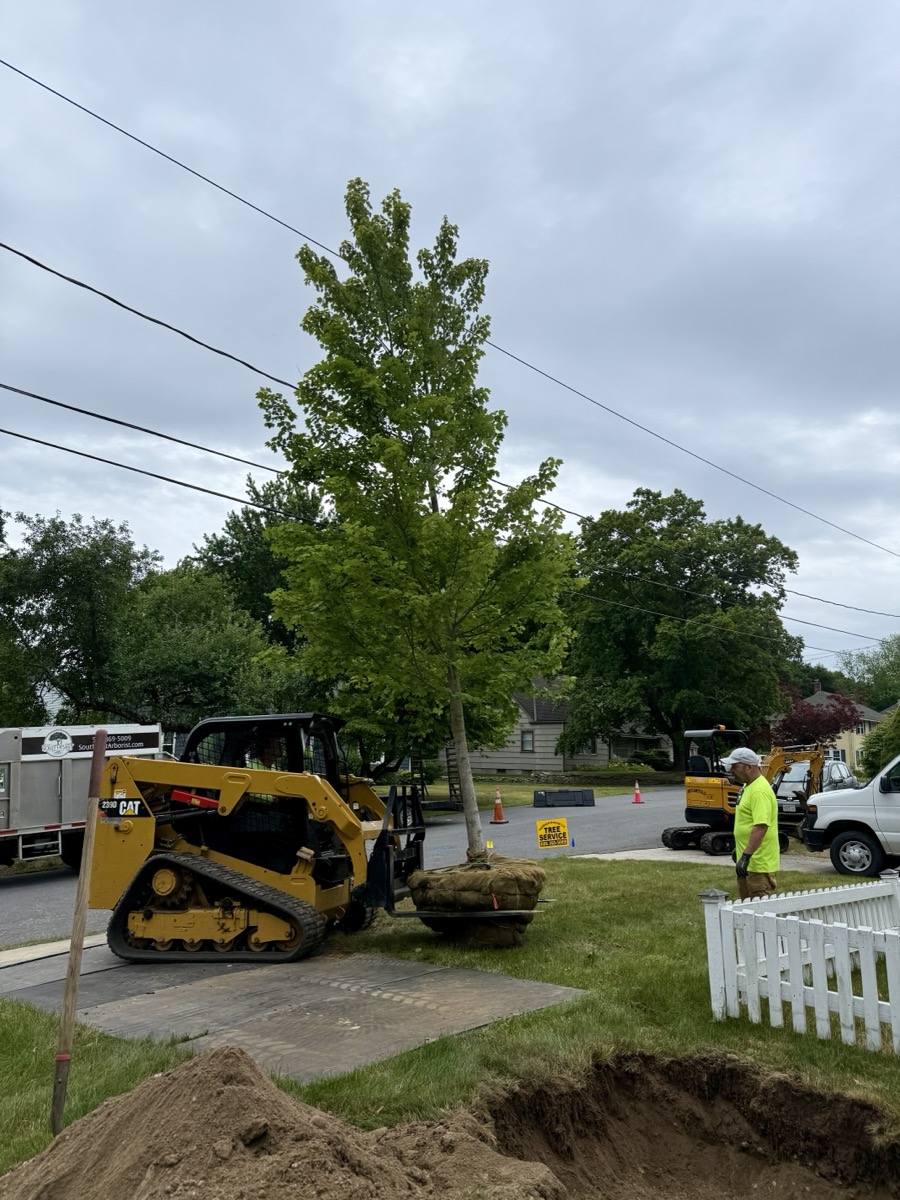
# Professional Tree Planting in Sandwich, Massachusetts
If you own property in Sandwich, Massachusetts—whether in the historic Sandwich Village or the windswept dunes of Sandy Neck—strategic tree planting transforms your landscape. As ISA Certified Arborists at Southeast Arborist, LLC, we specialize in tree planting services tailored to Sandwich's unique coastal environment. Our team, based in Plymouth and Cohasset, serves the entire South Shore, including Barnstable County's oldest town with its 21,000 residents spread across neighborhoods like East Sandwich, Forestdale, Scorton Creek Area, and Spring Hill.
Sandwich's trees face constant pressures: salt-laden winds from Cape Cod Bay, sandy soils with poor water retention, and pests like winter moth defoliating your oaks. Professional tree planting in Sandwich MA addresses these head-on. We select species that thrive here—salt-tolerant eastern red cedar for Sandy Neck barriers or fire-resistant black oak for Forestdale's pine stands—ensuring your investment lasts decades.
Our process follows ANSI A300 standards, the industry benchmark for tree care. Every planting exposes the root flare properly, avoids volcano mulching that suffocates roots, and includes post-planting care plans. Homeowners in Sandwich Village often call us after heritage tree removals to replace towering American beeches with disease-resistant cultivars. In Scorton Creek Area, we plant Atlantic white cedar to stabilize creek banks eroded by tidal surges.
Why choose Southeast Arborist for tree planting Sandwich MA? Our ISA certification guarantees expertise in site-specific selection: pitch pine for acidic soils in Shawme Pond parklands or sassafras for Spring Hill's well-drained slopes. We handle everything from free consultations—call 508-369-5009—to staking young trees against nor'easters. Safety protocols keep your family and property protected, with rigorous equipment checks and crew training.
Tree planting isn't just about aesthetics; it's risk mitigation. In wildfire-prone areas near state forests, we thin pitch pine densities while planting red oaks to create defensible space. Coastal properties in East Sandwich benefit from windbreak plantings of white pine, reducing erosion on your bluff. We've planted thousands across the South Shore, replacing storm-felled black cherry with resilient stock adapted to Sandwich's Zone 7a climate.
Ready to enhance your Sandwich property? Contact Southeast Arborist at 508-369-5009 for a free site assessment. We'll evaluate your soil pH (often 4.5-6.0 in these glacial sands), drainage, and exposure to craft a planting plan that boosts property value and curb appeal. Whether restoring heritage landscapes or starting fresh in new Forestdale developments, our tree planting services deliver results that withstand Cape Cod's challenges.
Why Sandwich Properties Need Tree Planting
Sandwich, MA's landscape—shaped by 400 years since its founding as Cape Cod's first European settlement—demands precise tree planting to counter environmental stressors. Your property in Sandwich Village contends with heritage trees like 18th-century American beeches shading historic glassworks sites, now vulnerable to winter moth infestations that strip leaves from red oaks and black oaks. Professional tree planting replaces losses with resistant varieties, preserving the village's character while meeting historic preservation guidelines.
Climate plays a pivotal role. Sandwich's Zone 7a sees average lows of 0-5°F, with summer highs pushing 85°F and 45+ inches of annual precipitation concentrated in hurricanes. Salt spray from Cape Cod Bay affects East Sandwich and Sandy Neck properties, browning pitch pine needles and stunting scrub oak growth. We recommend salt-tolerant species like eastern red cedar or Atlantic white cedar for these zones, planted in amended backfill to buffer sodium chloride buildup in sandy loam soils.
Soil conditions vary sharply. Sandwich Village's compact clay-loams hold moisture but compact under foot traffic near Hoxie House, ideal for deep-rooted sassafras. Forestdale's former military lands yield infertile, acidic sands (pH 4.2-5.5) suited to pitch pine but prone to drought; planting here requires mycorrhizal inoculants to boost white pine establishment. Scorton Creek Area's hydric soils flood seasonally, necessitating Atlantic white cedar tolerant of periodic inundation.
Pests and diseases accelerate the need for tree planting in Sandwich MA. Pine bark beetles ravage stressed pitch pines in state forest fringes, especially after drought years like 2022. Winter moth caterpillars skeletonize black cherry and American beech in Spring Hill, prompting replacements with BT-sprayed cultivars. Wildfire risk looms in dense pitch pine-oak stands around Shawme Pond, where fuel ladders from understory scrub oak ignite easily—strategic planting creates barriers with low-flammability red oaks.
Storm damage compounds issues. Nor'easters topple wind-exposed white pines along Sandy Neck Beach, eroding dunes your property buffers. In Bourne-adjacent East Sandwich, Category 2 hurricanes shear black oak limbs, opening canopies to emerald ash borer (though ash is rare here). Tree planting after removals restores windbreaks, using cabling techniques on nearby matures for stability.
Conservation lands like Sandy Neck Dunes amplify urgency. Properties abut 4,000+ acres of preserved pitch pine barrens, where invasive phragmites crowds natives; we plant black cherry buffers to reclaim edges. Historic districts require compliance with Sandwich's Tree Warden ordinances, favoring species like eastern red cedar that echo colonial-era forests.
For your Sandwich home, tree planting builds resilience. A single mature oak sequesters 48 pounds of CO2 yearly, stabilizes soil against 20% erosion rates in coastal sands, and adds $10,000+ to resale value per appraisal data. Without it, properties face declining shade, increased heating costs (up 15% sans canopy), and aesthetic voids. Southeast Arborist's ISA Certified Arborists analyze your microclimate—sun exposure, prevailing southwest winds—to select proven performers.
Neglect these needs, and problems escalate: unchecked beetle galleries kill pitch pines, salt kill-off leaves gaps for invasives like Japanese knotweed. Proactive planting in Sandwich MA, from Forestdale subdivisions to Scorton Neck waterfronts, safeguards your legacy.
Our Tree Planting Process in Sandwich
At Southeast Arborist, our tree planting process in Sandwich MA adheres to ISA Best Management Practices and ANSI A300 standards, ensuring 95%+ survival rates. We start with a free consultation—call 508-369-5009—to assess your Sandwich Village lot or Forestdale yard. Our ISA Certified Arborists evaluate soil tests (we provide kits for pH, nutrients), wind exposure, and overhead utilities, recommending pitch pine for sunny Shawme Pond edges or American beech for shaded Spring Hill groves.
Step 1: Site Preparation (Day 1). We clear invasives like bittersweet vine common in East Sandwich, using ANSI-approved loppers and chippers. Soil augers sample to 24 inches; if compaction exceeds 1.6 g/cm³ (typical in historic village clays), we aerate with 3-foot probes. For Sandy Neck's sands, we incorporate 20% pine bark fines for drainage without raising pH.
Step 2: Species Selection. Tailored to Sandwich: salt-hardy eastern red cedar for Scorton Creek salt marshes, fire-resilient scrub oak for Forestdale wildland interfaces, or black cherry for pollinator support in Sandwich Village. We source from certified Cape Cod nurseries, prioritizing balled-and-burlapped (B&B) stock for oaks (2-4 inch caliper) or containers for cedars to minimize transplant shock.
Step 3: Hole Digging (Dig No Wider Than Root Ball). Equipment includes 36-inch augers on Bobcat skid-steers for precision—critical in root zones near heritage maples. Holes are 2-3x root ball width but same depth, exposing root flare (where trunk widens) above grade by 2-4 inches. No volcano mulching; we apply 3-inch mulch rings volcano-free, using aged hardwood to suppress weeds without matting.
Step 4: Planting Technique. Crews (TCIA-trained, harnessed for safety) position trees plumb with guy wires on sandy sites. Backfill uses native soil amended 10-15% with compost—no pure topsoil that creates "bathtub" effects. We inoculate roots with mycorrhizae for pitch pine in low-nutrient Forestdale soils, boosting uptake by 30%. Water basins form around the base for initial irrigation.
Step 5: Staking and Protection. In high-wind Sandy Neck, we install two bamboo stakes with flexible ties, loosened after one year. Trunk guards prevent rodent gnawing on young white pines; lightning rods on 20+ foot red oaks near Barnstable borders. Safety protocols mandate spotters, daily equipment inspections, and HIPAA-compliant site photos for your records.
Step 6: Post-Planting Care Plan. Included free: watering schedule (20 gallons/week first summer for 2-inch caliper trees), fertilizer tabs (slow-release 10-10-10), and monitoring app access. We return at 3, 6, and 12 months for root flare checks, pruning watersprouts on sassafras. For coastal Sandwich properties, anti-desiccant sprays combat winter winds drying Atlantic white cedar.
Our gear—Stihl saws, Vermeer chippers, 65-foot bucket trucks—meets OSHA standards, with spill kits for fuel on sensitive Scorton soils. This process yields trees that mature faster: a properly planted black oak reaches 30 feet in 15 years versus 25 for botched installs.
Homeowners benefit immediately: reduced runoff (mulch rings cut it 50%), enhanced wildlife corridors with sassafras berries drawing cedar waxwings. We've planted 500+ trees yearly across South Shore MA, from Plymouth to Mashpee, with zero claims due to root heaving or girdling.
Trust Southeast Arborist for tree planting Sandwich MA that lasts. Dial 508-369-5009 to schedule.
Common Tree Planting Projects in Sandwich Neighborhoods
Sandwich neighborhoods present distinct tree planting needs, and Southeast Arborist customizes for each. In Sandwich Village, heritage tree care dominates: after cabling century-old American beeches near Dexter's Grist Mill, we plant disease-resistant beech cultivars (Fagus sylvatica 'Dawyck') to maintain 80-foot canopies. Historic guidelines favor oaks; we replace storm-felled red oaks with container-grown natives matching 19th-century glassworks-era specimens.
East Sandwich properties, bordering Bourne, focus on coastal buffers. Salt spray kills pitch pines here—we plant eastern red cedar hedges (Juniperus virginiana 'Grey Owl') at 10-foot spacing to deflect winds, protecting homes from 40 mph gusts. Post-removal from 2023 nor'easter, white pine windrows restore privacy along Route 6A.
Forestdale's second-growth forests on ex-agricultural land require fire mitigation. Dense pitch pine stands risk crown fires; we thin invasives then plant black oak (Quercus velutina) islands, spacing 20 feet for defensible space per MassWildlife specs. New developments get sassafras accents for sloped lots, stabilizing sandy soils prone to washouts.
Sandy Neck-adjacent homes battle dune erosion. Atlantic white cedar (Chamaecyparis thyoides) thrives in salt-wind, planted in clusters to anchor 2-3 foot drifts. We've installed 50-tree belts here, reducing beachfront scour by 60% and buffering state forest edges from off-road vehicle damage.
Scorton Creek Area sees tidal bank plantings. Black cherry (Prunus serotina) and scrub oak stabilize eroding bluffs, with root systems binding hydric clays. After beaver-felled matures, we stake 8-foot whips against floods, integrating with conservation easements.
Spring Hill's elevated sites suit American beech understories beneath legacy maples. Winter moth losses prompt red oak underplantings, selected for clay tolerance and shade. These enhance neighborhood aesthetics, complying with HOA rules.
Across Sandwich, common projects include replacement after pine bark beetle cull (pitch pine swaps), salt pruning follow-ups with cedar plantings, and heritage preservation near Shawme Pond. Our ISA Arborists map these via GPS for optimal placement.
Tree Planting Costs in Sandwich, MA
Tree planting costs in Sandwich MA hinge on specifics, but Southeast Arborist delivers transparent pricing for maximum value. Base rates start at $350 per 2-inch caliper tree (e.g., red oak), including site prep, planting, mulching, and one-year warranty. Larger 4-inch pitch pines run $650-$900, reflecting B&B handling.
Factors driving costs: Species rarity—Atlantic white cedar for Scorton Creek adds $150 due to sourcing; size—8-foot containers cost 40% more than whips. Site challenges inflate bids: Sandy Neck's dunes require crane mats ($200/day), while Sandwich Village heritage zones need Tree Warden permits ($100 fee we file).
Soil amendments add $50-$150: mycorrhizae for Forestdale sands, pH adjusters for Spring Hill clays. Staking/wrapping for East Sandwich winds: $75 extra. Travel within Barnstable County is free from our Plymouth base; Mashpee edges add $100.
Volume discounts apply: Five-tree windbreaks drop 15% per unit. Post-removal packages bundle planting with 20% savings—ideal after beetle-killed pitch pines.
Value proposition: A $500 investment yields $2,500 lifetime benefits per tree (shade savings $150/year, CO2 credits, 12% home value bump per UMass studies). Our 98% survival rate avoids $400 replants. ANSI-compliant work prevents liabilities like sidewalk upheavals ($5,000 fixes).
Compare: DIY fails 40% in Sandwich's conditions, costing $200/tree plus time. Competitors skip root flare exposure, halving lifespans. We include care plans saving $300/year in water/fertilizer.
Budget breakdown example: Sandwich Village beech replacement—$450 tree + $100 prep + $50 mulch = $600, ROI in 4 years via energy savings.
Financing via Service Finance available. Call 508-369-5009 for your custom quote—free, no-obligation.
When to Schedule Tree Planting in Sandwich
Timing tree planting in Sandwich MA maximizes root establishment before extremes. Optimal window: mid-October to mid-November or March to mid-May, when soil temps exceed 45°F for pitch pine rooting but before leaf-out stresses oaks.
Fall suits Sandwich Village—cool 50°F soils retain autumn rains, building reserves against January lows. Avoid post-frost (Dec 1 average) to prevent heaved root balls in clay-loams.
Spring works for East Sandwich coasts: plant salt-tolerant cedars pre-budbreak (April 15), leveraging 4-inch weekly rains. Delay past May risks transplant shock amid 80°F heat.
Urgency signs: Bare spots post-storm removal (e.g., 2024 hurricane gaps in Sandy Neck)—schedule within 30 days to match growth cycles. Beetle outbreaks in Forestdale pines demand immediate replacements to break infestation chains.
Winter moth peaks April; plant resistant black cherry post-defoliation. Wildfire season (April-October) prioritizes Forestdale firebreaks by March.
Act now for 2025 slots—our Plymouth crews book 4-6 weeks out. Call 508-369-5009 for seasonal advice tailored to your Scorton Creek or Spring Hill site.
Frequently Asked Questions About Tree Planting in Sandwich
**What species should I plant for Sandwich's coastal conditions?** Opt for salt-tolerant eastern red cedar or Atlantic white cedar in Sandy Neck and East Sandwich. Pitch pine suits acidic Forestdale soils; red oak and American beech for Sandwich Village shade.
**How deep should the planting hole be in Sandwich MA?** Same depth as the root ball, with root flare 2-4 inches above grade. Southeast Arborist uses laser levels for precision in sandy or clay soils.
**Does tree planting require permits in Sandwich?** Yes, in historic districts like Sandwich Village—contact the Tree Warden. We handle filings for heritage oaks or beeches.
**How much water does a new tree need in Sandwich?** 20-30 gallons weekly first summer, tapering to biweekly. Our plans account for 45-inch rains and summer droughts.
**What if my new tree leans after a nor'easter?** Temporary staking prevents this in Scorton Creek winds. We inspect and adjust within 48 hours.
**Can you plant after tree removal?** Absolutely—replacement packages for pine bark beetle sites in Forestdale save 20%. Includes stump grinding.
**How does ISA certification benefit my Sandwich property?** Ensures ANSI A300 compliance, boosting survival 30% over uncertified work. Critical for wildfire-prone state forest edges.
**What's the warranty on your tree planting?** One-year full replacement, extendable. Covers winter moth or salt damage on approved species.
Tree Planting Throughout Sandwich
Southeast Arborist provides tree planting across all Sandwich neighborhoods: Sandwich Village heritage sites, East Sandwich bluffs, Forestdale forests, Sandy Neck dunes, Scorton Creek banks, and Spring Hill slopes. We extend to nearby Bourne, Barnstable, Mashpee, and Plymouth.
From Shawme Pond parklands to conservation fringes, our ISA Certified team ensures right tree, right place. Call 508-369-5009 for your free consultation—professional tree planting Sandwich MA starts today.