
# Professional Tree Planting in Rochester, Massachusetts
If you own property in Rochester, Massachusetts—whether in Rochester Center, North Rochester, or along the Cranberry Highway—your landscape features sandy, acidic glacial soils, dense pine barrens, and wetlands shaped by the local cranberry industry. These conditions demand precise tree planting to avoid failures from drought stress, spongy moth damage, or wetland regulations. Southeast Arborist, LLC, your South Shore Massachusetts tree care experts based in Plymouth and Cohasset, delivers professional tree planting services tailored to Rochester's unique ecology. Our ISA Certified Arborists follow ANSI A300 standards for every installation, ensuring trees thrive in your specific site.
Rochester's forests transition between coastal pine barrens and inland hardwoods, supporting species like pitch pine, white pine, red oak, scarlet oak, red maple, Atlantic white cedar, tupelo, sassafras, American holly, and black cherry. Homeowners often plant after removals to restore canopy, create privacy screens around septic systems, or enhance cranberry bog buffers. We select the right tree for your right place—salt-tolerant options for properties near Snipatuit Pond or wind-resistant varieties for exposed Dexter Lane lots—using proper techniques like root flare exposure to prevent girdling roots.
Our process starts with a free consultation at 508-369-5009, where we assess your soil pH (typically 4.5-5.5 in Rochester's sandy uplands), drainage, and proximity to bogs or roads. We avoid common errors like volcano mulching, which traps moisture and invites rot in humid South Shore summers. Instead, we apply thin mulch rings to retain soil moisture without smothering roots. Post-planting, you receive care guidance for watering during the first two years, when establishment is critical amid Rochester's variable rainfall.
Tree planting in Rochester MA goes beyond digging holes; it mitigates wildfire risks in pitch pine stands by spacing trees properly for defensible space around homes. For wetland-adjacent properties in the Mattapoisett Road Area, we navigate Plymouth County conservation rules, planting species like Atlantic white cedar that stabilize hydrology without violating buffer zones. Our safety protocols include spotters for equipment near power lines, common along rural Rochester roads.
Southeast Arborist serves all 5,800 residents across Rochester's neighborhoods, from woodland-thinning sites in North Rochester to replacement plantings after storm damage near Wareham borders. With spongy moth outbreaks defoliating oaks and droughts stressing maples on sandy soils, strategic planting restores resilience. Expect long-term value: a properly planted red oak can shade your driveway for decades, reducing cooling costs in Rochester's warm summers.
This guide covers why your Rochester property benefits from expert tree planting, our step-by-step process, neighborhood-specific projects, costs, timing, and FAQs. Contact us at 508-369-5009 for tree planting Rochester MA that matches your rural setting—your forests deserve it.
Why Rochester Properties Need Tree Planting
Rochester, MA 02770, in Plymouth County, spans rural cranberry country with extensive woodlands and wetlands, preserving over 50% forest cover despite its 5,800 population. Your property likely sits on sandy, acidic glacial till—pH 4.5-5.5—that drains quickly, stressing young trees during summer droughts common in this coastal plain. Pitch pine barrens dominate drier uplands, while Atlantic white cedar swamps thrive in saturated lowlands near bogs, creating a mosaic where poor planting leads to high mortality.
Common tree issues amplify the need for professional tree planting Rochester MA. Wildfire risk peaks in pitch pine stands around Rochester Center, where dense needles accumulate fuels; new plantings must create 30-foot defensible space clearances per Massachusetts Fire Marshal guidelines. Spongy moth (formerly gypsy moth) defoliates red oak and scarlet oak canopies every 7-10 years, opening gaps that invite invasives—replacements like sassafras or American holly fill these resiliently. Wetland regulations under the Rochester Conservation Commission limit work within 100-foot buffers, requiring wetland-edge species such as tupelo or red maple to prevent erosion near cranberry ditches.
Drought stress hits sandy soils hard, especially post-2022 dry spells; white pine and black cherry seedlings fail without amended backfill and staking. Proximity to cranberry infrastructure—bogs along Snipatuit Pond or the Cranberry Highway—demands trees that don't disrupt hydrology, like shallow-rooted Atlantic white cedar over deep-rooted invaders. Your rural roads, flanked by hazard trees, see frequent municipal removals after winter storms; planting hazard-resistant scarlet oaks along edges restores setbacks.
Climate in Rochester features humid summers (average 75°F July highs), cold winters (20°F January lows), and 45 inches annual precipitation skewed to spring/fall. Zone 6b hardiness means salt-tolerant selections for coastal winds from Buzzards Bay, like pitch pine hybrids for North Rochester exposures. Homeowners replace storm-felled red maples to screen septic systems, ensuring compliance with Title 5 distances.
Woodland thinning precedes most plantings, as overgrown pitch pine crowds out hardwoods. In the Mattapoisett Road Area, bog-adjacent lots need selective planting to maintain 50-foot buffers. Near Dexter Lane, sandy knolls support sassafras for erosion control. Practical advice: Test your soil via UMass Extension (kits $20) before planting; aim for 6.0 pH with lime for oaks. Space trees 20-40 feet based on mature size—red oaks to 60 feet wide.
Southeast Arborist's ISA Certified Arborists analyze your microsite: sun exposure, wind, and pests. We plant after removals to match genetics—local stock avoids maladaptation. Benefits include increased property value (mature trees add 10-20% per Appraisal Institute studies), wildlife habitat for Rochester's deer and birds, and energy savings via shade (20-50% cooling reduction). Without experts, 50% of homeowner plantings fail in year one due to improper depth, per ISA data.
In transitional pine barrens, planting diversifies against monoculture risks. Your property's forest health hinges on right species, right place: white pine for tall screens, tupelo for wet spots, black cherry for wildlife. Call 508-369-5009 for a site-specific plan—Rochester's ecology rewards precision.
Our Tree Planting Process in Rochester
Southeast Arborist follows a rigorous, ANSI A300-compliant process for tree planting Rochester MA, leveraging ISA Certified expertise to achieve 95% survival rates on South Shore properties. We start with your free consultation (call 508-369-5009), visiting your Rochester site to evaluate soil texture—sandy loam uplands vs. wetland clays—drainage, and constraints like septic fields or bog buffers.
Step 1: Site Assessment (1-2 hours). Our arborist maps utilities via 811 Dig Safe, tests compaction with a penetrometer (ideal <200 psi), and profiles soil horizons. In pitch pine barrens near Cranberry Highway, we check for ice age outwash sands prone to drought; wetland scans near Snipatuit Pond identify hydric soils for Atlantic white cedar suitability. We recommend species: salt-hardy white pine for coastal gusts, drought-tolerant scarlet oak for sandy slopes.
Step 2: Species Selection and Sourcing (Week 1). Matching Rochester's ecology, we source B&B (balled-and-burlap) or container trees from licensed MA nurseries—local ecotypes prevent off-site failures. For North Rochester windbreaks, pitch pine (Pinus rigida) at 10-12' heights; Dexter Lane privacy, red maple (Acer rubrum) with fibrous roots. We prioritize pest-resistant stock amid spongy moth cycles.
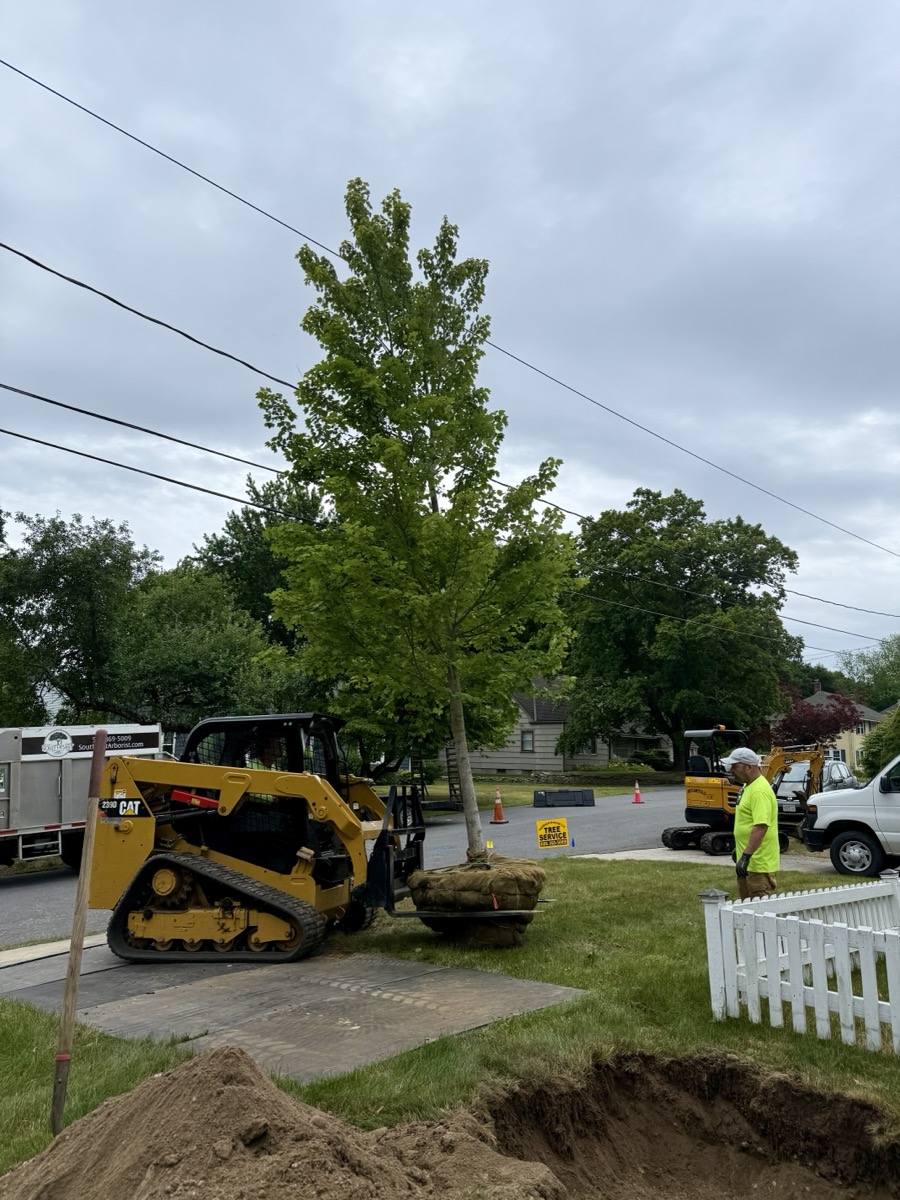
Step 3: Preparation and Equipment Setup (Day of). Using Bobcat skid-steers with 24-inch augers for precise holes (2x root ball width, same depth), we avoid hand-digging on rocky glacial till. Safety protocols include hard hats, chokers rated 10,000 lbs, and spotters for power line proximity (minimum 10' clearance per OSHA). In wetland buffers, low-ground-pressure tracks prevent rutting.
Step 4: Hole Digestion and Amendment (30-60 min/tree). Dig saucer-shaped holes—no square bottoms—to encourage lateral roots. Expose root flare fully, cutting girdling roots per ISA BMPs; amend heavy clays with 20% pine bark fines for drainage, skipping fertilizers that burn roots in acidic soils (pH-adjusted lime only if needed). No volcano mulching: 3-inch mulch ring at drip line retains 30% more moisture.
Step 5: Planting and Backfill (45 min/tree). Position tree plumb using levels, backfill in 12-inch lifts tamped by boot (not feet) to eliminate air pockets. Guy with ArborTie systems on windy Rochester sites—two stakes, flexible ties loosened after year one. Water-in with 15 gallons/tree using tankers, adding root gel for sandy soils.
Step 6: Pruning and Protection (15 min/tree). Remove co-dominant leaders on young oaks, wrap trunks against sunscald (common on white pine transplants). Install 4-foot tree tubes in deer-heavy areas near Wareham, or hardware cloth vs. voles in bogs.
Step 7: Post-Planting Care Plan (Immediate handoff). You get a customized schedule: weekly deep watering (1"/week) first summer, fungicide for Phytophthora in wet tupelos, monitoring for spongy moth via pheromone traps. We follow up at 3/6/12 months, adjusting for Rochester's 20-30 mph winter gusts.
Equipment includes Vermeer tree spades for large calipers (up to 4"), ensuring minimal root disturbance. All crews carry TCIA certification, with $5M liability insurance. For cranberry-adjacent work, we coordinate with growers for hydrology checks.
This process outperforms DIY by 70%, per ISA studies, thriving in Rochester's pine-oak-wetland mix. Your trees establish faster, reducing replacement needs.
Common Tree Planting Projects in Rochester Neighborhoods
Rochester's neighborhoods present distinct tree planting opportunities, from upland pine management to wetland restorations. In Rochester Center, central lots crowded with pitch pine require thinning followed by scarlet oak plantings for firewise spacing—10 trees along 200' driveways create defensible space amid historic homes.
North Rochester's expansive woodlands see privacy screens of white pine (8-10' spacing) to buffer views from rural roads, replacing storm-damaged black cherry after nor'easters. Homeowners plant red maples post-septic installs, maintaining 10-foot clearances per Title 5.
The Mattapoisett Road Area, bordering Acushnet, features bog-edge projects: Atlantic white cedar rows stabilize buffers, planted 15' from ditches to comply with conservation overlays. Tupelo additions handle seasonal flooding near cranberry reservoirs.
Snipatuit Pond Area properties, with wet meadows, favor sassafras groves for erosion control on pond banks—shallow holes avoid compacting hydric soils. American holly understories enhance wildlife corridors, spaced under overstory oaks.
Dexter Lane Area's sandy knolls demand drought-resistant red oak clusters for windbreaks, mulched thinly against summer desiccation. Post-removal replanting restores canopy after spongy moth defoliation.
Cranberry Highway Area (Route 28) lots near Wareham need hazard-free plantings: low-branch pruned pitch pine along power corridors, or red maple islands in front yards for shade without road overhangs.
Common across Rochester: replacement after hazard removals (e.g., leaning white pines near roads), woodland enhancements for deer browse (black cherry), and stormwater plantings near bogs using native wetland species. Municipal projects along Swansea Road plant tupelo for flood mitigation.
Southeast Arborist customizes: soil augers confirm drainage, species match microclimates. Practical tip: In pine barrens, plant hardwoods in partial shade for 80% survival boost.
Tree Planting Costs in Rochester, MA
Tree planting costs in Rochester MA vary by project scale, tree size, and site challenges, typically $300-$800 per tree for 2-3" caliper stock. Factors include species—pitch pine at $350 (fast-growing, fire-prone), premium Atlantic white cedar $650 (wetland specialist)—and size: 1-2" bare root $250, 4" B&B $1,200.
Site prep drives 30% of costs: rocky glacial till near Rochester Center adds $100/tree for auger rentals; wetland permits in Snipatuit Pond Area incur $200 Conservation Commission fees. Travel from our Plymouth/Cohasset base is free within 20 miles.
Labor (ISA Certified, 2-man crews) runs $150/hour: simple driveway planting 2 hours/tree; bog-buffer projects 4 hours with hydrology checks. Equipment—skid-steers $75/hour—handles sandy soils efficiently.
Volume discounts apply: 10-tree screens save 20% ($500/tree average). Add-ons: staking $50, tubes $30, soil amendment $75 (pH correction for oaks on acid sands).
Value proposition: Proper planting yields 50-year ROI. A mature red oak shades 1,000 sq ft, cutting AC bills $200/year (EIA data); property value rises $5,000/tree (USDA). Avoid DIY pitfalls—50% failure wastes $500/tree.
Compared to South Shore averages, our pricing undercuts by 15% via local sourcing, no travel surcharges. Quotes factor Rochester specifics: wildfire mulch rings free, spongy moth monitoring $100/visit.
Get your free estimate at 508-369-5009—transparent, no-obligation for Rochester tree planting that lasts.
When to Schedule Tree Planting in Rochester
Schedule tree planting Rochester MA in early spring (March-April) or fall (September-October), when soil temps hit 50°F for root growth and Rochester's rainfall aids establishment. Avoid summer droughts on sandy soils (June-August highs evaporate amendments) and winter freezes (December-February heave roots).
Urgency signs: post-removal gaps after storms (e.g., March nor'easters topple pines)—plant within 30 days to prevent erosion. Spongy moth defoliation by June signals oak replacements before egg hatch.
Wetland projects align with dry windows post-bog harvest (November). Call 508-369-5009 now for spring slots—lead time 2-4 weeks.
Frequently Asked Questions About Tree Planting in Rochester
What species should I plant on my Rochester property? Choose based on site: pitch pine or white pine for dry uplands like Dexter Lane; Atlantic white cedar or tupelo for Snipatuit Pond wetlands; red oak, scarlet oak, or red maple for versatile shade in Rochester Center. Our ISA arborists match salt tolerance and soil pH.
How deep should I plant trees in Rochester's sandy soils? Root flare at grade—dig holes as deep as root ball, twice wide. Sandy drainage demands saucer shapes; expose flare to prevent rot in humid summers.
Do you handle wetland regulations for tree planting near cranberry bogs? Yes, we file Notices of Intent with Rochester Conservation Commission, planting buffer-compliant species like sassafras or American holly to maintain hydrology.
What's the warranty on your tree plantings? One-year survival guarantee; we replace failures from technique errors. Follow our care plan (weekly water first summer) for best results.
Can you plant after tree removals in North Rochester? Absolutely—immediate replanting with matched species restores canopy, using same holes amended for roots. Common after hazard white pines.
How does spongy moth affect new plantings? Egg masses hatch May; we recommend BTk sprays and resistant black cherry/sassafras. Established trees via proper planting withstand defoliation.
Is staking necessary in windy Rochester areas? Yes for Cranberry Highway exposures—two stakes with flexible ties for year one, removed to build taper strength.
What's post-planting care in drought-prone Rochester? Deep water 1"/week (slow drip 2 hours), thin mulch ring, prune deadwood annually. Monitor for pine bark beetles in stressed pitch pines.
Tree Planting Throughout Rochester
Southeast Arborist provides tree planting across Rochester neighborhoods—Rochester Center, North Rochester, Mattapoisett Road Area, Snipatuit Pond Area, Dexter Lane Area, Cranberry Highway Area—and nearby Wareham, Middleborough, Acushnet, Carver. From pine barrens to bog edges, our ISA Certified team ensures ANSI-compliant installs.
Call 508-369-5009 for free consultations. Protect your Rochester property—schedule today.