
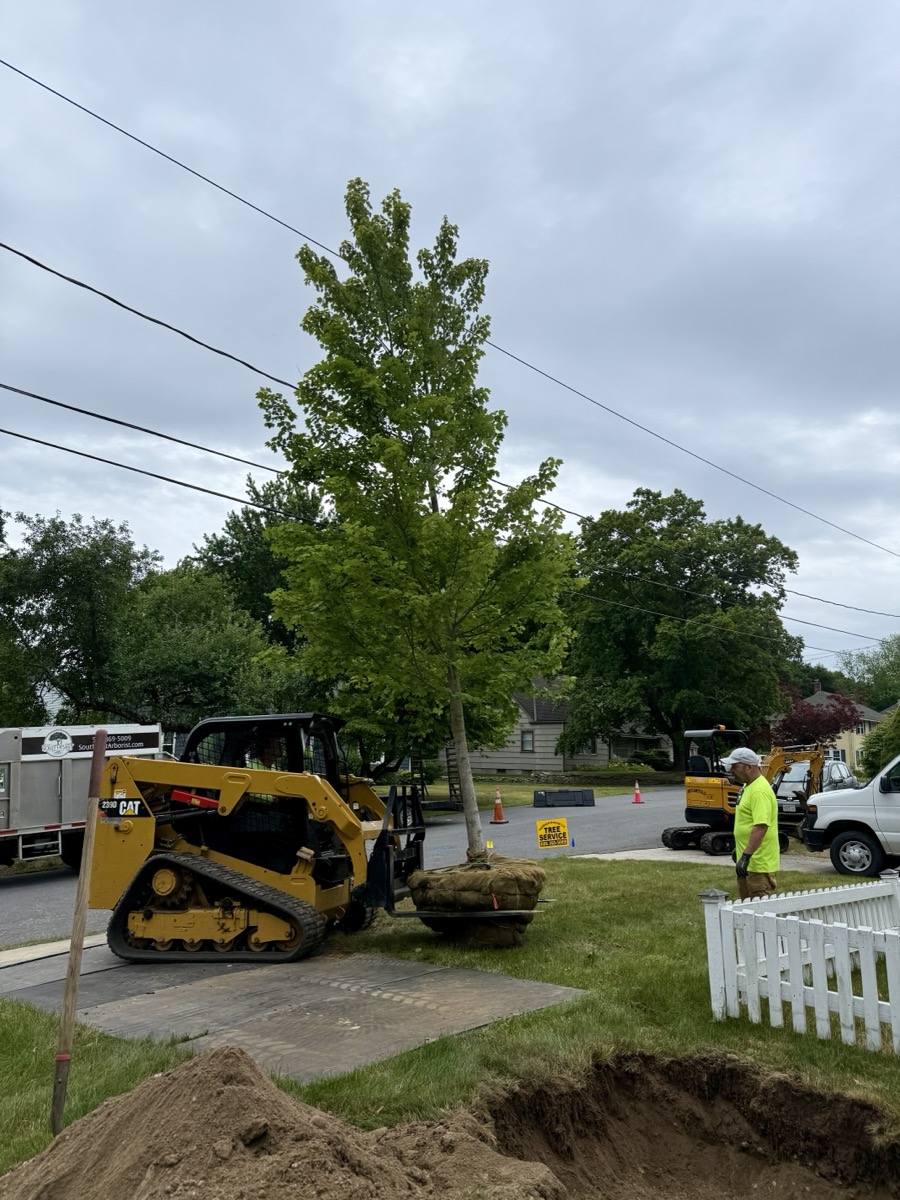
# Professional Tree Planting in Fall River, Massachusetts
If you own a home in Fall River, Massachusetts, your property sits in a unique hillside city where industrial history meets natural challenges. With 94,000 residents spread across diverse neighborhoods like The Highlands, Maplewood, and the Watuppa Ponds Area, Fall River's tree canopy faces constant pressure from hilltop winds off Mount Hope Bay, aging urban infrastructure, and strict watershed regulations. That's where professional tree planting in Fall River, MA, becomes essential. Southeast Arborist, LLC, your local ISA Certified Arborists based in Plymouth and Cohasset, delivers expert tree planting services throughout South Shore Massachusetts, including all of Bristol County.
Our team specializes in the "right tree, right place, right technique" approach, ensuring every planting withstands Fall River's coastal exposures and steep terrains. Whether you're replacing a storm-damaged Norway maple in the North End or adding salt-tolerant red oaks to your South End yard, we handle site-specific species selection, proper root flare exposure, and post-planting care. No volcano mulching—ever. We follow ANSI A300 standards for tree care and prioritize safety protocols on every job, from equipment handling on steep slopes to compliance with Watuppa watershed rules.
Fall River's tree planting needs stem from its 19th-century textile boom, which packed dense development onto hillsides above the mills. Residential areas like The Highlands boast century-old shade trees—red oaks, white oaks, and Norway maples—that now demand thoughtful replacements. The 1938 hurricane's legacy lingers, with hilltop properties above Mount Hope Bay still vulnerable to whipping winds. Emerald ash borer has decimated green ash trees citywide, creating gaps in canopies from Flint Village to Steep Brook. Urban street trees, often silver maples and red maples, suffer from poor soil compaction and salt exposure near roads.
Southeast Arborist steps in with free consultations—call 508-369-5009 today—to assess your site's soil pH (typically 5.5-6.5 in Fall River's granitic loams), drainage issues from steep grades, and wind patterns. We recommend species like London plane for polluted urban strips or honey locust for narrow parkways in Globe Village. Our ISA certification means we select trees suited to your microclimate: salt-tolerant white pines for bay-facing lots, American beech for shaded Watuppa Ponds properties.
Homeowners in Fall River benefit from our coastal expertise. After removing an aging silver maple weakened by storm winds, we plant disease-resistant red maples with proper backfill to promote root growth in compacted soils. We provide post-planting guidance, including watering schedules tailored to Fall River's humid summers (average 75-85°F) and dry spells. Safety comes first—our crews use restricted-access equipment for hillside work, preventing erosion on slopes toward the Taunton River.
Investing in tree planting in Fall River, MA, boosts your property value by 10-15% according to local real estate trends, while enhancing shade, privacy, and stormwater management. In Maplewood's family neighborhoods, a single well-placed white oak can cool your home, slashing AC costs by 20-30% in July heat waves. For Watuppa Ponds Area residents, our plantings comply with 1870s-era protections, preserving the watershed's mature forests of white pine and beech.
Southeast Arborist serves Fall River from our South Shore base, reaching neighborhoods quickly for emergency replacements post-storms. Our track record includes street tree projects for the city's older infrastructure, lot clearing with preservation planning on wooded parcels near Somerset and Swansea, and custom plantings for new construction in the North End. Every project includes a one-year warranty on plantings, with follow-up visits to monitor establishment.
Ready to enhance your Fall River landscape? Contact Southeast Arborist at 508-369-5009 for your free tree planting consultation. We'll evaluate your site, recommend Fall River-hardy species, and install with precision to thrive for decades.
Why Fall River Properties Need Tree Planting
Fall River's hillside topography and position above Mount Hope Bay create specific demands for tree planting services. Your property in The Highlands likely contends with relentless northwest winds that stunt young trees and topple mature ones, as seen after the 1938 hurricane that flattened hilltop canopies. These exposures, combined with compacted urban soils from 19th-century mill development, make improper planting a recipe for failure. Professional tree planting in Fall River, MA, addresses this by selecting wind-resistant species like red oak (Quercus rubra) or white oak (Quercus alba), which anchor deeply into granitic loams with pH levels around 6.0.
Aging street trees dominate common issues across neighborhoods. In the South End and Flint Village, Norway maples (Acer platanoides) planted over 100 years ago now suffer decline from girdling roots and branch failures, necessitating replacements. Silver maples (Acer saccharinum) in Globe Village crack sidewalks with aggressive roots, while red maples (Acer rubrum) fare better but demand salt-tolerant cultivars near salted winter roads. Emerald ash borer has wiped out 70-80% of green ash (Fraxinus pennsylvanica) in Steep Brook and the North End, leaving voids that invite invasives.
Climate plays a pivotal role. Fall River's USDA Zone 6b-7a brings humid continental weather: 45 inches annual rainfall, winters dipping to 10°F with bay-effect snow, and summers hitting 90°F with high humidity. Hilltop soils dry quickly on slopes, stressing new plantings without proper mulching techniques. Watuppa Ponds Area properties face watershed regulations prohibiting runoff pollution, so we plant American beech (Fagus grandifolia) or white pine (Pinus strobus) with amended backfill to filter stormwater naturally.
Coastal salt spray from Mount Hope Bay affects bay-facing homes in the North End, where sodium chloride damages foliage. We counter this with salt-tolerant options like London plane (Platanus x acerifolia) for urban streets or honey locust (Gleditsia triacanthos) for parkways in Maplewood. These species thrive in Fall River's poor drainage spots near the Taunton River tributaries, resisting root rot common in silver maples.
Storm vulnerability amplifies the need. Your hilltop yard in The Highlands mirrors the 1938 devastation, where winds gusted 120+ mph. Modern plantings use guy wires temporarily on white oaks to stabilize against similar events, which occur every 5-10 years per NOAA data. Urban heat islands in dense Flint Village raise temperatures 5-10°F, making shade trees critical— a mature red maple cools asphalt, reducing energy bills.
Soil conditions vary: acidic loams (pH 5.5) in Watuppa forests suit beech and pine, while alkaline fills near mills demand lime adjustments for maples. Steep terrain limits equipment, so hand-planting prevents erosion toward ponds. Lot clearing for new homes on wooded edges near Swansea generates demand; we preserve heritage trees like century-old red oaks while planting natives.
Without expert intervention, DIY plantings fail 50% of the time in Fall River due to buried root flares, leading to girdling and early decline. Southeast Arborist's ISA Certified Arborists conduct soil tests (free with consultation) to match species: honey locust for narrow Globe Village lots, avoiding wide-spreading silver maples. Post-emergald ash borer, we plant resistant ash hybrids or diversifying with planes.
Tree planting restores biodiversity, too. Fall River's canopy covers 25% of the city, per recent assessments, but losses from age and pests threaten it. Your new white pine in the Watuppa Area supports wildlife corridors, hosting warblers and owls. Economically, healthy trees add $1,000-$5,000 to home values in competitive Bristol County markets.
Call 508-369-5009 for a site evaluation— we'll pinpoint why your property needs tree planting in Fall River, MA, now.
Our Tree Planting Process in Fall River
Southeast Arborist follows a meticulous, ANSI A300-compliant process for tree planting in Fall River, MA, tailored to local challenges like steep slopes and wind exposure. We start with your free consultation (508-369-5009), visiting your property in neighborhoods from The Highlands to Steep Brook. Our ISA Certified Arborists assess micro-site factors: wind tunnel effects above Mount Hope Bay, soil compaction from urban fill, drainage toward Watuppa Ponds, and sun exposure in dense South End yards.
Step 1: Site Evaluation and Species Selection (1-2 hours). We test soil pH (Fall River average 5.8), texture, and compaction using a penetrometer. For hilltop North End lots, we recommend salt-tolerant red oaks or London planes over vulnerable silver maples. In shaded Maplewood backyards, American beech or red maples fit. We avoid invasives like Norway maple, opting for natives like white oak that resist emerald ash borer analogs.
Step 2: Permitting and Planning (if needed, 3-7 days). Watuppa Ponds Area requires watershed compliance; we submit plans ensuring no sediment runoff. For street trees in Flint Village, we coordinate with city forestry under Fall River's urban tree ordinance.
Step 3: Site Preparation (Day 1). On steep terrains, our crews use portable winches and low-impact excavators to dig pits 2-3x wider than root balls, avoiding equipment scars that cause erosion. We amend heavy loams with organic compost (no synthetic fertilizers initially) to improve drainage. Root flare exposure is non-negotiable—we locate and position it at grade to prevent rot, a killer in Fall River's wet springs.
Step 4: Tree Delivery and Placement. Sourced from certified nurseries, trees arrive balled-and-burlapped or container-grown. For a 2-3" caliper honey locust in Globe Village, we stake minimally with flexible ties to flex in bay winds, per ISA best practices. No volcano mulching—we apply 3-4" of shredded hardwood mulch in a 3-6' diameter ring, keeping it 6" from trunk.
Step 5: Planting and Backfill. We backfill in layers, watering each to eliminate air pockets—critical on slopes to prevent settling. Guy wires or root ball anchors secure wind-exposed plantings in The Highlands. Safety protocols include harnesses, spotters for steep work, and traffic control near Swansea-adjacent roads.
Step 6: Initial Watering and Pruning. We deep-water with 15-20 gallons per caliper inch, using soil probes for root zone saturation. Structural pruning removes co-dominant leaders on young white pines, promoting wind resistance.
Step 7: Post-Planting Care Guidance. You receive a customized plan: water 1-2" weekly for first year (more in July droughts), fertilize sparingly with slow-release in spring, inspect for guy wire damage. We schedule 3, 6, and 12-month check-ins, with one-year warranty.
Equipment adapts to Fall River: handheld augers for inaccessible Watuppa slopes, aerial lifts for urban pruning tie-ins, and erosion blankets on disturbed soil. All crews wear PPE and follow OSHA standards, minimizing risks on bay bluffs.
This process yields 95% survival rates versus 60% for DIY, per ISA studies. After emerald ash borer removals in Steep Brook, we replant green ash-resistant London planes seamlessly. For coastal Somerset-border properties, salt-tolerant cultivars like 'Sea Green' honey locust handle spray.
Our techniques counter local issues: deep planting combats frost heaving in Zone 6b winters, wide pits encourage lateral roots in thin soils. In aging neighborhoods, we integrate new red maples with existing white oaks for uniform canopy.
Experience this precision firsthand—dial 508-369-5009 to start your tree planting process in Fall River today.
Common Tree Planting Projects in Fall River Neighborhoods
Tree planting projects in Fall River, MA, vary by neighborhood, reflecting each area's history, terrain, and exposures. In The Highlands, with its oldest residential trees, we replace century-old Norway maples felled by wind or decline. A typical project: after pruning a failing red oak near the hilltop views of Mount Hope Bay, we plant two salt-tolerant white oaks (2.5" caliper), spaced 40' apart for future shade on steep lawns.
Maplewood homeowners call for street tree replacements amid aging silver maples that heave sidewalks. We install narrow-profile honey locusts, compliant with 4' planting strips, ensuring root flare exposure to thrive in compacted soils near family playgrounds.
South End urban lots demand small-stature London planes for polluted air near historic mills. Post-storm removal of a wind-snapped white pine, we plant disease-resistant red maples, using guy wires against bay gusts.
Flint Village sees frequent emerald ash borer replacements; we remove infested green ash and plant American beech natives, mulched properly to filter runoff toward the Taunton River.
Globe Village parkways favor low-branching red oaks over aggressive silver maples. For a recent lot clearing near new construction, we preserved heritage white pines while planting honey locusts for privacy screening.
Steep Brook's steep terrains challenge access, so we hand-plant white oaks on slopes, incorporating erosion control matting. Watershed-adjacent properties get white pines suited to acidic loams.
North End bay-front homes need wind- and salt-hardy species; after 1938-hurricane-style storm damage, we install London planes with deep staking.
Watuppa Ponds Area projects prioritize regulations—selective planting of American beech amid mature forests, ensuring no soil disturbance impacts the 1870s-protected watershed.
These neighborhood-specific projects restore canopies, enhance views (like Highlands overlooks), and boost curb appeal near Dartmouth and New Bedford. Southeast Arborist's ISA experts handle them all safely.
Tree Planting Costs in Fall River, MA
Tree planting costs in Fall River, MA, range from $300-$800 for a 1.5-2.5" caliper tree, including delivery, planting, mulching, and initial care. Factors drive pricing: species (red oak at $450 vs. honey locust at $550 due to availability), size (larger caliper adds $100/inch), and site difficulty (steep Highlands slopes +20-30%).
Neighborhood impacts costs: Watuppa Ponds compliance adds $100-200 for permitting; North End wind staking ups fees by $150. Soil amendment for compacted Flint Village loams: $50-100 extra. Street trees in South End require city coordination ($75 permit fee reimbursed).
Volume discounts apply: three silver maple replacements in Maplewood save 15%. Post-removal replanting (e.g., emerald ash borer green ash in Steep Brook) bundles at $400/tree versus standalone.
Labor (40% of cost) reflects ISA expertise and safety gear for bay exposures. Equipment for Globe Village access: minimal add-on. One-year warranty included—no hidden fees.
Value proposition: A $500 white pine investment yields $2,000+ lifetime benefits—shade saves $200/year on energy, per DOE estimates, vital in Fall River's humid summers. Increased property values hit 7-12% in Bristol County, outpacing costs. Storm resilience prevents $1,000+ removal bills.
Compare: DIY risks 50% failure ($300 loss/tree), while our ANSI A300 process ensures longevity. Free consultations (508-369-5009) provide exact quotes.
Budget for multiples: $1,200 for three red maples in a North End yard. Financing via local banks available.
Professional tree planting in Fall River, MA, delivers ROI through durability against winds, pests, and regulations.
When to Schedule Tree Planting in Fall River
Schedule tree planting in Fall River, MA, from mid-April to early June or September-October, aligning with dormancy ends and soil thaw. Spring avoids summer drought stress; fall leverages root growth before winter dormancy. Avoid July-August heat (85°F+ averages) when new trees transpire heavily in bay humidity.
Urgency signs: canopy gaps post-storm (common after nor'easters whipping Mount Hope Bay), emerald ash borer kills in Steep Brook, or declining Norway maples in The Highlands. Act within 4-6 weeks of removal to minimize erosion on slopes.
Soil cues: plant when workable, post-frost (mid-April) for Watuppa loams. Monitor for dry spells—pre-irrigate sites.
Seasonal tips: spring for fast-growers like red maples; fall for oaks to establish before leaf-out. Call 508-369-5009 now for slots—our South Shore base fills quickly pre-storm season.
Frequently Asked Questions About Tree Planting in Fall River
What species work best for tree planting in Fall River, MA? Red oak, white oak, red maple, and London plane suit hilltop winds; salt-tolerant honey locust and white pine for bay exposures. Avoid silver maple on streets due to roots.
How do I prepare my yard for tree planting in The Highlands? Clear debris, test soil pH (aim 6.0), ensure 20x20' space. Our free consult handles details.
Does Southeast Arborist comply with Watuppa Ponds regulations? Yes, all plantings use erosion controls and native species like American beech to protect the watershed.
How long until new trees establish in Fall River's climate? 1-2 years with proper care; we provide watering guides for Zone 6b winters.
Can you plant on steep slopes in Steep Brook? Absolutely—hand-digging and anchors prevent washout.
What's the warranty on tree planting services? One year full replacement, plus follow-ups.
How much salt exposure can Fall River trees handle? London plane and honey locust tolerate coastal spray; we select accordingly for North End.
When should I replace emerald ash borer-damaged trees? Immediately after removal—call 508-369-5009 to prevent gaps.
Tree Planting Throughout Fall River
Southeast Arborist provides tree planting throughout Fall River neighborhoods: The Highlands, Maplewood, South End, Flint Village, Globe Village, Steep Brook, North End, and Watuppa Ponds Area. We extend to nearby Somerset, Swansea, Dartmouth, New Bedford, and Taunton from our Plymouth/Cohasset base.
Our ISA Certified team ensures right tree, right place for your hillside property. Call 508-369-5009 for free consultation—professional tree planting in Fall River, MA, starts today.