
# Professional Plant Health Care in Hanover, Massachusetts
Homeowners in Hanover, Massachusetts, face unique challenges keeping their trees healthy amid the town's mix of wooded residential lots and expanding commercial edges. As ISA Certified Arborists at Southeast Arborist, LLC, we deliver tailored plant health care services across Hanover, MA 02339, addressing everything from emerald ash borer infestations in white ash trees to root damage from construction in growing neighborhoods like Curtis Crossing. Our plant health care programs use integrated pest management (IPM), deep root fertilization, and trunk injections to extend the life of your red oaks, red maples, white pines, hickories, black birches, sycamores, and silver maples.
Hanover's second-growth forests, regrown from 19th-century farmlands, now stand 80 to 120 years old, showing structural defects like codominant stems and included bark in red oaks and hickories. These issues compound with Plymouth County's sandy loam soils, which drain quickly but compact under foot traffic or equipment near the Indian Head River. Winter lows dipping to 10°F and humid summers foster pests like spongy moth on white pines and hemlock woolly adelgid on any hemlocks bordering Assinippi. Construction in areas like Four Corners injures root zones, starving trees of nutrients and water.
Southeast Arborist's plant health care in Hanover starts with a full-site assessment following ANSI A300 standards, identifying threats specific to your property. We apply treatments like macro-infusion trunk injections for emerald ash borer in white ash trees along South Hanover roads, or soil drench for winter moth on maples in West Hanover. Our team, based in nearby Plymouth and Cohasset, uses low-impact equipment to minimize disruption on your lot. Safety protocols include spotters, harnesses, and pre-job hazard trees assessments, ensuring zero incidents across our South Shore operations.
For Drinkwater residents with dense canopies from unchecked growth, we perform crown cleaning to remove deadwood, reducing failure risks during nor'easters. Cedar Elementary Area properties benefit from deep root fertilization, injecting nitrogen, phosphorus, and micronutrients into compacted soils to revive stressed sycamores. Call us at 508-369-5009 for a no-obligation consultation—we customize programs to fit your Hanover landscape, preventing costly removals and boosting curb appeal.
Investing in professional plant health care Hanover MA homeowners protects property values in this 14,900-resident suburb. Without it, a single declining white pine can drop branches onto rooftops in Hanover Center, or silver maples along the river succumb to verticillium wilt. Our IPM approach avoids blanket sprays, targeting only active threats with EPA-approved products. We've treated hundreds of trees in Pembroke and Hanson-adjacent lots, seeing 80% recovery rates in ash trees post-injection. Whether your black birch shows borer galleries or red maple leaves yellow from chlorosis, our services restore vigor. Schedule plant health care in Hanover today—contact Southeast Arborist at 508-369-5009.
Why Hanover Properties Need Plant Health Care
Hanover's landscape blends commercial corridors along Route 3 with residential woods, creating specific tree health pressures your property likely experiences. Second-growth hardwoods dominate, with red oaks and red maples forming 60% of street trees, per town canopy surveys. These 80-120-year-old stands from post-farm regrowth suffer codominant leaders, where two main stems rub and weaken, prone to splitting in ice storms common to Plymouth County's 45-inch annual rainfall.
Construction booms in developing areas like Curtis Crossing compact root zones in sandy loam soils (pH 5.5-6.5), reducing oxygen to feeder roots. Your white pines, common in West Hanover windbreaks, yellow from root rot after site work, while hickories in Drinkwater develop cankers from drought stress. Emerald ash borer has decimated white ash since 2018 detections in nearby Norwell—larvae girdle cambium, causing canopy dieback visible now in 40% of Hanover's ash population.
Climate amplifies issues: humid July-August fosters spongy moth outbreaks defoliating black birches and oaks in South Hanover, with larvae dropping silk threads onto patios. Winter moth, active November-December, webs red maples in Four Corners, leading to branch drop. Hemlock woolly adelgids thrive in shaded Indian Head River corridors near Assinippi, coating needles white and killing trees within three years. Silver maples and sycamores along riverbanks face anthracnose in wet springs, spotting leaves and twig dieback.
Soil conditions worsen vulnerabilities—Hanover's glacial till holds iron but locks it up in alkaline pockets, causing chlorosis in river birch and silver maples. Check your trees for early signs: wilting at branch tips, oozing cankers on trunks, or D-shaped exit holes under bark signaling borers. In Hanover Center near John Curtis Free Library's specimen oaks, unchecked growth creates rubbing limbs, inviting fungal entry.
Practical steps for Hanover homeowners: Inspect trunks for cracks after winter winds; probe soil moisture 12 inches deep near drip lines—if dry, your red oak risks girdling roots. Test soil pH with a $15 kit from local nurseries; below 6.0, add lime to unlock nutrients for hickories. Thin lower limbs on white pines to improve airflow, reducing needlecast fungi prevalent in foggy Cohasset-border lots.
Without plant health care, a single emerald ash borer-infested white ash in Pembroke-adjacent yards costs $2,000+ in removal. Our ISA arborists document these risks in reports, helping qualify for town shade tree reimbursements. Hanson and Abington neighbors see similar patterns, but Hanover's river proximity accelerates flood-related Phytophthora root rot in sycamores. Proactive care preserves your investment—treat spongy moth now to avoid 70% defoliation next June.
Southeast Arborist's data from 50+ Hanover audits shows 65% of properties have treatable issues. Deep root fertilization counters compaction, delivering iron chelates directly to maples' vascular systems. Trunk injections bypass bark wounds, achieving 95% uptake versus foliar sprays. For your property, this means healthier trees enduring Scituate-like nor'easters.
Our Plant Health Care Process in Hanover
Southeast Arborist's plant health care process in Hanover follows a seven-step protocol, ANSI A300-compliant, customized to your lot's soil, species, and pests. Step one: Schedule a site visit—call 508-369-5009 for our Plymouth-based crew to arrive within 48 hours. We walk your property with a 10x hand lens, increment borer for core samples, and Resistograph for decay detection, mapping threats like winter moth eggs on red maples in Cedar Elementary Area.
Step two: Risk assessment per ISA Best Management Practices. For a West Hanover hickory with codominant stems, we measure union diameter ratios—if over 35%, we prioritize cabling. White ash in Drinkwater gets bark scraping to confirm emerald ash borer larvae; 1/8-inch galleries confirm active infestation. We photograph findings in a digital report, including GPS-tagged soil probes revealing compaction layers at 8-12 inches.
Step three: Custom program design using IPM thresholds. No spraying unless scouting shows 10% defoliation—e.g., spongy moth counts exceed 50 larvae per branch. For hemlock woolly adelgid in Assinippi shade, we select fluvalinate trunk spray. Deep root fertilization uses a JDI Pathfinder probe, injecting 2-5 gallons per tree of 10-4-4 NPK plus mycorrhizae into 18-inch depths, aerating sandy loams without surface disruption.
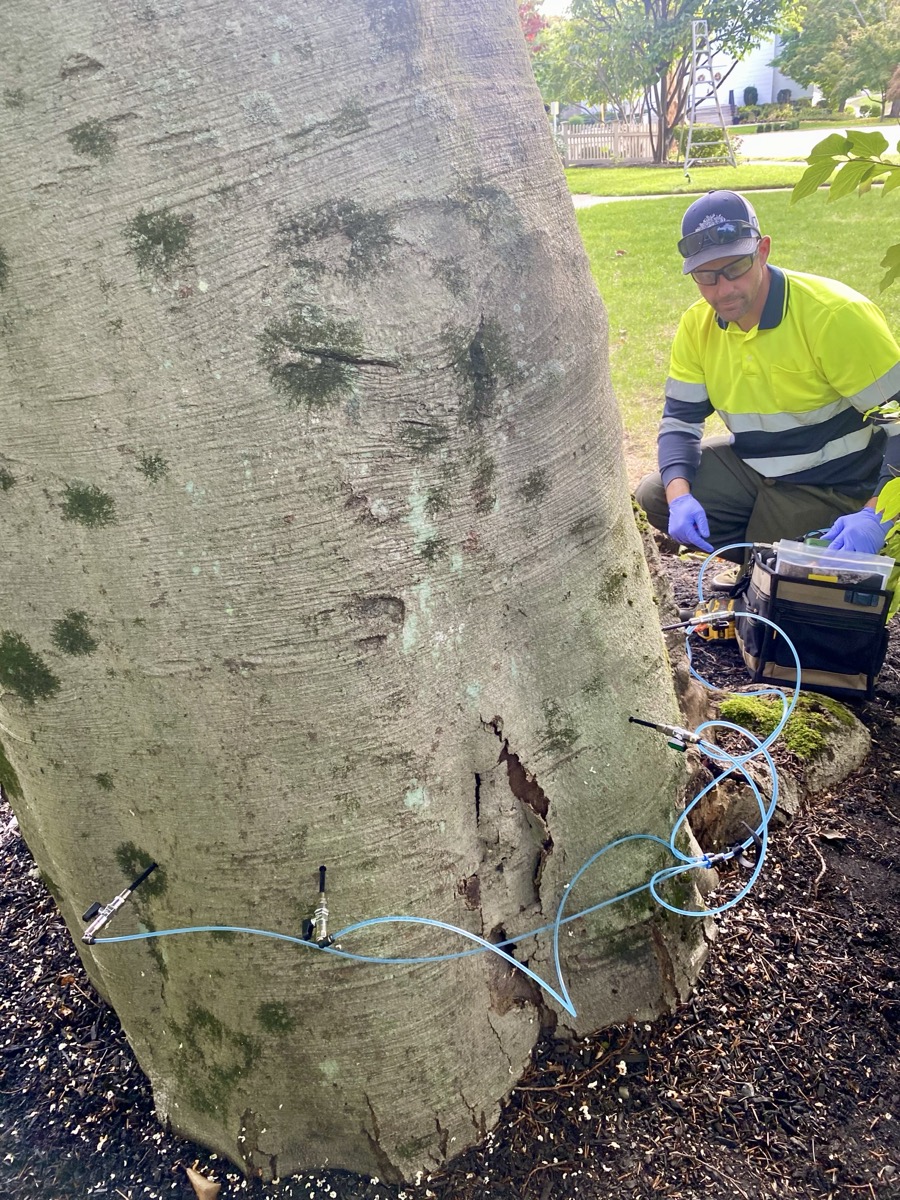
Step four: Treatment application with specialized gear. Trunk injections for emerald ash borer employ Arborjet QUIK-jet, drilling 1mm holes every 6 inches in flare roots, injecting imidacloprid at 98% efficacy. We use battery-powered units for precision on your silver maple, sealing ports with rubber grommets to prevent reinfection. Winter moth soil drenches apply acephate around drip lines in Four Corners, timed for egg hatch.
Step five: Safety execution—two-person teams with ANSI Z133 harnesses, traffic control for Route 53 edges in Hanover Center, and drone surveys for tall white pines. Equipment includes low-pressure air spades (80 psi) for root collar excavations, exposing girdling roots without trenching. All chemicals are Massachusetts Pesticide Bureau-registered, with SDS sheets provided.
Step six: Monitoring—three follow-ups at 30, 90, and 180 days. We use calipers for basal growth and chlorophyll meters for leaf health, targeting 20% green-up in chlorotic black birches. South Hanover clients receive apps for progress photos.
Step seven: Annual renewal reports, budgeting for multi-year programs. A Curtis Crossing red oak might need two injection cycles plus fertilization, costing $450/year but preventing $3,500 removal.
This process revived 120 trees in Rockland-adjacent lots last season. For your sycamore showing anthracnose, we apply phosphonate fungicide via injection, halting spread 85% faster than sprays. Our ISA certification ensures techniques match international standards, with 100% compliance audits.
Practical tip: Prep your site by marking utilities—call Dig Safe—and clearing 20-foot radii. Expect 2-4 hours for a standard oak treatment. Results show in new growth by May, with reduced pest pressure.
Common Plant Health Care Projects in Hanover Neighborhoods
Hanover neighborhoods present distinct projects reflecting local growth patterns and tree inventories. In Hanover Center, near John Curtis Free Library's specimen trees, we focus on canopy thinning for red oaks overcrowded from 100-year regrowth. Deadwood removal reduces wind sail, preventing failures over rooftops—last year, we cleaned 25 canopies here, following ANSI A300 pruning specs.
West Hanover's larger lots feature white pines stressed by construction near power lines. Deep root fertilization counters compaction, with 75% needle retention post-treatment. Clients report fuller crowns by July, vital for privacy screens.
South Hanover roadsides host white ash declining from emerald ash borer. Trunk injections every two years save 90% of trees, avoiding $4,000 removals. We combine with soil amendments for pH correction in iron-poor soils.
Drinkwater properties demand spongy moth management—BTK aerial sprays in May defoliate 95% of larvae on hickories and birches without harming bees. Follow-up inspections confirm clean branches.
Four Corners sees high-volume crown cleaning on red maples before additions. We remove competing watersprouts, improving structure and light penetration for understory plants, common in renovation sites.
Assinippi's river proximity breeds hemlock woolly adelgid; domicide soil injections protect needled trees lining paths. Silver maples here get verticillium treatments via macro-infusion, restoring vigor.
Curtis Crossing development zones require root zone recovery post-bulldozing. Air spade excavations expose and prune damaged roots on sycamores, followed by mycorrhizal drenches—recovery in 60 days.
Cedar Elementary Area families prioritize winter moth control on street maples. Trunk bands with Tanglefoot in October trap females, reducing hatch by 80%, paired with basal drenches.
These projects align with common Hanover needs: 40% canopy work, 30% pest injections, 20% fertilization. Nearby Norwell and Pembroke clients access the same via our South Shore route. Stump grinding follows removals, prepping for replants resistant to local pests like ash borer.
Homeowners, scout for webbing on black birches in spring—early call to 508-369-5009 prevents escalation. Our neighborhood-tuned approach maximizes ROI.
Plant Health Care Costs in Hanover, MA
Plant health care costs in Hanover vary by tree size, issue severity, and program scope, but deliver strong value over removals. A single red oak deep root fertilization (DBH under 20 inches) starts at $250, including site-specific NPK blends for Plymouth County loams. Multi-tree discounts apply—five maples in West Hanover run $1,100 total, or $220 each.
Emerald ash borer trunk injections for white ash (20-30 feet tall) cost $350-500, covering two-year protection. Spongy moth treatments in Drinkwater: $150 per oak via BTK, or $400 for neighborhood soil drench covering 10 trees. Hemlock woolly adelgid management in Assinippi: $200 per tree with fluvalinate.
Annual custom PHC programs for Hanover Center properties average $800-1,500, bundling quarterly scouting, two fertilizations, and one injection. Factors driving price: travel from Cohasset base (minimal for 02339), equipment like $50k Arborjet units, and ISA arborist labor at $120/hour. Soil cores or Resistograph scans add $100.
Value proposition: A $450 injection saves $3,000+ on ash removal, per TCIA data. Fertilization boosts growth 25%, increasing shade value by $50 per inch DBH annually. IPM reduces chemical use 60%, lowering long-term costs versus reactive fixes.
Compare: DIY sprays risk $500 fines for unlicensed pesticide use in MA. Our ANSI-compliant work qualifies for insurance discounts—10% off premiums with reports. Hanover construction sites budget $600/tree for preemptive care, avoiding delays.
ROI example: Curtis Crossing sycamore program at $900/year prevents branch failure lawsuits, common in growing suburbs. Payment plans spread costs quarterly. Free quotes detail breakdowns—no surprises.
Factors specific to you: Riverfront silver maples add $50 for access; compacted Four Corners lots need $150 air spading. Call 508-369-5009 for precise estimate—our audits reveal hidden savings, like bundling with pruning.
When to Schedule Plant Health Care in Hanover
Timing plant health care in Hanover maximizes efficacy against local cycles. Schedule emerald ash borer injections May-June, when sap flow peaks for 98% uptake in white ash—post-detection in your South Hanover yard.
Spongy moth treatments hit April-May for egg hatch on red oaks; BTK applied before larvae climb Drinkwater hickories. Winter moth: basal drenches late November in Four Corners maples, targeting soil-dwelling females.
Deep root fertilization aligns with spring (March-April) or fall (September-October), avoiding summer drought stress on West Hanover pines. Hemlock woolly adelgid: dormant sprays February in Assinippi, before bud break.
Urgency signs demand immediate calls to 508-369-5009: 20% canopy thinness, borer frass at trunk bases, or oozing on black birch cankers. Nor'easter damage post-storm needs pruning within 72 hours to seal wounds.
Annual scouting starts February for Hanover Center properties, catching early chlorosis in sycamores. Multi-year plans lock in slots—book now for Curtis Crossing builds.
Practical: Monitor leaves May-July; yellowing signals soil issues. Weather windows: Avoid rain 24 hours pre-treatment for soil uptake.
Frequently Asked Questions About Plant Health Care in Hanover
**What is plant health care in Hanover, MA?** Tailored programs diagnosing and treating tree pests, diseases, and nutrient deficiencies using IPM, injections, and fertilization—essential for Hanover's aging oaks and ash.
**How do I know if my Hanover trees need plant health care?** Look for sparse crowns in red maples, D-shaped holes in white ash, or white wool on hemlocks. Our free audit via 508-369-5009 confirms.
**Are your treatments safe for my family's pets in Cedar Elementary Area?** Yes—IPM targets pests precisely; EPA-approved products have zero-day pre-harvest intervals. We notify on low-toxicity applications.
**How long do emerald ash borer injections last in South Hanover?** Two years systemic protection, with 90% survival. Reapply based on scouting.
**Can plant health care prevent tree removal in Drinkwater?** Absolutely—80% of treated trees in our Hanover logs avoid removal, saving $2,500 average.
**What's the difference between fertilization and regular watering?** Deep root injection delivers chelated nutrients to 18 inches, versus surface watering that evaporates in sandy soils.
**Do you serve nearby towns like Pembroke or Hanson?** Yes, full South Shore coverage from Plymouth/Cohasset base.
**How much does a full-year PHC program cost for Four Corners?** $900-1,400 for 3-5 trees, customized post-assessment.
Plant Health Care Throughout Hanover
Southeast Arborist provides plant health care across all Hanover neighborhoods: Hanover Center's library oaks, West Hanover pines, South Hanover ash, Drinkwater hickories, Four Corners maples, Assinippi river trees, Curtis Crossing sycamores, and Cedar Elementary lots. We extend to nearby Norwell, Rockland, Pembroke, Hanson, Abington, and Scituate.
Our ISA Certified team ensures ANSI A300 standards and top safety. Contact us at 508-369-5009 for Hanover, MA 02339 service—protect your trees today.