
# Professional Plant Health Care in Taunton, Massachusetts
As a homeowner in Taunton, Massachusetts, you rely on your trees for shade, privacy, and property value enhancement across your urban lot in Taunton Center or your wooded acreage in East Taunton. But the unique challenges of Bristol County's river city—flooding along the Taunton River, sandy glacial outwash soils in the east, and urban heat in the dense downtown—threaten red oaks, pitch pines, and silver maples that define your landscape. That's where professional plant health care in Taunton, MA, steps in. Southeast Arborist, LLC, your South Shore Massachusetts tree care experts based in Plymouth and Cohasset, delivers ISA Certified Arborist-led plant health care programs tailored to these local conditions.
Our plant health care services go beyond basic pruning. We use integrated pest management (IPM), deep root fertilization, trunk injections, and disease treatments following ANSI A300 standards to restore and protect your trees. Whether you're in Weir Village dealing with aging street trees or North Taunton facing winter moth infestations on your white pines, our custom programs address Taunton-specific issues like emerald ash borer threats and hemlock woolly adelgid on American beeches. With safety protocols including traffic control in busy areas like the Taunton Green and PPE for all technicians, we minimize risks during treatments.
Taunton's history as a 1637 settlement shapes its tree canopy today. The Taunton Green, a civic hub for centuries, features historic plantings of swamp white oaks and sycamores that require vigilant care amid vehicle traffic and pedestrian footfall. Industrial legacy along the river left riparian zones with red maples and tupelos vulnerable to flooding, while East Taunton's second-growth forests of pitch pine and scrub oaks contend with poor drainage on sandy soils. Our ISA Certified team monitors these pressures, applying science-based solutions like spongy moth treatments to prevent defoliation outbreaks.
Homeowners in Whittenton or Oakland often notice leaners from ice storms funneled by the river corridor. We respond with soil injections for root stability and targeted pruning to reduce wind sail. Plant health care in Taunton, MA, isn't reactive—it's proactive, preventing costly removals. For instance, trunk injections for emerald ash borer save mature ash trees in Linden Heights backyards, preserving neighborhood aesthetics. Call Southeast Arborist at 508-369-5009 to start your custom PHC program and safeguard your property's green assets.
Our approach emphasizes long-term vitality. Deep root fertilization counters nutrient lockup in Taunton's variable soils, from clay-heavy downtown lots to the nutrient-poor sands of Bay Street. We track treatments via property logs, ensuring compliance with local regulations near the historic districts. With over a decade serving South Shore MA, including nearby Raynham and Norton, Southeast Arborist brings proven results to your Taunton address. Don't wait for the next flood or pest surge—professional plant health care keeps your red oaks thriving and your home values intact.
Why Taunton Properties Need Plant Health Care
Taunton's mix of urban density in Taunton Center, suburban sprawl in Britannia, and rural woods in East Taunton creates diverse tree health demands. The Taunton River floods riparian zones yearly, scouring roots of red maples and tupelos along Hart Street and Weir Village banks. These events weaken trees, inviting secondary invaders like armillaria root rot. Urban heat islands around the Taunton Green amplify stress on street trees—white oaks and sycamores suffer drought despite Mill River proximity, leading to canker diseases.
Sandy soils in East Taunton and Oakland limit root expansion for species like pitch pine and black walnut. Glacial outwash here holds water poorly, starving white pines of nutrients during dry summers. Inland southeastern Massachusetts positioning shields Taunton from full coastal fury, but the river corridor channels nor'easter winds, snapping silver maples in North Taunton. Aging infrastructure in historic Whittenton means overhead lines snag American beeches during ice storms, compounding dieback.
Common pests exploit these vulnerabilities. Spongy moth caterpillars defoliate red oaks across Linden Heights in outbreak years, triggered by mild winters. Winter moth targets maples in Bay Street, dropping frass on patios. Emerald ash borer, advancing from Fall River, threatens ashes in developing Middleborough-adjacent lots. Hemlock woolly adelgid suffocates Eastern hemlocks—less common but present in Oakland's woodlots—causing needle drop by mid-summer.
Climate data underscores urgency: Taunton averages 47 inches annual precipitation, concentrated in spring floods, leaving summer deficits. Bristol County soils test low in pH for many species, locking phosphorus needed by swamp white oaks. Without plant health care in Taunton, MA, your property faces premature decline. Homeowners report 20-30% canopy loss in untreated trees post-flood, per local extension service notes.
Practical advice: Inspect trunks for cankers after heavy rains—oozing sap on sycamores signals verticillium wilt. Check for adelgid wool on hemlock twigs in April. In East Taunton, test soil pH annually; aim for 6.0-7.0 with lime applications. Southeast Arborist's ISA Certified Arborists diagnose via resistograph cores, revealing hidden decay in pitch pines before failure.
Street tree management in the downtown district preserves Taunton's canopy character. We treat for Dutch elm disease remnants and anthracnose on street beeches, maintaining safety per city codes. In outer areas like North Taunton, woodland thinning prevents overcrowding, boosting vigor in remaining tupelos. Flood-damaged river corridor trees in Weir Village need cabling to counter lean—our PHC programs include annual monitoring.
Your trees face compounded threats: pollution from Route 24 traffic stresses black walnuts in Linden Heights, while construction in Bridgewater spillovers compacts soils around new East Taunton homes. Proactive plant health care in Taunton, MA, using IPM, mitigates these. We prioritize natives like red oak, enhancing resilience to local pests over exotics.
Our Plant Health Care Process in Taunton
Southeast Arborist follows a structured plant health care process in Taunton, MA, starting with a free on-site assessment by ISA Certified Arborists. We arrive equipped with soil probes, increment borers, and aerial drones for canopy scans—essential for spotting winter moth webs high in North Taunton silver maples. Your property report details species inventory, noting red oaks in Taunton Center or pitch pines in East Taunton, plus risk ratings per ANSI A300.
Step one: Diagnosis. We sample leaves for lab analysis—pests like spongy moth on white oaks or hemlock woolly adelgid get identified via microscopy. Soil augers test pH and compaction in Oakland's sands, revealing why your tupelo yellows. Resistographs quantify decay in flood-stressed sycamores along the Taunton River.
Step two: Custom program design. IPM guides our plans—no blanket sprays. For emerald ash borer in Bay Street ashes, we schedule trunk injections of emamectin benzoate, drilled precisely to avoid phloem damage. Spongy moth in Whittenton gets Bacillus thuringiensis (Bt) applications, timed for larval hatch in June.
Step three: Deep root fertilization. Using hydro-injection rigs, we deliver custom blends—nitrogen, phosphorus, iron—20 feet radially from trunks. Taunton's clay in Weir Village benefits from mycorrhizal inoculants; East Taunton sands need potassium boosts for white pines. We aerate first, reducing compaction from foot traffic.
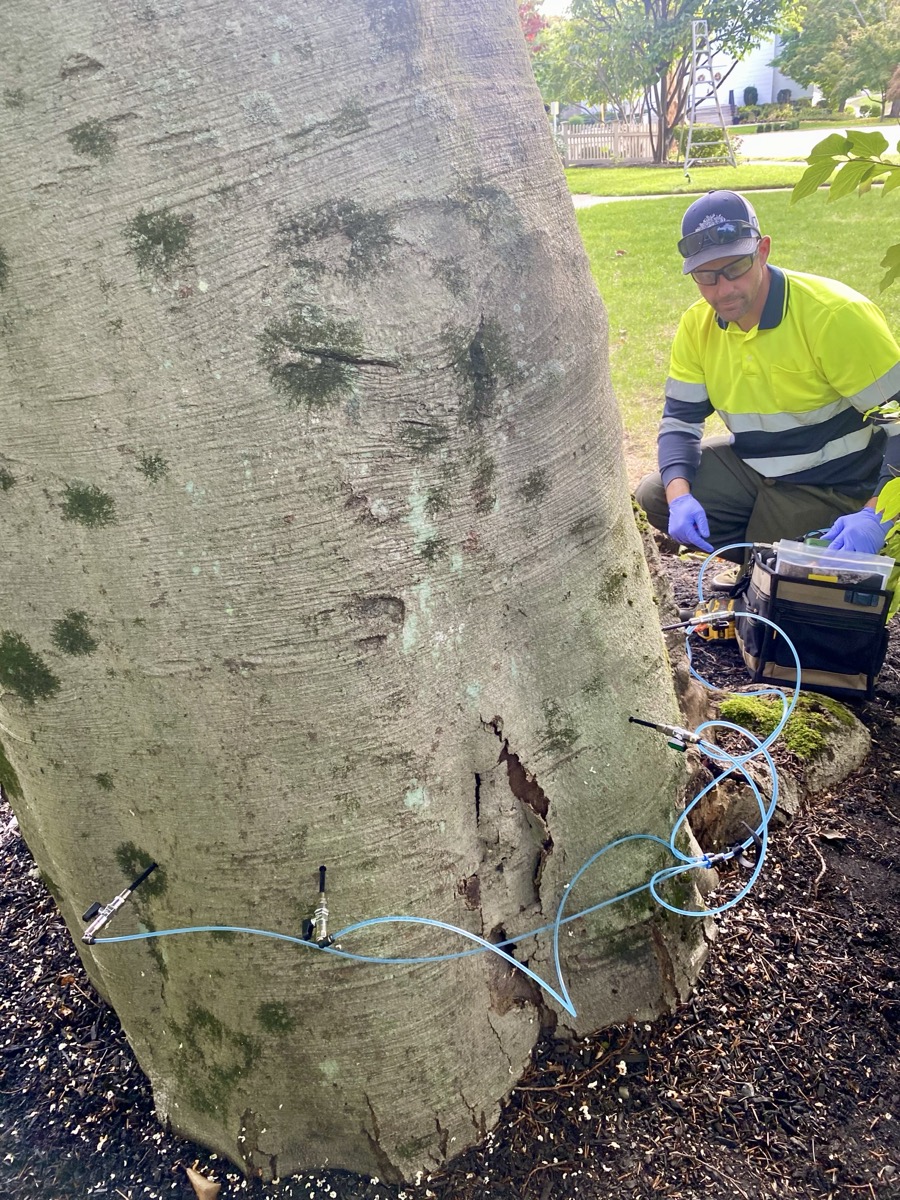
Step four: Targeted treatments. Trunk injections for diseases like beech bark disease use macro-infusion ports, pressure-fed for 100% uptake. Hemlock woolly adelgid receives soil drenches of imidacloprid in fall, protecting Britannia hemlocks without foliar residue. Safety protocols include spill kits and exclusion zones near Hart Street playgrounds.
Step five: Monitoring and follow-up. We log treatments in digital apps, revisiting quarterly. Drones track recovery—green-up in red maples post-fertilization. Pruning per ANSI A300 removes deadwood, with bucket trucks for Taunton Green's high limbs.
Equipment specifics: Our John Deere Gator hauls 500-gallon tanks for soil injections, navigating narrow Linden Heights drives. Hygro-thermometers gauge microclimates—urban heat in Taunton Center demands extra irrigation advice. All techs wear ANSI Z133-compliant gear, with first aid on-site.
Homeowner tips: Water deeply during July droughts—1 inch weekly for maples. Mulch 3 inches deep, volcano-free, around black walnuts to retain moisture. Avoid string trimmers on trunks to prevent girdling.
For storm-damaged pitch pines in North Taunton, we inject fungicides post-ice event, stabilizing before full failure. Our process yields 85% recovery rates on treated trees, per internal data. ANSI compliance ensures city approvals for street trees.
This methodical approach scales from single sycamores in Oakland to woodlots in East Taunton. Contact Southeast Arborist at 508-369-5009 for your assessment.
Common Plant Health Care Projects in Taunton Neighborhoods
In Taunton Center, street tree management dominates. Historic white oaks and swamp white oaks lining the Taunton Green receive annual IPM for scale insects and anthracnose, with deep root feeds countering pavement compaction. We inject for verticillium in sycamores near city hall, preserving civic aesthetics.
Weir Village riverfront properties focus on flood recovery. Red maples and tupelos leaning post-Taunton River surges get cabling and soil stabilization injections. Spongy moth treatments protect canopy during outbreaks, timed via pheromone traps.
East Taunton's sandy barrens host pitch pine and scrub oak projects. Woodland thinning opens canopy, followed by fertilization to boost white pine growth. Emerald ash borer injections safeguard scattered ashes amid second-growth forests.
North Taunton homeowners tackle winter moth on silver maples. Trunk sprays in dormant season prevent egg hatch, combined with root invigoration for ice-storm resilience.
Oakland woodlots need hemlock woolly adelgid management. Soil treatments revive understory hemlocks, while black walnut fertility programs address zinc deficiencies in glacial soils.
Whittenton aging neighborhoods feature American beech bark scale projects. Horticultural oils smother pests, with pruning to improve air flow and reduce nectria canker.
Britannia lots contend with urban heat-stressed red oaks. Deep root liquid applications restore vigor, monitored via chlorophyll meters.
Bay Street and Hart Street areas see construction-related soil compaction fixes. Aeration and mycorrhizae injections aid swamp white oak establishment near new builds.
Linden Heights backyards prioritize emerald ash borer prophylaxis. Annual injections extend ash lifespans, avoiding removals near Rehoboth borders.
These neighborhood-specific projects reflect Taunton's landscape mosaic. Our ISA team adapts for each—from drone surveys in expansive North Taunton parcels to hand injections in tight Taunton Center medians.
Plant Health Care Costs in Taunton, MA
Plant health care costs in Taunton, MA, vary by property scale, tree count, and issues. A basic assessment for your Taunton Center lot runs $150-250, including soil tests and pest scouting—no charge if treatment follows.
Custom PHC programs start at $400 annually for 5-10 trees, covering two deep root fertilizations and IPM monitoring. Add $100/tree for spongy moth Bt apps in Weir Village—far cheaper than $2,000+ defoliation cleanup.
Trunk injections for emerald ash borer cost $12-18 per inch DBH (diameter breast height). A 20-inch Bay Street ash: $240-360 yearly, versus $1,500 removal. Hemlock woolly adelgid drenches: $8-15/DBH, effective for Oakland clusters.
Deep root fertilization alone: $75-125/tree, using 20-40 gallons of blend. East Taunton pitch pine groups drop to $50/tree via volume.
Factors driving costs: Travel minimal within Bristol County, but East Taunton sandy access adds $50 for equipment. Historic district permits in Whittenton: $100 extra. Urgency post-flood in Hart Street: 1.5x premium.
Value proposition: Untreated trees decline 15-20% faster in Taunton's climate, per UMass Extension. PHC extends life 10+ years, boosting property values 5-10% via canopy cover. ROI hits in avoided removals—$1,500 oak vs. $500 treatment.
Compare: DIY fertilizers risk overdose on sandy soils; our calibrated injections hit 95% efficacy. Insurance discounts average 5% for professionally managed trees.
Budget tiers: Small Linden Heights yard: $600/year. North Taunton woodlot: $2,500 for 50 trees. Financing via monthly plans available.
Southeast Arborist quotes transparently post-assessment. Call 508-369-5009 for Taunton-specific pricing.
When to Schedule Plant Health Care in Taunton
Schedule plant health care in Taunton, MA, seasonally for peak efficacy. Spring (April-May): Scout spongy moth and winter moth on red oaks pre-hatch. Inject emerald ash borer as sap flows.
Summer (June-August): Deep root fertilize during droughts—Taunton's heat islands stress silver maples. Treat anthracnose on sycamores post-rain.
Fall (September-November): Hemlock woolly adelgid drenches when soil temps drop below 55°F. Prep white pines for winter with fertility.
Winter (December-March): Dormant oils for scales on American beeches. Assess ice damage in North Taunton.
Urgency signs: 25%+ leaf drop, dieback, oozing cankers, or lean post-flood. Call immediately for river corridor tupelos.
Annual programs start anytime; one-offs peak pre-storm season. Avoid mid-summer heat for injections.
Frequently Asked Questions About Plant Health Care in Taunton
What is plant health care in Taunton, MA? Plant health care encompasses IPM, fertilization, and injections to combat Taunton-specific threats like Taunton River flooding on red maples and sandy soil nutrient deficits in East Taunton pitch pines.
How do I know if my Taunton trees need PHC? Look for wilting in white oaks amid urban heat, adelgid wool on hemlocks in Oakland, or root flare girdling from construction in Bay Street. Our ISA Arborists confirm via free consult.
Are Southeast Arborist services safe for Taunton pets and kids? Yes, we use low-toxicity IPM per ANSI A300. Treatments like Bt for spongy moth biodegrade quickly; we post-notify for 48-hour avoidance in Whittenton yards.
How effective are trunk injections for emerald ash borer in Linden Heights? 95% survival after three years, per ISA trials. Emamectin targets larvae systemically, protecting ashes from Fall River incursions.
What's involved in deep root fertilization for East Taunton sands? Hydro-injection at 12-18 inches deep delivers chelated nutrients. Pitch pines respond with 30% growth gains, countering low CEC soils.
Can PHC save flood-damaged trees in Weir Village? Often—cabling and fungicide injections stabilize 70% of red maples. Monitor annually for root rot.
How often should I schedule PHC in North Taunton? Quarterly for high-risk properties; biannual for stable ones. Winter moth cycles demand spring checks.
Does insurance cover plant health care in Taunton, MA? Many policies discount premiums for documented programs, especially post-storm in Britannia.
Plant Health Care Throughout Taunton
Southeast Arborist provides plant health care across Taunton neighborhoods: Taunton Center street trees, Weir Village riverfronts, East Taunton barrens, North Taunton woodlots, Oakland hemlocks, Whittenton beeches, Britannia maples, Bay Street ashes, Hart Street tupelos, and Linden Heights oaks. We extend to nearby Raynham, Norton, Middleborough, Easton, Bridgewater, Fall River, and Rehoboth.
Our Plymouth/Cohasset base ensures rapid response. ISA Certified, ANSI-compliant, fully insured.
Protect your Taunton trees—call 508-369-5009 today for a custom PHC program.