
# Professional Plant Health Care in Swansea, Massachusetts
Homeowners in Swansea, Massachusetts, face unique challenges keeping their trees healthy amid tidal river erosion, salt exposure from Mount Hope Bay, and pest pressures on mature oaks and pines. Plant health care in Swansea MA delivers targeted solutions like pest management, disease treatments, deep root fertilization, and trunk injections to protect your waterfront properties, rural woodlands, and residential shade trees. Southeast Arborist, LLC, your ISA Certified Arborists based in Plymouth and Cohasset, serves the South Shore Massachusetts area with custom plant health care programs tailored to Bristol County's coastal conditions.
Swansea's 16,500 residents rely on mature stands of red oak, white oak, white pine, red maple, eastern red cedar, pitch pine, American beech, black cherry, sycamore, and sassafras that define neighborhoods from Swansea Center to Ocean Grove. These species thrive in the town's sandy loam soils and temperate climate but suffer from spongy moth defoliation on oaks, hemlock woolly adelgid on evergreens, and root damage from Warren and Palmer River bank erosion. Our integrated pest management (IPM) approach minimizes chemical use while maximizing tree vigor, following ANSI A300 standards for pruning and treatments.
As ISA Certified Arborists, we conduct thorough site assessments before recommending deep root fertilization for nutrient-deficient white pines in Hortonville or emerald ash borer trunk injections for red maples in Barneyville. Safety protocols include traffic control in busy Swansea Center and protective gear for elevated injections along Luther's Corner ridges. Call Southeast Arborist at 508-369-5009 to schedule a free consultation for plant health care in Swansea MA—your first step to resilient trees that withstand coastal storms.
This comprehensive guide details why your Swansea property needs professional plant health care, our step-by-step process, neighborhood-specific projects, costs, timing, and FAQs. With decades of experience in South Shore MA tree care, we address local issues like Mount Hope Bay salt spray stressing eastern red cedars and pitch pines on Ocean Grove shores. Practical advice includes monitoring for spongy moth egg masses on red oaks in early spring and testing soil pH in Palmer River Area gardens, which often drops below 5.5 due to acidic coastal rains.
Investing in plant health care prevents costly removals—undermined sycamores along Warren River can topple without intervention, while untreated black cherry decline spreads rapidly in agricultural-residential interfaces near Rehoboth. Our programs boost property values in Swansea's waterfront communities, where healthy trees enhance curb appeal and provide natural windbreaks for farms in Hortonville. Contact us today at 508-369-5009 for plant health care Swansea MA services that deliver long-term results.
Why Swansea Properties Need Plant Health Care
Swansea's location in Bristol County exposes trees to tidal influences from the Warren and Palmer Rivers, plus Mount Hope Bay's salt-laden winds, creating conditions that demand proactive plant health care. Red oaks and white oaks along river corridors suffer root exposure from bank erosion, where fluctuating water levels wash away sandy loam soils during nor'easters. White pines in upland areas like Luther's Corner face needle scorch from salt spray, reducing photosynthesis by up to 30% in exposed stands.
Spongy moth outbreaks devastate oak stands across Swansea Center and Barneyville, with larvae stripping foliage from American beech and black cherry in May and June. These pests, formerly gypsy moths, lay egg masses on trunks that homeowners can scout by scraping bark in late summer—remove and bag them to reduce populations before hatch. Eastern red cedar and pitch pine dominate Ocean Grove shorelines for their salt tolerance, yet winter moth caterpillars defoliate them, weakening branches against coastal storms.
Red maples in Hortonville yards show iron chlorosis in alkaline pockets of Swansea's variable soils, with leaves yellowing between veins due to pH above 7.0 near concrete driveways. Sassafras and sycamore in Palmer River Area woodlands battle laurel wilt disease, transmitted by ambrosia beetles, causing sudden wilting—cut affected branches below symptoms and destroy them to limit spread. Emerald ash borer threatens any Fraxinus species creeping in from Fall River edges, boring into cambium and girdling trunks.
Coastal storm vulnerability peaks during winter, when hurricane-force winds from Mount Hope Bay snap limbs on overmature white oaks in Warren River Area. Historical context amplifies this: Swansea's role in King Philip's War cleared original forests, allowing today's mixed pine-oak woodlands to mature unchecked, now overcrowded and prone to disease. Agricultural-residential interfaces near Seekonk require fence line management to prevent black cherry suckers invading pastures.
Deep root fertilization counters nutrient lockout in compacted soils from heavy farm equipment in rural Swansea. Hemlock woolly adelgids, tiny aphids sucking sap from hemlocks near Somerset borders, cause needle drop—spot white woolly masses on branch undersides and treat early. Our IPM monitors these threats via pheromone traps for spongy moths in Swansea Center parks.
Climate data shows Swansea averages 45 inches of rain yearly, with 20+ storm days stressing trees. Droughty summers parch sycamores, while humid falls foster fungal pathogens like anthracnose on sassafras. Homeowners should mulch 3-inch rings around bases, avoiding trunks to prevent rot, and water deeply during dry spells—1 inch weekly mimics natural rainfall.
Without plant health care in Swansea MA, declining trees drop limbs onto roofs in Ocean Grove or block riverside views in Palmer River Area. Healthy trees stabilize eroding banks, filter stormwater, and boost biodiversity for Swansea's wildlife corridors. Southeast Arborist's ISA Certified team uses soil probes to assess compaction and pH, prescribing amendments for your property's microclimate.
Our Plant Health Care Process in Swansea
Southeast Arborist follows a structured, science-based process for plant health care in Swansea MA, starting with a free on-site evaluation by ISA Certified Arborists. We arrive equipped with resistographs to measure trunk decay in red oaks along Warren River and soil augers for sampling Palmer River Area loams, assessing compaction levels exceeding 300 psi that starve roots.
Step 1: Diagnostic Assessment (1-2 hours). We inspect for pests like spongy moth frass under white oaks in Swansea Center or hemlock woolly adelgid crawlers on pitch pines in Ocean Grove. Drones survey tall sycamores in Hortonville for crown dieback, while we use anemometers to gauge wind exposure on Luther's Corner ridges. Lab tests confirm pathogens, such as Verticillium wilt in red maples.
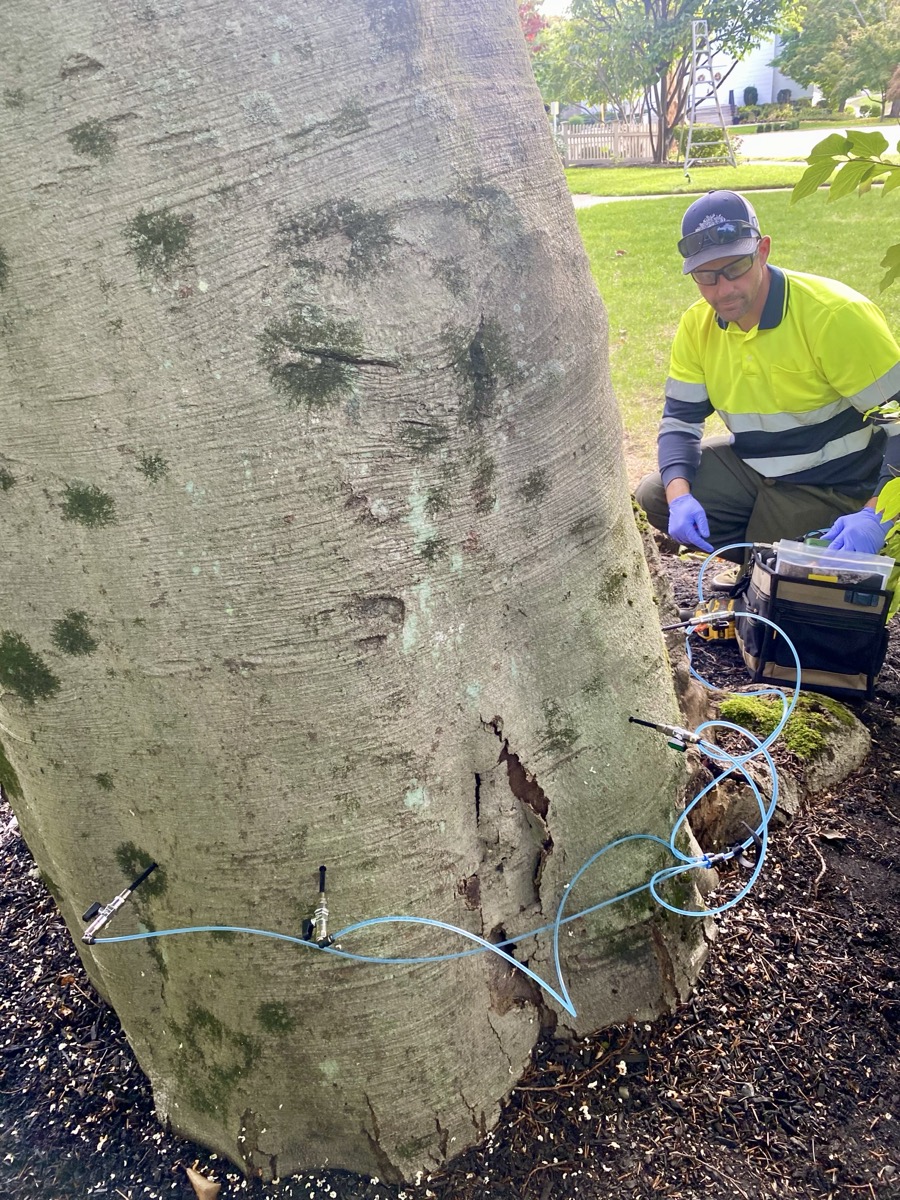
Step 2: Custom Program Design. Based on findings, we craft IPM plans prioritizing cultural, mechanical, and biological controls before chemicals. For emerald ash borer in Barneyville ash trees, we schedule trunk injections of emamectin benzoate using Arborjet systems—pressurized delivery through drilled ports ensures 95% uptake without soil contamination.
Step 3: Soil and Root Care. Deep root fertilization injects liquid nutrients via soil probes spaced 4-6 feet apart under the drip line. In Swansea's acidic soils (pH 4.8-6.2), we balance with micronized iron for chlorotic white pines and phosphorus for pitch pine root growth. Aeration relieves compaction from coastal clay layers, improving oxygen to roots stressed by tidal flooding.
Step 4: Pest and Disease Treatments. Spongy moth management deploys BTK bacterial sprays timed to larval hatch (late April in Swansea), targeting 3rd instar for 90% efficacy. Winter moth in eastern red cedars receives dormant oil applications in February, suffocating eggs without harming pollinators. Hemlock woolly adelgid gets soil drenches of imidacloprid, applied post-rain to maximize absorption.
Step 5: Foliar and Injection Therapies. High-pressure sprayers reach 60 feet for fungicides on American beech leaf spots, while macro-infusion ports deliver systemic insecticides to black cherry cankers. All treatments comply with ANSI A300 (Part 9) for plant health and Massachusetts pesticide regulations.
Step 6: Pruning and Structural Support. We thin crowns per ANSI A300 (Part 1) to reduce wind sail on sassafras near Mount Hope Bay, cabling compromised red oaks in Warren River Area. Safety protocols include two-rope climbing systems and ground crews with spotters.
Step 7: Monitoring and Follow-Up. Quarterly reports track progress with photos and resistograph data. Apps alert us to weather events, prompting post-storm checks in coastal Swansea.
Equipment includes tree tracers for root mapping, thermal imagers for internal rot in sycamores, and GPS for precise neighborhood mapping from Swansea Center to Rehoboth borders. Our crews wear PFAS-free PPE and use electric sprayers to minimize emissions in residential Hortonville.
Homeowners benefit from this process: a treated white oak in Palmer River Area regains 50% vigor in one season. Schedule your assessment at 508-369-5009—our Swansea-tailored methods prevent erosion losses and extend tree lifespans.
Common Plant Health Care Projects in Swansea Neighborhoods
In Swansea Center, we manage declining red oaks threatened by spongy moth and urban soil compaction, injecting imidacloprid and fertilizing to restore shade over village green spaces. Ocean Grove waterfront properties receive salt mitigation for pitch pines, with foliar rinses and root zones amended to buffer sodium levels exceeding 500 ppm from Mount Hope Bay spray.
Hortonville farms need windbreak maintenance on white pine rows bordering pastures—deep root injections combat pine tip moths, while pruning clears fence lines encroaching with black cherry suckers. Barneyville residents call for emerald ash borer prevention on red maples, using trunk injections before larval galleries form, preserving fall color displays.
Warren River Area projects focus on erosion control: we brace undermined sycamores with cabling and treat fungal rots from saturated roots, stabilizing banks during high tides. Palmer River Area woodlands undergo hemlock woolly adelgid programs for mixed evergreens, combining predator beetle releases with systemic treatments to save understory diversity.
Luther's Corner uplands feature American beech with beech bark disease; we prune cankers and apply horticultural oil to halt scale insects. Sassafras groves near agricultural edges get anthracnose sprays, timed to bud break in Swansea's April climate.
Common across neighborhoods: post-storm response after nor'easters, injecting storm-stressed eastern red cedars and fertilizing white oaks. In interfaces with Somerset and Fall River, we clear invasives from red cedar stands while enhancing natives.
These projects follow IPM, reducing pesticide loads by 70% versus reactive sprays. Your Swansea trees gain resilience—contact Southeast Arborist at 508-369-5009 for neighborhood-specific plant health care.
Plant Health Care Costs in Swansea, MA
Plant health care costs in Swansea MA vary by property size, tree count, and issues like river erosion or spongy moth density. Initial assessments start at $150-$250, covering diagnostics for 10-15 trees in Swansea Center yards—value lies in preventing $2,000+ removals.
Custom programs for a typical Ocean Grove waterfront lot (5-10 trees) range $400-$800 annually. Deep root fertilization for white pines costs $20-$30 per tree, addressing nutrient deficiencies in compacted soils; a 20-tree farm windbreak in Hortonville totals $500-$600 per application.
Pest treatments: spongy moth BTK sprays for Barneyville oaks run $300-$500 per acre, far cheaper than 40% defoliation losses. Emerald ash borer trunk injections cost $12-$18 per inch DBH (diameter breast height), so a 20-inch red maple is $240-$360—effective for 2-3 years.
Hemlock woolly adelgid management in Palmer River Area: $400-$700 for soil drenches on 10 trees, including monitoring. Winter moth oils for pitch pines in Luther's Corner add $200-$400 seasonally.
Factors influencing costs: access challenges in Warren River Area raise crane fees by 20%; salt-stressed eastern red cedars need premium micronutrients, upping fertilization 15%. Multi-year contracts save 10-20%, with IPM minimizing repeat visits.
ROI is clear: healthy sycamores boost property values 5-10% in Swansea's $500K median market. Untreated black cherry decline spreads to neighbors, costing shared remediation. ANSI A300 compliance ensures insurance discounts.
Compare bids carefully—our ISA Certified transparency avoids upcharges. Budget $500-$1,500 yearly for comprehensive care on 1/4-acre lots. Call 508-369-5009 for a customized quote on plant health care Swansea MA.
When to Schedule Plant Health Care in Swansea
Schedule plant health care in Swansea MA in early spring (March-April) for spongy moth egg mass removal on oaks before May hatch, aligning with Swansea's average last frost of April 15. Deep root fertilization follows soil thaw, ideally before May rains leach nutrients from sandy loams.
Summer (June-August) targets emerald ash borer injections for red maples, post-adult flight in June. Monitor for wilting sassafras indicating laurel wilt—urgent treatments prevent mortality.
Fall (September-October) suits hemlock woolly adelgid drenches, with crawlers active; prune American beech before leaf drop reveals bark disease. Winter moth sprays hit in December dormant season for pitch pines.
Urgency signs: 20%+ defoliation on white oaks, yellowing needles on eastern red cedars from salt, or leaning sycamores from Warren River erosion—call within 48 hours to avert failure.
Post-storm: inspect within 72 hours after nor'easters, common November-March. Annual programs start anytime; contact 508-369-5009 now for Swansea timing.
Frequently Asked Questions About Plant Health Care in Swansea
What is plant health care in Swansea MA? Plant health care in Swansea MA involves IPM programs diagnosing and treating pests, diseases, and soil issues for trees like red oaks and white pines, using fertilization, injections, and pruning per ANSI A300.
How do I know if my Swansea trees need plant health care? Look for defoliation from spongy moths in Swansea Center oaks, salt scorch on Ocean Grove pitch pines, or root exposure in Palmer River sycamores—our free assessment confirms.
Are your treatments safe for my Swansea family and pets? Yes, ISA Certified applications like BTK for spongy moths biodegrade quickly; we notify pre-treatment and restrict access for 24-48 hours.
How effective are trunk injections for emerald ash borer in Barneyville? 95% mortality reduction for 2 years; emamectin targets larvae in red maples without foliar residue.
What causes bank erosion on my Warren River trees? Tidal fluctuations undermine roots in sandy loams; we fertilize and cable to stabilize.
Can you treat hemlock woolly adelgid in Luther's Corner? Yes, imidacloprid drenches protect pitch pines and hemlocks, with 85% recovery in year one.
How often should I fertilize trees in Hortonville? Annually in spring for white pines on farms; soil tests guide formulations.
Do you serve nearby towns like Fall River? Yes, from Seekonk to Somerset, alongside all Swansea neighborhoods.
Plant Health Care Throughout Swansea
Southeast Arborist delivers plant health care across Swansea neighborhoods: Swansea Center shade trees, Ocean Grove salt-tolerant cedars, Hortonville windbreaks, Barneyville maples, Warren River erosion fixes, Palmer River woodlands, and Luther's Corner beeches. We extend to Somerset, Fall River, Rehoboth, and Seekonk.
ISA Certified, ANSI-compliant services protect your trees from local threats. Call 508-369-5009 for Swansea MA plant health care—schedule today.