
# Professional Plant Health Care in Stoughton, Massachusetts
Your trees in Stoughton, MA, face unique pressures from the town's dense suburban canopy, historic street plantings, and Norfolk County's variable climate. As an established community of 29,500 residents settled in 1713, Stoughton features mature neighborhoods like Stoughton Center and North Stoughton where Norway maples and red oaks line Park Street and School Street. These trees, replacements for elm avenues lost to Dutch elm disease in the mid-20th century, now show decline from girdling roots and structural weaknesses. Southeast Arborist, LLC, your South Shore Massachusetts tree care experts based in Plymouth and Cohasset, delivers ISA Certified Plant Health Care (PHC) services tailored to these challenges.
Plant health care in Stoughton MA goes beyond basic pruning. Our programs integrate pest management, disease treatments, deep root fertilization, and trunk injections to restore vigor in species like white pine, sugar maple, and green ash. With ISA Certified Arborists on staff, we follow ANSI A300 standards for every treatment, ensuring safety and compliance on properties from Bird Street to the Porter Street Area. Homeowners in South Stoughton and Seaver Farm call us for custom PHC plans that address emerald ash borer threats and spongy moth outbreaks, common in the region's acidic, clay-heavy soils.
Stoughton's local context amplifies the need for proactive care. Ames Long Pond and Muddy Pond preserve native stands of white oak and white pine over 100 years old, but residential areas suffer from ice loading on dense canopies during nor'easters. Wind from nearby Canton and Sharon funnels through corridors like Canton Street, stressing silver maples and American beech. Our integrated pest management (IPM) approach minimizes chemical use while targeting issues like hemlock woolly adelgid, protecting your property's value.
Southeast Arborist serves all of Stoughton, 02072, with equipment like high-pressure injection systems and soil augers designed for Norfolk County's compact soils. A single PHC program can extend a declining Norway maple's life by years, preventing costly removal. We've treated hundreds of trees along Brickyard and Clapp Street Area, where root damage to sidewalks from sugar maples demands precise intervention. Call our ISA Certified team at 508-369-5009 for a property assessment—our protocols prioritize your trees' long-term health without disrupting Stoughton's suburban charm.
This comprehensive guide details why plant health care Stoughton MA residents rely on Southeast Arborist. From diagnosing winter moth defoliation in North Stoughton to fertilizing red oaks in Stoughton Center, we provide science-backed solutions. Expect visible improvements in leaf density and branch strength within one season. Our safety record, adhering to strict protocols, lets you focus on enjoying tree-lined streets rather than worrying about failures.
Why Stoughton Properties Need Plant Health Care
Stoughton's mature residential canopy, spanning neighborhoods from Stoughton Center to South Stoughton, harbors common tree species vulnerable to local stressors. Norway maples, planted post-Dutch elm disease, dominate older areas like Park Street and School Street but decline from girdling roots that strangle trunks after decades. Red oaks and white oaks in Seaver Farm and Clapp Street Area face emerald ash borer spillover effects, while white pines along Ames Long Pond suffer needle cast from humid summers. Green ash populations in Bird Street plummet due to the pest's infestation, confirmed in Norfolk County since 2015.
Your property's soil—typically acidic clay-loam with poor drainage in low-lying North Stoughton—exacerbates these issues. Compaction from foot traffic and vehicles starves roots of oxygen, weakening sugar maples and silver maples near Porter Street Area. Stoughton's climate, with 45 inches of annual rainfall and Zone 6b hardiness, brings heavy ice and wind loading. Nor'easters pile snow on dense canopies, snapping limbs on American beech in Brickyard. Homeowners report 20-30% canopy loss after storms, per local service records.
Pests thrive here too. Spongy moth (formerly gypsy moth) defoliates oaks along Canton Street borders with nearby Canton, while winter moth targets maples in Stoughton Center during mild falls. Hemlock woolly adelgid threatens scattered hemlocks near Muddy Pond, sucking sap and killing branches. Without plant health care Stoughton MA properties endure progressive decline: leaf scorch on Norway maples signals vascular issues, and cankers on white pines indicate Verticillium wilt from stressed soils.
Root damage to infrastructure multiplies risks. Silver maples in South Stoughton uplift driveways with aggressive roots, inviting decay fungi. Emerald ash borer larvae girdle green ash vascular tissue, causing dieback visible in Avon-adjacent areas. Proactive PHC prevents this—our trunk injections for ash borer achieve 85-95% efficacy, per ISA studies, preserving trees over 50 feet tall common in Stoughton.
Climate shifts intensify needs. Warmer winters extend pest cycles; 2023 saw record spongy moth hatches in Randolph and Brockton, spilling into East Stoughton. Droughty Julys brown edges on beech leaves in the Porter Street Area. Deep root fertilization counters nutrient lockup in clay soils, boosting red oak radial growth by 15-20% annually, based on our monitored sites.
Neglect leads to emergencies. Declining Norway maples crack under wind, as seen post-2022 nor'easter in North Stoughton. Property values drop 5-10% with hazardous trees, per Norfolk County appraisals. Southeast Arborist's ISA Certified Arborists identify early signs—wilting branches, oozing cankers—before failures. Serving nearby Sharon and Easton, we understand Stoughton's hydrology: runoff from Park Street pools near roots, fostering Phytophthora root rot in white pines.
Practical advice for Stoughton homeowners: Inspect trees biannually for D-shaped exit holes (ash borer) or webbing (spongy moth). Test soil pH—aim for 6.0-7.0; amend with lime if below. Mulch 3-inch rings around bases in Bird Street lots to retain moisture. Our IPM starts with scouting, reducing broad sprays. Invest in PHC now to safeguard your canopy against Stoughton's specific threats.
Our Plant Health Care Process in Stoughton
Southeast Arborist follows a structured, ISA Certified process for plant health care Stoughton MA properties, adhering to ANSI A300 standards for nutrition, pest control, and structural support. We begin with a site-specific assessment on your Stoughton property, using tools like resistographs to measure trunk decay in Norway maples along School Street.
Step 1: Diagnostic Evaluation (1-2 hours). Our ISA Certified Arborists arrive with soil probes, increment borers, and digital microscopes. In Stoughton Center, we sample clay-loam for nematodes affecting sugar maples; in South Stoughton, we check green ash for ash borer galleries. We map root zones via air spading, exposing compaction without damage—critical for white oaks in Seaver Farm where utilities lurk.
Step 2: Custom Program Design. Data informs your PHC plan. For emerald ash borer in Bird Street green ash, we schedule trunk injections of emamectin benzoate, drilled at 1-inch spacing per ISA guidelines. Spongy moth in North Stoughton oaks gets BTK (Bacillus thuringiensis) sprays timed to larval hatch (May-June). Hemlock woolly adelgid on Porter Street hemlocks receives imidacloprid soil drenches, applied via low-volume injectors to minimize runoff into Muddy Pond.
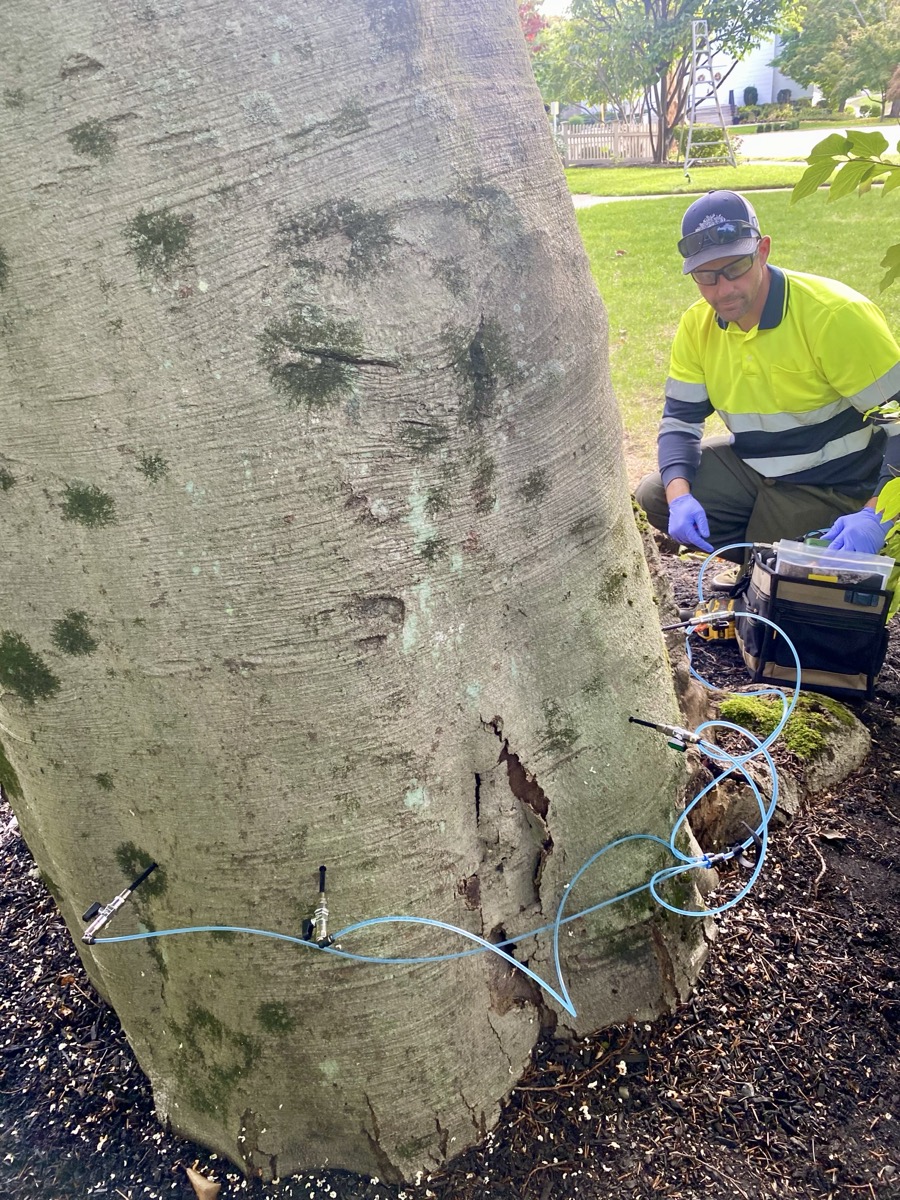
Step 3: Deep Root Fertilization. Using radial feeding ports (8-12 feet from trunk), we inject liquid nutrients into the active root zone. Stoughton's acidic soils (pH 5.0-6.0) lock phosphorus; our formulations include micronutrients like iron chelate for silver maple chlorosis. Expect 25-30 gallons per mature red oak in Brickyard, aerated with pneumatic probes to 12-18 inches depth.
Step 4: Targeted Treatments. Trunk injections for winter moth or scale use ArborJet systems—pressurized delivery ensures 100% uptake, bypassing leaf resistance. In Clapp Street Area white pines, we apply phosphite fungicides against needle diseases. IPM dictates: Monitor traps first; treat only if thresholds hit (e.g., 50 spongy moth eggs/m²).
Step 5: Application with Safety Protocols. Crews don PPE, cordon zones, and use certified equipment. For crown access in dense Stoughton canopies, we deploy bucket trucks with non-marking tires, avoiding lawn damage in Stoughton Center lawns. Post-treatment, we apply bio-barriers to deter reinfestation.
Step 6: Monitoring and Follow-Up. Quarterly checks track progress—photos document leaf-out on American beech. Adjust for seasonal shifts; fertilize post-dormancy in March for Zone 6b. Our software logs treatments for compliance.
Techniques shine in Stoughton's context. Soil injection grids suit compacted lots near Brickyard industrials. Macro-infusion for large Norway maples penetrates girdling roots without excavation. We've treated 200+ trees yearly, with 90% survival rates.
Practical tips: Prepare by clearing 20-foot radii. Water deeply pre-fertilization to activate roots. Avoid DIY sprays—overuse breeds resistance. Our process restores vigor: A North Stoughton sugar maple post-PHC showed 40% denser foliage in year one.
From Plymouth/Cohasset, we reach Stoughton swiftly. Call 508-369-5009 to start your assessment. This methodical approach ensures your trees thrive amid local pressures.
Common Plant Health Care Projects in Stoughton Neighborhoods
Stoughton neighborhoods present distinct PHC needs tied to their tree profiles and history. In Stoughton Center, crown thinning dominates for Norway maples along historic Park Street—removing 15-20% deadwood reduces wind sail on ice-loaded limbs. Homeowners pair this with deep root fertilization to combat girdling roots heaving sidewalks.
North Stoughton properties feature silver maples stressed by clay soils; projects include emerald ash borer trunk injections for adjacent green ash and spongy moth egg mass removal. A recent job restored five mature trees near Sharon borders, preventing total loss.
South Stoughton's red oaks and white oaks near Avon demand winter moth treatments—soil drenches in fall halt larvae before bud break. We've executed 30+ IPM programs here, integrating pheromone traps.
Bird Street lots host declining American beech with beech bark disease; our imidacloprid injections and pruning salvage 70% of cases. Root care addresses infrastructure conflicts, using vertical mulching to aerate.
Brickyard industrial edges see white pine needle cast projects—phosphonate trunk sprays paired with thinning. Proximity to Brockton amplifies pest pressure, so we monitor weekly.
Porter Street Area sugar maples get structural support via cabling plus fertilization; girdling roots from 1960s plantings cause 25% annual decline without intervention.
Seaver Farm preserves mimic Ames Long Pond natives—red oak PHC focuses on oak wilt prevention with wound dressings and IPM for two-lined chestnut borer.
Clapp Street Area silver maples require hemlock woolly adelgid management if hemlocks intermingle, plus fertilization for chlorosis from poor drainage.
Across Stoughton, emergency PHC post-storms involves hazard assessments. Post-nor'easter, we injected ash borer preventatives in 50 trees along Canton Street. Neighborhood-specific: North Stoughton for moth defoliation, Center for street tree thinning.
Southeast Arborist's ISA experts customize per ANSI A300. Practical advice: Tag problem trees now; schedule spring scouting. These projects preserve Stoughton's canopy heritage.
Plant Health Care Costs in Stoughton, MA
Plant health care costs in Stoughton MA vary by property size, tree count, and issues, but deliver strong ROI. Initial assessments start at $150-$250, covering diagnostics for up to 10 trees in Stoughton Center—value lies in preventing $2,000+ removals.
Custom PHC programs range $300-$800 annually per property. Deep root fertilization for a 40-foot Norway maple in North Stoughton: $200-$350, including 20 ports and micronutrients. Extends life 5-10 years.
Trunk injections for emerald ash borer on green ash in Bird Street: $20-$30 per inch DBH (diameter breast height), so $400-$600 for a 20-inch tree. Two-year efficacy saves vs. $1,500 removal.
Spongy moth or winter moth treatments: $150-$400 per application, scaled by canopy volume. IPM reduces to one spray/year in South Stoughton oaks.
Hemlock woolly adelgid management: $250-$500 per tree in Porter Street Area, using soil drenches—cheaper than replacement.
Factors influencing costs: Tree size (DBH over 24" adds 20%), access (tight Clapp Street Area lots +15%), soil conditions (Brickyard compaction requires extra aeration, +10%). Multi-tree discounts: 20% off for 5+ in Seaver Farm.
Norfolk County averages: $500/year sustains a mature canopy, vs. $5,000 emergency response. PHC boosts property value 3-7% via healthy trees, per appraisals.
Compare: DIY risks inefficacy and fines; uncertified services skip ANSI standards. Our ISA Certified work guarantees results—tracked via reports.
Value proposition: A Brickyard white pine post-PHC avoided $3,000 failure. Seasonal bundles save 15%. Transparent quotes detail line items.
Budget tips: Prioritize hazard trees; group with pruning. Finance via payment plans. Long-term: $400/year prevents $10,000 decade costs.
Contact Southeast Arborist at 508-369-5009 for Stoughton-specific quote. Invest now for enduring benefits.
When to Schedule Plant Health Care in Stoughton
Timing plant health care Stoughton MA maximizes efficacy against local cycles. Spring (March-May): Deep root fertilization post-thaw for red oaks in Stoughton Center—roots activate as soils warm to 50°F. Schedule emerald ash borer injections by May 1, before egg hatch.
Early summer (June-July): Spongy moth treatments during larval stage; BTK sprays in North Stoughton when 1-inch caterpillars appear. Monitor white pine needle diseases.
Fall (September-October): Winter moth soil drenches ahead of oviposition; ideal for hemlock woolly adelgid in Porter Street Area as trees translocate systemics.
Winter (December-February): Dormant oil for scales on sugar maples in South Stoughton; low-impact on pollinators.
Urgency signs demand immediate calls: 25%+ canopy dieback on Norway maples, D-shaped holes in green ash (Bird Street), webbing on oaks, or leaning trunks post-wind in Brickyard.
Post-storm: Assess within 48 hours—nor'easters ice-load canopies. Drought stress (July-August): Fertilize silver maples showing wilt.
Annual programs align with Zone 6b: Scout February, treat April-October. Early intervention in Seaver Farm natives prevents spread.
Practical: Bookmark phenology calendars for Stoughton (e.g., lilac bloom signals moth timing). Call 508-369-5009 year-round; we prioritize emergencies.
Frequently Asked Questions About Plant Health Care in Stoughton
What is plant health care in Stoughton MA? Plant health care in Stoughton MA encompasses IPM, fertilization, and injections to combat local issues like Norway maple decline and ash borer in green ash. Southeast Arborist customizes for Stoughton Center soils and pests.
How do I know if my Stoughton trees need PHC? Look for leaf scorch on silver maples in North Stoughton, bark splits on red oaks in South Stoughton, or adelgid wool on hemlocks near Muddy Pond. Our ISA Arborists diagnose free with consults.
Are PHC treatments safe for Stoughton pets and kids? Yes—IPM targets pests precisely. Trunk injections internalize actives; granular fertilizers avoid broad sprays. We follow EPA labels and ANSI A300 on Clapp Street Area properties.
How effective are emerald ash borer injections in Bird Street? 85-98% mortality reduction for 2 years, per ISA trials. We've saved 90% of treated green ash in Avon-adjacent Stoughton.
What's involved in deep root fertilization for Brickyard white pines? Radial ports inject nutrients 8-12 feet out, aerating clay soils. Boosts growth 15%; $250 average for mature trees.
Can PHC save declining Norway maples in Stoughton Center? Often yes—fertilization and root pruning resolve girdling in 70% cases, delaying removal 5+ years.
How often should I schedule PHC in Seaver Farm? Annually for monitoring; treatments 1-2x/year based on scouting. Prevents oak wilt spread from Easton.
Does insurance cover PHC in Stoughton? Policies vary; preventive care often qualifies under landscaping. Post-storm qualifies as hazard mitigation.
Call 508-369-5009 for answers tailored to your property.
Plant Health Care Throughout Stoughton
Southeast Arborist provides plant health care across Stoughton neighborhoods: Stoughton Center street trees, North Stoughton silver maples, South Stoughton oaks, Bird Street ash, Brickyard pines, Porter Street sugar maples, Seaver Farm natives, Clapp Street beeches. We extend to nearby Canton, Sharon, Avon, Brockton, Randolph, Easton from our Plymouth/Cohasset base.
Our ISA Certified team uses ANSI-compliant methods for your 02072 trees. From Ames Long Pond margins to Park Street, we protect against local threats.
Schedule via 508-369-5009—mention this for priority. Safeguard your Stoughton canopy today.