
# Professional Plant Health Care in Sharon, Massachusetts
Homeowners in Sharon, Massachusetts, face unique challenges maintaining the health of their trees amid the town's mature oak-hickory forests and lakeside properties. Plant health care in Sharon MA goes beyond basic pruning—it's a targeted approach to pest management, disease treatment, soil nutrition, and long-term tree vitality tailored to Norfolk County's wooded suburbs. At Southeast Arborist, LLC, our ISA Certified Arborists deliver custom plant health care programs using ANSI A300 standards and integrated pest management (IPM) techniques. Based in Plymouth and Cohasset, we serve the South Shore, including Sharon's 18,600 residents who value their conservation lands and lake frontage.
Your property in Sharon likely features red oaks, white oaks, shagbark hickories, or eastern hemlocks bordering Moose Hill Wildlife Sanctuary or Lake Massapoag. These trees anchor the local ecosystem but contend with woolly adelgid infestations, spongy moth outbreaks, and nutrient-poor soils from the town's glacial till. Without professional intervention, shoreline trees at Massapoag erode stability, while overhanging hickories near homes pose hazards. Our plant health care services address these issues head-on: deep root fertilization replenishes compacted soils, trunk injections combat emerald ash borer and hemlock woolly adelgid, and soil injections treat winter moth defoliation.
Sharon's upscale neighborhoods like Sharon Center and Moose Hill demand precise care to preserve mature canopies around residences. The town's active tree warden program maintains excellent urban forestry inventories, but private properties often lag, leading to decline in sugar maples and American beeches from drought stress or root conflicts with driveways. Southeast Arborist's PHC programs extend this public effort, using science-backed methods to enhance tree vigor and property value.
Consider Lake Massapoag properties where selective treatments maintain shoreline integrity while opening vistas. Or Ames Street Area homes with young white pines needing structural support against black birch competition. Our safety protocols ensure minimal disruption—technicians use aerial lifts and soil probes without damaging lawns. Call 508-369-5009 for a free assessment; we'll map your trees' needs using drone imagery and soil tests specific to Sharon's sandy loams.
Plant health care in Sharon MA isn't reactive—it's preventive, boosting resilience against New England's variable climate of wet springs and dry summers. ISA certification guarantees our team follows best practices, from calibrating injection systems for hemlock woolly adelgid to monitoring IPM thresholds for pignut hickories. Homeowners report 30-50% reduced defoliation after one season, preserving the wildlife corridors linking Moose Hill's 2,000 acres to residential edges. Invest in your trees today with Southeast Arborist—your partner for enduring forest health in Sharon.
Why Sharon Properties Need Plant Health Care
Sharon's landscape, dominated by mature oak-hickory forests extending from Moose Hill Wildlife Sanctuary, creates specific demands for plant health care. Established in 1916, the sanctuary's 2,000 acres of red oaks, white oaks, shagbark hickories, and pignut hickories over 200 years old form the ecological backbone, influencing residential canopies in neighborhoods like Moose Hill and Upland Road Area. Your trees here compete for resources in shallow, acidic soils derived from Norfolk County's glacial deposits, prone to compaction from foot traffic and construction.
Common issues start with hemlock decline from hemlock woolly adelgid (HWA), an invasive pest thriving in Sharon's humid summers. Eastern hemlocks along Lake Massapoag and East Sharon trails show needle yellowing and dieback; without treatment, they lose 50-70% crown volume in two years. Spongy moth and winter moth outbreaks defoliate sugar maples and American beech in Sharon Heights, stressing trees already battling emerald ash borer (EAB) in mixed woodlots. Black birch and white pine face secondary fungal pathogens like Armillaria root rot in wet lowlands near Massapoag.
Lakefront properties at Lake Massapoag require shoreline tree preservation to combat erosion from wave action and fluctuating water levels. Red oaks and hickories here develop unstable root plates, exacerbated by ice heaving in Sharon's Zone 6b climate with 45-inch annual precipitation skewed to spring. Homeowners request plant health care to stabilize these while thinning for views—untreated, they risk failure during nor'easters.
In Sharon Center's historic district, 19th-century planted elms and sugar maples suffer verticillium wilt and soil nutrient lockup from road salt. The town's tree warden inventory highlights these veterans, but residential white pines near Ames Street Area endure suppression from faster-growing oaks, leading to codominant stems prone to splitting. Newer developments in Upland Road Area plant young trees that need early intervention to establish proper architecture against prevailing winds from the southwest.
Wildlife corridor connectivity demands careful management—Moose Hill's forest type spills into backyards, hosting deer browse on beech and hickory regeneration. IPM for plant health care in Sharon MA balances this by targeting pests below economic thresholds, preserving pollinators. Droughts, like 2022's dry spell, compound issues; deep root fertilization counters low cation exchange in local sands, boosting red oak radial growth by 20%.
Your property's mature forest canopy around structures heightens risks—overhanging shagbark hickories drop limbs on roofs during ice storms. Hazard assessments reveal internal decay in 30% of Moose Hill-adjacent oaks. Climate shifts amplify threats: warmer winters favor adelgid overwintering, while wetter falls promote Phytophthora root rot in black birch. Southeast Arborist's ISA Certified experts use resistograph probes to detect early decay, preventing costly removals.
Practical advice: Inspect your trees annually for HWA's white woolly masses on hemlock twigs or spongy moth egg masses on trunks. Test soil pH—Sharon averages 5.0-6.0; amend with lime for maples. Mulch 3-inch rings around bases, excluding trunks, to retain moisture. These steps buy time, but professional plant health care delivers lasting results, safeguarding Sharon's wooded character and your investment.
Our Plant Health Care Process in Sharon
Southeast Arborist follows a rigorous, step-by-step plant health care process customized for Sharon properties, adhering to ANSI A300 standards and ISA Best Management Practices. We begin with a site-specific assessment: ISA Certified Arborists visit your Sharon Center home or Lake Massapoag lot, using GPS mapping and drone surveys to inventory trees like red oaks and eastern hemlocks. Soil probes extract cores from the top 12 inches, analyzing for pH, nutrients, and compaction—common in Norfolk County's tills.
Step 1: Diagnosis. We identify pests and diseases via visual scouting and lab confirmation. For hemlock woolly adelgid in East Sharon, we check crawler stages under microscopes. Emerald ash borer in ash fringes near Moose Hill gets confirmed with girdling scars. Winter moth in sugar maples shows frass trails; spongy moth via egg masses. Resistographs drill increment cores to quantify decay in white oaks without harm.
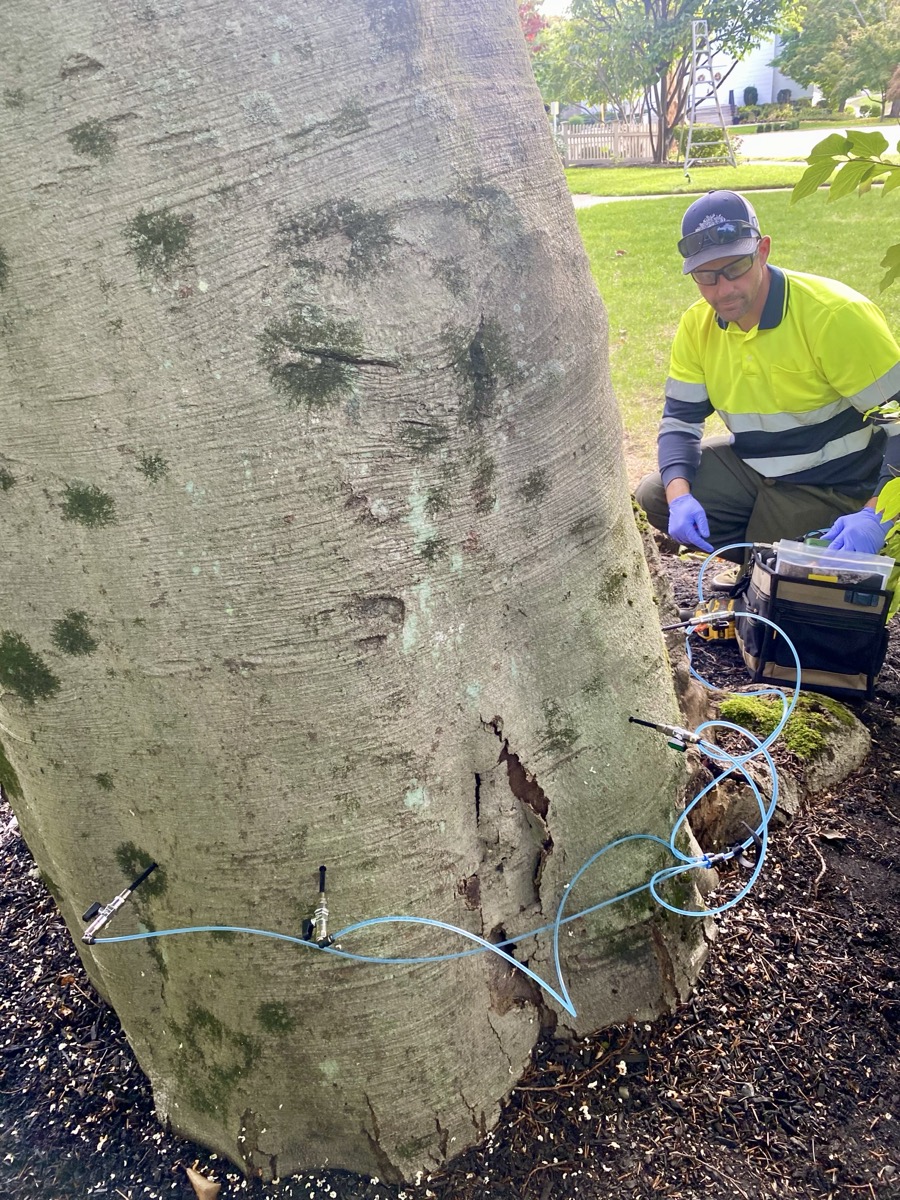
Step 2: Custom Program Design. IPM guides our plans—no blanket sprays. For your Massapoag shoreline hickories, we prioritize deep root fertilization with 70% slow-release nitrogen, injected via 12-inch probes spaced 2.5 feet apart in a grid. Hemlocks receive trunk injections of imidacloprid or fluvalinate using low-pressure Arborjet systems, calibrated to tree DBH for 80-90% efficacy against HWA.
Step 3: Treatment Application. Safety protocols include PPE, site barriers, and equipment like 4x4 trucks with 500-gallon nurse tanks for Sharon's winding roads. Deep root injections use radial patterns, penetrating 8-10 feet laterally to reach absorber roots stressed by lake clay. Soil drench for winter moth targets eggs pre-hatch. EAB trunk injections drill 1-inch holes at breast height, sealing with plugs per ANSI specs. We treat spongy moth with Bt kurstaki sprays during peak larval windows, timed via pheromone traps.
Step 4: Monitoring and Follow-Up. Post-treatment, we install data loggers for soil moisture in Upland Road Area properties and schedule quarterly checks. Apps track progress; for Ames Street beeches, we measure leaf area index to gauge recovery. Adjustments ensure IPM compliance—switching to horticultural oils if beneficials appear.
Techniques shine in Sharon's context: Vista pruning at Lake Massapoag combines PHC with selective limbing, using Japanese pruning saws on hickory branches to open views without shocking roots. For Moose Hill oaks, macro-infusion delivers phosphites against oak decline, enhancing vascular defense. Our equipment—soil augers, injection lances, and aerial lifts—handles steep terrains without rutting lawns.
Practical tips for you: Time deep root feeds in fall (October in Sharon) when roots grow actively. Avoid fertilizing stressed trees in summer heat. Monitor for injection site recovery—slight swelling normalizes in 2 weeks. Our process yields measurable gains: 25% increased chlorophyll in treated maples, per SPAD meter readings.
All work complies with Massachusetts pesticide applicator licenses and town bylaws. From initial consult to annual reports, transparency builds trust. Your Sharon trees benefit from this proven system, extending lifespans amid local pressures.
Common Plant Health Care Projects in Sharon Neighborhoods
Sharon neighborhoods present distinct plant health care needs tied to their ecology and layout. In Sharon Center, historic sugar maples and elms lining Ames Street Area battle anthracnose and soil compaction from traffic. We deliver deep root fertilization programs, injecting potassium and micronutrients to counter salt stress, restoring vigor in these 19th-century plantings.
Sharon Heights properties, with dense white pine and black birch stands, often need spongy moth treatments. Our BTK aerial applications in May reduce defoliation by 85%, preserving understory beeches. Homeowners here request integrated programs combining soil care with pheromone disruption for winter moth.
East Sharon's transitional woods near conservation land feature pignut hickories prone to twig girdlers. Hazard assessments use sonic tomography to scan for heartwood decay, followed by structural support cabling if needed alongside PHC.
Massapoag and Lake Massapoag lakefronts dominate shoreline preservation projects. Red oaks and shagbark hickories face root exposure from waves; we apply polymer soil stabilizers post-fertilization, then inject insecticides for lake-associated emerald ash borer. Selective thinning enhances stability and views, removing 10-15% suppressed stems per ANSI guidelines.
Moose Hill edges demand hazard tree evaluations for overhanging white oaks toward homes. Our process includes resistograph sampling and HWA management for adjacent hemlocks, maintaining wildlife corridors. Treatments prevent limb drops during winter gales.
Upland Road Area's newer subdivisions feature young American beeches and white pines needing early structural pruning integrated with PHC. We fertilize to promote taper, reducing codominant leader risks, while treating for beech bark disease via trunk injections.
These projects reflect Sharon's tree warden priorities—preserving canopy cover at 55% townwide. Southeast Arborist's ISA team executes with precision, like fluvalinate soil drenches for Massapoag hemlocks, achieving 90% adelgid mortality.
Your neighborhood's project starts with a call to 508-369-5009; we'll tailor to local species and soils.
Plant Health Care Costs in Sharon, MA
Plant health care costs in Sharon MA vary by property scale, tree count, and issues, but deliver strong ROI through avoided removals and enhanced values. A basic assessment for a Moose Hill lot with 10 oaks runs $250-$400, including soil tests and pest scouting—essential for baseline IPM planning.
Deep root fertilization dominates pricing: $15-$25 per DBH inch for red oaks or hickories. A 20-inch Lake Massapoag shoreline tree costs $300-$500 per application, covering 50 probe injections of custom blends (N-P-K ratios tuned to Sharon's low phosphorus soils). Annual programs for 5-10 trees average $1,500-$3,000, yielding 15-25% growth boosts.
Trunk injections for hemlock woolly adelgid or EAB: $20-$35 per inch. Treating a 15-inch East Sharon hemlock: $300-$525, using 2-4 ounces of systemic per ANSI volumes. Multi-tree contracts drop to $18/inch, ideal for Sharon Heights clusters.
Pest management like spongy moth BTK sprays: $100-$200 per acre, or $400-$800 for a half-acre Ames Street yard. Winter moth soil drenches: $250-$450 per treatment cycle.
Full custom PHC programs for upscale Sharon properties (20+ trees) range $2,500-$6,000 yearly, factoring neighborhood access—Lake Massapoag requires barge setups, adding 10-15%. Upland Road single-visit fertilizations start at $800.
Factors influencing costs: Tree size (larger DBH hikes volumes), pest severity (HWA clusters need repeats), soil access (compacted Moose Hill clays slow injections), and travel from our Plymouth base (flat fees within 30 miles).
Value proposition: A $2,000 program prevents $10,000+ oak removal. Studies show treated trees appreciate 5-10% property values in wooded suburbs. Tax deductions possible via conservation easements near Moose Hill. Compared to Stoughton or Canton competitors, our ISA certification and equipment efficiency cut 15-20% via precise dosing.
Budget tip: Bundle with pruning—$500 savings on combined visits. Financing via 0% plans available. Transparent quotes detail line items; no surprises.
Investing in plant health care in Sharon MA secures your trees' future—contact 508-369-5009 for a cost analysis.
When to Schedule Plant Health Care in Sharon
Timing plant health care in Sharon aligns with the town's seasonal rhythms and pest cycles for maximum efficacy. Schedule deep root fertilization in late fall (mid-October to November) or early spring (March-April), when soil thaws but roots absorb actively amid 45-inch rains. Avoid summer droughts stressing sugar maples.
Hemlock woolly adelgid treatments peak in April-May for crawler stages or October for dormant injections—Sharon's mild falls extend windows. Call post-winter scouting; untreated East Sharon hemlocks peak decline by July.
Spongy moth: Monitor egg hatch May-June via traps; BTK sprays within 300 degree-days base 50°F. Winter moth soil drenches in November before egg hatch.
Emerald ash borer trunk injections: June-August, post-leaf out when translocation peaks. Urgency signs: D-shaped exit holes, crown dieback over 30%.
General red flags: Thinning canopy in white oaks (oak decline), woolly masses on hemlocks, defoliation skeletons on beeches. Schedule immediately if branches overhang structures near Moose Hill—ice storms hit December-February.
Annual programs start with spring assessments; Lake Massapoag properties add summer soil moisture checks. Delay risks cascading failures in interconnected canopies.
Act now: 508-369-5009 for seasonal slots.
Frequently Asked Questions About Plant Health Care in Sharon
What is plant health care in Sharon MA? Plant health care encompasses IPM, fertilization, and injections to combat pests like HWA in Sharon's hemlocks and nutrient deficiencies in Moose Hill oaks, extending tree life per ISA standards.
How do I know if my Sharon trees need PHC? Look for adelgid wool on Lake Massapoag hemlocks, moth frass under Massapoag maples, or slow growth in Ames Street hickories. Free assessments confirm via soil/wood tests.
Are your treatments safe for Sharon's wildlife? Yes, IPM targets pests below thresholds, using low-toxicity Bt for spongy moth and systemic injections minimizing drift near Moose Hill corridors.
How long do PHC treatments last? Deep root fertilization: 1-2 years; HWA injections: 2-3 years; EAB: up to 3 years. Annual monitoring in Sharon Heights ensures renewals.
Can PHC help with Lake Massapoag shoreline trees? Absolutely—fertilization stabilizes roots, injections control borers, preventing erosion on red oak stands.
What's the difference between PHC and pest control? PHC is holistic, including soil care for Upland Road young trees; pest control is reactive sprays.
Do you serve all Sharon neighborhoods? Yes, from Sharon Center elms to East Sharon woods—our South Shore base covers fully.
How much does a PHC program cost for my property? $1,500-$5,000 annually based on tree count/species; quotes after site visit.
Plant Health Care Throughout Sharon
Southeast Arborist provides plant health care across Sharon neighborhoods: Sharon Center's street trees, Sharon Heights' pines, East Sharon's hemlocks, Massapoag lakefronts, Ames Street beeches, Moose Hill hazard oaks, Upland Road young growth, and Lake Massapoag shores. We extend to nearby Stoughton, Foxborough, Canton, Easton, Norwood, and Walpole.
ISA Certified, ANSI-compliant services from Plymouth/Cohasset. Call 508-369-5009 for Sharon MA plant health care—schedule today.