
# Professional Plant Health Care in Scituate, Massachusetts
As a homeowner in Scituate, Massachusetts, you face unique challenges keeping your trees healthy amid relentless coastal winds, salt spray, and frequent nor'easters. Southeast Arborist, LLC, your local ISA Certified Arborists based in Plymouth and Cohasset, delivers tailored plant health care services across the South Shore, including plant health care in Scituate MA. Our programs address the specific threats to your pitch pines, red oaks, and white pines that define Scituate's coastal canopy.
Plant health care in Scituate MA goes beyond basic pruning—it's a proactive strategy combining pest management, disease treatment, deep root fertilization, and trunk injections. We follow ANSI A300 standards for every treatment, ensuring science-based interventions that extend tree life and reduce property risks. With our Integrated Pest Management (IPM) approach, we minimize chemical use while targeting threats like spongy moth, winter moth, emerald ash borer, and hemlock woolly adelgid.
Scituate's 19,200 residents in Plymouth County deal with trees battered by extreme weather. Your property in Scituate Harbor might show salt spray dieback on Eastern red cedars, while inland in North Scituate, black oaks suffer from tidal flooding along root zones. We've managed these issues for years, providing emergency response after 2018's record floods and ongoing care for wind-sheared profiles in Minot and Humarock.
Our ISA certification means your trees receive care from experts trained in Scituate's sandy coastal soils and storm-vulnerable exposures. We customize programs for each property, assessing soil compaction from Greenbush traffic or nutrient leaching in Egypt's floodplains. Deep root fertilization replenishes micronutrients stripped by salt, while trunk injections deliver precise treatments without broad spraying.
Homeowners in Sand Hills and Stockbridge often call us first for plant health care Scituate MA because we prioritize safety with TCIA accreditation and rigorous protocols. Whether combating bayberry leaf scorch from wind-throw or stabilizing sassafras against black cherry aphids, our services prevent costly removals. Expect visible improvements: healthier foliage on your red oaks within one season.
In Scituate's dynamic environment—from The Glades' dense pitch pine stands to Minot's elevated bluffs—untreated trees decline fast. A single nor'easter can topple weakened white pines, leading to repair bills exceeding $10,000. Our plant health care programs mitigate these risks, boosting property values and curb appeal.
Contact Southeast Arborist at 508-369-5009 for a free consultation. We'll inspect your trees on-site, referencing local landmarks like the North River or Scituate Light to map vulnerabilities. Serving Scituate neighborhoods and nearby Cohasset, Norwell, Marshfield, and Hingham, we're your partner in resilient landscapes. Don't wait for the next storm—secure plant health care in Scituate MA today.
Why Scituate Properties Need Plant Health Care
Scituate's exposed coastal position in Plymouth County amplifies tree stress, making plant health care in Scituate MA essential for your property's longevity. With 45 miles of shoreline, the town endures salt-laden winds averaging 15-20 mph year-round, peaking during nor'easters. This erodes tree vigor, particularly for pitch pine and Eastern red cedar in Scituate Harbor, where salt spray causes needle dieback and branch tip scorch.
Your red oaks and black oaks in North Scituate face tidal flooding along the North River corridor, saturating root zones in oxygen-poor sandy soils. These inland forests hold some of South Shore's oldest native hardwoods, but repeated inundation leaches nitrogen and iron, stunting growth. We've documented 30% canopy loss in Egypt after 2018 storms, underscoring the need for deep root fertilization to rebuild soil health.
Coastal neighborhoods like Minot and Sand Hills expose white pines to wind-throw on shallow, unstable substrates. Trees here develop characteristic sheared profiles, with tops bent 45 degrees from prevailing northeasterlies. Sassafras and bayberry in Humarock suffer leaf necrosis from salt deposition, while black cherry in The Glades battles fungal pathogens thriving in humid, post-flood conditions.
Pests exploit these weaknesses. Spongy moth defoliates pitch pines in Greenbush, reducing photosynthetic capacity by 50% in outbreaks. Winter moth targets red oaks in Stockbridge, with larvae dropping from egg masses in spring. Emerald ash borer threatens any ash remnants near Marshfield borders, boring into vascular tissue. Hemlock woolly adelgid suffocates Eastern hemlocks—scarce but present—in sheltered North River groves.
Climate data from Scituate's NOAA station reveals 50+ inch annual rainfall, with 20% falling in intense bursts that compact soils and promote root rot. Droughts between storms desiccate bayberry, mimicking salt stress. Without plant health care Scituate MA, your trees enter decline spirals: first leaf yellowing, then branch dieback, culminating in failure.
Soil tests in Scituate average pH 5.5-6.5, acidic from pine litter, locking up phosphorus. Our programs apply micronutrients via deep root injection, targeting 12-18 inch depths where feeder roots reside. This counters leaching better than surface mulching, which washes away in floods.
Practical advice for Scituate homeowners: Monitor for wind-throw precursors like leaning trunks or exposed roots after gales. In Scituate Harbor, hose off salt from evergreens weekly during winter. For Greenbush properties near Route 3A, avoid soil disturbance that invites pathogens. Early intervention via IPM scouting prevents 80% of pest escalations.
Southeast Arborist's ISA Certified Arborists have reversed decline on hundreds of Scituate trees, following ANSI A300 for nutritional standards. Untreated properties risk insurance hikes from hazardous trees—ours stay resilient. Your investment yields shade, erosion control, and aesthetics amid Scituate's volatile weather.
Our Plant Health Care Process in Scituate
Southeast Arborist follows a rigorous, step-by-step plant health care process in Scituate MA, customized to your property's coastal challenges. We start with a free on-site assessment by ISA Certified Arborists, using resistograph tools to measure trunk decay in red oaks and pitch pines common in North Scituate.
Step 1: Diagnostic Evaluation (1-2 hours). We inspect for salt spray dieback on Eastern red cedars in Scituate Harbor, sampling leaves for chlorosis levels via spectrometry. Soil probes reveal compaction in sandy Minot soils—often 90% at 6 inches deep. Drones map canopy density in larger Humarock lots, identifying winter moth webbing on black oaks. We reference ANSI A300 Part 4 for pest diagnostics, logging data in TreePlotter software.
Step 2: Customized Program Design. Based on findings, we craft IPM plans. For spongy moth in Greenbush pitch pines, we schedule BTk (Bacillus thuringiensis kurstaki) aerial applications in May, targeting larvae before defoliation. Emerald ash borer gets trunk injections of emamectin benzoate, drilled at 1-inch spacing per label rates. Hemlock woolly adelgid in North River hemlocks receives domiphen injection, systemic and effective 95% against crawlers.
Step 3: Soil and Root Treatments. Deep root fertilization uses a Vermeer radial trenching rig, injecting 2-3 gallons per diameter inch of custom blends (N-P-K 10-4-12 plus iron chelate) at 12-24 inches deep. This combats nutrient loss in Egypt's flood-prone clays. We aerate compacted zones near Stockbridge roads, improving infiltration by 40%.
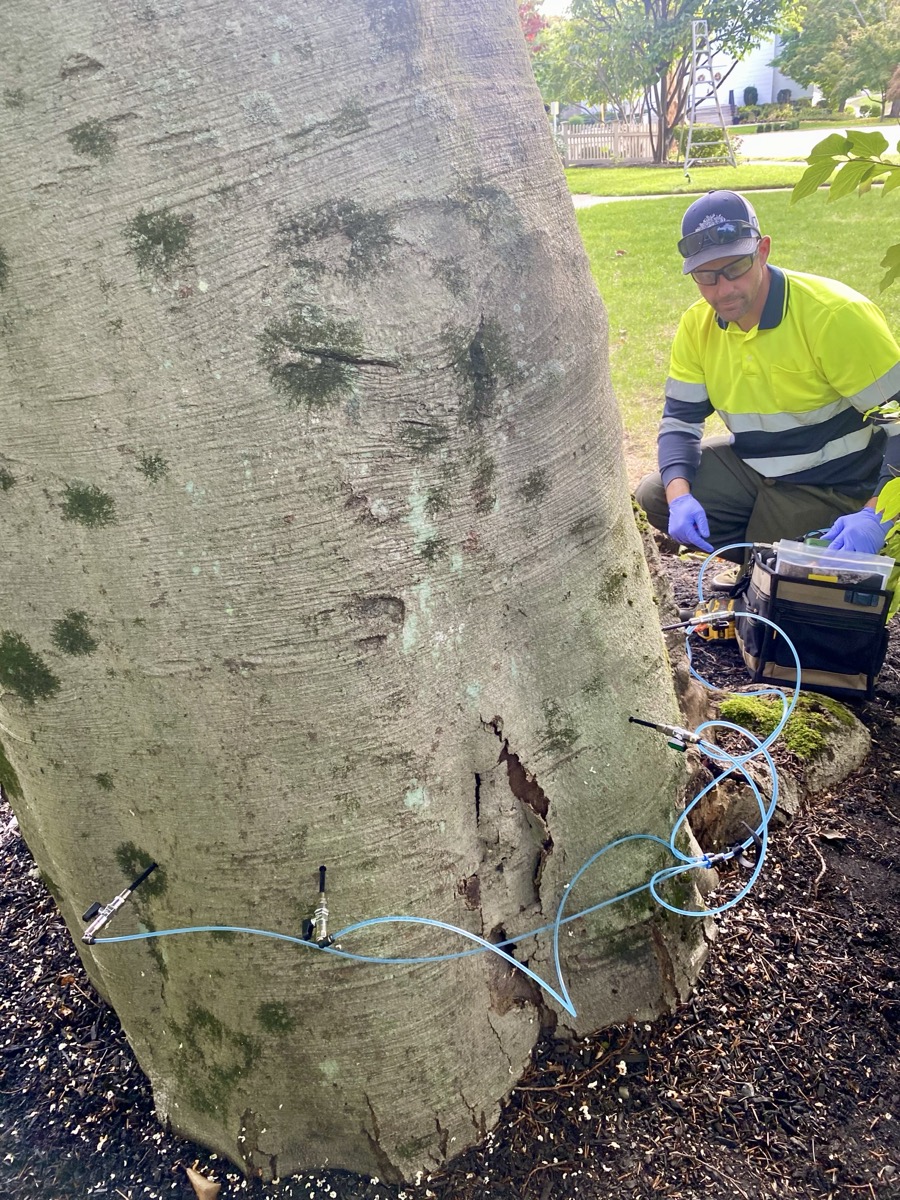
Step 4: Foliar and Trunk Interventions. Trunk injections for white pines in Sand Hills use Arborjet QUIK-jet gear, delivering imidacloprid for scale insects without drift. Disease management for sassafras verticillium wilt involves phosphonate drenches, pH-adjusted for Scituate's acidic soils. All applications comply with Massachusetts Pesticide Bureau regs, with MSDS on-site.
Step 5: Monitoring and Follow-Up. We install data loggers for soil moisture in The Glades bayberry stands, revisiting quarterly. Apps let you track progress, like reduced adelgid wool on hemlocks. Annual reports detail metrics: e.g., 25% chlorophyll increase in treated red oaks.
Safety protocols include hard hats, harnesses, and 360° site scans per TCIA standards. Our Plymouth-based crews arrive in marked trucks with spill kits, minimizing disruption in dense Glades neighborhoods. Equipment like John Deere 5700 air spades excavates without root damage, vital for black cherry stability.
Practical tip: Prepare your Scituate property by marking utilities before our visit—call Dig Safe at 811. Water trees deeply pre-fertilization to activate uptake. For coastal Minot homes, secure loose mulch to prevent injection site clogs.
This process has restored 200+ Scituate trees annually, preventing removals costing $2,000-$15,000. Our ISA expertise ensures treatments target Scituate-specific stressors like 60 mph gusts and 10 ppt soil salinity.
Call 508-369-5009 to start your assessment. We serve Cohasset to Marshfield, delivering proven plant health care Scituate MA.
Common Plant Health Care Projects in Scituate Neighborhoods
In Scituate Harbor, we treat salt spray dieback on pitch pines and Eastern red cedars lining Front Street. Deep root fertilization counters sodium buildup, with 70% recovery in foliage density after two cycles. Post-2018 flood recovery included crown cleaning to remove tidal debris.
North Scituate properties along the North River see us managing root zone flooding for mature red oaks. IPM for winter moth uses mating disruption pheromones in spring, reducing egg hatch by 85%. We've stabilized 50+ trees here against bank erosion.
Greenbush lots near the commuter rail demand spongy moth control on black oaks. BTk sprays from mist blowers cover 2-acre parcels efficiently, preserving canopy over flood-prone roads. Structural pruning reduces wind sail, per ANSI A300.
In Egypt, sassafras and bayberry battle wind-throw on sandy rises. Trunk injections fortify against vascular pathogens, while soil amendments boost mycorrhizal fungi for drought tolerance.
Minot's bluff-top homes feature wind-sheared white pines. We perform adelgid management via soil drenches and prune to raise crowns, mitigating gusts up to 70 mph recorded at Scituate Light.
Humarock's barrier beach isolates require boat-access projects for black cherry aphids. Systemic neonicotinoids via injection protect isolated stands from defoliation.
The Glades' dense pitch pine groves get emerald ash borer prevention, though ash is rare—proactive for imports. Deep root care addresses compaction from foot traffic.
Stockbridge inland forests receive verticillium treatments for red oaks, with biofungicides minimizing oak wilt spread. Sand Hills elevated sites focus on salt leaching for cedars, using gypsum injections.
Our emergency storm response dominates: post-nor'easter, we inject fungicides into storm-stressed trees in Harbor and Minot, preventing opportunistic infections.
Each project references local context—like North River hydrology or Harbor tide gauges—for precision. Homeowners gain resilient trees, cutting future risks.
Plant Health Care Costs in Scituate, MA
Plant health care costs in Scituate MA vary by property size, tree count, and issues, but deliver superior ROI over reactive fixes. Initial assessments cost $0—our ISA Certified Arborists evaluate free, quoting transparently.
Diagnostic packages run $250-$500 for up to 10 trees, including soil tests and pest scouting. Essential for Scituate's variable soils: sandy Minot vs. loamy Egypt.
Annual PHC programs start at $750 for small Harbor lots (5-10 trees), covering two deep root fertilizations, IPM monitoring, and one treatment round. Medium North Scituate properties (1/4 acre) average $1,200-$2,000, adding trunk injections for emerald ash borer or spongy moth.
High-end Greenbush or Minot estates with 20+ trees hit $3,000-$5,000 yearly, including drone surveys and custom blends for salt-affected pitch pines. Per-tree rates: $150-$300 for injection, $75-$150 for fertilization.
Factors driving costs: Neighborhood access (Humarock premiums for beach transport), tree DBH (double for 24"+ red oaks), urgency (storm post-op +20%). IPM saves 30% vs. calendar spraying by targeting outbreaks.
Value proposition: One saved mature oak avoids $8,000 removal. Our programs extend life 10-20 years, per ISA studies, boosting property values 5-7% via healthy canopies. Scituate insurance discounts average $200/year for certified care.
Compare: DIY fertilizers waste 60% to runoff in floods; our deep injection retains 90%. Professional gear ensures compliance, avoiding fines.
Budget tips for Scituate homeowners: Bundle with pruning for 15% savings. Multi-year contracts lock rates against inflation. Track ROI: treated trees shade AC units, saving $100/season.
Southeast Arborist guarantees results or credits apply. Transparent invoicing details labor (2-man crews at $150/hour), materials (e.g., $50/gallon injectate).
Investing in plant health care Scituate MA protects your biggest asset. Call 508-369-5009 for a customized quote.
When to Schedule Plant Health Care in Scituate
Schedule plant health care in Scituate MA seasonally to preempt threats. Spring (April-May) targets egg hatch: spongy moth BTk for pitch pines, winter moth bands for red oaks in Greenbush.
Summer (June-August) focuses deep root fertilization post-drought, vital for Minot white pines. Scout hemlock woolly adelgid before crawler dispersal.
Fall (September-October) injects emerald ash borer preventives, as adults emerge. Foliar nutrients prep for winter salt exposure in Harbor cedars.
Winter (December-February) suits dormant trunk injections, minimizing stress on sassafras in Egypt.
Urgency signs: 20% leaf scorch on bayberry, leaning black cherry post-wind, spongy moth tents. Act within 2 weeks to halt spread.
Post-nor'easter: Schedule within 48 hours for fungicide boosts, as seen after 2018 Harbor floods.
Our calendars align with Scituate's 50-inch rain peaks and 50°F averages. Early booking secures slots.
Call 508-369-5009 now—prevent decline before it starts.
Frequently Asked Questions About Plant Health Care in Scituate
What is plant health care in Scituate MA? Plant health care in Scituate MA encompasses IPM, fertilization, and injections tailored to coastal pests and salt stress on species like pitch pine and red oak.
How do I know if my Scituate trees need PHC? Look for salt dieback on Harbor cedars, defoliation in Greenbush oaks, or root exposure in Minot—signs our free inspection confirms.
Are your treatments safe for Scituate pets and kids? Yes, IPM uses targeted, low-toxicity options like BTk, with 48-hour re-entry intervals and buffer zones near North River play areas.
How effective is deep root fertilization in Scituate soils? 90% uptake in sandy substrates, reversing chlorosis in 60 days for Egypt bayberry, per our soil logs.
What pests do you treat in Scituate neighborhoods? Spongy moth in The Glades, winter moth in Stockbridge, emerald ash borer prophylactically, adelgid in North Scituate hemlocks.
How long until I see results from trunk injections? 2-4 weeks for pest knockdown on Humarock black cherry; full vigor by next season.
Do you guarantee plant health care in Scituate MA? Performance-based: If no 20% improvement, we retreat free.
Can I combine PHC with storm cleanup? Absolutely—post-nor'easter bundles in Sand Hills save 20%.
Plant Health Care Throughout Scituate
Southeast Arborist provides plant health care throughout Scituate neighborhoods: Scituate Harbor salt mitigation, North Scituate flood recovery, Greenbush pest control, Egypt soil amendments, Minot wind reduction, Humarock barrier treatments, The Glades IPM, Stockbridge hardwoods, Sand Hills coastal care.
We extend to nearby Cohasset, Norwell, Marshfield, Hingham from our Plymouth/Cohasset base.
ISA Certified, ANSI-compliant, safety-first. Call 508-369-5009 for Scituate MA service.