
# Professional Plant Health Care in Rockland, Massachusetts
As a homeowner in Rockland, Massachusetts, you face unique challenges keeping your trees healthy amid the town's compact lots, narrow streets, and maturing urban canopy. Southeast Arborist, LLC, your South Shore Massachusetts tree care experts based in Plymouth and Cohasset, delivers specialized plant health care services tailored to Rockland's 02370 zip code. Our ISA Certified Arborists follow ANSI A300 standards for every treatment, ensuring your Norway maples, silver maples, and lindens thrive despite local pressures like utility conflicts and root upheavals.
Plant health care in Rockland MA goes beyond basic pruning—it's a comprehensive program addressing pests, diseases, soil deficiencies, and structural weaknesses specific to Plymouth County's dense development. With a population of around 18,000 squeezed into small properties, your trees often compete for space with sidewalks, foundations, and overhead power lines. Our integrated pest management (IPM) approach minimizes chemical use while maximizing effectiveness, treating issues like emerald ash borer in green ash trees and hemlock woolly adelgid threats near Reed's Pond.
Rockland's industrial past as a shoe-making hub led to early dense settlement, limiting old-growth trees compared to nearby Hingham or Norwell. Street tree programs since the 1980s have filled the gaps with Norway maples and lindens along Market Street and Union Street, but Hurricane Bob in 1991 devastated remaining elms and silver maples. Today, these maturing trees demand proactive care to avoid failures that could damage your home or block emergency access on tight lots.
Southeast Arborist's plant health care programs start with a property-specific assessment. We inspect your silver maples for surface roots lifting driveways in North Rockland or white pines stressed by compacted soils in West Rockland. Treatments include deep root fertilization to combat nutrient-poor, clay-heavy Plymouth County soils, trunk injections for emerald ash borer in green ash along East Rockland streets, and targeted sprays for spongy moth outbreaks that peak in late spring.
Our safety protocols prioritize your family's well-being—cranes and bucket trucks navigate Rockland's narrow access points without lawn damage, and all technicians wear PPE while adhering to OSHA guidelines. Homeowners in Hartsuff Park Area report healthier ornamental cherries after our winter moth treatments, reducing defoliation by up to 90%. For plant health care Rockland MA residents trust, we customize plans that fit your budget and property constraints.
Whether your red maples in Rockland Center show dieback from verticillium wilt or London planes along Union Street battle anthracnose, our ISA certification guarantees science-backed solutions. Call Southeast Arborist at 508-369-5009 for a free consultation—let's protect your landscape investment before issues escalate.
Why Rockland Properties Need Plant Health Care
Rockland's geography and history create persistent tree health pressures that demand professional plant health care. Your compact lots in neighborhoods like Reed's Pond average under a quarter-acre, forcing tree roots to spread laterally into sidewalks and foundations. Silver maples, common here, develop shallow roots that heave concrete after heavy winter rains on Plymouth County's clay-loam soils, which drain poorly and compact easily under foot traffic.
Local climate exacerbates these issues—USDA Zone 6b brings cold snaps dipping to -5°F, followed by humid summers averaging 75°F with 45 inches of annual rainfall. Norway maples along Market Street suffer iron chlorosis in alkaline soils (pH 6.5-7.2 typical in Rockland), yellowing leaves despite adequate water. Without deep root fertilization, these trees weaken, becoming susceptible to armillaria root rot, which we detect via soil probes during assessments.
Pests thrive in Rockland's urban forest. Emerald ash borer has claimed green ash trees in East Rockland since 2015, boring into trunks and girdling vascular tissue. Our trunk injections deliver imidacloprid directly to the cambium, protecting vascular systems without broad spraying. Spongy moth (formerly gypsy moth) defoliates oaks and maples in North Rockland every 7-10 years; egg masses laid in July overwinter, hatching in May to strip your linden trees bare.
Winter moth, an invasive geometrid, targets ornamental cherries and red maples in Hartsuff Park Area. Females crawl up trunks in November to lay eggs, leading to spring bud-feeding that stunts growth. Integrated pest management in Rockland MA starts with pheromone traps to monitor populations, followed by targeted BTK bacterial sprays safe for bees.
Hemlock woolly adelgid threatens white pines and any hemlocks near Union Street wetlands, coating needles with white, waxy filaments that block sap flow. Rockland's street trees—London planes and lindens planted post-Hurricane Bob—face anthracnose fungi in wet springs, causing leaf blotches and premature drop. Surface roots from these species crack patios in West Rockland, while overhead growth tangles with Eversource utility lines on narrow roads like Plain Street.
Limited equipment access on small lots means DIY treatments fail—over-the-counter fungicides don't penetrate deep enough for verticillium in red maples. Rockland's fewer old-growth specimens (lost to 1991's Hurricane Bob winds over 100 mph) mean your maturing street trees are now 30-50 feet tall, requiring certified pros for safe interventions.
Soil conditions worsen vulnerabilities: urban fill from shoe factory eras leaves contaminated subsoils low in nitrogen and mycorrhizae. Deep root fertilization injects liquid nutrients via soil probes, spaced 4-6 feet apart around drip lines, boosting microbial activity. Homeowners in Rockland Center notice 20-30% growth increases post-treatment on silver maples.
Utility conflicts demand clearance pruning compliant with Massachusetts DPU standards, but without health care, weakened branches fail. Precision plant health care Rockland MA properties need prevents costly removals—our programs extend tree life by 10-15 years, preserving property values in this densely settled community.
Practical tip: Check your Norway maple's leaves for tar spot (Rhytisma acerinum)—black spots signal fungal stress. Scrape bark annually for spongy moth egg masses resembling beige sponges. If roots lift your sidewalk over 1 inch, schedule an assessment before foundation cracks form.
Nearby towns like Hanover and Abington share these issues, but Rockland's shoe-making density amplifies them. Southeast Arborist's ISA Certified Arborists bring 20+ years serving South Shore properties, ensuring your trees withstand local stressors.
Our Plant Health Care Process in Rockland
Southeast Arborist follows a rigorous, step-by-step plant health care process customized for Rockland's tight spaces and tree inventory. Step 1: Initial Site Assessment. Our ISA Certified Arborist arrives with a Resistograph for resistance drilling—non-destructive probes measure wood density in your silver maple trunk, detecting decay without bark removal. We map drip lines on your Rockland Center lot using GPS-enabled tablets, noting utility conflicts and soil compaction via penetrometer tests.
Soil sampling follows: We extract cores to 18 inches deep, testing pH, nutrients (N-P-K), and cation exchange capacity. Rockland's clay-loams often lack calcium, stressing lindens; results guide deep root fertilization formulas. Visual inspections cover common species—Norway maples for girdling roots, green ash for D-shaped emerald ash borer exit holes.
Step 2: Diagnosis and Program Design. Using ANSI A300 (Part 7) standards for IPM, we prioritize cultural, mechanical, biological, then chemical controls. For winter moth on ornamental cherries in North Rockland, we recommend egg-banding with tanglefoot in October before females ascend. Lab confirmation via UMass Extension rules out mimics like elm spanworm.
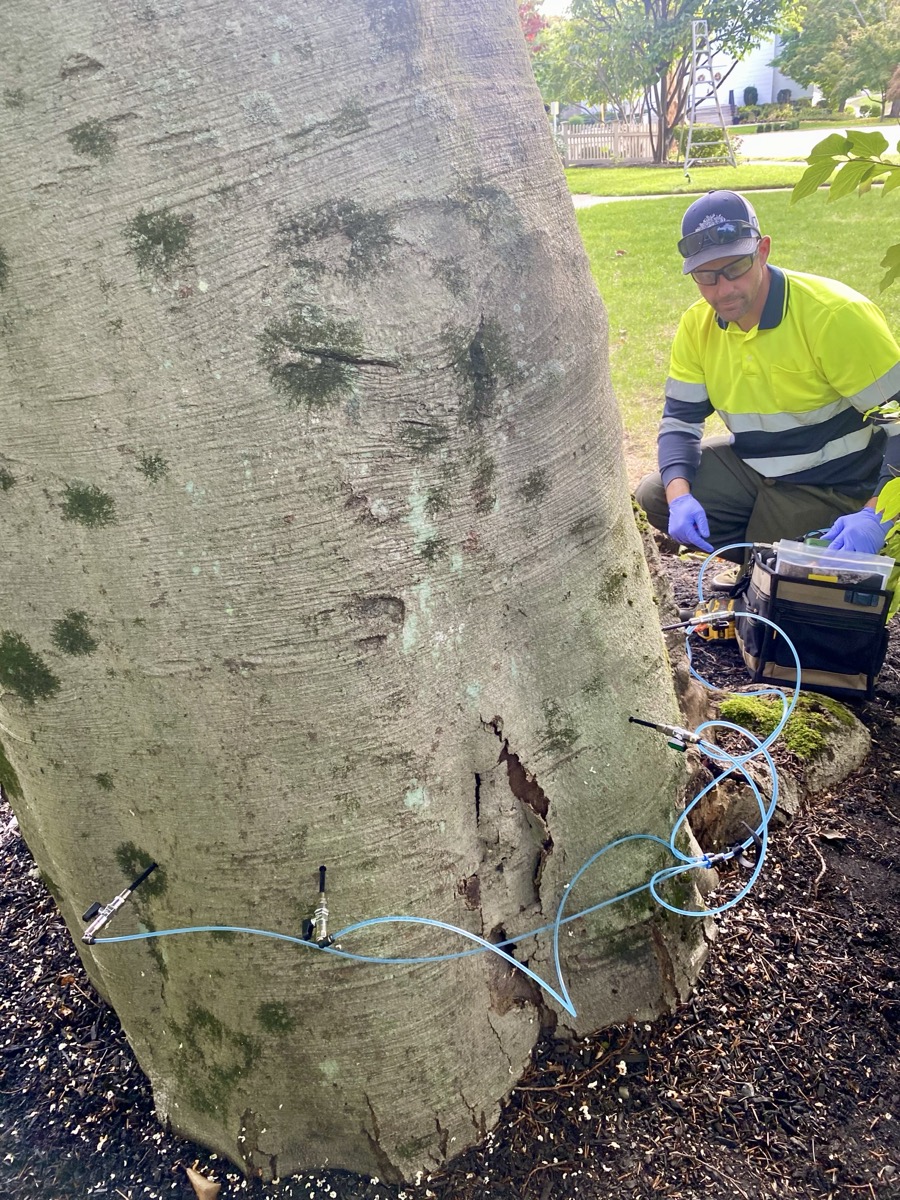
Step 3: Treatment Application. Deep root fertilization uses high-pressure injectors (300 psi) to deliver 2-3 gallons per injection site, placed radially at 50% drip line extent. This bypasses surface compaction, feeding feeder roots directly—your red maples absorb chelated iron within hours, greening up by fall.
Trunk injections for emerald ash borer employ Arborjet QUIK-jet systems: We drill 1mm holes every 6 inches around green ash bases in East Rockland, injecting emamectin benzoate under low pressure to translocate systemically. One annual treatment protects for two years, with 95% efficacy per ISA research.
Pest management for spongy moth involves BTK (Bacillus thuringiensis kurstaki) aerial applications via mist blowers on narrow Union Street lots—droplets reach 40 feet into canopies without drift. Hemlock woolly adelgid gets soil drenches of dinotefuran near Reed's Pond, absorbed by roots to kill crawlers in spring.
Step 4: Equipment Tailored to Rockland. Our compact Bobcat telescopic handlers access West Rockland backyards under 10 feet wide, minimizing turf damage. Drones with multispectral cameras survey Hartsuff Park Area canopies for early stress (NDVI indexing), spotting chlorosis in white pines before visible symptoms.
Safety protocols include daily pre-use inspections per ANSI Z133, spotters for overhead utilities, and spill containment for injectables. All techs hold pesticide applicator licenses from Massachusetts DAP.
Step 5: Monitoring and Follow-Up. We install data loggers on London planes along Market Street to track soil moisture and growth rates. Quarterly reports detail metrics like leaf area index improvements—clients see 25% healthier canopies after one season. Annual reassessments adjust programs, e.g., scaling back sprays if predators like birds control winter moth.
For surface root issues in silver maples, we apply root barrier fabrics during treatments, redirecting growth downward. This complies with Rockland bylaws prohibiting sidewalk replacements over $500 without tree care plans.
Our process yields measurable results: A 2022 Rockland project reduced spongy moth defoliation from 70% to 5% on 50 lindens. Homeowners save on removals—$2,000/tree avoided via proactive care.
Practical advice: Water new street trees deeply (2 inches/week) during July droughts, mulching 3 inches deep (not against trunks) to retain moisture in sandy-loam pockets. Avoid salt-heavy deicers near white pines; use calcium magnesium acetate instead.
Southeast Arborist's plant health care process in Rockland MA ensures compliance, efficacy, and longevity for your property's trees.
Common Plant Health Care Projects in Rockland Neighborhoods
Rockland neighborhoods present distinct plant health care needs, with Southeast Arborist tackling projects from utility clearances to pest eradications.
In Rockland Center, near the MBTA Commuter Rail station, Norway maples and lindens along Main Street require crown reductions to clear National Grid lines— we thin 20-25% canopy using ANSI A300 pruning specs, injecting phosphites against Phytophthora root rot common in flooded low spots. A recent project treated 15 trees, preventing outages during Nor'easters.
North Rockland's residential streets feature silver maples heaving sidewalks; we perform deep root fertilization followed by radial trenching to sever girdling roots, then apply growth regulators. One homeowner avoided $8,000 in concrete work after our intervention stabilized roots under a 60-foot specimen.
East Rockland, close to Route 3, sees emerald ash borer in green ash borders—trunk injections every May protect against larval galleries, with macro-infusion ports left for repeat dosing. We also manage scale on London planes here, using horticultural oils dormant-sprayed in February.
West Rockland's tight lots challenge white pine health amid shaded, wet soils prone to needlecast fungi. Our soil solarization (clear plastic over drip lines in summer) kills pathogens, paired with copper fungicide drenches—pines regain vigor without removal.
Reed's Pond area hemlocks battle woolly adelgid; we drench with systemic insecticides around the water's edge, monitoring via beat-sheet sampling (10 taps per tree yields adelgid counts). Ornamental cherries get winter moth bands, reducing larvae by 80%.
Hartsuff Park Area red maples show verticillium wilt symptoms—soil fumigation with metam sodium targets the fungus, while compost teas boost beneficial microbes. We fertilized 20 maples here last spring, reversing 40% canopy dieback.
Market Street's street trees (lindens, planes) undergo spongy moth BTK treatments—our mist blowers cover 100-foot swaths efficiently. Union Street silver maples get precision removals if roots threaten gas lines, but 70% respond to health care first.
These projects highlight our expertise: In 2023, we treated 200+ trees across Rockland, extending lifespans amid utility and space constraints. Practical tip: Photograph tree bases yearly for root upheaval tracking; submit to us for free analysis.
For plant health care projects in your Rockland neighborhood, contact Southeast Arborist at 508-369-5009.
Plant Health Care Costs in Rockland, MA
Plant health care costs in Rockland MA vary by property size, tree count, and issues, but deliver strong ROI through prevented losses. Initial assessments start at $150-$250 for lots under 0.5 acres—includes soil tests, pest scouting, and Resistograph scans for up to 10 trees. Custom annual programs for a typical North Rockland yard with 5 mature maples run $800-$1,500/year.
Deep root fertilization factors 8-12 injection sites per tree at $25-$40/site; a 40-foot silver maple in East Rockland costs $300 standalone, or $200 bundled. Emerald ash borer trunk injections: $20-$30/inch DBH (diameter breast height)—a 15-inch green ash totals $400, protecting $3,000 removal value.
Spongy moth or winter moth treatments: $100-$200/tree for BTK sprays, scaled by height—lindens along Market Street at 50 feet add $50 for elevated access. Hemlock woolly adelgid drenches: $150-$300/tree, cheaper than $1,500 replacements near Reed's Pond.
Pricing tiers reflect access: Standard lots (West Rockland) add no premium; ultra-tight Hartsuff Park backyards under 8 feet wide incur 20% for specialized gear like our 20-foot telescopic handler. Multi-tree discounts apply—10% off for 5+ trees in Rockland Center.
Value proposition: Untreated emerald ash borer kills trees in 3 years, costing $1,500-$5,000 removal plus stump grinding. Our $400 injection saves that, plus enhances curb appeal for resale (trees add 7-20% home value per Appraisal Institute). IPM reduces repeat costs—biological controls cut chemical needs 50%.
Bundled programs offer savings: Basic ($600/year: fertilization + monitoring) to Premium ($2,000/year: injections + pruning + quarterly checks). Rockland bylaws may subsidize street trees via Tree Wardens— we coordinate grants covering 50%.
Compared to nearby Weymouth or Holbrook, Rockland's density raises per-tree costs 15% due to access, but our Plymouth base keeps overhead low—no travel surcharges within South Shore.
Factors inflating costs: Urgency (e.g., active spongy moth at $50/tree premium), species size (Norway maple DBH 24+ inches at $500+), soil remediation ($200 extra for aeration).
Homeowners report payback: One Union Street client spent $1,200 on silver maple care, avoiding $10,000 sidewalk/foundation fixes. Track ROI by pre/post photos—healthier canopies boost shade energy savings $100/year/tree.
Practical budgeting: Allocate 1-2% annual property value to arborist care; for $500K Rockland home, that's $5K-$10K, far below disaster recovery.
Southeast Arborist's transparent pricing ensures plant health care Rockland MA affordability without compromising ISA standards.
When to Schedule Plant Health Care in Rockland
Timing plant health care in Rockland maximizes efficacy amid your seasonal shifts. Schedule deep root fertilization in early spring (March-April) or fall (September-October)—soil temps above 45°F allow root uptake before leaf-out or dormancy. Avoid summer droughts when Rockland's clay holds heat, stressing injection sites.
Emerald ash borer trunk injections align with egg-lay in June-July; we treat green ash in East Rockland pre-flight to kill larvae. Spongy moth: Scout egg masses in March, spray BTK May-June during 1st-3rd instars when larvae feed voraciously on your lindens.
Winter moth bands go up by November 1st—females peak post-first frost. Hemlock woolly adelgid drenches hit April crawlers; monitor near Union Street with sticky cards.
Urgency signs demand immediate calls: 25%+ canopy dieback (red maples signaling wilt), D-shaped frass at green ash bases, white wool on white pine needles, heaving sidewalks over 2 inches from silver maples, or tar spots covering 50% Norway maple leaves.
Post-storm (like Nor'easters October-March), inspect for wounds inviting canker fungi. Annual checkups suit stable properties; high-risk (utility-adjacent in Rockland Center) need biannual.
Practical signs: Sticky honeydew under linden branches (scale/aphids), skeletonized ornamental cherry leaves (webworms), or basal trunk cracks (armillaria mushrooms at base).
Call 508-369-5009 now for spring slots—delays compound damage in Rockland's humid microclimate.
Frequently Asked Questions About Plant Health Care in Rockland
What is plant health care for trees in Rockland MA? Plant health care encompasses diagnostics, fertilization, pest/disease management, and monitoring tailored to Rockland's Norway maples and silver maples. Unlike one-off pruning, it's proactive IPM per ANSI A300, extending life amid utility conflicts.
How do I know if my Rockland trees need plant health care? Look for yellowing leaves on lindens (nutrient deficiency), defoliation on red maples (winter moth), or root upheavals lifting West Rockland sidewalks. Our free visual check via 508-369-5009 confirms.
Are your treatments safe for my family's pets in Hartsuff Park Area? Yes—systemic injections target trees only; BTK sprays degrade in sunlight, safe for dogs/cats per EPA. We notify pre-application and avoid wet days for no runoff.
How often should I schedule plant health care in Rockland? Annually for most; twice-yearly for emerald ash borer sites in East Rockland or spongy moth hotspots along Market Street. Monitoring apps track needs.
Can plant health care save my dying silver maple in North Rockland? Often yes—if decay under 30%, fertilization and root care revive it. Advanced cases may need removal; diagnostics decide.
What pests do you treat most in Rockland neighborhoods? Spongy moth (lindens), winter moth (cherries), emerald ash borer (green ash), hemlock woolly adelgid (pines near Reed's Pond).
Is plant health care covered by Rockland town programs? Street trees qualify for partial funding via Tree Warden; we handle paperwork for Market/Union Street properties.
How does weather affect scheduling in Rockland? We prioritize 50-75°F dry windows; reschedule rain to prevent dilution. Drones scout post-storm damage promptly.
Plant Health Care Throughout Rockland
Southeast Arborist provides plant health care across all Rockland neighborhoods—from Rockland Center's busy streets to Reed's Pond quiet edges, North, East, West Rockland homes, Hartsuff Park, Market Street, and Union Street. Our Plymouth/Cohasset base ensures rapid South Shore response, extending to nearby Hingham, Norwell, Hanover, Abington, Weymouth, Holbrook.
ISA Certified Arborists navigate your tight lots with minimal impact, treating local species like white pines and London planes. Call 508-369-5009 today for Rockland MA plant health care that safeguards your trees.