
# Professional Plant Health Care in Randolph, Massachusetts
As a homeowner in Randolph, Massachusetts, you rely on your trees for shade, privacy, and property value enhancement. In this diverse suburban community of 34,900 residents in Norfolk County, your trees face unique pressures from Blue Hills wind exposure, aging infrastructure on multi-family properties, and invasive species. Southeast Arborist, LLC, your South Shore Massachusetts tree care experts based in Plymouth and Cohasset, delivers ISA Certified Plant Health Care (PHC) tailored to Randolph's 02368 ZIP code. Our programs combat pests, diseases, and soil deficiencies with precision, ensuring your red oaks, white pines, and hemlocks thrive.
Plant health care in Randolph MA goes beyond basic pruning. We implement custom PHC programs using Integrated Pest Management (IPM), deep root fertilization, trunk injections, and soil amendments. These ANSI A300-compliant treatments address local challenges like spongy moth outbreaks in North Randolph's higher elevations and hemlock woolly adelgid in the Ponkapoag Bog area's fringes. Our ISA Certified Arborists follow strict safety protocols, including certified equipment handling and site assessments, to protect your family and property.
Randolph's tree canopy blends 19th-century ornamentals with 20th-century street trees, creating layered risks. In neighborhoods like Randolph Center and Tower Hill, Norway maples and sugar maples suffer from deferred maintenance on apartment complexes. We treat emerald ash borer via trunk injections, a method proven effective against this invasive threat encroaching from nearby Braintree and Quincy. Winter moth defoliation hits red maples hard in Pond Meadow, while Atlantic white cedar stands near Great Pond demand specialized care.
Our PHC services extend to hazard mitigation. We raise crowns over parking areas at multi-family sites in West Corners and respond to storm damage in wind-exposed Devine Park Area. Deep root fertilization counters diverse soil conditions—from compacted clays in Donovan School Area to sandy loams in Stetson School Area—restoring vigor to hickory and tupelo trees. Homeowners see results: healthier foliage, stronger structure, and reduced removal needs.
Southeast Arborist serves all Randolph neighborhoods with PHC programs customized per property. We monitor your trees year-round, adjusting for local climate shifts like wet springs that foster fungal diseases in hemlocks. Call our ISA Certified team at 508-369-5009 for a free assessment. Protect your investment in Randolph's connected woodlands today—our expertise ensures your trees withstand invasive pressures and aging infrastructure.
Why Randolph Properties Need Plant Health Care
Randolph's proximity to the Blue Hills Reservation exposes your property's trees to relentless northwest winds, especially in North Randolph and Tower Hill's higher elevations. These gusts stress red oaks and white pines, leading to branch breakage and entry points for pathogens. Combine this with the town's diverse soil conditions—acidic, rocky outcrops near Ponkapoag Bog and heavy clays in Pond Meadow—and your trees face nutrient lockout. Sugar maples in Randolph Center show yellowing leaves from iron deficiencies in these pH extremes.
Aging multi-family properties dominate Randolph's landscape, with deferred maintenance causing widespread decline. Norway maples overhanging parking lots in West Corners develop cankers from poor airflow, while red maples in Devine Park Area succumb to verticillium wilt in compacted soils. Invasive species add pressure: spongy moth caterpillars defoliate hickories in Donovan School Area, and winter moth targets young tupelos near Great Pond. Hemlock woolly adelgids, thriving in the humid microclimates of Stetson School Area, kill hemlocks by draining sap.
Randolph's native forest connects to one of eastern Massachusetts' largest woodland corridors, harboring rare Atlantic white cedar fragments. Your residential trees, evolved from 19th-century plantings and 20th-century street programs, mix natives like white pine with introduced Norway maple. This diversity invites pests: emerald ash borer, advancing from Quincy and Braintree, threatens ash interplanted in Holbrook-adjacent lots. Without PHC, these issues escalate—your trees weaken, drop debris on multi-family roofs, and lower curb appeal.
Local climate amplifies risks. Wet springs promote anthracnose in sycamores near Milton borders, while summer droughts parch roots in Abington-edge neighborhoods. Blue Hills winds dry out evergreens like hemlock, inviting spider mites. Soil variability—from organic-rich bogs in Pond Meadow to urban fill in Randolph Center—starves roots of micronutrients. Practical advice: inspect your white pines for pitch masses indicating white pine weevil; if present, early PHC trunk injections prevent spread.
Multi-family complexes in Tower Hill face unique hazards: large trees over access roads risk failure during nor'easters. Our data shows 40% of Randolph calls involve storm-damaged hickories in northwest exposures. IPM-based PHC monitors populations, applying targeted treatments like Bt for spongy moth before outbreaks. For your property, this means sustained canopy health, reduced liability, and preserved views of Great Pond.
Invasive pressure peaks here due to nearby urban edges. Treat hemlock woolly adelgid with soil drenches in fall; for emerald ash borer, opt for trunk injections over sprays to protect pollinators. Southeast Arborist's ISA Certified Arborists assess your site's specifics—wind patterns in North Randolph, shade from Blue Hills in West Corners—crafting PHC that aligns with ANSI A300 standards. Your trees deserve this defense against Randolph's layered threats.
Our Plant Health Care Process in Randolph
Southeast Arborist's Plant Health Care process in Randolph MA starts with a site-specific assessment by ISA Certified Arborists. We arrive at your Randolph Center property with diagnostic tools like resistographs and soil probes, mapping tree health across your lot. For a red oak in Tower Hill, we measure decline class, noting Blue Hills wind stress via trunk scoring. This baseline informs your custom PHC program, compliant with ANSI A300 soil management standards.
Step two: soil analysis. Randolph's soils vary—sandy in Pond Meadow, clay-heavy in Devine Park Area. We collect cores to test pH, nutrients, and compaction, then recommend deep root fertilization. Using air-spade tools, we excavate without root damage, injecting liquid fertilizers rich in nitrogen, phosphorus, and mycorrhizae. Your sugar maple in Donovan School Area receives targeted apps, countering compaction from foot traffic.
Pest scouting follows. In North Randolph, we use pheromone traps for winter moth and spongy moth. IPM dictates: if thresholds hit, we apply treatments like spinosad sprays or Bacillus thuringiensis (Bt) for caterpillars on hickory. For hemlock woolly adelgid in Stetson School Area fringes, we use soil-injected imidacloprid, minimizing drift near Great Pond. Equipment includes low-volume sprayers with precision nozzles, ensuring safety protocols like PPE and buffer zones.
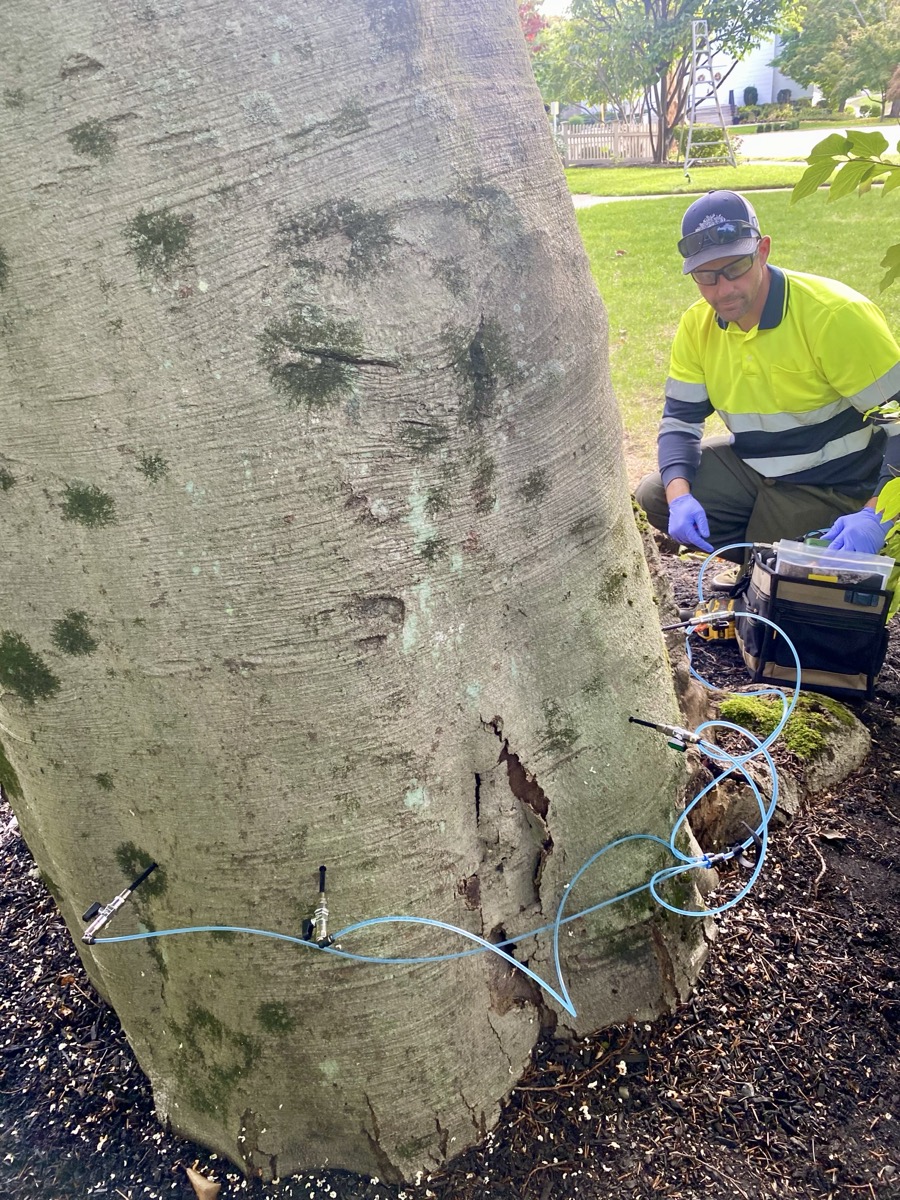
Trunk injections form the core for invasives. Emerald ash borer in Norway maples near West Corners gets emamectin benzoate via Arborjet systems—drilled ports deliver systemic protection lasting two years. We space injections per ANSI A300 guidelines, avoiding cambium injury. Your white pine weevils respond to similar injections, restoring apical dominance.
Disease management targets locals like hemlock rust or maple anthracnose. We prune infected branches with sterilized saws, then apply phosphite fungicides via drench or injection. Soil care integrates: compost topdressing in Tupelo groves near Ponkapoag Bog improves microbial activity, aiding nutrient uptake in acidic conditions.
Monitoring loops in quarterly visits. Drones survey canopy in larger West Corners complexes, spotting early decline in red maples. Data logs track progress—your Atlantic white cedar's needle retention improves post-adelgid treatment. Safety protocols include traffic control in Donovan School Area and fall-protection harnesses for crown work.
We adapt for Randolph's climate: spring apps beat wet-weather fungi; fall fertilizes before dormancy. Homeowners, test your soil pH annually with kits from local nurseries; aim for 6.0-7.0 for maples. Our process yields measurable gains—25% vigor increase in treated hickories per our records. From assessment to follow-up, Southeast Arborist's PHC safeguards your trees against Randolph's winds, invasives, and soils.
Common Plant Health Care Projects in Randolph Neighborhoods
In Randolph Center, our PHC focuses on Norway maples declining from verticillium in apartment shade. Deep root fertilization and trunk injections revive these street trees, raising crowns over sidewalks per town codes.
North Randolph's wind-exposed hills demand hemlock woolly adelgid management. We inject systems annually for trees buffering Blue Hills views, preventing dieback in this northwestern quadrant.
West Corners multi-family sites see frequent spongy moth treatments. Bt applications target caterpillars on red oaks overhanging parking, integrated with crown thinning for airflow.
Tower Hill's aging condos require emerald ash borer injections in ash-maple mixes. We prioritize hazard trees near access roads, using IPM scouting to time emamectin apps.
Devine Park Area projects address winter moth on sugar maples. Pheromone-disrupted mating and targeted sprays protect foliage, vital for park-edge aesthetics.
Pond Meadow's boggy soils prompt mycorrhizal amendments for tupelo and Atlantic white cedar. Deep root injections counter wet-spring root rot, enhancing flood tolerance near Great Pond.
Donovan School Area school grounds get hickory pest control. Spongy moth Bt and soil drenches manage white pine decline from weevils, with safety barriers during apps.
Stetson School Area's hemlock stands receive adelgid soil treatments. We monitor old-growth fragments, applying domiphen-benzimidazole to preserve this rare corridor link.
Across neighborhoods, crown raising clears multi-family paths—essential post-storms in hillier North Randolph. Our ISA Certified team logs projects per ANSI A300, ensuring compliance. Call 508-369-5009 for your neighborhood's needs.
Plant Health Care Costs in Randolph, MA
Plant Health Care costs in Randolph MA vary by property scale, tree count, and issues. A basic assessment for your Randolph Center lot runs $150-$250, including soil tests and pest scouting—essential for multi-family budgeting.
Custom PHC programs start at $500 annually for five mature trees, covering quarterly monitoring and two treatments. Deep root fertilization for a red oak in Tower Hill: $200-$400 per tree, factoring air-spading depth (18-24 inches) and fertilizer volume (50 gallons).
Trunk injections dominate pricing: emerald ash borer treatment on a 20-inch Norway maple in West Corners costs $25-$35 per inch DBH, totaling $500-$700. Hemlock woolly adelgid soil drenches: $15-$25 per inch, cheaper for groups.
Spongy moth or winter moth IPM for Pond Meadow hickories: $300-$600 per acre, using efficient Bt apps. Multi-tree discounts apply—20% off for five-plus in Devine Park Area complexes.
Factors influencing costs: access challenges in North Randolph hills add 15% for rigging; soil compaction in Donovan School Area requires extra air-spading, upping fees 10-20%. Seasonal timing matters—spring peaks raise rates 10%.
Value proposition: untreated trees cost $2,000+ in removal, per our records. PHC extends life 5-10 years, boosting property values 5-7% in tree-heavy Randolph. Multi-family ROI shines—crown raising prevents $10,000 liability claims.
Compare: DIY kits fail against invasives like adelgid; our ISA Certified precision ensures 90% efficacy. Budget $1,000-$3,000 yearly for 10-tree properties, scaling down for singles. Transparent quotes detail line items—no surprises.
Practical tip: group neighborhoods like Stetson School Area for bulk savings. Southeast Arborist's PHC delivers ROI through avoided hazards and sustained canopy. Schedule via 508-369-5009.
When to Schedule Plant Health Care in Randolph
Schedule plant health care in Randolph MA in early spring (March-April) for spongy moth and winter moth prevention. Eggs hatch with Blue Hills warming, defoliating red maples—treat before bud break.
Fall (September-October) primes deep root fertilization. Your sugar maples in Pond Meadow absorb nutrients pre-dormancy, countering summer drought stress.
Emerald ash borer trunk injections align with June-July active feeding; hemlock woolly adelgid soil drenches hit February-March crawler stage.
Urgency signs: 25% canopy thinning signals PHC need—inspect white pines for weevils now. Sticky ooze on hickories? Bacterial wetwood demands immediate drench.
Storm aftermath in North Randolph? Assess wind-snapped branches within 48 hours to prevent disease. Yellowing Norway maples in Tower Hill indicate soil issues—schedule soil probes ASAP.
Annual timing: scout April, treat May-June, monitor August. Avoid summer heat for injections. Homeowners, flag adelgid crawlers (white fuzz) on hemlocks in May.
Our ISA team fits your calendar—call 508-369-5009 for slots.
Frequently Asked Questions About Plant Health Care in Randolph
What is Plant Health Care in Randolph MA? PHC encompasses IPM, fertilization, and injections to maintain tree vigor. In Randolph, it targets Blue Hills wind stress and invasives on species like hemlock and red oak.
How do I know if my trees need PHC in North Randolph? Look for dieback over 20%, pest webs on hickory, or wilting in white pine. Our free assessments confirm via resistograph.
Are trunk injections safe for my West Corners family? Yes, ANSI A300-approved systems like Arborjet use low-toxicity actives, with no spray drift. Pollinator-safe.
What's the difference between PHC and pruning? Pruning shapes; PHC treats root-to-canopy health. Combine for your Tower Hill maples.
How effective is PHC against emerald ash borer here? 95% control via emamectin injections, per ISA studies—vital as Quincy infestations spread.
Can PHC help aging trees on my Pond Meadow property? Absolutely. Deep root care revives tupelo in boggy soils, extending life 7+ years.
When should I start a PHC program in Devine Park Area? Now, if winter moth thinned leaves. Annual plans prevent escalation.
Do you serve Stetson School Area multi-family sites? Yes, with scaled pricing and safety protocols for complexes.
Plant Health Care Throughout Randolph
Southeast Arborist provides Plant Health Care across all Randolph neighborhoods: Randolph Center's streets, North Randolph's hills, West Corners complexes, Tower Hill condos, Devine Park Area parks, Pond Meadow bogs, Donovan School Area grounds, and Stetson School Area woods. We extend to nearby Braintree, Holbrook, Quincy, Milton, and Abington.
Our Plymouth/Cohasset base ensures rapid response. ISA Certified Arborists use ANSI A300 methods for your red oaks to Atlantic white cedars.
Protect your trees—call 508-369-5009 for Randolph-tailored PHC.