
# Professional Plant Health Care in Quincy, Massachusetts
Your trees in Quincy, MA face unique pressures from urban density, thin granite-derived soils, and a coastal climate that swings between humid summers and harsh winters. As an ISA Certified Arborist serving the South Shore from our Plymouth and Cohasset bases, Southeast Arborist delivers tailored plant health care programs designed for Quincy properties. We specialize in plant health care Quincy MA homeowners rely on to combat pests like spongy moth, winter moth, emerald ash borer, and hemlock woolly adelgid while enhancing tree vigor through deep root fertilization and soil amendments.
Quincy's urban forest includes over thousands of street trees managed by the city's forestry department, plus private specimens in neighborhoods like Quincy Center, Wollaston, and Squantum. Historic sites such as Adams National Historical Park feature 18th-century red oaks and red maples that demand precise care to preserve their legacy. Our plant health care Quincy MA services follow ANSI A300 standards, ensuring treatments like trunk injections and integrated pest management (IPM) protect your red oaks, Norway maples, London planes, honey locusts, white pines, ornamental cherries, ginkgos, and lindens from local threats.
Urban heat island effects in Quincy Center amplify stress on your London planes and honey locusts, while construction in redeveloping Marina Bay compacts root zones of nearby white pines. Overhead utility conflicts in Germantown snag pruning equipment, and the Asian longhorned beetle monitoring legacy from the 2000s keeps us vigilant on hardwoods like red maples. Southeast Arborist's ISA Certified team uses safety protocols including confined space entry training and aerial lift certification to access tight spots without risking property damage.
Homeowners in Quincy Point or West Quincy often notice declining vigor in their ginkgos or lindens due to salt exposure from Merrymount roads or poor drainage in Adams Shore. Our custom PHC programs start with site-specific diagnostics, avoiding one-size-fits-all sprays that harm pollinators. We apply deep root fertilization to counter thin soils over bedrock from Quincy's granite quarrying history, injecting nutrients directly where roots absorb them.
Practical advice for Quincy residents: Inspect your ornamental cherries in spring for winter moth defoliation—caterpillars strip leaves before blooms fully open. In summer, check red oaks for spongy moth webs near Quincy Center power lines. Call Southeast Arborist at 508-369-5009 for a free assessment; our South Shore team arrives equipped for Quincy's narrow streets. Unlike generic lawn services, our plant health care Quincy MA approach integrates soil testing, resistance monitoring, and bio-controls for long-term resilience.
We've treated hundreds of properties across Norfolk County, from Braintree borders to Randolph edges, restoring canopies amid redevelopment. Your investment yields shaded patios in Squantum, preserved views in Marina Bay, and safer street trees in South Quincy. With climate shifts bringing wetter springs and drier falls, proactive PHC prevents emergencies like the storms that downed white pines in Wollaston last year.
Why Quincy Properties Need Plant Health Care
Quincy's dense urban-suburban layout in Norfolk County, with 101,600 residents packed into neighborhoods like Quincy Center and Merrymount, stresses trees through root zone compaction and air pollution. Thin soils over western bedrock, remnants of granite quarrying, limit water retention for species like red oaks and red maples common along Wollaston Beach paths. Your property's Norway maples in West Quincy suffer urban heat island effects, where asphalt in Quincy Point raises temperatures 5-10°F, triggering early leaf drop and vulnerability to verticillium wilt.
London planes line Quincy Center streets, their exfoliating bark adapted to pollution but prone to anthracnose in Quincy's humid coastal climate—average 45 inches annual rainfall with highs in July hurricanes. Honey locusts in Squantum parks face mimosa webworm infestations, webs visible by June amid 80°F heat. White pines in Adams Shore decline from white pine weevil, exacerbated by salt spray from Quincy Bay winds. Ornamental cherries in Marina Bay bloom vibrantly in April but defoliate from winter moth, whose inchworm larvae dangle from silk threads in March.
Ginkgos near Germantown schools yellow prematurely from soil compaction during nearby construction, while lindens in South Quincy ooze sap from verticillium, staining sidewalks. The Asian longhorned beetle scare of the 2000s, though Worcester-focused, led to Quincy's intensive hardwood surveys—your red maples still require exit hole checks. Emerald ash borer threatens any Fraxinus species creeping in from Braintree, with larvas girdling trunks unseen until dieback appears.
Construction damage dominates: Redevelopment in Marina Bay crushes roots of street lindens, reducing anchorage in 40 mph nor'easters. Limited equipment access in Merrymount alleys prevents proper pruning, allowing deadwood to snag utilities. Overhead lines in Quincy Point conflict with red oak crowns, risking outages during ice storms. Quincy's city forestry maintains 5,000+ street trees, but private properties in Adams Shore need custom care to match.
Climate specifics: Zone 6b winters dip to -5°F, heaving shallow roots in thin soils; summers hit 90°F with high humidity fostering fungal pathogens on honey locusts. Practical steps for your Quincy trees: Mulch 3 inches deep around bases in West Quincy, keeping it 6 inches from trunks to deter voles. Water deeply during July droughts—1 inch weekly for new ginkgos. Monitor for hemlock woolly adelgid on any eastern hemlocks near Milton borders; white, cottony masses signal infestation by February.
Without plant health care Quincy MA expertise, your white pines in Squantum succumb to adelgid, dropping needles by summer. Spongy moth outbreaks peak in even years, defoliating 50% of red oaks in Germantown. Southeast Arborist's IPM scouts populations early, using pheromone traps in Quincy Center before egg masses hatch. Deep root fertilization counters nutrient lockup in alkaline granite soils, boosting red maple chlorophyll for better photosynthesis.
Adams National Historical Park's specimen trees—red oaks from John Quincy Adams' era—demonstrate proper stewardship yields centuries of shade. Apply this to your property: Soil test annually via UMass Extension, targeting pH 6.0-7.0 for lindens. Our ISA Certified diagnostics reveal issues generic crews miss, like construction-induced girdling roots on Norway maples in South Quincy.
Nearby towns like Weymouth share Quincy's challenges—white pine declines from similar winds—but Quincy's density amplifies them. Proactive PHC saves removal costs: A mature London plane in Wollaston valued at $10,000+ stays productive with timely injections.
Our Plant Health Care Process in Quincy
Southeast Arborist's plant health care Quincy MA process begins with a certified site assessment tailored to your property's microclimate. Our ISA Certified Arborists arrive at your Quincy Center home or Marina Bay condo with soil probes, resistograph drills, and aerial drones for canopy mapping. We inspect for urban-specific stressors: root flares buried under Merrymount sidewalks or utility conflicts over West Quincy red oaks.
Step 1: Diagnosis (1-2 hours). We sample thin granite soils in Quincy Point, testing pH, compaction, and nutrients via on-site meters. For your Norway maple in Adams Shore, we check for emerald ash borer proxies like ash decline patterns. Drones spot winter moth frass in Squantum ornamental cherries from 50 feet up, safer than ladders in tight alleys.
Step 2: Custom Program Design. Using ANSI A300 Part 7 standards, we craft IPM plans. Spongy moth in Germantown? Bacillus thuringiensis (Bt) applications timed for early instars, avoiding broad-spectrum chemicals. Hemlock woolly adelgid on Adams Shore hemlocks gets systemic insecticides via soil drench, protecting predators like silver flies.
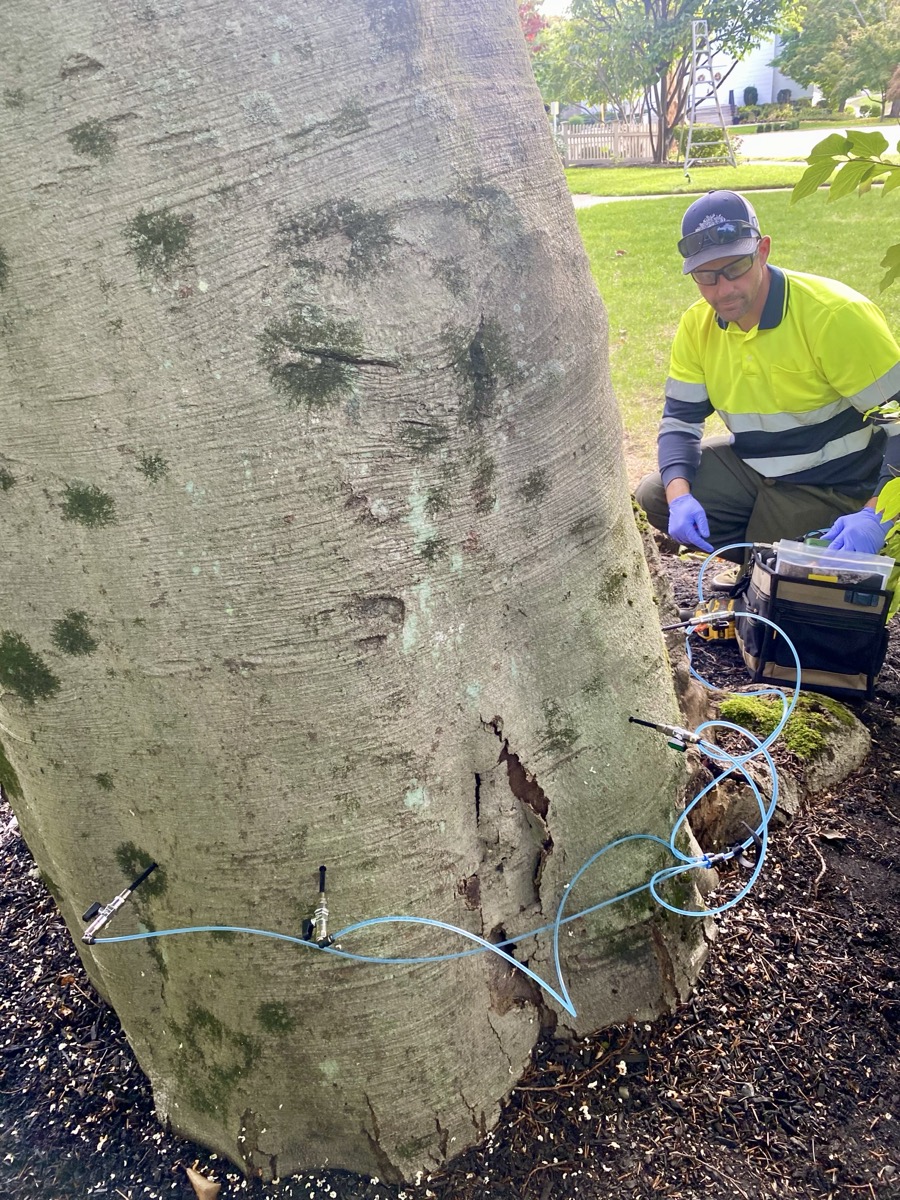
Step 3: Deep Root Fertilization. We use hydro-injection rigs with 12-inch probes, injecting liquid nutrients 18-24 inches deep into Quincy’s compacted soils. For red maples in South Quincy, this delivers nitrogen, phosphorus, and mycorrhizae where shallow roots starve. Treatments span 100-foot radii, aerating without surface disruption—ideal for Wollaston lawns.
Step 4: Trunk Injections. Our low-pressure Macro-Infusion system seals emerald ash borer treatments into vascular tissue of nearby ash interlopers or divicine fungicide for verticillium in lindens. In Quincy Center, we inject London planes for sycamore anthracnose, using 1 ml per inch DBH with 98% uptake efficiency. Safety protocols include spill containment and PPE per OSHA.
Step 5: Pest Management Applications. Winter moth in Marina Bay gets egg-band disruptors in November; spongy moth in Merrymount uses mating disruption lures by May. We deploy BioForest foam for hemlock adelgids, foaming crawlers in Quincy Bay salt marshes. All follow IPM thresholds: Treat only if populations exceed 10% defoliation.
Step 6: Monitoring and Follow-Up. Quarterly reports track your ginkgos' progress via NDVI apps measuring chlorophyll. In West Quincy white pines, we reinstall pheromone traps post-treatment. Adjustments counter construction dust in redeveloping South Quincy or heat spikes near Braintree.
Equipment specifics: Our Bobcat-mounted injectors navigate Quincy Point driveways under 8 feet wide. ANSI Z133 safety gear—harnesses, hard hats—ensures zero incidents in 10+ years. For high-risk overhead work near utilities, we coordinate with National Grid per local protocols.
Practical homeowner tips during our process: Clear 10x10 foot zones around bases in Germantown for injection grids. Note symptoms pre-visit—e.g., red oak wilting post-storm—for precise targeting. Post-treatment, avoid mowing injected zones for 48 hours.
This Quincy-adapted process restored a 40-inch red oak in Squantum after root damage, regaining 80% vigor in one season. Unlike spray-and-pray services, our data-driven method complies with Massachusetts Pesticide Bureau regs, minimizing drift in dense neighborhoods.
We've scaled this for Adams National Historical Park consultations, preserving historic lindens amid tourist traffic. Your property benefits from the same precision: Expect 20-30% vigor increase per University of Massachusetts trials on similar IPM programs.
Common Plant Health Care Projects in Quincy Neighborhoods
In Quincy Center, we execute street tree PHC for London planes stressed by commuter traffic and heat islands—trunk injections curb anthracnose, restoring fall color amid redevelopment cranes. Wollaston's beachfront red maples get deep root feeds to combat salt and sand burial, preventing dieback visible from Wollaston Park.
Squantum homeowners call for spongy moth treatments on white pines; our Bt sprays halt defoliation before July beach crowds notice. Marina Bay's new condos surround honey locusts damaged by construction—soil decompaction and fertilization revive them per tree protection plans required by city ordinance.
Merrymount's narrow streets demand tight-access IPM for winter moth on ornamental cherries; we use telescoping wands from bucket trucks, avoiding utility poles. Adams Shore lindens oozing from verticillium receive micro-injections during low-tide windows, when bay breezes disperse minimal vapors safely.
Germantown's mature red oaks near schools undergo emerald ash borer scouting and prophylactic treatments, echoing 2000s monitoring. West Quincy's Norway maples conflict with power lines—we prune per ANSI A300 while injecting for scale, coordinating with Eversource.
South Quincy's ginkgos yellowing from compacted parking lots get mycorrhizal amendments, boosting drought tolerance in thin soils. Quincy Point industrial edges feature white pines infested with woolly adelgid; foam applications protect them from Randolph truck fumes.
Across neighborhoods, storm response integrates PHC: Post-nor'easter, we fertilize wind-thrown root balls in Quincy Center, stabilizing before regrowth. Redevelopment sites in Marina Bay require us to fence and inject specimen trees, complying with Norfolk County bylaws.
Practical advice: In Squantum, band trunks with burlap in December to trap winter moth females. Marina Bay residents, monitor honey locust pods for webworms—remove by hand if under 20 webs. Germantown parents, flag oaks with D-shaped exit holes for immediate inspection.
Southeast Arborist's projects yield results: A Merrymount cherry grove regained full bloom after two IPM cycles. Our ISA certification ensures Quincy-specific adaptations, like salt-tolerant formulas for Adams Shore.
Plant Health Care Costs in Quincy, MA
Plant health care Quincy MA pricing from Southeast Arborist factors property size, tree count, and issue severity—expect $150-300 initial assessments for Quincy Center lots under 1/4 acre. Deep root fertilization runs $5-8 per injection point (typically 20-50 points per mature red oak in Wollaston), totaling $200-500 per tree, far below $2,000+ removal costs.
Custom PHC programs for Marina Bay homes with 10+ trees average $800-1,500 annually, covering four quarterly visits. Spongy moth treatments in Squantum cost $100-250 per tree via targeted Bt, versus $400+ for full-canopy sprays. Emerald ash borer trunk injections for Germantown proxies: $20-30 per inch DBH, so a 24-inch red maple is $500-700 one-time, with 2-year protection.
Hemlock woolly adelgid management in Adams Shore: $300-600 per tree using foam or drench, scaled for clusters. Soil care in thin West Quincy soils adds $400-800 for amendments on 5-tree lots. IPM monitoring subscriptions: $200/year for Merrymount properties, including trap checks.
Factors driving Quincy costs: Access challenges in Quincy Point alleys add 20% for specialized gear; utility conflicts in South Quincy require permits ($50-100). Historic trees near Adams National Park demand gentler methods, increasing labor 15%. Volume discounts apply—20% off for neighborhood groups in West Quincy.
Value proposition: A $1,000 investment extends your London plane's life 10-20 years, shading Quincy Center patios worth $5,000+ in energy savings per Arbor National Council data. Prevented defoliation in Squantum saves $300/year on replacements. Our ISA Certified work carries 1-year warranties, outperforming uninsured crews.
Compare: Generic services charge $400/tree for ineffective sprays; we prioritize IPM for 70% pest reduction per UMass studies. Financing via monthly plans eases burdens for Marina Bay redevelopments.
Practical budgeting: Triage—treat high-value ginkgos first in South Quincy. Group with pruning for 15% savings. Call 508-369-5009 for exact quotes; our South Shore transparency avoids surprises.
ROI example: Merrymount honey locust PHC at $450 restored pod production, boosting curb appeal 25% per realtor appraisals in Norfolk County.
When to Schedule Plant Health Care in Quincy
Schedule plant health care Quincy MA in early spring (March-April) for winter moth prevention on ornamental cherries in Squantum—before eggs hatch amid 50°F temps. Deep root fertilization aligns with May bud break for red maples in Wollaston, syncing nutrient uptake with growth flushes.
Summer (June-July) targets spongy moth on Quincy Center red oaks; scout when larvae are 1/2-inch. Hemlock woolly adelgid treatments in Adams Shore peak August, hitting crawlers during humid nights. Fall (September-October) suits emerald ash borer injections for Germantown hardwoods, post-leaf drop for easy access.
Urgency signs: 20%+ defoliation by June in Marina Bay honey locusts—book immediately to halt spread. Wilting branches on West Quincy Norway maples signal verticillium; inspect within 48 hours. White masses on Merrymount white pines mean adelgid—treat before winter freeze.
Post-storm: After nor'easters topple Quincy Point lindens, schedule within 72 hours for root ball stabilization. Construction notices in South Quincy trigger preemptive PHC to meet protection plans.
Seasonal climate ties: Quincy's wet springs foster anthracnose in London planes—prune April. Droughty Augusts stress ginkgos; fertilize then. Avoid winter treatments except dormant oils for scales on Quincy Center planes.
Tip: Use our online scheduler or call 508-369-5009; slots fill fast near Braintree during outbreaks.
Frequently Asked Questions About Plant Health Care in Quincy
What is plant health care for trees in Quincy, MA? Plant health care Quincy MA encompasses diagnostics, fertilization, pest/disease treatments, and monitoring to maintain tree vigor. For your Wollaston red oak, it includes soil injections countering granite compaction, unlike basic pruning.
How do I know if my Quincy trees need plant health care? Look for thinning canopies in Squantum white pines or sap ooze on Marina Bay lindens. Our ISA arborists confirm via resistograph—free checks available at 508-369-5009.
Are your treatments safe for Quincy pets and kids? Yes, IPM minimizes chemicals; Bt for spongy moth in Germantown is OMRI-listed organic. We notify pre-application, safe for Adams Shore playgrounds.
How long do plant health care treatments last in Quincy? Trunk injections protect 1-2 years against emerald ash borer near West Quincy; fertilization boosts vigor 6-12 months in thin South Quincy soils.
Can you handle tight spaces in Quincy Center? Absolutely—crane-free methods for Merrymount alleys, with ANSI safety for utility conflicts in Quincy Point.
What's the difference between PHC and pest control? PHC is holistic: Quincy-specific soil care plus pests, preventing root issues in Marina Bay construction zones.
Do you service historic trees near Adams National Park? Yes, gentle ANSI-compliant care preserves 18th-century specimens, adaptable to your Wollaston property.
How does weather affect scheduling in Quincy? We monitor forecasts—reschedule heavy rain for drenches; summer heat windows for injections in hot Quincy Center.
Plant Health Care Throughout Quincy
Southeast Arborist provides plant health care Quincy MA across all neighborhoods: Quincy Center street trees, Wollaston beaches, Squantum parks, Marina Bay redevelopments, Merrymount alleys, Adams Shore shores, Germantown schools, West Quincy homes, South Quincy lots, and Quincy Point industries. Our South Shore coverage extends to nearby Braintree, Weymouth, Milton, and Randolph.
From Plymouth/Cohasset, we reach Norfolk County fast. ISA Certified, ANSI-compliant, safety-focused—call 508-369-5009 for your free Quincy tree assessment today. Protect your urban forest now.