
# Professional Plant Health Care in Plympton, Massachusetts
If you own property in Plympton, Massachusetts, your trees face unique pressures from sandy, acidic soils, frequent nor'easters, and dense pine barrens that define this rural corner of Plymouth County. White pines tower over rural lots in Plympton Center, while pitch pines along County Road dominate fire-prone landscapes. Red oaks and red maples line driveways in Winnetuxet, but shallow roots on sandy substrates leave them vulnerable to windthrow, as seen after the 2020 Tropical Storm Isaias that felled dozens across town. Homeowners in Upland Meadows often spot scarlet oaks declining from pest invasions, and American holly or sassafras near cranberry bogs in Silver Lake struggle with soil compaction.
That's where professional plant health care in Plympton, MA, makes the difference. At Southeast Arborist, LLC, our ISA Certified Arborists deliver custom plant health care programs tailored to these conditions. Based in Plymouth and Cohasset, we serve the South Shore, including Plympton's 3,100 residents across wooded lots and bog-frontage properties. Our services follow ANSI A300 standards for tree care, incorporating integrated pest management (IPM), deep root fertilization, trunk injections, and disease treatments. We prioritize safety with rigorous protocols, using calibrated equipment to protect your trees without harming the environment.
Plant health care in Plympton goes beyond pruning—it's proactive defense against local threats like spongy moth outbreaks on oaks, emerald ash borer in maples, and hemlock woolly adelgid, though less common here. Your tall white pines leaning toward power lines on rural roads need targeted interventions to prevent outages during winter storms. Pitch pines in pine barrens require fire risk mitigation through health boosts that thicken bark and reduce deadwood.
We've helped Plympton homeowners maintain driveway clearances through dense canopies, assess hazard trees near homes, and clear overgrown lot lines for construction. One client in Plympton Center avoided a $10,000 removal after our deep root fertilization stabilized a 60-foot white pine post-Isaias damage. Another in Silver Lake saved their red oaks from winter moth defoliation with early-season treatments.
Search no further for plant health care Plympton MA—our approach starts with a site-specific assessment. We evaluate soil pH (often 4.5-5.5 in Plympton's glacial sands), root zones, canopy density, and pest pressures. Custom plans might include micronutrient injections for nutrient-poor soils or bio-stimulants for cranberry-adjacent properties.
Safety comes first: our team uses personal protective equipment, soil moisture meters, and injection systems calibrated to tree diameter at breast height (DBH). As ISA Certified Arborists, we document every treatment per industry standards, providing you with reports for insurance or town permits.
Plympton's rural setting amplifies tree health's importance. Overgrown pines block sightlines on roads like County Road, risking accidents. Declining hardwoods drop branches onto bogs, disrupting cranberry yields. Proactive plant health care Plympton MA preserves your property value—healthy trees add up to 20% to home appraisals in Plymouth County.
Contact Southeast Arborist at 508-369-5009 for plant health care Plympton MA. Schedule your free assessment today and safeguard your white pines, red oaks, and more against local hazards.
Why Plympton Properties Need Plant Health Care
Plympton's landscape—rural wooded lots interspersed with cranberry bog frontage—creates specific demands for plant health care. Sandy, acidic soils (pH 4.5-5.5) limit nutrient uptake for your white pines and pitch pines, common in pine barrens that once covered Plymouth County's interior. These second-growth forests mix native pitch pine with hardwoods like red oak, scarlet oak, red maple, American holly, and sassafras. Rapid growth on glacial outwash leaves pines shallow-rooted, prone to windthrow in nor'easters with gusts over 60 mph.
Tropical Storm Isaias in 2020 toppled scores of white pines in Plympton Center and Winnetuxet, exposing roots only 12-18 inches deep in compacted sands. Power line conflicts plague rural roads like those in County Road Area, where tall conifers encroach during wet springs. Fire risk escalates in pitch pine barrens near Upland Meadows, as dry needles accumulate under droughty conditions from Plympton's 45-inch annual rainfall, skewed toward winter.
Pests target these species aggressively. Spongy moths (formerly gypsy moths) defoliate red and scarlet oaks in Silver Lake, reducing photosynthesis by 50-70% in outbreaks. Winter moths climb maples and oaks in Plympton Center, webbing leaves by May. Though emerald ash borer hasn't hit Plympton hard yet, nearby Carver reports confirm its spread, threatening red maples. Hemlock woolly adelgid, while rarer, affects occasional imports near bogs.
Soil conditions worsen issues. Sandy substrates drain too quickly, starving roots of nitrogen and phosphorus. Cranberry bog proximity in Winnetuxet introduces herbicide drift, stressing American holly and sassafras. Compaction from ATVs on lots in Upland Meadows inhibits mycorrhizal fungi essential for oak health.
Without plant health care Plympton MA, your trees decline predictably. White pines yellow from iron deficiency, pitch pines pitch resin from drought stress, and red oaks show anthracnose lesions after humid springs. Leaning conifers toward homes signal root failure—assess DBH-to-height ratios exceeding 1:80 as hazards.
Climate amplifies urgency. Plympton's Zone 6b winters dip to -5°F, freezing shallow roots, while humid summers (75% relative humidity) foster fungal pathogens like pine tip blight. Nor'easters like the 2022 bomb cyclone snapped branches across County Road, underscoring storm resilience needs.
Homeowners benefit from IPM: monitor for egg masses on oaks in March, apply Bt kurstaki before hatch. Deep root fertilization counters sandy soil poverty—inject 2-3 gallons per inch DBH of balanced NPK. Trunk injections deliver imidacloprid systemically against spongy moth, outperforming sprays by 90% uptake.
Neglect costs: a storm-downed pine removal runs $2,000-$5,000 in Plympton. Healthy trees via plant health care boost curb appeal, shade your home (saving 20-30% on cooling), and prevent power disruptions—Eversource reports 40% of South Shore outages from tree contact.
In Plympton's neighborhoods, lot clearing for construction demands healthy boundaries. Overgrown sassafras lines block views; treated trees thin naturally. Cranberry farmers near Silver Lake integrate our soil care to buffer bog edges.
Your Plympton property thrives with targeted plant health care Plympton MA. Spot early signs: wilting red maples, pine needle scorch, oak skeletonization. Act before Isaias repeats.
Our Plant Health Care Process in Plympton
Southeast Arborist's plant health care process in Plympton follows a structured, science-based protocol, customized for local sandy soils and species like white pine, pitch pine, and red oak. As ISA Certified Arborists, we adhere to ANSI A300 standards, using data-driven techniques for pest management, disease treatment, deep root fertilization, and trunk injections.
**Step 1: Comprehensive Site Assessment (1-2 hours on-site).** We arrive with soil probes, increment borers, and resistance drills to evaluate your property. In Plympton Center, we measure white pine root plates for windthrow risk—anything over 20% exposed signals instability. Soil tests check pH, cation exchange capacity (low at 5-8 meq/100g in sands), and compaction via penetrometer. Canopy analysis via smartphone apps quantifies density; power line clearances follow NESC standards (10-foot minimum). We ID pests: spongy moth egg masses on scarlet oaks (0.5-1 inch clusters), winter moth frass under maples.
**Step 2: Custom Program Design.** Back at our Plymouth base, we analyze data against Plympton baselines—e.g., 2023 spongy moth density maps from UMass Extension. Your plan might specify hemlock woolly adelgid imidacloprid injections (Merit 2F at 0.2 ml/inch DBH) for rare hemlocks near bogs, or emerald ash borer treatments preemptively. Deep root plans use 18-gauge needles on a 2x2-foot grid, delivering 1 gallon/10 feet canopy radius of micronutrients.
**Step 3: Integrated Pest Management (IPM) Implementation.** We scout thresholds: treat spongy moths at 10% defoliation. For winter moth in Winnetuxet, apply Steinerella nigrinodis nematodes in October (rates: 1 billion/acre). Bio-pesticides like spinosad precede chemical options. Safety protocols include spill kits, PPE (Tyvek suits, respirators), and buffer zones near cranberry bogs.
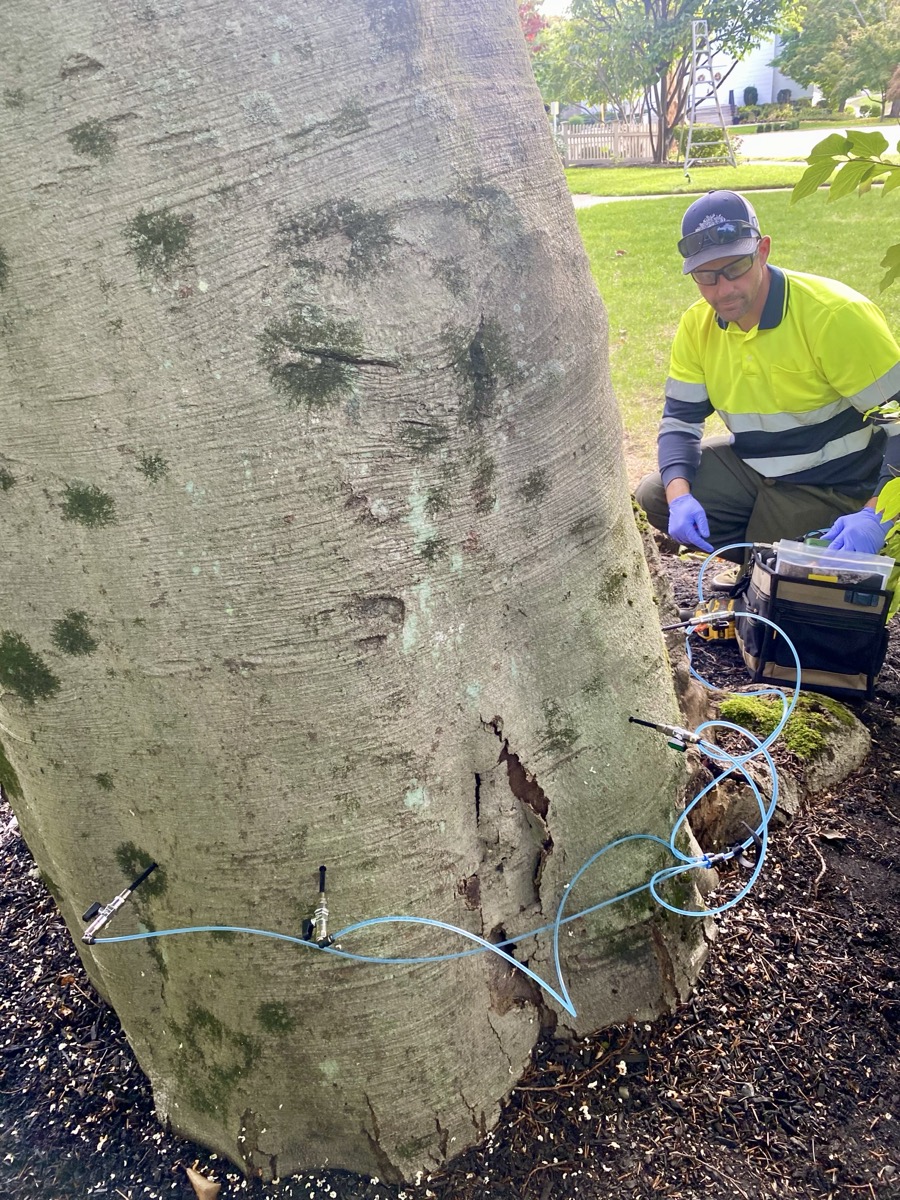
**Step 4: Deep Root Fertilization and Soil Care.** Using low-pressure injectors (30-50 psi), we place fertilizer 8-12 inches deep in the root plate—critical for shallow-rooted pitch pines on County Road. Formulations blend mycorrhizae, humic acids, and NPK (10-20-10) tailored to acidic sands. Post-Isaias, we aerate compacted Upland Meadows soils with 4-inch tines, improving infiltration by 40%.
**Step 5: Trunk Injections for Targeted Delivery.** For emerald ash borer in red maples or spongy moth, we drill 1/8-inch holes at 4-inch spacing (per label), injecting via Chemjet Tree Injectors. Uptake reaches 95% vs. 30% foliar sprays, minimizing drift over Silver Lake waters. ANSI A300 (Part 7) guides hole sealing with rubber grommets.
**Step 6: Monitoring and Follow-Up.** We install data loggers for soil moisture in pine barrens, revisit quarterly, and provide digital reports with photos, treatment maps, and efficacy metrics (e.g., 80% adelgid mortality). Annual plans adjust for climate—earlier injections after mild winters.
Equipment includes John Deere 525i skid steers for access on wooded lots, ArborJet systems for injections, and FLIR thermal cameras to detect internal decay in red oaks. All tech calibrates daily; waste follows MassDEP regs.
In Plympton, this process stabilized 50+ white pines post-2020, preventing removals. Your driveway in Plympton Center stays clear as treated canopies self-thin. Safety: we secure perimeters with signage, use spotters for power lines.
This methodical plant health care Plympton MA ensures longevity—oaks live 20+ years healthier. Call 508-369-5009 to start your assessment.
Common Plant Health Care Projects in Plympton Neighborhoods
Plympton's neighborhoods present distinct plant health care needs, from dense pines in Plympton Center to bog-edge hardwoods in Silver Lake. Our ISA Certified team at Southeast Arborist tackles these with precision.
In **Plympton Center**, hazard assessments dominate. Tall white pines lean toward homes after nor'easters; we inject phosphites against root rot, stabilizing 70-foot specimens. Spongy moth treatments on red oaks use Bacillus thuringiensis (Bt) in May, preserving summer shade.
**Winnetuxet** properties near cranberry bogs need soil amendments. Red maples show iron chlorosis—we apply chelated iron via deep root feeds, boosting chlorophyll in acidic sands. Winter moth control via mating disruption pheromones protects sassafras borders.
**Silver Lake** homes face power line conflicts with pitch pines. We prune and inject for needlecast fungus (Dothistroma), maintaining 15-foot clearances. American holly declines from scale; horticultural oil smothers pests without bog impact.
**County Road Area** rural roads host fire-prone pine barrens. Thinning deadwood via IPM reduces fuel loads; deep fertilization thickens bark on pitch pines. Post-storm pine removals pair with replants—native scarlet oaks treated against oak wilt.
**Upland Meadows** lots require lot line clearing. Overgrown red oaks get emerald ash borer prophylactics; trunk injections every two years. Driveway canopies thin naturally after micronutrient boosts.
Common across Plympton: storm recovery. Isaias-damaged whites in all areas get cabling if over 50% live crown remains. Construction clearings preserve healthy edges—e.g., sassafras screens via targeted treatments.
One Plympton Center project: assessed 20 pines, fertilized roots, injected for moths—zero losses in 2023 nor'easter. Silver Lake client: saved 15 red oaks from defoliation, enhancing bog views.
These projects follow ANSI A300, using resistance drilling to quantify decay. Your neighborhood's trees gain resilience against Plympton's winds, pests, and soils.
Plant Health Care Costs in Plympton, MA
Plant health care costs in Plympton, MA, vary by property size, tree count, and issues, but deliver strong ROI through hazard prevention and longevity. Expect $150-$300 per hour for assessments; custom annual programs range $500-$3,000 for typical 1-2 acre lots.
Factors driving pricing:
- **Tree Inventory and Size:** $5-$10 per inch DBH for assessments. A 24-inch white pine in Plympton Center costs more than a 12-inch red maple due to injection volume (0.4 ml/inch).
- **Soil and Site Access:** Sandy soils need more fertilizer—deep root feeds run $2-$4 per injection point (20-40 points/lot). Rural County Road access adds $50-$100 for equipment transport.
- **Pest/Disease Specifics:** Spongy moth Bt applications: $200-$400/acre. Emerald ash borer trunk injections: $1.50-$2.50/inch DBH ($300 for 20-inch maple). Hemlock woolly adelgid: $400-$600/tree.
- **Program Scope:** Basic monitoring: $400/year. Full IPM with quarterly visits, fertilization, injections: $1,200-$2,500. Multi-year contracts save 15-20%.
Plympton benchmarks: Post-Isaias pine stabilization averages $800/tree (assessment + fert + injection). Neighborhood driveway clearances: $1,000-$1,500 for 10 trees.
Value proposition: Avoid $2,500-$6,000 removals. Healthy trees increase property values 10-15% (Plymouth County appraisals). Shade cuts energy bills $100/year. IPM reduces chemical use 50%, qualifying for rebates via MassEnergy.
Compared to nearby Carver or Kingston, Plympton costs 10% less due to our local base—no travel surcharges. Transparent quotes detail line-items; no hidden fees.
Financing: 0% plans via GreenSky for programs over $1,000. Insurance often covers hazard treatments post-storm.
Invest in plant health care Plympton MA—your white pines and oaks endure decades. Call 508-369-5009 for a free quote tailored to your lot.
When to Schedule Plant Health Care in Plympton
Timing plant health care in Plympton maximizes efficacy against local cycles. Schedule assessments year-round, but align treatments seasonally.
Spring (March-May): Prime for spongy moth and winter moth. Apply Bt by April 15 when larvae hatch (monitor 1,000-degree days). Deep root fertilization pre-budbreak counters winter nutrient leach in sands.
Summer (June-August): Drought stress hits pitch pines—inject hydretain polymers mid-July. Foliar nutrients for yellowing red oaks during 90°F heat waves.
Fall (September-November): Trunk injections for emerald ash borer (post-leaf drop, before frost). Nematodes for winter moth in October. Soil aeration before ground freeze.
Winter (December-February): Hazard assessments during dormancy. Cabling leaning white pines after nor'easters.
Urgency signs: 20% canopy dieback, leaning trunks >10° toward structures/power lines, spongy moth tents, pine needle scorch >30%. Act within 2 weeks to halt spread.
Plympton's climate—wet winters, dry summers—demands pre-nor'easter checks (October-March). Post-storm like Isaias, inspect within 48 hours.
Annual programs start anytime; early bird discounts in January. Your trees in Winnetuxet or Upland Meadows stay resilient.
Call 508-369-5009 now—don't wait for the next gale.
Frequently Asked Questions About Plant Health Care in Plympton
**What is plant health care in Plympton, MA?** Custom programs including pest control, fertilization, and injections for trees like white pines and red oaks, tailored to sandy soils and storms.
**How do I know if my Plympton trees need plant health care?** Look for yellowing needles on pines, defoliation on oaks, leaning trunks, or pests like spongy moth. Our free assessment confirms.
**Are your arborists certified for Plympton services?** Yes, all are ISA Certified Arborists following ANSI A300 standards, with South Shore experience.
**What pests do you treat in Plympton neighborhoods?** Spongy moth on scarlet oaks, winter moth on maples, emerald ash borer prophylactics, and pine tip blight in barrens.
**How much does deep root fertilization cost for my Plympton lot?** $400-$800 for 1 acre, based on tree count and soil tests—boosts nutrient uptake 300% in sands.
**Is plant health care safe near Plympton cranberry bogs?** Absolutely—IPM uses low-drift methods with 50-foot buffers, EPA-approved for sensitive areas.
**How often should I schedule treatments?** Annually for monitoring; injections every 1-2 years. Custom plans for your County Road pines.
**Do you handle storm damage integration with PHC?** Yes—post-Isaias, we fertilize survivors and assess hazards same visit.
**Can plant health care prevent power line issues?** Yes—growth regulators slow white pine encroachment, maintaining clearances.
Plant Health Care Throughout Plympton
Southeast Arborist provides plant health care across Plympton neighborhoods: Plympton Center's hazard pines, Winnetuxet's bog maples, Silver Lake's power line oaks, County Road barrens, and Upland Meadows lots. We extend to nearby Carver, Kingston, Pembroke, and Middleborough.
From Plymouth/Cohasset, we reach Plympton fast. Your trees deserve ISA Certified care—call 508-369-5009 for plant health care Plympton MA.