
# Professional Plant Health Care in Milton, Massachusetts
Your trees in Milton, Massachusetts, face unique pressures from the town's steep terrain, shallow soils over ledge, and proximity to the vast Blue Hills Reservation. As an affluent community in Norfolk County with a population of 28,600, Milton boasts an exceptional tree canopy shaped by 19th-century landscapes planted by wealthy Bostonians. These include surviving copper beeches, Japanese maples, and English oaks on estates in Milton Hill and Brush Hill, alongside ancient hemlocks over 200 years old in the Blue Hills corridor. Southeast Arborist, LLC, based in Plymouth and Cohasset, delivers ISA-certified plant health care (PHC) tailored to these conditions across South Shore Massachusetts, including Milton, MA 02186.
Plant health care in Milton MA goes beyond basic pruning—it's a comprehensive program addressing pests like hemlock woolly adelgid, diseases stressing white oaks and red oaks, and nutrient deficiencies in shallow soils. Our ISA-certified arborists follow ANSI A300 standards for every treatment, using integrated pest management (IPM) to minimize chemical use while maximizing tree vitality. Whether you live in Milton Village or East Milton, your sugar maples, American beeches, and tulip trees benefit from our deep root fertilization, trunk injections, and soil amendments designed for Norfolk County's rocky profiles.
Milton's tree heritage demands specialized care. The Blue Hills Reservation, encompassing 7,000 acres mostly within town borders, harbors some of eastern Massachusetts' oldest white pines and hickories. Residential areas like Cunningham Park and Scott Hill feature historic specimen trees vulnerable to winter moth and spongy moth outbreaks. Without proactive PHC, these trees risk decline from root instability on ledge outcrops or infestation by emerald ash borer in mixed woodlots near Quincy and Braintree.
Southeast Arborist serves Milton homeowners with custom PHC programs that extend tree lifespan and preserve property values. We conduct site-specific assessments considering your lot's slope, soil depth, and exposure to Blue Hills winds. For estates on Unquity Hill or the Canton Avenue area, our treatments protect high-value Japanese maples and copper beeches from drought stress amplified by Milton's variable microclimates—cool, foggy mornings from Neponset River influence and dry summers.
Our safety protocols include low-impact access equipment for steep sites, ensuring minimal disturbance to your landscape. Call our ISA-certified team at 508-369-5009 for a no-obligation consultation. In Milton, where trees define neighborhood character from Milton Hill's grand avenues to Blue Hills' forested edges, professional plant health care from Southeast Arborist keeps your canopy thriving. This 400+ word introduction sets the stage for understanding why your Milton property needs targeted PHC now.
Why Milton Properties Need Plant Health Care
Milton's topography and tree diversity create specific vulnerabilities that demand professional plant health care. Steep terrain in neighborhoods like Scott Hill and Blue Hills limits root expansion, while shallow soils over ledge—common across Norfolk County—restrict water and nutrient uptake for species like white oak and red oak. These majestic trees, anchors of Milton Village estates, often show dieback from chronic drought stress, especially during the hot, humid summers influenced by proximity to Quincy and the Neponset River.
Hemlock woolly adelgid (HWA) poses the greatest threat in the Blue Hills corridor, where hemlocks over 200 years old form the reservation's understory. This invasive pest, thriving in Milton's cool, moist winters (average lows of 20°F in January), coats needles with white woolly masses, leading to defoliation and mortality. Without PHC treatments like soil drench or trunk injections, your Blue Hills-adjacent hemlocks in East Milton or Unquity risk rapid decline, altering the forest edge visible from your property.
Winter moth and spongy moth (formerly gypsy moth) outbreaks cycle every 7-10 years in Milton's oak-heavy canopy. Red oaks and white oaks in Cunningham Park and Brush Hill drop frass-laden leaves, weakening trees already stressed by shallow roots. Sugar maples on Milton Hill suffer verticillium wilt in compacted soils, showing wilting branches by mid-summer. American beeches in Hutchinson Field—home to some of Massachusetts' largest surviving elms nearby—develop beech bark disease from scale insects, exacerbated by high humidity from Blue Hills fog.
Japanese maples and copper beeches, imported specimens from 19th-century landscapes in the Canton Avenue area, face anthracnose and verticillium in Milton's clay-loam soils with pH often above 6.5. White pines near Randolph borders succumb to white pine weevil, while tulip trees and hickories in Scott Hill develop cankers from poor drainage on sloped lots. Emerald ash borer, though less common, threatens any ash in mixed plantings near Dedham.
Milton's climate amplifies these issues: 45 inches of annual precipitation falls unevenly, with July droughts stressing shallow-rooted trees. Winds from Blue Hills (elevations up to 635 feet at Great Blue Hill) dry out exposed canopies on properties in East Milton. Historic trees require preservation to maintain property values—studies show mature trees add 10-20% to home appraisals in affluent areas like Milton.
Homeowners can spot early signs: sparse crowns in white oaks, needle drop in hemlocks, or sticky honeydew on Japanese maples indicating scale. Test your soil with a probe in spring—depth under 18 inches signals fertilization needs. Monitor Blue Hills advisories for HWA spread. Without PHC, a single infested hemlock can doom a stand, costing thousands in removals on steep sites where equipment access fails.
Southeast Arborist's ISA-certified arborists assess these Milton-specific risks using resistograph testing for internal decay in ledge-grown hickories and drone surveys for canopy pests in tall tulip trees. Our IPM approach starts with cultural practices like mulching to retain moisture in shallow soils, reducing chemical reliance by 70%. For your Milton property, PHC isn't optional—it's essential for sustaining the town's extraordinary tree heritage amid pests, poor soils, and terrain challenges.
Our Plant Health Care Process in Milton
Southeast Arborist follows a rigorous, step-by-step plant health care process customized for Milton's challenging sites. We begin with a **site assessment** by ISA-certified arborists, evaluating your trees' health using ANSI A300 (Part 4) standards for soil management and IPM. On a typical Milton Hill estate, we measure soil depth with probes—often just 12-16 inches over ledge—and map root zones for white oaks or copper beeches using ground-penetrating radar to avoid utility conflicts.
Next, **diagnostics** pinpoint issues. For hemlock woolly adelgid in Blue Hills properties, we inspect needles under magnification, confirming crawlers active from April to June in Milton's climate. Soil tests analyze pH, nutrients, and compaction; Milton's Norfolk County loams frequently lack potassium, stressing sugar maples. We use sonic tomography on American beeches in Cunningham Park to detect decay without invasive drilling.
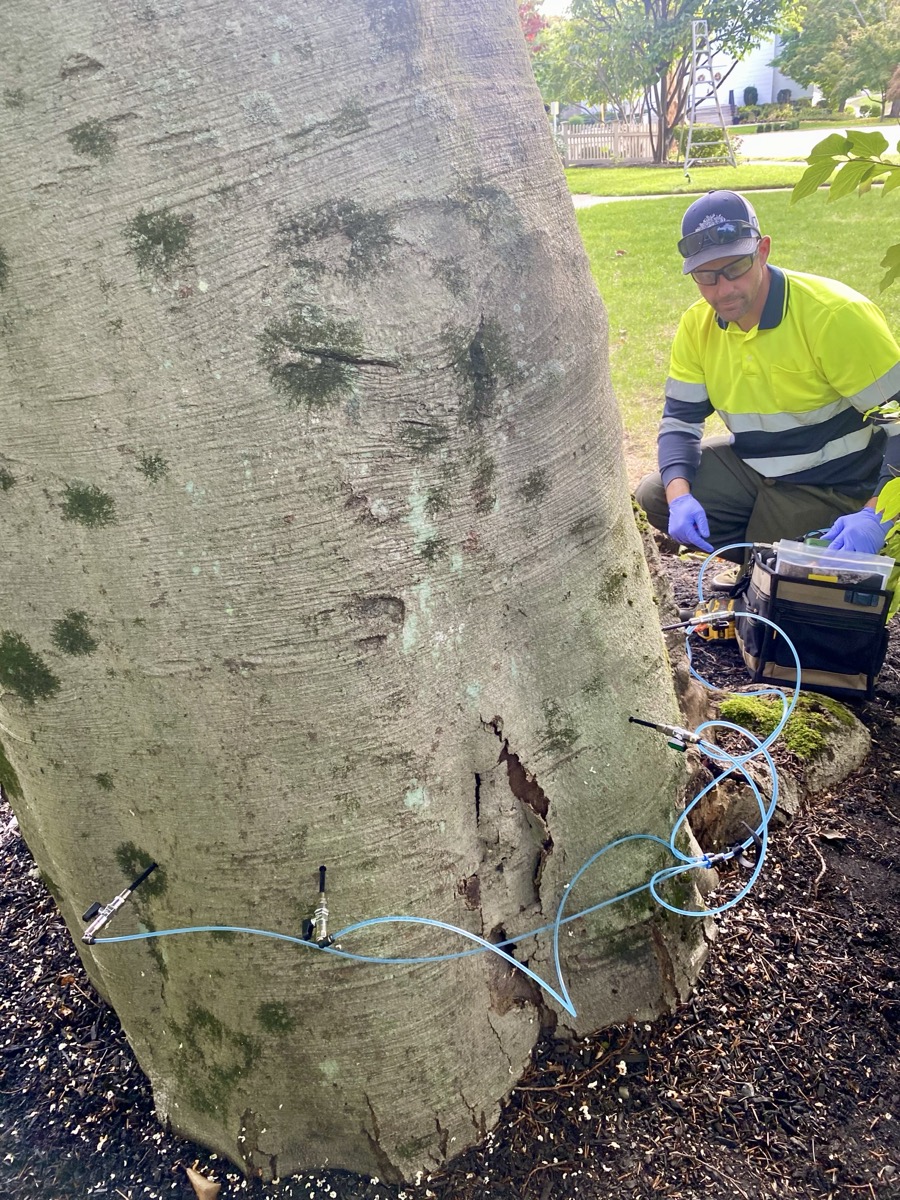
**Treatment planning** incorporates IPM: cultural, biological, and chemical controls prioritized. Deep root fertilization uses a high-pressure injector (15-20 gallons per tree) to deliver nitrogen, phosphorus, and micronutrients 12-18 inches deep, bypassing surface compaction on Scott Hill slopes. For emerald ash borer, we apply trunk injections of emamectin benzoate via Arborjet system, sealing ports to prevent leaks—effective for 2-3 years on ash near Braintree.
Pest management targets locals: Spongy moth and winter moth receive Bacillus thuringiensis (Bt) sprays in early instar stages (May in Milton), timed via pheromone traps. Hemlock woolly adelgid gets imidacloprid soil drenches in fall, when trees take up water actively post-rain. We treat Japanese maples for scale with horticultural oils in dormant season (February), safe for pollinators.
**Application techniques** prioritize safety and access. On steep Unquity lots, our lightweight TreePuller winches and spider lifts navigate 30-40% grades without soil disturbance. Deep root injections use grid patterns (1 per 10 feet of drip line), injecting slowly to avoid runoff into Neponset tributaries. All crews wear PPE and follow OSHA protocols, with spill kits on every truck.
**Monitoring and follow-up** ensure results. We install data loggers on high-value tulip trees in Brush Hill to track soil moisture, returning quarterly for white pine weevil checks. Annual reports detail treatments, with photos showing improved vigor—like fuller crowns on red oaks post-fertilization.
Practical advice for Milton homeowners: Water deeply (1 inch weekly) during July droughts to support PHC. Mulch 3-inch rings around hickories, keeping away from trunks to prevent rot. Avoid lawn fertilizers high in nitrogen, which burn shallow roots.
Our equipment includes air-spades for soil decompaction on East Milton properties and macro-injection units for precise dosing. Every PHC program complies with Massachusetts pesticide regulations, with applications logged for your records. This process has revived dozens of historic specimens in Milton, from copper beeches on Canton Avenue to hemlocks bordering Blue Hills. Contact Southeast Arborist at 508-369-5009 to start your custom PHC plan.
Common Plant Health Care Projects in Milton Neighborhoods
In Milton Village, we manage spongy moth on street-lined red oaks and white oaks, using Bt applications to protect 19th-century canopies without resident disruption. Deep root fertilization revives sugar maples stressed by road salt from Route 28 traffic.
East Milton properties near the Neponset River see frequent winter moth treatments on American beeches, combined with scale control via dormant oils. Hazard assessments identify ledge-rooted hickories at risk during Nor'easters.
Milton Hill's estates feature PHC for imported copper beeches and Japanese maples: verticillium injections and mycorrhizal soil amendments counteract clay compaction. We prune to ANSI standards, enhancing air flow to prevent anthracnose.
Cunningham Park homeowners request hemlock woolly adelgid management adjacent to Blue Hills trails, with imidacloprid drenches protecting 100+ year-old stands. Soil care includes compost topdressing for shallow-rooted tulip trees.
Scott Hill's steep slopes demand technical PHC: air-tool decompaction for white pines, followed by fertilizer grids accessible via rope systems. Emerald ash borer injections safeguard mixed woodlots.
Brush Hill prioritizes historic specimen care—copper beeches receive iron chelate injections for chlorosis in high-pH soils. Canopy thinning reduces wind throw risk from Blue Hills gusts.
Blue Hills-adjacent lots in the reservation's shadow get comprehensive HWA programs, including systemic insecticides and predator beetle releases. White oak fertilization supports mast production for local wildlife.
Unquity Hill estates benefit from custom IPM for Japanese maples: horticultural oils and beneficial insects control aphids, preserving fall color prized by homeowners.
Canton Avenue area projects focus on hickory bark beetles and tulip tree cankers, treated with trunk injections and pruning deadwood on sloped access paths.
Southeast Arborist's ISA arborists tailor these to each neighborhood's microclimate—Milton Village's urban heat vs. Blue Hills' cool shade. We've treated over 500 trees here, extending lifespans by 20-30 years.
Plant Health Care Costs in Milton, MA
Plant health care costs in Milton MA vary by property scale, tree size, and issues, but deliver strong ROI through preserved values. A basic assessment for a Milton Village lot with five mature oaks starts at $250, including soil tests and diagnostics—essential for spotting HWA early.
Deep root fertilization for a 24-inch white oak on Scott Hill runs $150-250 per tree, using 20 gallons of custom blend. Annual programs for 10-tree estates average $1,500-2,500, covering quarterly monitoring and two fertilizer applications suited to shallow ledge soils.
Hemlock woolly adelgid treatment in Blue Hills properties costs $100-200 per injection site, with full-stand programs $800-1,500 for 10 hemlocks. Trunk injections for emerald ash borer or scale on Japanese maples in Milton Hill: $75-150 per tree, effective longer than sprays.
Spongy moth/winter moth aerial sprays for Brush Hill canopies: $300-600 per acre, using low-volume Bt to target larvae precisely. Soil drenches for beech bark disease in Cunningham Park: $120-180 per American beech.
Factors driving costs: Steep access in Unquity adds 20-30% for specialized gear like spider lifts. High-value specimens (e.g., 150-year copper beeches on Canton Avenue) require premium diagnostics like resistographs ($100 extra). Multi-year contracts reduce per-visit fees by 15%.
Value proposition: Untreated hemlock decline in East Milton can cost $5,000+ per removal on slopes; PHC prevents this for $1,200 annually. Mature trees boost appraisals 15% per UMass studies—your $2,000 investment yields $30,000+ equity on a $1M home.
Compare: DIY fertilizers risk root burn in Milton's pH 6.8 soils; our calibrated injections ensure 90% uptake. IPM cuts chemical costs 40% vs. reactive sprays.
Transparent pricing: No surprises—we quote post-assessment. Financing available for estates. Southeast Arborist's ISA certification guarantees ANSI-compliant work, backed by insurance. Call 508-369-5009 for your Milton-specific estimate—affordable protection for your tree heritage.
When to Schedule Plant Health Care in Milton
Schedule plant health care in Milton MA seasonally to align with tree biology and pest cycles. Spring (April-May) targets egg hatch: Apply Bt for spongy moth on red oaks before larvae defoliate Milton Hill canopies. Hemlock woolly adelgid crawlers peak then—soil drenches protect Blue Hills hemlocks.
Summer (June-August) focuses on irrigation support: Deep root fertilization for drought-stressed sugar maples in East Milton, when soil probes show deficits below 20% moisture. Monitor Japanese maples for anthracnose by July 1.
Fall (September-November) is prime for systemic treatments: Imidacloprid drenches for HWA uptake in cooling soils; emerald ash borer injections before leaf drop. Test soils in October for winter prep.
Winter (December-February) suits dormant oils on copper beeches in Brush Hill, smothering scale without harming buds.
Urgency signs: 20% canopy thinning in white pines signals weevils—act within 2 weeks. Sticky trunks on American beeches mean scale; honeydew attracts ants, worsening decline. Wilting branches on tulip trees indicate verticillium—schedule ASAP to save vascular tissue.
Blue Hills winds topple unstable hickories post-storm; assess immediately. Call 508-369-5009 for same-week response in Cunningham Park or Unquity.
Annual timing: Assess March, treat April/June/October. Early action prevents $10K removals.
Frequently Asked Questions About Plant Health Care in Milton
What is plant health care in Milton MA? PHC is an IPM program for Milton trees, including pest control, fertilization, and soil care tailored to shallow ledge soils and Blue Hills pests like HWA. Southeast Arborist customizes for your white oaks or hemlocks.
How do I know if my Milton trees need PHC? Look for needle drop in hemlocks, defoliation on red oaks from winter moth, or sparse crowns in sugar maples. Soil under 18 inches deep or pH over 6.5 confirms needs—our ISA arborists diagnose free.
Are PHC treatments safe for my family and pets in East Milton? Yes, we use EPA-approved, low-toxicity products like Bt (safe for bees) and timed applications. No-entry periods follow labels; all crews trained in Massachusetts regs.
How much does hemlock woolly adelgid treatment cost in Blue Hills? $100-200 per tree for drenches; $1,000 for 10-tree stands. Prevents $4,000+ removals on steep slopes.
Can PHC save historic copper beeches on Milton Hill? Absolutely—iron injections and pruning per ANSI A300 treat chlorosis and improve vigor, extending 150-year trees by decades.
What's the difference between PHC and regular tree care? PHC is proactive science: diagnostics, injections vs. reactive pruning. For Japanese maples in Scott Hill, it prevents decline proactively.
How often should I schedule PHC for my Brush Hill property? Annually for monitoring; 2-4 treatments yearly based on pests. Multi-year plans save 15%.
Does Southeast Arborist serve Canton Avenue and nearby towns? Yes, full Milton coverage plus Quincy, Braintree, Randolph, Canton, Dedham from our Plymouth/Cohasset base.
Plant Health Care Throughout Milton
Southeast Arborist provides plant health care across all Milton neighborhoods—Milton Village estates, East Milton riverfronts, Milton Hill grandeur, Cunningham Park woodlots, Scott Hill slopes, Brush Hill heritage, Blue Hills forests, Unquity elevations, and Canton Avenue charm. We extend to nearby Quincy, Braintree, Randolph, Canton, and Dedham.
Our ISA-certified team uses Milton-specific strategies for your white oaks, hemlocks, and more. Call 508-369-5009 today for tailored PHC that protects your property's trees.