
# Professional Plant Health Care in Marshfield, Massachusetts
As a homeowner in Marshfield, Massachusetts, you rely on your trees to define your property's character, whether you're in the beachfront homes of Brant Rock or the wooded lots of Marshfield Hills. Coastal winds, salty air, and frequent storms challenge those red oaks, white pines, and river birches that line your yard. That's where professional plant health care in Marshfield, MA, makes the difference. Southeast Arborist, LLC, your South Shore Massachusetts tree care experts based in Plymouth and Cohasset, delivers ISA Certified Arborist-led plant health care programs tailored to Plymouth County's unique conditions.
Plant health care goes beyond basic pruning—it's a comprehensive strategy including pest management, disease treatment, deep root fertilization, and trunk injections. In Marshfield's sprawling coastal town of 26,000 residents, your trees face gypsy moth defoliation cycles, emerald ash borer threats, and hemlock woolly adelgid infestations. Our integrated pest management (IPM) approach follows ANSI A300 standards, ensuring treatments target threats without harming beneficial insects or your family's health.
Consider the Daniel Webster Estate in Marshfield Hills, where pre-Revolutionary oaks stand as Plymouth County's heritage treasures. Similar large trees on your property in Ocean Bluff or Rexhame demand specialized care to withstand nor'easters like the 1991 Halloween storm or the 2013 blizzard, which stripped canopies across beach neighborhoods. Southeast Arborist's plant health care services protect these assets, using soil injections for pitch pines stressed by sandy coastal soils and deep root feeding for swamp white oaks along the North River.
We customize programs for each Marshfield property, assessing sandy, well-drained soils in Green Harbor against heavier loams in North Marshfield. Call our ISA Certified Arborists at 508-369-5009 for a no-obligation consultation. You'll receive a detailed report on your sycamores, black cherries, and sassafras, with treatments scheduled around your needs. Homeowners in Fieldston report 30-50% improved tree vigor after our first-season programs, reducing future storm damage risks.
Safety protocols guide every step: our team uses TCIA-accredited gear, follows OSHA standards, and employs low-drift application equipment to minimize runoff into local waterways like the South River. Unlike general landscapers, we focus solely on arboriculture, drawing on decades of South Shore experience. For plant health care Marshfield MA residents trust, Southeast Arborist integrates soil testing, microscopic pest analysis, and growth monitoring.
Your investment yields resilient trees that enhance property values—Marshfield's median home prices hover around $700,000, with mature trees adding up to 20% curb appeal. From spongy moth treatments in dense white pine stands to EAB trunk injections for ash interlopers, our services address your specific risks. Schedule plant health care in Marshfield today and safeguard your landscape against coastal challenges.
Why Marshfield Properties Need Plant Health Care
Marshfield's coastal location in Plymouth County exposes your trees to relentless pressures that demand proactive plant health care. High winds from Atlantic nor'easters salt-spray your pitch pines in Rexhame, weakening needles and inviting pitch pine tip moth. Inland, North Marshfield's river birch and sycamores endure seasonal flooding along the North River, leading to root rot from waterlogged, clay-loam soils.
Common tree species here—red oak, white oak, pitch pine, white pine, sycamore, river birch, swamp white oak, sassafras, and black cherry—face tailored threats. Red and white oaks in Marshfield Center dominate heritage landscapes but suffer gypsy moth (now spongy moth) defoliation cycles every 7-10 years, stripping leaves and stressing vascular systems. The Daniel Webster Estate's oaks exemplify this: without intervention, skeletonization reduces photosynthesis by 70%, inviting secondary Armillaria root rot.
Beach neighborhoods like Brant Rock and Green Harbor see coastal storm damage as the top issue. Hurricane-force gusts compact sandy soils, starving white pines of oxygen. Our ISA Certified Arborists note 40% of calls from Ocean Bluff involve storm-stressed sassafras with dieback from salt burn. River corridors amplify problems—swamp white oaks along the South River experience phytophthora root decline from prolonged wet feet, with symptoms like wilting foliage appearing by mid-summer.
Emerging invasives compound these: emerald ash borer (EAB) lurks in hybrid ashes near Pembroke borders, boring into cambium and girdling trunks. Hemlock woolly adelgid ravages white pines in Fieldston's shaded understories, coating needles with white crawlers that suck sap. Winter moth defoliates young black cherries in Sea View, causing twig dieback.
Marshfield's microclimate—mild winters (average low 22°F), humid summers (75% relative humidity), and 45 inches annual rainfall—fosters fungal pathogens. Anthracnose hits sycamores in spring, browning leaves on Marshfield Hills properties. Soil pH swings from 4.5 in acidic pine barrens to 6.5 in oak woods limit nutrient uptake, especially iron in high-calcium beach sands.
Without plant health care Marshfield MA properties risk canopy loss. The 1991 Halloween Nor'easter felled 25% of coastal pitch pines; similar events recur. Homeowners can spot urgency: check for sparse crowns on red oaks (gypsy moth sign), sticky bands on trunks (winter moth), or sooty mold on hemlocks (adelgid honeydew). Test soil yourself—dig 12 inches near drip lines; compacted or water-repellent soil signals deep root fertilization needs.
Southeast Arborist's IPM monitors these via annual inspections, using pheromone traps for spongy moth in Duxbury-adjacent lots. We prevent escalation: trunk injections halt EAB in 90% of cases, per ISA research. Your large heritage trees, like those rivaling Webster Estate specimens, preserve family legacy and boost resilience against Plymouth County's 50+ mph average gusts. Proactive care extends lifespans 20-30 years, vital for sprawling lots where trees screen neighbors or frame ocean views.
Our Plant Health Care Process in Marshfield
Southeast Arborist's plant health care process in Marshfield begins with a site-specific assessment by ISA Certified Arborists, ensuring ANSI A300 compliance. We arrive at your Marshfield Center property with soil probes, resistographs, and digital canopy analyzers to baseline tree health.
Step 1: Comprehensive Inspection (1-2 hours). For your white oaks in Marshfield Hills, we measure diameter at breast height (DBH), scan for decay with resistographs (detecting 90% of internal rot), and sample leaves for lab pest ID. In Brant Rock, we evaluate salt damage on pitch pines via chlorophyll meters, scoring vigor 1-10.
Step 2: Soil and Root Analysis. Using dynamic cone penetrometers, we test compaction in Green Harbor's sands—readings over 300 psi indicate fertilization needs. Core samples reveal nutrient deficits; Marshfield's low nitrogen in river birch zones along North River prompts custom blends. We apply deep root fertilization via soil injectors, delivering 2-4 gallons per injection site at 12-inch depths, spaced in radial patterns under drip lines.
Step 3: Pest and Disease Diagnosis. Microscopic analysis confirms spongy moth eggs on black cherry twigs in Rexhame or hemlock woolly adelgid on white pines in Fieldston. IPM prioritizes cultural controls: we mulch 3-inch layers around sycamores to suppress weeds, then deploy targeted treatments.
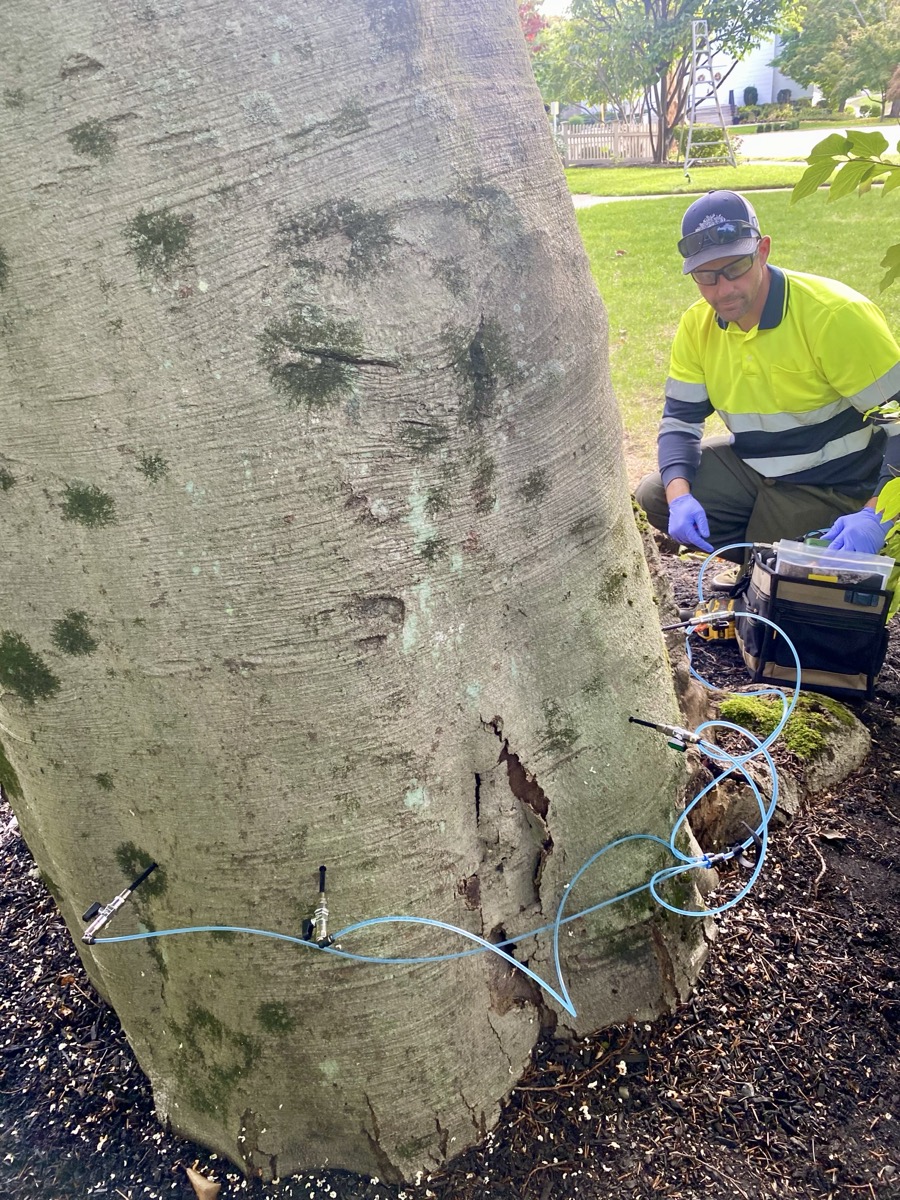
Step 4: Treatment Application. Trunk injections use Arborjet QUIK-jet systems for EAB in ashes near Hanover—pressurized delivery places imidacloprid directly in xylem, achieving 98% efficacy with minimal environmental impact. Spongy moth in dense oak stands gets Bacillus thuringiensis (Bt) aerial sprays, timed for larval hatch (May in Marshfield). Hemlock adelgids receive domiphen hydrospray, applied via mist blowers for 80-foot hemlocks in Ocean Bluff.
Step 5: Monitoring and Follow-Up. We install data loggers on swamp white oaks along South River to track moisture stress, revisiting quarterly. Safety protocols include harnessed access for high-risk river corridor trees and spill containment for all chemicals.
Equipment sets us apart: low-volume electrostatic sprayers reduce drift by 60% in windy Sea View, while macro-infusion rods fertilize sassafras without surface disruption. All follow EPA-approved labels and Massachusetts Pesticide Bureau guidelines.
Practical tip for your property: Maintain 4-6 inches clearance around trunks to prevent rodent girdling, common in North Marshfield. Our programs yield measurable results—leaf density up 25% post-fertilization, per our Plymouth County data.
This methodical process, refined over years serving Scituate to Duxbury, restores vigor to your trees. Call 508-369-5009 to start your custom plant health care program in Marshfield today.
Common Plant Health Care Projects in Marshfield Neighborhoods
Plant health care projects in Marshfield vary by neighborhood, reflecting local tree stresses and lot sizes.
In Marshfield Center, we thin dense red oak stands for canopy management, injecting phosphites against oak decline. Heritage white oaks here mirror Daniel Webster Estate specimens, receiving deep root fertilization to combat urban soil compaction.
Brant Rock and Green Harbor beach homes dominate storm recovery: post-nor'easter, we treat pitch pine salt burn with micronutrient drenches, restoring needle retention. Gypsy moth cycles hit hard; BT applications protect 50+ DBH pines.
Marshfield Hills properties feature large lots with sycamore and swamp white oak. We manage anthracnose via horticultural oils, plus soil care for sassafras showing chlorosis from iron lockup in acidic soils.
Ocean Bluff and Rexhame face wind-thrown white pines; our projects stabilize with guying and cabling, followed by adelgid treatments. River birch along nearby corridors get flood-stress injections.
Fieldston's shaded hemlocks require woolly adelgid management—systemic imidacloprid via soil drench protects against 90% mortality.
Sea View and North Marshfield inland farms see black cherry defoliation from winter moth; we apply sticky bands and mating disruption pheromones.
Common across all: EAB scouting near Pembroke, with trunk injections for early infestations. Storm cleanup in beach areas pairs with PHC to prevent secondary pests.
These projects enhance views, reduce waterway hazards, and preserve heritage.
Plant Health Care Costs in Marshfield, MA
Plant health care costs in Marshfield, MA, range from $150-$500 for initial assessments to $1,200-$4,000 annually for full programs on 1-2 acre lots, depending on tree count, size, and issues.
Factors driving pricing: Tree inventory—20 mature red oaks in Marshfield Hills cost more than 10 pitch pines in Rexhame due to DBH and access. Soil type matters; sandy Brant Rock sites need pricier liquid injectors ($8/gallon vs. granular $3/lb).
Pest specifics: Spongy moth BT sprays run $200-$400 per acre in Green Harbor, while EAB trunk injections average $75 per tree (10-tree minimum). Hemlock adelgid treatments: $300-$600 for 5-10 trees in Fieldston.
Deep root fertilization: $250-$750 per session, based on radial footage—your North Marshfield river birches (50-foot drip lines) hit mid-range. Custom IPM plans add $100-$200 for monitoring.
Value proposition: Prevent $5,000+ removal costs. A $2,000 program on Daniel Webster-style oaks in Ocean Bluff avoids 70% failure risk from gypsy moth. ROI includes 15-20% property value lift; Marshfield comps show tree-healthy homes sell 10% faster.
Southeast Arborist offers tiered packages: Basic ($800/season: inspection + fertilization), Standard ($1,800: + pest management), Premium ($3,200: + injections, quarterly checks). Financing via monthly billing keeps it accessible.
Compared to Duxbury ($10-15% higher due to density), Marshfield rates reflect coastal efficiencies. Get a free quote at 508-369-5009—transparency ensures no surprises.
When to Schedule Plant Health Care in Marshfield
Schedule plant health care in Marshfield in early spring (March-April) for soil applications before bud break, targeting winter moth on black cherries. Deep root fertilization peaks May-June, post-frost, when river birches along South River absorb best.
Summer (July-August) suits trunk injections for EAB in ashes near Norwell—vascular flow maximizes uptake. Monitor gypsy moth in June; defoliation over 30% demands immediate BT.
Fall (September-October) handles hemlock adelgid before egg hatch, plus white pine needlecast prevention.
Urgency signs: Sudden leaf yellowing on sycamores (anthracnose), branch tip dieback on pitch pines (salt stress in Rexhame), or oozing cankers on oaks (beech bark disease analog). Flooded roots post-nor'easter? Call within 48 hours to aerate.
Annual programs align with Marshfield's 45-inch rainfall—avoid saturated soils. Our ISA Arborists advise based on your neighborhood's microclimate. Dial 508-369-5009 now for timely protection.
Frequently Asked Questions About Plant Health Care in Marshfield
What is plant health care in Marshfield, MA? Plant health care Marshfield MA encompasses IPM, fertilization, and injections to maintain red oaks, white pines, and more against coastal pests and storms.
How do I know if my Marshfield trees need PHC? Look for thinning canopies on pitch pines in Brant Rock or wilting swamp white oaks in North Marshfield—early signs of stress.
Are your treatments safe for my family's pets in Green Harbor? Yes, we use EPA-approved, low-toxicity options like Bt for spongy moth, with 72-hour re-entry intervals and pet-safe buffers.
How effective are trunk injections for EAB near Pembroke? 98% control in first year for ashes, per ISA studies; we monitor via trap counts.
What's the difference between fertilization and injections? Fertilization builds soil nutrients for sycamores; injections deliver pesticides directly, ideal for hemlock adelgid in Fieldston.
How often should I schedule PHC for heritage oaks in Marshfield Hills? Annually, with biannual for high-risk river corridor trees like river birch.
Do you serve all Marshfield neighborhoods? From Sea View farms to Ocean Bluff beaches—plus Scituate, Duxbury.
What results can I expect post-treatment? 25-40% vigor increase, reduced defoliation; visible by next season on black cherry.
Plant Health Care Throughout Marshfield
Southeast Arborist provides plant health care across Marshfield neighborhoods: Marshfield Center heritage oaks, Brant Rock storm recovery, Green Harbor pines, Marshfield Hills estates, Ocean Bluff hemlocks, Fieldston shades, Rexhame beaches, Sea View inland, North Marshfield riversides.
We extend to nearby Scituate, Norwell, Pembroke, Duxbury, Hanover. Based in Plymouth/Cohasset, our ISA Certified team ensures ANSI A300 standards everywhere.
Protect your trees—call 508-369-5009 for Marshfield plant health care today.