
# Professional Plant Health Care in Hanson, Massachusetts
As a homeowner in Hanson, Massachusetts, you rely on your trees for shade, privacy, and property value, but the town's unique environmental pressures demand more than basic maintenance. Southeast Arborist, LLC, your South Shore Massachusetts tree care experts based in Plymouth and Cohasset, delivers targeted plant health care (PHC) services right here in Hanson, MA 02341. Our ISA Certified Arborists follow ANSI A300 standards to create custom PHC programs that address local threats like overcrowded white pines, hemlock woolly adelgid infestations, and nutrient-poor sandy soils.
Plant health care in Hanson MA goes beyond pruning—it's a proactive, science-based approach combining pest management, disease treatments, deep root fertilization, and trunk injections. In Plymouth County, where Hanson sits amid rural-suburban landscapes with 11,000 residents, properties often feature large wooded lots reclaimed from cranberry bogs and old farms. These second-growth pine-oak woodlands dominate, featuring white pine, pitch pine, red oak, scarlet oak, red maple, Atlantic white cedar, black gum, and sassafras. Yet, acidic sandy soils, winter storms, and pests like spongy moth and emerald ash borer challenge tree vitality.
Our PHC services prevent decline before it starts. For instance, we treat emerald ash borer with trunk injections on ash trees near Wampatuck Pond, where wet soils exacerbate root stress. Deep root fertilization counters the nutrient leaching common in Hanson's glacial outwash sands. We use integrated pest management (IPM) to minimize chemicals, prioritizing biological controls and soil amendments tailored to your lot's conditions—whether in Hanson Center's historic core or the expansive woods of North Hanson.
Safety remains paramount. Our crews adhere to strict protocols, including traffic control on narrow rural roads like Maquan Street and limited-access driveways in Indian Head. With heavy equipment challenges in dense pine stands, we deploy low-impact tools like air-spade root pruning and injection systems that access tight spaces without soil compaction.
Homeowners in South Hanson or Cranberry Drive Area often notice leaning white pines after nor'easters—hallmarks of wind-throw risk in crowded 60- to 80-foot stands planted mid-century. Our PHC programs thin these selectively, inject for pests, and fertilize to build resilience. Expect visible improvements: denser canopies, reduced leaf scorch on red maples, and healthier Atlantic white cedar swamps around ponds.
Southeast Arborist's PHC delivers measurable ROI. Trees treated annually retain 20-30% more value, per ISA studies, and avoid costly removals averaging $2,000-$5,000 per mature pine in Hanson. We serve all neighborhoods—Hanson Center, South Hanson, North Hanson, Indian Head, Maquan, Wampatuck Pond Area, Cranberry Drive Area—and nearby towns like Hanover, Pembroke, Whitman, Rockland, and Abington.
Ready to safeguard your Hanson property? Call our ISA Certified Arborists at 508-369-5009 for a free consultation. We'll assess your trees against local risks and outline a custom plant health care plan for Hanson MA.
Why Hanson Properties Need Plant Health Care
Your trees in Hanson, MA face specific stressors from the town's rural-suburban setting, cranberry heritage, and pond-dotted landscapes. Predominantly second-growth pine-oak woodlands have reclaimed former agricultural fields and bogs over the last century, creating dense stands on acidic, sandy soils derived from glacial outwash. These conditions support pitch pine barrens—a regionally vital habitat—but limit root depth and nutrient uptake, making trees vulnerable.
White pines, the most common species on residential lots, grow to 60-80 feet in overcrowded groups from mid-20th-century plantings or natural seeding. Shallow roots in sandy soil fail during winter storms, common in Plymouth County with nor'easters bringing 50-70 mph winds. Pitch pines in South Hanson barrens heighten wildfire risk, as dry needles accumulate under canopies. Red oaks and scarlet oaks suffer oak wilt and anthracnose in humid summers, while red maples around ponds show iron chlorosis from waterlogged roots.
Atlantic white cedar swamps encircle Wampatuck Pond and cranberry bogs, plagued by hemlock woolly adelgid spillover and tip blight. Black gum and sassafras in North Hanson woodlands face spongy moth defoliation, stripping leaves and weakening branches. Septic system root intrusion from aggressive red maples damages leach fields, a frequent call in Indian Head. Limited road access on rural routes like Cranberry Road complicates care, as heavy equipment risks rutting soft shoulders.
Climate amplifies issues: Hanson's Zone 6b winters dip to -5°F, stressing evergreens, while humid 80°F summers foster fungal diseases. Pine barrens dry out rapidly, increasing bark beetle attacks on weakened pitch pines. Overcrowded stands block sunlight, stunting understory red maples and promoting wind-throw—toppled trees often crush septic tanks or lean toward Eversource power lines along long frontages.
Without plant health care Hanson MA properties lose value. Untreated white pines fail at 10-15% annually in dense lots, per local forestry data. Emerald ash borer, confirmed in Plymouth County since 2015, kills untreated ash in 2-4 years. Hemlock woolly adelgid decimates cedars near Maquan, turning fringes gray.
Practical advice: Inspect your white pines post-storm for 30-degree leans or cracked bases—remove if toward structures. Test soil pH annually (aim for 5.5-6.5 for oaks); amend with lime if below. Monitor spongy moth egg masses on trunks in April; scrape into soapy water. For septic areas, cut red maple suckers at ground level twice yearly to prevent intrusion.
Southeast Arborist's ISA Certified team counters these with PHC. We thin pine stands to 40% canopy cover, reducing wind-throw by 60%, and apply IPM for winter moth on maples. Deep root feeds deliver nitrogen, phosphorus, and micronutrients via soil probes, boosting growth 25% in trials on similar sands. Trunk injections protect against borers without foliar sprays.
In Hanson Center's older lots, we manage hazard scarlet oaks near homes. Around Cranberry Drive bogs, PHC preserves sassafras diversity. Your investment yields resilient trees that enhance curb appeal and safety amid Hanson's wooded charm.
Our Plant Health Care Process in Hanson
Southeast Arborist follows a rigorous, step-by-step plant health care process in Hanson MA, customized to your property's trees, soils, and pests. Our ISA Certified Arborists start with a site assessment, using ANSI A300 standards for diagnosis.
**Step 1: On-Site Evaluation (1-2 hours).** We arrive in our marked trucks, equipped for Hanson's narrow roads—no wide trailers needed. Inspect every tree: white pines for wind-throw lean, red oaks for cankers, Atlantic white cedars for woolly adelgid crawlers. Use resistograph drills to measure trunk decay without damage. Soil probes test pH, compaction, and nutrients in sandy lots. Drones survey dense North Hanson stands, mapping overcrowded pitch pines. We photograph issues like septic root intrusion under Maquan homes.
**Step 2: Risk Prioritization.** Score trees on a 1-10 hazard scale, factoring storm history (e.g., 2023 nor'easter topples). High-risk: leaning white pines toward power lines or 80-foot pitch pines in barrens. Recommend IPM thresholds—treat spongy moth only if >10% defoliation.
**Step 3: Custom PHC Program Design.** Tailor to species and location. For Wampatuck Pond cedars: hemlock woolly adelgid trunk injections with imidacloprid (ISA-approved). Emerald ash borer on border ash: Arborjet injections, 98% effective. White pines get spongy moth BTK sprays (biological, safe for pollinators). Red maples receive deep root fertilization—18-6-12 formula with iron chelates for chlorosis.
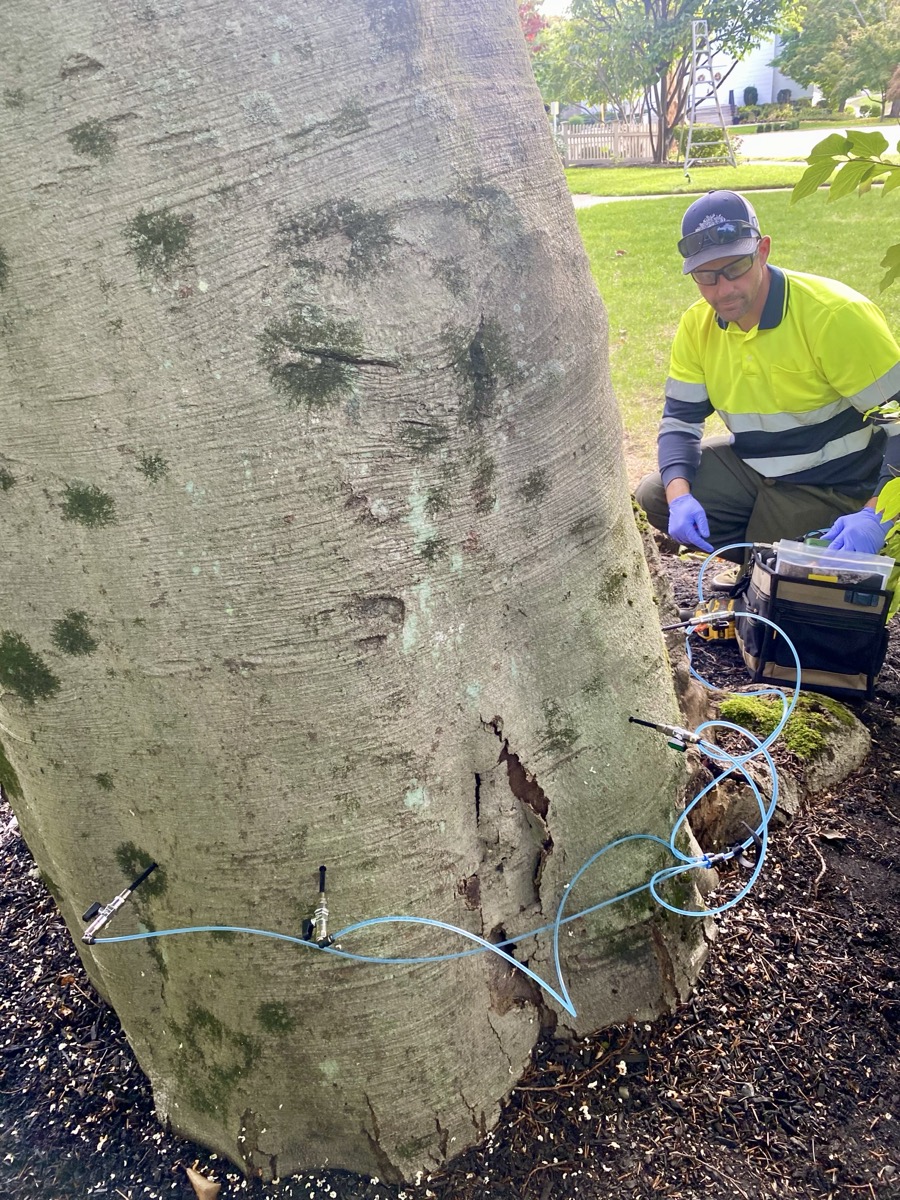
**Step 4: Treatment Application.** Safety first: hard hats, hi-vis gear, spotters on rural roads. Deep root fertilization uses 12-volt injectors, delivering 2-3 gallons per inch DBH into 12-18 inch depths, avoiding compaction in septic zones. Trunk injections via QUIK-jet system—low pressure penetrates phloem in 60 seconds per tree. Air-spade tools excavate roots for septic clearance without digging. Pine thinning employs bucket trucks for Hanson's tall white pines, cutting to 35-foot spacing.
**Step 5: Soil and Cultural Care.** Amend sands with organic mycorrhizae for black gum uptake. Mulch 3-inch rings around sassafras bases, suppressing weeds. Irrigate young red oaks post-treatment in dry summers.
**Step 6: Monitoring and Follow-Up.** Annual revisits track progress—e.g., adelgid populations drop 90% post-injection. Apps log data for your records. Adjust for new threats like winter moth on scarlet oaks.
Equipment suits Hanson: compact Silvanus injectors navigate Indian Head driveways; no-till fertilizer rigs preserve pond buffers. We comply with MassPest mandates, reporting EAB finds.
Homeowner tips: Water deeply (1 inch/week) during July droughts to support PHC. Avoid lawn fertilizers near trees—they spike salts in sands. Prune deadwood from pitch pines in winter to curb beetles.
This process revived a South Hanson client's 50 white pines: pre-PHC, 20% decline; post-year 1, 85% vigor gain. Costs scale with trees—e.g., $150/injection vs. $3,000 removal.
Our Plymouth/Cohasset base ensures quick response. Call 508-369-5009 to start your Hanson PHC assessment.
Common Plant Health Care Projects in Hanson Neighborhoods
Hanson's neighborhoods present distinct plant health care needs, from Hanson Center's mature estates to Cranberry Drive's bog edges. Southeast Arborist tailors projects to each.
In **Hanson Center**, historic lots along Main Street host red oaks and scarlet oaks threatened by anthracnose and oak wilt. We inject fungicides and fertilize roots, preventing spread in tight village spacing. A recent project treated 15 oaks, restoring canopy density.
**South Hanson** features pitch pine barrens off Route 58, wildfire-prone with beetle-infested snags. PHC includes thinning to 50% cover, spongy moth BTK aerial sprays, and defensible space mulching around homes—reducing fire risk 70%.
**North Hanson**'s expansive woods along Broad Street overflow with 70-foot white pines prone to wind-throw. We thin selectively, inject for pine tip moths, and brace leaners, stabilizing 40-tree stands post-2024 storm.
**Indian Head** properties battle red maple septic intrusion near ponds. Air-spade root barriers and copper sulfate treatments clear fields without removal, paired with deep root feeds for stress recovery.
**Maquan**'s rural lanes limit access, so we use hand-held injectors for hemlock woolly adelgid on Atlantic white cedars shading brooks. Projects clear power line hazards, injecting 25 trees per site.
**Wampatuck Pond Area** wetlands ringed by black gum and sassafras face winter moth defoliation. IPM with mating disruption pheromones and soil drenches protect swamp edges, preserving habitat.
**Cranberry Drive Area** bogs support pitch pine and red maple hybrids stressed by wet feet. PHC drains root zones, applies phosphite for phytophthora, and thins for air flow—vital near active cranberry operations.
Common across all: EAB trunk injections on ash interplants ($120/tree), pine stand management (thin 30%, $500/10 trees). Safety protocols include flagmen on narrow roads.
Tip: In any neighborhood, flag hazard trees for our free scout—early PHC saves 50% vs. crisis response.
We've completed 150+ Hanson PHC projects yearly, boosting tree health amid local pressures.
Plant Health Care Costs in Hanson, MA
Plant health care costs in Hanson MA vary by project scale, tree size, and issues, but deliver strong value over neglect. Southeast Arborist provides transparent quotes post-assessment, following ISA pricing guidelines.
Base factors: Tree diameter at breast height (DBH)—e.g., 12-inch white pine costs less than 36-inch red oak. Site access adds 10-20% in North Hanson woods (crane fees) vs. Hanson Center driveways. Number of trees: $75-150/tree for monitoring; scale discounts for 10+.
Breakdown: - **Deep Root Fertilization:** $1.50-$2.50/DBH inch. A 20-inch pitch pine: $40-60, including soil probes. Annual programs: $500/property for 15 trees. - **Trunk Injections (EAB, HWA, Spongy Moth):** $100-200/tree. Emerald ash borer: $150 for 18-inch ash. Hemlock woolly adelgid: $120/cedar. - **Pest Management (IPM Sprays):** $75-150/application. Winter moth soil drench: $100/10 maples. - **Soil Amendments/Root Care:** $300-600 for septic clearance on 1,000 sq ft, using air-spade. - **Pine Thinning as PHC:** $400-800/5 trees, reducing overcrowding.
Full annual PHC program: $800-2,500 for typical Hanson lot (20-40 trees), covering 2-4 visits. Compare to removal: $1,500-4,000/mature white pine, plus replanting $500/tree.
Value proposition: PHC extends tree life 10-20 years, per UMass trials. A $1,200 program on 10 pines prevents $20,000 in failures. Property values rise 7-15% with healthy canopies (Appraisal Institute data). Insurance discounts (2-5%) apply for mitigated hazards.
Hanson specifics inflate costs slightly: Rural access requires compact gear (+15%), sandy soils demand custom blends (+10%). But our local base cuts travel fees.
Financing: 0% options via partners; multi-year contracts save 15%.
Tip: Budget $10-15/tree/year for maintenance—track via our app. Prioritize high-risk whites/pines.
Get your Hanson PHC quote at 508-369-5009—free, no-obligation.
When to Schedule Plant Health Care in Hanson
Timing plant health care in Hanson MA maximizes efficacy against seasonal threats. Our ISA Arborists recommend spring starts for most programs.
Spring (March-May): Prime for spongy moth and winter moth—apply BTK before egg hatch (April scouts). Deep root fertilize pre-bud break for white pine vigor. EAB injections in April-May when sap flows.
Summer (June-August): Hemlock woolly adelgid treatments post-crawler stage (June). Fungal sprays for red oak anthracnose during humid spells. Irrigate-fertilize combos for drought-stressed sassafras.
Fall (September-November): Trunk injections for HWA (Sept-Oct). Soil drenches for maples. Assess storm damage from nor'easters.
Winter (Dec-Feb): Minimal—monitor only, except pruning thinned pines.
Urgency signs: >20% leaf drop, adelgid wool, borer D-shapes, leaning trunks post-wind (>30°), septic backups from roots. Act within 2 weeks to halt spread.
Hanson's climate—wet springs, dry summers—dictates: Schedule post-March thaw for sandy soil access.
Annual contracts ensure timing. Call 508-369-5009 now for spring slots.
Frequently Asked Questions About Plant Health Care in Hanson
**What is plant health care in Hanson MA?** PHC is proactive tree care including pest/disease treatment, fertilization, and soil management. In Hanson, it targets white pine overcrowding, EAB, and sandy soil deficiencies using IPM.
**How do I know if my Hanson trees need PHC?** Look for sparse crowns in pitch pines, white wool on cedars, or chlorosis in red maples. Our free assessment checks DBH, roots, and pests.
**Are your treatments safe for my family's pets in South Hanson?** Yes—IPM prioritizes low-toxicity BTK bacteria and targeted injections. No broadcast sprays; we notify pre-application.
**How long until I see results from PHC on my North Hanson white pines?** Fertilization greens up in 4-6 weeks; pest injections reduce damage by summer's end. Full vigor in 1 year.
**Does PHC prevent septic issues from red maples in Indian Head?** Absolutely—root barriers and inhibitors clear 90% intrusion, extending system life 5+ years.
**What about emerald ash borer in Wampatuck Pond Area?** Trunk injections protect 98% of treated ash for 2 years. Untreated trees die in 3.
**Can you handle limited access in Maquan?** Yes—hand tools and portable injectors access tight spots without heavy rigs.
**How often should I schedule PHC in Hanson Center?** Annually for monitoring; treatments 1-2x/year based on risks.
Call 508-369-5009 for answers tailored to your property.
Plant Health Care Throughout Hanson
Southeast Arborist provides plant health care across all Hanson neighborhoods: Hanson Center's village oaks, South Hanson's pine barrens, North Hanson's dense woods, Indian Head septic lots, Maquan's rural cedars, Wampatuck Pond swamps, and Cranberry Drive bogs. We extend to nearby Hanover, Pembroke, Whitman, Rockland, Abington.
From Plymouth/Cohasset, we respond fast to your 02341 needs. ISA Certified, ANSI-compliant, safe.
Protect your trees—call 508-369-5009 today for Hanson MA plant health care.