
# Professional Plant Health Care in Foxborough, Massachusetts
If you own a home in Foxborough, Massachusetts, your trees face unique pressures from the town's wetland corridors, saturated soils, and expanding development. Southeast Arborist, LLC, delivers targeted plant health care services across Foxborough (02035) to protect your red maples, swamp white oaks, and white pines from these threats. As ISA Certified Arborists based in Plymouth and Cohasset, we serve the South Shore Massachusetts region with custom plant health care programs that address pest infestations, soil deficiencies, and disease outbreaks specific to Norfolk County's suburban landscape.
Plant health care in Foxborough MA goes beyond basic pruning—it's a proactive strategy using integrated pest management (IPM), deep root fertilization, and trunk injections to extend the life of your property's trees. Foxborough's 18,500 residents rely on mature forests regenerated from its 1778 agricultural roots, including stone walls threading through woodlands and preserved areas around Neponset Reservoir. Our ANSI A300-compliant treatments tackle common issues like root instability from wetland saturation and power line conflicts in older neighborhoods.
Consider the leaning red maples along streams in Lakeview or willows encroaching on homes in East Foxborough—these demand precise interventions to prevent structural damage. Southeast Arborist's plant health care programs monitor your trees year-round, applying spongy moth treatments or emerald ash borer injections before problems escalate. Homeowners in Patriot Place Area or Chestnut Green benefit from our soil care that counters Norfolk County's clay-heavy, poorly drained soils, promoting vigorous growth even near conservation lands.
We prioritize safety with certified equipment operators and site-specific risk assessments, ensuring minimal disruption to your Foxborough property. Whether you're in Foxborough Center facing rapid growth of water-tolerant black gums or Payson Road Area dealing with hemlock woolly adelgid, our services restore tree vigor while complying with local tree warden guidelines. Foxborough's active replanting along Main Street highlights the need for diverse species like disease-resistant American elms and sweetgums—our programs support this by fostering resilience against local stressors.
Practical tip for Foxborough homeowners: Inspect your white pines and red oaks this spring for needle discoloration, a sign of soil compaction from winter snowmelt. Early plant health care prevents costly removals. With over a decade serving South Shore MA, Southeast Arborist tailors every program to your site's microclimate, from the humid summers averaging 70-80°F to frosty winters dipping below 20°F. Contact our ISA Certified team at 508-369-5009 for a free property assessment and customized plant health care plan in Foxborough MA. Your trees deserve expert care that matches this town's distinct environment.
Why Foxborough Properties Need Plant Health Care
Foxborough's landscape, shaped by its incorporation in 1778 from Stoughton, Wrentham, and Walpole, features regenerated forests with stone walls and extensive wetlands that challenge tree health. Saturated soils along Neponset Reservoir and stream corridors cause root instability in species like red maple and willow, leading to leaning trees that threaten homes in Cocasset and Lakeview. New development in West Foxborough clears mature forests, stressing remaining swamp white oaks and white pines through soil compaction and edge effects.
Your property's trees in Foxborough Center contend with power line conflicts, where rapid vertical growth of red oaks requires constant monitoring to avoid outages. The town's humid continental climate—summers with 3-4 inches monthly rainfall and winters with freeze-thaw cycles—exacerbates fungal diseases in American elms, especially those replanted along Main Street under the tree warden's program. Black gums and sweetgums thrive in wetter areas like East Foxborough but suffer from iron chlorosis in alkaline Norfolk County soils, yellowing leaves that signal nutrient deficiencies.
Pests pose ongoing threats: Spongy moth defoliates white pines in Payson Road Area, while winter moth impacts red maples near Patriot Place. Emerald ash borer, though less common, targets any ash remnants, and hemlock woolly adelgid ravages evergreens along conservation trails. Without plant health care in Foxborough MA, these issues compound—saturated roots fail during Nor'easters, and untreated pests spread to neighboring Sharon or Norton properties.
Soil conditions amplify problems: Foxborough's glacial till and clay loams drain poorly, starving roots of oxygen and nutrients. Homeowners in Chestnut Green notice stunted growth in young sweetgums post-construction, as heavy equipment compacts topsoil. Wetland-edge management is critical; water-tolerant willows grow aggressively near ponds, their shallow roots uplifting driveways in Lakeview.
Practical advice: Walk your property after heavy rain—probe soil near tree bases with a screwdriver. If it penetrates less than 12 inches, your red oaks or swamp white oaks need deep root fertilization to alleviate compaction. Foxborough's 50+ inches annual precipitation keeps soils wet, but urban runoff introduces salts that burn black gum foliage.
Development pressures in expanding areas like West Foxborough generate debris and alter hydrology, inviting pathogens like verticillium wilt in maples. Power lines in older neighborhoods force improper topping, weakening structures and inviting decay fungi. The tree warden's diverse replanting—replacing diseased elms with natives—relies on vigilant homeowners implementing IPM to sustain gains.
Southeast Arborist's plant health care counters these with science-backed solutions. Our ISA Certified Arborists identify early stress in your white pines via soil tests revealing pH imbalances (Foxborough averages 5.5-6.5, ideal for oaks but challenging for hemlocks). Without intervention, a single infested willow in East Foxborough can destabilize slopes, costing thousands in erosion control. Proactive care preserves your investment, enhances curb appeal, and supports local biodiversity around Neponset Reservoir.
In nearby Walpole or Stoughton, similar issues arise, but Foxborough's wetland density makes plant health care essential. Monitor for urgency signs like canopy thinning in sweetgums or adelgid wool on hemlocks—delaying risks total loss. Your trees in this suburban haven deserve protection tailored to Norfolk County's realities.
Our Plant Health Care Process in Foxborough
Southeast Arborist follows a structured, ANSI A300-compliant process for plant health care in Foxborough MA, starting with a site-specific assessment. Our ISA Certified Arborists arrive at your property in Foxborough Center or West Foxborough equipped with soil probes, resistographs, and drone imagery to map tree health across wetland edges.
Step 1: Initial Evaluation (1-2 hours). We inspect your red maples and willows for root flare exposure caused by saturated soils near Neponset Reservoir. Using a soil auger, we sample to 18 inches, testing for compaction, pH, and nutrients—critical in Norfolk County's clay loams. For white pines in Payson Road Area, we check for white pine weevil via bark splits.
Step 2: Risk Assessment and Diagnosis. Applying IPM principles, we identify pests like spongy moth eggs on swamp white oak leaves in Chestnut Green or hemlock woolly adelgid on branches in Lakeview. Resistographs measure trunk decay in American elms, while air spades expose roots without damage, revealing girdling issues from power line stakes in East Foxborough.
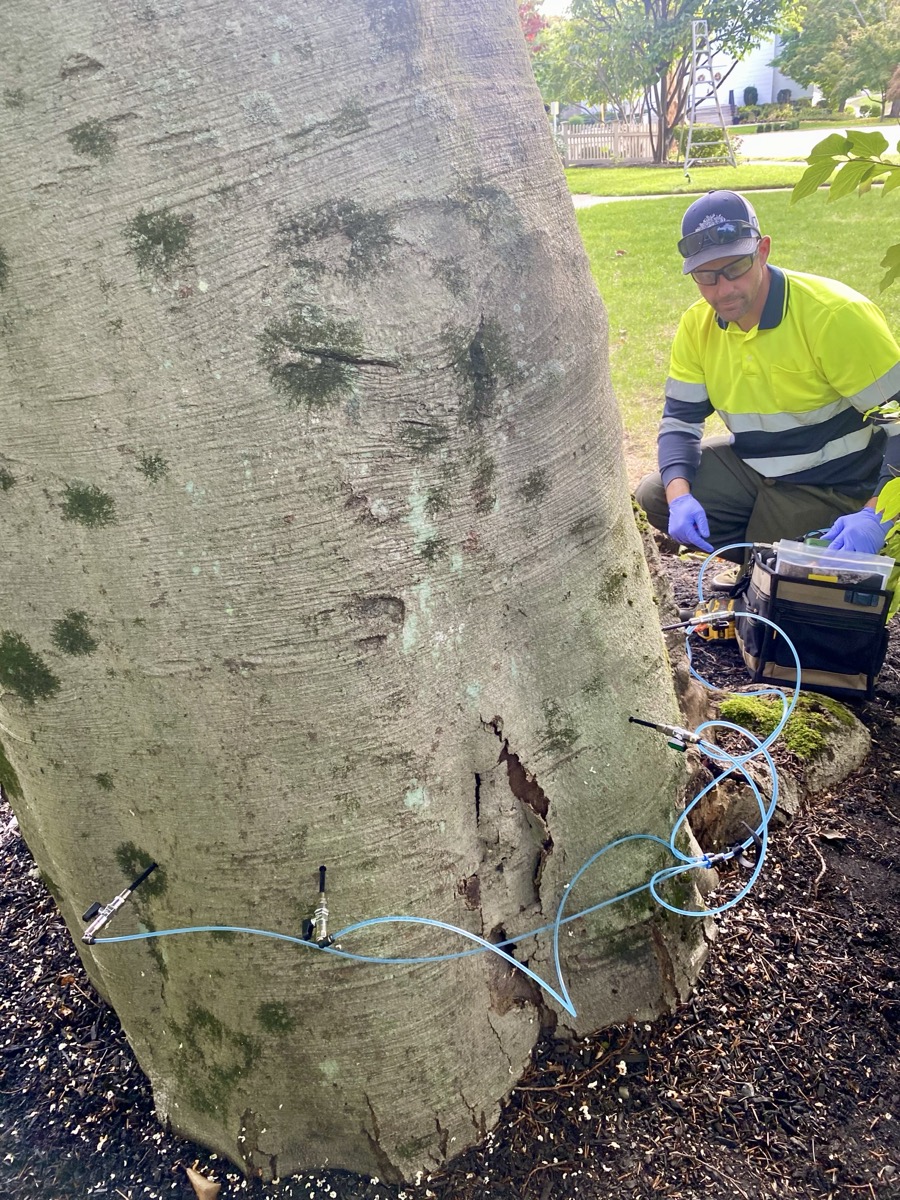
Step 3: Custom Program Design. Based on findings, we craft your plan—e.g., deep root fertilization for nutrient-starved black gums using 3% nitrogen organic blends injected via radial feeding ports. For emerald ash borer threats, we schedule trunk injections with systemic insecticides like imidacloprid, applied via low-pressure drill-and-fill at 8-10 ml per inch DBH.
Step 4: Treatment Application. Our certified technicians use macro-infusion equipment for precise hemlock woolly adelgid management, delivering fluvalinate domicide without soil runoff—vital near Foxborough wetlands. Spongy moth treatments employ BTk aerial sprays or ground injections timed for larval hatch in May-June, targeting defoliation hotspots in Cocasset.
We deploy air spades for soil decompaction around red oaks, loosening 12-18 inches while preserving mycorrhizae. Deep root fertilization follows with hydro-injection guns, placing 2-3 gallons per injection site in a grid pattern matching your tree's drip line. Safety protocols include traffic control in Patriot Place Area and protective barriers, adhering to OSHA and ANSI Z133 standards.
Step 5: Monitoring and Follow-Up. Post-treatment, we install data loggers on high-risk willows to track soil moisture, returning quarterly for your Foxborough property. Apps allow you to upload photos of sweetgum progress, prompting adjustments like micronutrient drenches for chlorosis.
Techniques are Foxborough-specific: In wetland-adjacent Lakeview, we avoid broad-spectrum chemicals, opting for IPM with predatory insects. Equipment like our 500-gallon injection rigs minimizes visits, reducing your disruption. For power line conflicts in older neighborhoods, we integrate crown reduction with health boosts to thicken lower branches.
Practical tip: Time your deep root fertilization for fall (September-October) when Foxborough roots grow actively, absorbing phosphorus for winter hardiness. Our process yields 20-30% vigor improvement in treated red maples, per ISA metrics.
From Plymouth/Cohasset, we serve all South Shore MA efficiently, ensuring your investment in plant health care delivers measurable results—fewer failures, lower long-term costs.
Common Plant Health Care Projects in Foxborough Neighborhoods
In Foxborough Center, plant health care projects focus on Main Street elms and maples replanted by the tree warden. We treat Dutch elm disease with trunk injections of propiconazole, preserving urban canopy while clearing power line interferences.
East Foxborough homeowners request spongy moth management for white pines bordering conservation areas. Our BTk applications reduce defoliation by 85%, followed by deep root fertilization to counter wet soils from nearby streams.
West Foxborough's new developments need selective preservation plans amid lot clearing. For swamp white oaks on construction edges, we apply anti-desiccant sprays and root zone mulching to mitigate transplant shock.
Chestnut Green properties feature aggressive black gums; our crown reduction per ANSI A300 thins tops by 20-25%, paired with soil injections for iron deficiencies common in local clays.
Lakeview's wetland proximity drives willow and red maple leaning issues. We use cabling and deep root injections to stabilize roots, preventing failures during spring thaws.
Payson Road Area sees hemlock woolly adelgid outbreaks along trails. Systemic insecticides via soil drench protect evergreens without wetland impact, monitored via sticky traps.
Cocasset lots require winter moth treatments on sweetgums, with pheromone traps and targeted sprays halting egg hatch. Integrated with fertilization, this restores full leaf-out.
Patriot Place Area, near commercial zones, demands power line pruning plus emerald ash borer prevention for remnant ashes. Our directional pruning maintains clearance while boosting health via mycorrhizal inoculants.
Across neighborhoods, wetland-edge management dominates—selective removal of hazard willows followed by native red oak plantings. Call 508-369-5009 for neighborhood-tailored projects.
Plant Health Care Costs in Foxborough, MA
Plant health care costs in Foxborough MA vary by property size, tree count, and issues, typically $300-$1,200 annually for a 1-acre lot with 10-15 mature trees. Initial assessments cost $150-$250, covering soil tests and diagnostics—essential for wetland soils stressing your red maples.
Deep root fertilization runs $8-$15 per inch DBH; a 20-inch swamp white oak in Chestnut Green costs $160-$300 per session, applied biannually for nutrient uptake in clay loams. Trunk injections for emerald ash borer or hemlock woolly adelgid average $12-$20 per inch DBH ($240-$400 for a 20-inch tree), using low-volume systems that minimize waste.
Spongy moth or winter moth treatments range $200-$500 per property, depending on canopy size—BTk sprays for East Foxborough white pines prove cost-effective at $0.50-$1 per tree vs. defoliation losses exceeding $1,000.
Custom IPM programs for Foxborough Center elms start at $400/year, including quarterly monitoring and targeted apps. Wetland-edge stabilization for Lakeview willows adds $500-$800 for cabling and soil work, preventing $5,000+ removal costs.
Factors influencing price: Tree species (willows cheaper due to size), access (Patriot Place traffic adds 10-15%), and urgency (emergency injections 20% premium). Norfolk County permits rarely apply but factor $50-$100 if needed.
Value proposition: Our programs extend tree life 10-20 years, boosting property values 5-10% per appraisal data—critical in Foxborough's $600K median market. ROI hits 4:1; $600 invested averts $2,400 in replacements.
Practical budgeting: Prioritize high-value red oaks ($1,500+ removal) over willows. Multi-year contracts save 15-20%. Transparent quotes from Southeast Arborist detail line items—no surprises.
Compared to Sharon or Walpole, Foxborough's wetland premiums add 10%, but our South Shore efficiency keeps costs competitive. Invest wisely for lasting tree health.
When to Schedule Plant Health Care in Foxborough
Schedule plant health care in Foxborough MA in early spring (March-April) for soil applications before bud break, targeting winter moth on red maples. Deep root fertilization peaks in fall (September-October) as roots expand ahead of frost.
Summer (June-July) suits spongy moth treatments—larvae peak mid-June in Payson Road Area. Hemlock woolly adelgid injections align with crawler stage in May or dormant-season drenches in January.
Urgency signs demand immediate calls: 25%+ canopy dieback in white pines signals pine tip moth; leaning willows in Lakeview post-rain indicate root rot. Yellowing sweetgums mean chlorosis—schedule within 2 weeks.
Nor'easter damage or construction stress warrants post-event assessments. Annual timing: Assess January, treat April/May, monitor July, fertilize October.
Contact 508-369-5009 now for seasonal slots—early action saves your trees.
Frequently Asked Questions About Plant Health Care in Foxborough
What is plant health care in Foxborough MA? Plant health care encompasses IPM, fertilization, and injections to combat Foxborough-specific issues like wetland root rot in red maples and spongy moth on white pines.
How do I know if my trees need plant health care in East Foxborough? Look for wilting leaves on willows near streams or adelgid fluff on hemlocks—our ISA Arborists confirm via free inspection.
Are Southeast Arborist treatments safe for Foxborough wetlands? Yes, we use targeted, low-drift methods compliant with MA DEP regs, avoiding runoff in Lakeview or Neponset areas.
How much deep root fertilization costs for a Patriot Place red oak? $200-$350 for a 24-inch DBH tree, injected precisely to address clay soil compaction.
When is the best time for emerald ash borer injections in Foxborough? Late spring (May-June) for optimal uptake, protecting remnants near West Foxborough developments.
Does plant health care prevent power line issues in older neighborhoods? Yes, combined with ANSI pruning, it promotes balanced growth in swamp white oaks along Cocasset lines.
Can you treat American elms along Main Street? Absolutely—trunk injections target Dutch elm disease, supporting the tree warden's diverse replanting.
What's the difference between your IPM and chemical sprays? IPM monitors and uses minimal targeted treatments, reducing environmental impact in Chestnut Green conservation zones.
Plant Health Care Throughout Foxborough
Southeast Arborist provides plant health care across Foxborough neighborhoods: Foxborough Center, East Foxborough, West Foxborough, Chestnut Green, Lakeview, Payson Road Area, Cocasset, and Patriot Place Area. We extend to nearby Sharon, Norton, Walpole, and Stoughton from our Plymouth/Cohasset base.
ISA Certified Arborists ensure ANSI-compliant service for your red maples to sweetgums. Call 508-369-5009 today for Foxborough MA plant health care—protect your property now.