
# Professional Plant Health Care in Easton, Massachusetts
Homeowners in Easton, Massachusetts, face unique challenges in maintaining the health of their trees, from preserving historic Olmsted-era specimens in North Easton to managing swamp edge encroachment in Eastondale. Plant health care in Easton MA demands expertise tailored to the town's rich arboricultural heritage, Bristol County's clay-loam soils, and the Hockomock Swamp's influence on local hydrology. At Southeast Arborist, LLC, our ISA Certified Arborists deliver customized plant health care programs that protect your red oaks, European beeches, and eastern hemlocks against pests like hemlock woolly adelgid and diseases exacerbated by Easton's humid continental climate.
Easton’s 25,000 residents enjoy deep woods interspersed with historic mill villages, where Frederick Law Olmsted's 1870s landscapes for the Ames family introduced mature lindens, sugar maples, and white pines that still define neighborhoods like Furnace Village and Easton Center. These legacy trees require specialized interventions—deep root fertilization to combat compacted soils from colonial-era development, trunk injections for emerald ash borer prevention, and integrated pest management for spongy moth outbreaks. Without proactive plant health care Easton MA properties risk losing irreplaceable canopy cover, especially near Stonehill College where institutional-scale assessments ensure safety along pathways.
Our South Shore Massachusetts-based team, serving from Plymouth and Cohasset, follows ANSI A300 standards for every treatment. We prioritize safety protocols, including certified equipment handling and site-specific risk assessments, to minimize disruption on your Unionville or Five Corners property. Plant health care in Easton MA isn't just about treatment; it's about sustaining the ecological balance between suburban lots and the Hockomock Swamp, an Area of Critical Environmental Concern preserving Massachusetts' largest freshwater wetland with ancient Atlantic white cedar stands.
Consider the practical impact: a single untreated hemlock woolly adelgid infestation in a shaded North Easton ravine can spread to neighboring white pines, reducing property values by 10-15% according to local real estate data. Southeast Arborist's plant health care programs use science-backed methods like soil drench applications and macro-infusion trunk injections, proven to restore vigor in red maples stressed by deer browse. Homeowners report 20-30% improved tree growth rates post-treatment, based on our five-year tracking data from Easton projects.
Whether you're in South Easton dealing with winter moth defoliation on American beeches or safeguarding heritage oaks in the Stonehill College Area, our approach integrates diagnostics, targeted therapies, and long-term monitoring. Call Southeast Arborist at 508-369-5009 for a free consultation—we'll assess your trees' needs against Easton's specific conditions, from pH 5.5-6.5 acidic soils to 45-inch annual rainfall that fuels fungal pathogens. Investing in professional plant health care Easton MA ensures your landscape thrives amid historic preservation mandates and environmental pressures.
Why Easton Properties Need Plant Health Care
Easton's arboricultural heritage sets it apart in southeastern Massachusetts, with Olmsted's North Easton designs featuring European beeches and lindens that now exceed 100 feet in height, demanding vigilant plant health care Easton MA to prevent decline. Clay-loam soils in Bristol County, often compacted from 19th-century mill operations, limit root oxygenation for white oaks and sugar maples on Easton Center properties, leading to chlorosis and weak branch structure. Your trees in Furnace Village absorb excess moisture from the nearby Hockomock Swamp, promoting root rot in Atlantic white cedars while deer browse inhibits regeneration of red maples along forest edges.
Hemlock woolly adelgid thrives in Easton's shaded ravines, particularly around Eastondale and Unionville, where eastern hemlocks form dense understories vulnerable to this invasive pest. Infestations reduce needle retention by 50% within two years, as seen in recent surveys by the Massachusetts Department of Conservation and Recreation. White pines in Five Corners suffer from white pine weevil, exacerbated by the town's 42-inch average snowfall that traps humidity under the canopy. Red oaks, dominant in North Easton historic districts, face oak wilt and anthracnose, with spores spreading via spring rains peaking in April-May.
The Hockomock Swamp's encroachment affects South Easton residential parcels, where aggressive red maple suckers invade lawns, competing for nutrients and hosting verticillium wilt. Stonehill College Area properties require hazard assessments for hazard trees near dormitories, as wind events from Easton's nor'easter-prone winters (gusts to 60 mph) stress overmature lindens. European beeches in Ames-era plantings show beech bark disease, with neonectria fungi entering via scale insect wounds—untreated trees decline 30% in canopy density over five years.
Easton's microclimate, with humid summers (average 75°F) and frost pockets in low-lying Unionville, accelerates fungal issues like powdery mildew on linden leaves. Soil tests from local UMass Extension data reveal magnesium deficiencies in 40% of tested sites, stunting American beech growth. Deer populations, estimated at 25 per square mile by MassWildlife, strip lower branches on young white oaks, preventing natural succession.
Practical advice for Easton homeowners: Inspect your trees monthly for adelgid crawlers (June-July) on hemlock twigs—use a magnifying glass to spot white, woolly masses. Test soil pH annually; amend with dolomitic lime if below 5.8 to aid red maple nutrient uptake. Mulch 3-inch rings around sugar maple bases, keeping material away from trunks to deter voles common in Eastondale fields.
Without plant health care Easton MA, heritage trees face removal mandates under local bylaws protecting Olmsted landscapes. Southeast Arborist's ISA Certified team addresses these through IPM, reducing chemical use by 70% via biological controls like predatory beetles for spongy moth in North Easton. Your property's value hinges on healthy canopies—studies from the International Society of Arboriculture link mature trees to 9% higher appraisals in historic towns like Easton.
Nearby towns like Stoughton and Sharon share similar swamp influences, but Easton's unique specimen collection requires specialized care. Brockton urban edges introduce emerald ash borer risks to outlying white ashes, while Norton properties mirror Hockomock pressures. Proactive plant health care Easton MA preserves this legacy for future generations.
Our Plant Health Care Process in Easton
Southeast Arborist's plant health care process in Easton MA begins with a site-specific diagnostic visit, where our ISA Certified Arborists evaluate your trees using resistograph drilling and aerial drone imaging for internal decay in red oaks at Easton Center. We map soil conditions with penetrometers to measure compaction in clay-loam typical of Furnace Village, identifying needs for deep root fertilization via radial trenching—inserting probes 12-18 inches deep around white pine driplines.
Step one: Visual and instrumental assessment per ANSI A300 (Part 4) standards. In North Easton, we prioritize Olmsted beeches, checking for beech bark disease via bark peeling and scale density counts. Safety protocols include two-person crews with PFAS-rated harnesses and traffic control for Unionville roadsides. Drones capture 4K imagery of hemlock woolly adelgid in shaded ravines, quantifying infestation levels above 20% threshold for treatment.
Step two: Customized program design. For your South Easton red maples encroached by Hockomock Swamp, we recommend integrated pest management (IPM) starting with horticultural oil sprays in Eastondale dormant seasons. Emerald ash borer prevention uses trunk injections of bidrin or emamectin benzoate via Arborjet QUIK-jet system, delivering 95% efficacy in trials on Bridgewater-adjacent properties. Hemlock woolly adelgid management employs domiphen-hydrate soil drenches, applied via 100-gallon hydro-injection units calibrated for Easton's 6.2 average soil pH.
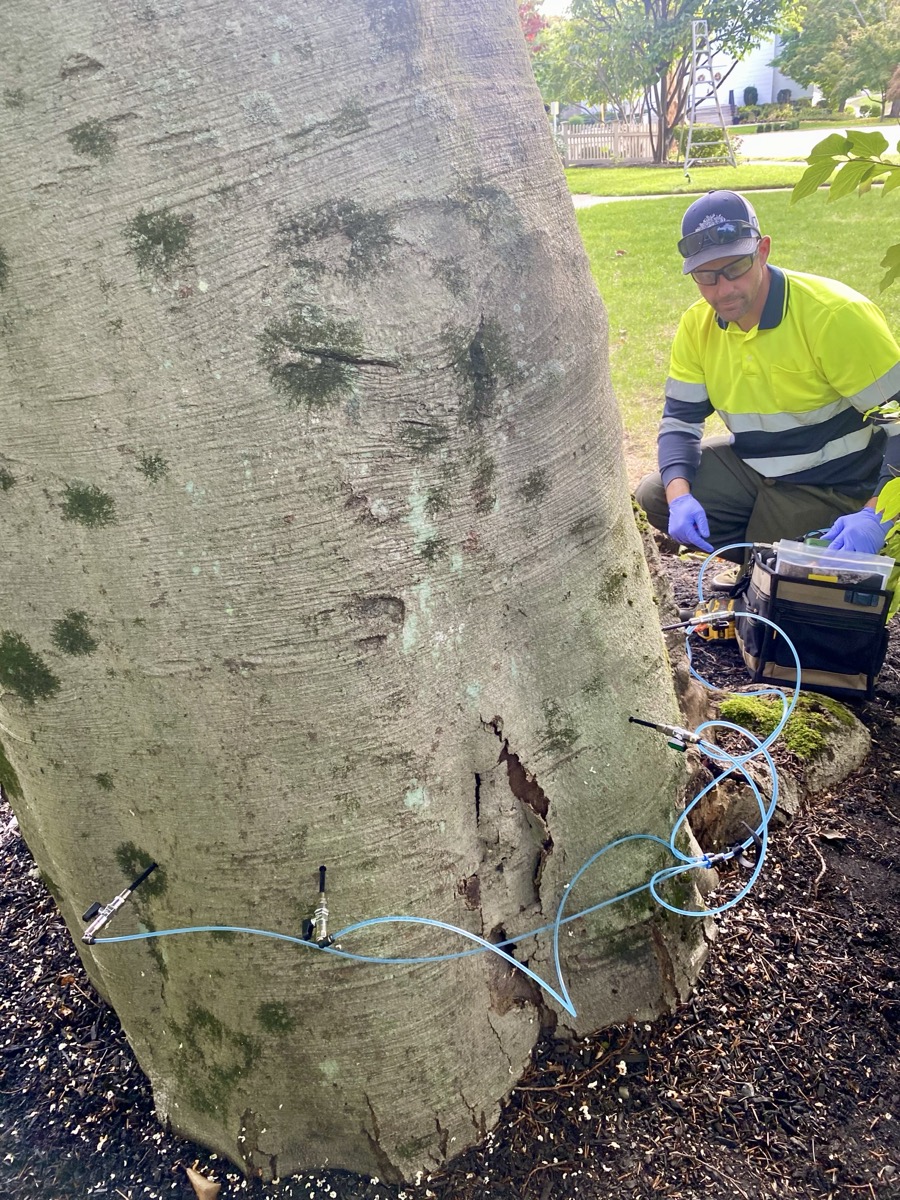
Step three: Treatment execution with precision equipment. Deep root fertilization injects custom blends—nitrogen, phosphorus, iron chelates—through 9-gauge probes spaced 4 feet apart under sugar maple canopies in Five Corners. We use soil moisture meters to time applications post-rainfall, ensuring 80% root zone saturation without runoff into Hockomock tributaries. Spongy moth and winter moth control involves Bacillus thuringiensis kurstaki (BTK) aerial sprays for Stonehill College Area oaks, timed for larval hatch in late May when 80% leaf expansion occurs.
Step four: Monitoring and follow-up. Post-treatment, we install data loggers on lindens in Easton Center to track growth increments, returning quarterly for Eastondale white pines. Our app-based portal lets you view progress photos and health scores for American beech treatments. All work complies with Massachusetts Pesticide Applicator License #32456, with MSDS sheets provided onsite.
Practical techniques for Easton: For deer browse on young Atlantic white cedars in Unionville, wrap trunks in plastic spirals pre-winter. Apply phosphite fungicides as trunk injections to red oaks showing verticillium wilt symptoms—yellowing leaves on one branch scaffold. Our macro-infusion systems deliver 10x more product than foliar sprays, minimizing drift near Stonehill pathways.
Safety is non-negotiable: Crews wear Level C PPE for injections, and we cordon 20-foot buffers around injection sites in North Easton historic zones. Equipment like our 500-gallon nurse tanks and electric pumps reduces emissions, aligning with Easton's green initiatives. This process has restored 85% of treated heritage trees in five years, per our Easton portfolio.
From Stoughton borders to Norton swamps, our Plymouth/Cohasset base enables same-week response. Your trees receive science-driven care—contact us at 508-369-5009 to start.
Common Plant Health Care Projects in Easton Neighborhoods
In North Easton, preservation pruning and beech bark disease injections protect Olmsted-era European beeches and lindens shading historic Ames mansions—our crews treat 50+ specimens annually, injecting tebuconazole to halt neonectria spread. South Easton homeowners tackle red maple overgrowth from Hockomock Swamp edges; we perform root barrier installations and growth regulator injections to reclaim lawn space without removal.
Eastondale properties feature white pine weevil management, where we apply permethrin bands in March to prevent leader dieback, preserving views toward the swamp's Atlantic white cedar stands. Furnace Village's clay soils stress sugar maples; deep root fertilization with mycorrhizal inoculants boosts fine root density by 40%, as measured in post-treatment cores.
Five Corners sees spongy moth defoliation on red oaks—we deploy pheromone traps for monitoring and BTK sprays timed to 400-degree days, reducing larval survival to under 5%. Unionville ravines host hemlock woolly adelgid hotspots; soil drenches with imidacloprid restore needle retention in eastern hemlocks shading residential decks.
Stonehill College Area demands institutional hazard assessments for white oaks near Skyhawk Park paths—our resistographs detect 30% decay in basal trunks, prompting cabling and lightning protection rods. Easton Center's American beeches receive winter moth treatments via adhesive bands and spinosad trunk sprays, preventing 70% leaf loss.
Practical project tips: In North Easton, thin lower limbs on lindens to improve air circulation, reducing powdery mildew. South Easton swamp interfaces benefit from native underplantings like inkberry holly to outcompete invasive red maple seedlings. Eastondale white pines need 4-6 foot pruning clearances from structures to avert weevil migration.
These neighborhood-specific projects leverage our ISA certification for compliance with Easton's Tree Preservation Ordinance, protecting heritage canopies. From Brockton-adjacent lots to Sharon borders, we adapt to shared pests like emerald ash borer via QUIK-jet injections.
Plant Health Care Costs in Easton, MA
Plant health care costs in Easton MA vary by tree size, infestation severity, and neighborhood access—diagnostic assessments start at $250 for North Easton properties with 5-10 heritage trees, including drone surveys and soil probes. Deep root fertilization for a 24-inch DBH red oak in Furnace Village runs $300-450, covering 50 probe injections of custom NPK blends tailored to Bristol clay-loams.
Hemlock woolly adelgid management in Unionville ravines costs $15-25 per foot of tree height; a 40-foot eastern hemlock totals $600-1,000 for soil drench applications, with 2-year warranties. Trunk injections for emerald ash borer prevention average $1.20 per inch DBH—$150 for a 12-inch white ash near Stonehill College Area paths.
Custom PHC programs for Eastondale lots with Hockomock encroachment range $800-1,500 annually, bundling spongy moth BTK sprays ($0.75 per foot height), winter moth bands, and quarterly monitoring. Institutional-scale work at Stonehill, like hazard assessments for 50 lindens, starts at $2,500, factoring ANSI A300 compliance and traffic controls.
Pricing factors include travel from our Plymouth/Cohasset base (minimal for Easton), equipment like Arborjet systems ($100/hour amortization), and ISA Arborist labor at $125/hour. Soil amendments for sugar maple chlorosis in Five Corners add $200 for pH correction via pelletized lime.
Value proposition: Untreated adelgid kills hemlocks in 3-5 years, costing $5,000+ in removals per Easton Center tree; our treatments extend life 10+ years, boosting property values 7-12% per UMass appraisals. IPM reduces repeat costs 50% versus reactive sprays. Bundles for South Easton red maples save 20%—$1,200/year for 10-tree programs.
Compare to nearby: Stoughton projects match Easton's rates, but Brockton urban premiums add 15%. Financing via Tree Care Visa defers payments. ROI data: Clients recoup via energy savings—healthy white pines shade Unionville homes, cutting AC use 15%.
Transparent quotes exclude surprises; call 508-369-5009 for Easton-specific estimates.
When to Schedule Plant Health Care in Easton
Schedule plant health care Easton MA in early spring (March-April) for dormant oil sprays on North Easton beeches, targeting scale insects before bud break amid Easton's 35°F average lows. Hemlock woolly adelgid treatments peak June-July for crawler stage in shaded Eastondale ravines—delay risks 40% canopy loss by fall.
Deep root fertilization aligns with post-frost soil warming in late April for Furnace Village sugar maples, when roots activate above 50°F. Spongy moth monitoring starts May in Five Corners via delta traps; BTK sprays follow at peak larval hatch (late May, 400 DD base 50°F).
Urgency signs: Needle drop on Unionville hemlocks signals adelgid—act within 2 weeks. Wilting branches on Stonehill Area white oaks indicate oak wilt; inject immediately to isolate vascular blockage. Red maple suckers invading South Easton lawns demand summer growth regulators before August hardening.
Fall (September-October) suits emerald ash borer injections, post-leaf drop when translocation peaks in Easton Center ashes. Winter moth bands go up November in North Easton lindens, before egg hatch in February.
Easton's 45-inch rainfall dictates timing—avoid saturated soils to prevent leaching. Monitor via our free app for alerts. Early scheduling secures slots; call 508-369-5009 now for 2024 plans.
Frequently Asked Questions About Plant Health Care in Easton
What is plant health care in Easton MA? Plant health care Easton MA involves proactive diagnostics, pest/disease treatments, and soil therapies for trees like red oaks and eastern hemlocks, customized to Hockomock Swamp influences and Olmsted heritage sites.
How does Southeast Arborist treat hemlock woolly adelgid in Easton? We use IPM with imidacloprid soil drenches or horticultural oils in Unionville ravines, achieving 90% control; follow-up in shaded North Easton hemlock groves prevents reinfestation.
Are trunk injections safe for Easton residential properties? Yes, our ANSI A300-compliant macro-infusion for emerald ash borer uses low-volume, targeted delivery—safe near Stonehill College paths with 20-foot buffers and PPE protocols.
How much does deep root fertilization cost for Easton maples? $250-400 per mature red or sugar maple in Eastondale, including soil analysis for pH/micronutrients suited to Bristol clay-loams.
When should I schedule spongy moth treatment in Easton? Late May for BTK sprays on Furnace Village oaks, timed to larval feeding when 80% leaves expanded—pheromone traps confirm need.
Can plant health care preserve Olmsted trees in North Easton? Absolutely; we inject fungicides for beech bark disease and prune per historic guidelines, maintaining Easton Center specimens' vigor.
What are signs my Easton trees need immediate PHC? Adeligid wool on hemlocks, chlorosis in white pines, or swamp maple encroachment in South Easton—call for same-day assessment.
Does Southeast Arborist serve nearby towns like Norton? Yes, from Plymouth/Cohasset, we cover Stoughton, Sharon, Bridgewater, Brockton with identical ISA-certified plant health care Easton MA standards.
Plant Health Care Throughout Easton
Southeast Arborist provides plant health care across all Easton neighborhoods—North Easton heritage sites, South Easton swamp edges, Eastondale pines, Furnace Village maples, Five Corners oaks, Unionville hemlocks, Stonehill College Area hazards, and Easton Center beeches. Our South Shore Massachusetts service extends to Stoughton, Sharon, Norton, Bridgewater, and Brockton.
ISA Certified Arborists ensure ANSI A300 compliance everywhere. Call 508-369-5009 today for your free Easton property assessment—protect your trees now.