
# Professional Plant Health Care in Duxbury, Massachusetts
Homeowners in Duxbury, Massachusetts, face unique challenges when maintaining the health of trees on their large coastal properties. With its affluent estates, protected salt marshes, and historic landscapes, Duxbury demands specialized plant health care services that address salt stress, storm damage, and invasive pests. Southeast Arborist, LLC, based in Plymouth and Cohasset, delivers ISA-certified plant health care in Duxbury, MA, tailored to your waterfront lots and wooded acres. Our programs protect white oaks, red oaks, Eastern hemlocks, and other species prevalent in Plymouth County from threats like hemlock woolly adelgid and emerald ash borer.
Plant health care in Duxbury MA goes beyond basic pruning—it's a comprehensive strategy involving deep root fertilization, trunk injections, and integrated pest management (IPM). As ISA Certified Arborists, we follow ANSI A300 standards to ensure treatments enhance tree vigor without harming the environment. Your property in neighborhoods like Duxbury Center or Snug Harbor likely includes mature trees shaped by four centuries of Pilgrim-era settlement and modern conservation rules. These trees endure coastal winds, brackish soils, and proximity to Duxbury Bay, which weaken root systems and invite diseases.
Consider the impacts of past storms: the 1991 Halloween Nor'easter felled countless white pines along Duxbury Beach, while the 2013 blizzard stressed beeches in Millbrook. Today, spongy moth outbreaks defoliate oaks in Tarkiln, and winter moth caterpillars threaten Island Creek hardwoods. Southeast Arborist's plant health care programs counteract these issues with site-specific diagnostics. We assess soil pH—often acidic in Duxbury's glacial till—and nutrient deficiencies common in salt-influenced zones near Standish Shore.
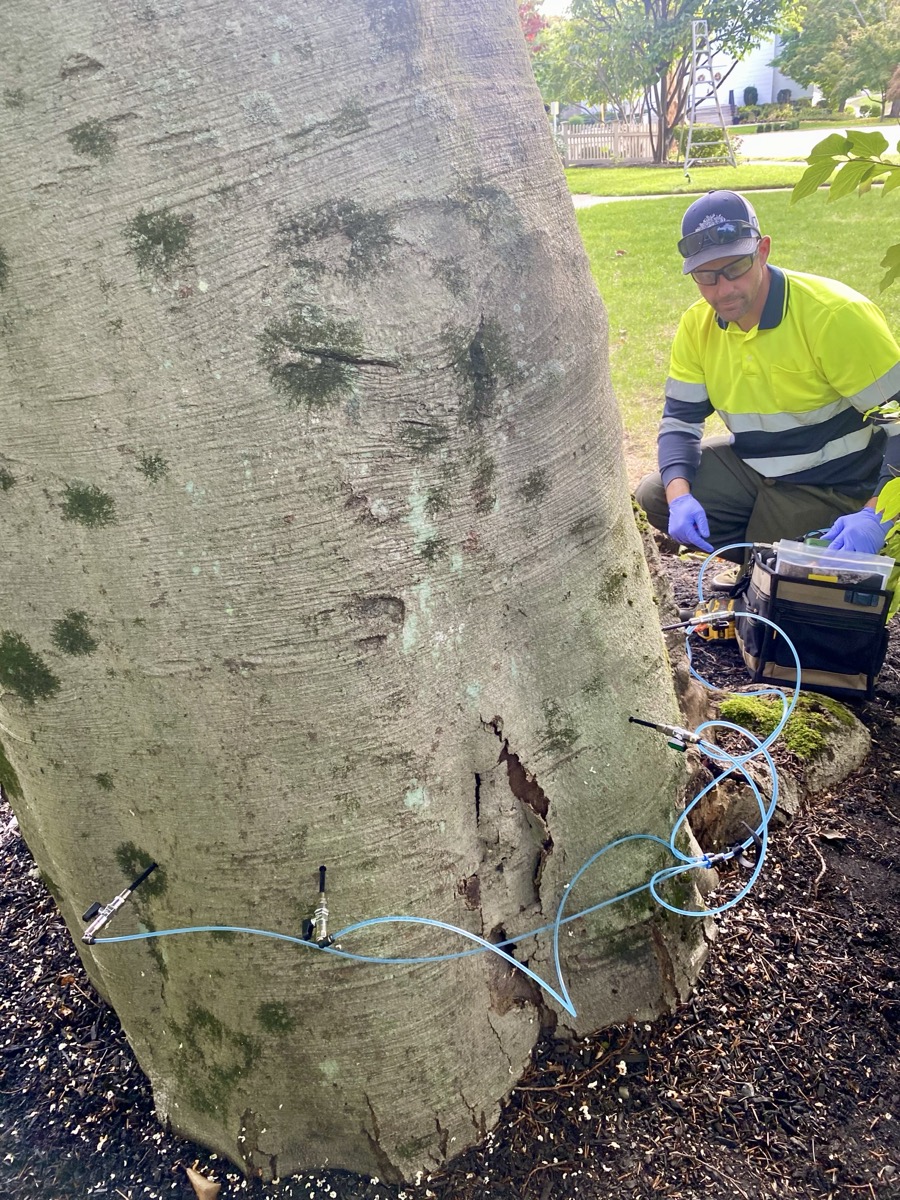
Our approach starts with a property walk-through, identifying stressors like compacted soil from foot traffic or construction in Hall's Corner. We then deploy treatments such as macro-infusion trunk injections for precise pesticide delivery, minimizing drift over your marshes. Deep root fertilization uses high-pressure injection to deliver nitrogen, phosphorus, and micronutrients directly to feeder roots, bypassing salty surface layers. For hemlocks in South Duxbury, we apply dormant-season imidacloprid treatments targeting woolly adelgid.
Duxbury's conservation restrictions limit removals, making proactive care essential to preserve views while complying with local bylaws. Estate owners rely on our multi-year PHC contracts for ongoing monitoring, reducing long-term costs by preventing decline. Safety protocols include TCIA accreditation standards, with arborists using personal protective equipment and calibrated gear to protect your family and pets.
If your white pine in Duxbury Center shows needle yellowing or your red oak in Snug Harbor has dieback, plant health care in Duxbury MA from Southeast Arborist restores vitality. Call our ISA Certified Arborists at 508-369-5009 for a free assessment. Serving the South Shore from Plymouth County, we ensure your trees thrive amid Duxbury's coastal climate—average winter lows of 20°F, summer highs of 80°F, and 45 inches of annual rainfall that can foster fungal pathogens.
This expertise positions Southeast Arborist as your partner in sustaining Duxbury's tree canopy, from Miles Standish State Forest edges to private waterfronts.
Why Duxbury Properties Need Plant Health Care
Duxbury's coastal location in Plymouth County exposes trees to salt spray from Duxbury Bay and the Atlantic, stressing root systems on properties in Snug Harbor and Duxbury Beach. White oaks and red oaks, dominant in Duxbury Center, absorb sodium chloride through leaves and roots, leading to chlorosis—yellowing between veins. Without plant health care in Duxbury MA, these symptoms progress to branch dieback, especially on large estates where trees exceed 100 feet tall.
Soil conditions amplify vulnerabilities: Duxbury's sandy loam and glacial outwash retain salt but drain poorly during 50-inch annual rains, causing root rot in American beeches near Millbrook meadows. Eastern hemlocks in Tarkiln suffer from woolly adelgid, an invasive pest that sucks sap and coats branches with white wool, thriving in the town's humid summers (70-90% relative humidity). Pitch pines in Island Creek face pitch pine tip moth, while white pines along Standish Shore battle white pine weevil, exacerbated by coastal winds gusting to 50 mph.
Historic context matters—Duxbury's town green preserves colonial elms, but nearby white pines and oaks trace to 17th-century plantings, now weakened by four centuries of activity. Miles Standish State Forest, bordering South Duxbury, holds the South Shore's largest pine-oak stands, but emerald ash borer threatens any ash intermingled. The 1991 Nor'easter snapped trunks in Hall's Corner, and 2013's Nemo blizzard buried roots under 30 inches of snow, compacting soil and inviting Armillaria root rot.
Conservation bylaws restrict removals near protected marshes, forcing reliance on plant health care to maintain vistas. Homeowners in South Duxbury balance tree health with water views, where excessive salt marsh proximity causes tupelo and holly decline. Spongy moth (formerly gypsy moth) defoliates 50-100% of oak canopy in outbreak years, as seen in Pembroke-adjacent lots; winter moth webs buds on maples and beeches in Norwell borders.
Climate shifts worsen issues: warmer winters (up 3°F since 1970) extend pest cycles, with hemlock woolly adelgid surviving to elevations over 1,000 feet in nearby Marshfield. Fungal diseases like anthracnose hit sycamores post-wet springs, while beech bark disease scars American beeches in Millbrook. Your property's microclimate—foggy mornings in Duxbury Beach or frosty inland pockets in Tarkiln—dictates custom PHC.
Practical advice: Inspect trunks for cankers and roots for girdling. Test soil salinity (aim for under 2 mmhos/cm) via local extension services. Mulch 3 inches deep around bases, keeping it 6 inches from trunks to deter rodents in oak-heavy yards. Thin dense canopies in white pine stands to improve airflow, reducing needlecast fungi.
Southeast Arborist's ISA Certified Arborists diagnose via resistograph testing for internal decay in red oaks and soil core sampling for nematodes affecting holly. IPM prioritizes biological controls, like Bt kurstaki sprays for spongy moth larvae timed to egg hatch in May. Untreated, a single hemlock infestation spreads to neighbors, violating Duxbury's tree ordinance.
Plant health care in Duxbury MA prevents hazardous failures near homes, especially post-storm in waterfront areas. Your investment yields resilient landscapes enduring coastal storms.
Our Plant Health Care Process in Duxbury
Southeast Arborist's plant health care process in Duxbury MA begins with a certified site assessment by ISA arborists, evaluating your trees against ANSI A300 standards. We arrive with diagnostic tools like increment borers for white oaks in Duxbury Center and Soil Nutrient Analyzers for salty soils in Snug Harbor, mapping stressors on digital plats.
Step one: Visual inspection identifies symptoms—adelgid wool on Eastern hemlocks in Millbrook or spongy moth frass under red oaks in Tarkiln. We use 40x hand lenses and anemometers to measure wind exposure on Island Creek pitches, noting pitch pine decline.
Step two: Soil and tissue analysis. Deep root probes extract cores from 18-24 inches, testing pH (Duxbury average 5.2-6.0) and cations. Foliar samples from American beeches reveal magnesium deficiencies common near marshes. Lab results guide custom blends.
Step three: Risk assessment per ISA Best Management Practices. Resistographs detect decay in tupelo trunks near Standish Shore; sonic tomography scans large white pines in Hall's Corner for hollows. Hazard trees near homes get priority.
Step four: Treatment planning with IPM. For emerald ash borer, we schedule macro-infusion trunk injections using Arborjet QUIK-jet equipment—drilling 1mm ports and pressurizing insecticides like azadirachtin to 200 psi, reaching 90% canopy uptake without foliar sprayover bays.
Deep root fertilization employs Vermeer root feeders, injecting 500-2,000 gallons of liquid fertilizer (20-4-8 NPK with mycorrhizae) radially at drip lines. This counters compaction from Duxbury Beach foot traffic, boosting feeder root growth in white pines.
Hemlock woolly adelgid management uses soil drench or basal trunk sprays of dinotefuran in March, when crawlers emerge, achieving 95% control. Spongy moth treatments apply Bacillus thuringiensis in late May, targeting 1-inch larvae on oaks before defoliation peaks.
Step five: Implementation with safety protocols. Arborists wear ANSI Z133-compliant harnesses and use insulated injection guns. Ground crews deploy 4x4 trucks with 300-gallon tanks for Millbrook estates. We contain runoff with berms near protected wetlands.
Monitoring follows: Quarterly apps track growth via dendrometers on beeches, with annual reports detailing metrics like leaf area index. Adjustments combat resistance, rotating modes of action per IRAC guidelines.
Equipment specifics: Silvan SelectSpray for precise winter moth emulsions in South Duxbury; Chemjet Tree Injectors for organic phosphite fungicides against Phytophthora in holly. All calibrated daily for efficacy.
For post-storm recovery in Duxbury Beach, we apply stress tabs—slow-release nutrients buried 12 inches deep—and mycorrhizal inoculants to rebuild roots after Nor'easter-like events.
Homeowner tips: Water deeply during July droughts (1 inch/week), avoiding sprinklers that salt foliage. Scout for winter moth eggs (silvery scales on twigs) in November. Companion plant nitrogen-fixers like clover under young oaks.
Our process ensures compliance with Duxbury Conservation Commission rules, documenting treatments for permits. Southeast Arborist's 20+ years serving South Shore properties guarantee results—trees gain 20-30% vigor post-program.
Contact us at 508-369-5009 to initiate your Duxbury plant health care plan.
Common Plant Health Care Projects in Duxbury Neighborhoods
In Duxbury Center, estate-scale PHC manages 50+ white oaks and beeches around historic homes. We implement annual deep root fertilization and spongy moth Bt sprays, preserving the town green's colonial legacy while preventing defoliation.
Snug Harbor waterfront lots require salt mitigation for red oaks exposed to bay spray. Our projects include chelated iron injections and vista pruning, maintaining water views without removals banned by marsh buffers.
Millbrook properties feature American beech groves stressed by bark disease. Trunk injections of thiabendazole halt spread, paired with sanitation of fallen beechmast to break fungal cycles.
Tarkiln's inland woods host pitch pine stands battling tip moths. We apply systemic insecticides via root flare drench, monitored by pheromone traps, restoring cone production.
Island Creek farms and homes need emerald ash borer prevention. Macro-injections protect remnant ashes near Kingston borders, using emamectin benzoate for two-year residual.
South Duxbury estates bordering Miles Standish State Forest undergo hemlock woolly adelgid programs. Dormant imidacloprid treatments save 80-foot specimens, with follow-up scouting.
Duxbury Beach faces storm recovery: post-Nemo, we fertilized white pines with potassium boosts for needle retention, using air-spade excavation to relieve compacted sand.
Standish Shore's tupelo in swamp edges get Phytophthora root rot treatments—phosphorous acid injections improve flood tolerance in brackish zones.
Hall's Corner developments involve holly hedges with scale infestations. Horticultural oil dormant sprays control without impacting pollinators.
Common across neighborhoods: multi-year contracts with biannual inspections, hazard mitigation for trees over structures, and IPM for winter moth in maples. Vista pruning in Snug Harbor thins lower limbs on white pines, enhancing Bay panoramas per conservation approvals.
Southeast Arborist's ISA arborists document each project with photos and metrics, aiding insurance claims after Marshfield-sourced winds. Your neighborhood's project yields healthier canopies, higher property values.
Plant Health Care Costs in Duxbury, MA
Plant health care costs in Duxbury MA vary by property scale, tree count, and issues. A basic assessment for a Duxbury Center lot with 10 oaks runs $250-$400, including soil tests and diagnostics. Custom annual programs for 1-2 acre estates average $1,500-$4,000/year, covering four visits.
Factors driving costs: Tree size—DBH over 24 inches adds 20% for injection ports. Neighborhood access: Duxbury Beach requires tidal-aware scheduling, increasing fuel 15%. Pest type: Hemlock woolly adelgid soil drench costs $15-25/tree; emerald ash borer injections $20-40/tree.
Deep root fertilization: $4-8 per injection point (24-48 points/acre), totaling $1,200 for Millbrook meadows. Spongy moth aerial Bt: $300/acre via mistblower. Trunk injections scale by volume—$500 for five large red oaks in Tarkiln.
Value proposition: Untreated spongy moth defoliation costs $5,000+ in oak replacement; PHC saves 60% long-term. ISA certification ensures ANSI compliance, reducing liability—insured arborists prevent $50K claims from failures.
Multi-year discounts: 10-20% off for three-year contracts in Island Creek, bundling fertilization and IPM. Compared to Marshfield or Pembroke, Duxbury premiums (10%) reflect conservation permitting and marsh logistics.
ROI examples: Snug Harbor hemlock program ($2,000/year) preserves $100K landscape value. Post-storm recovery in Standish Shore ($3,500) averts full removals at $2K/tree.
Budget tips: Prioritize hazards near homes (20% of budget). Group treatments—fall adelgid with winter moth. Tax deductions via conservation easements cover 30-50%.
Off-season savings: Schedule January diagnostics at reduced rates. Southeast Arborist provides line-item quotes, no surprises.
Investing in plant health care in Duxbury MA yields durable trees, compliance, and curb appeal for your affluent property. Call 508-369-5009 for a cost analysis.
When to Schedule Plant Health Care in Duxbury
Schedule plant health care in Duxbury MA in early spring (March-April) for hemlock woolly adelgid drenches before bud break. Deep root fertilization aligns with April soil thaw, when roots activate amid 45°F soils.
Summer (June-July) targets spongy moth larvae peaks; scout egg masses in February for preemptive Bt. Winter moth treatments hit in December-January dormant sprays.
Fall (September-October) suits emerald ash borer injections and beech scale control, leveraging sap flow before leaf drop.
Urgency signs: 25% canopy thinning in white oaks signals salt stress—act within weeks. White wool on hemlocks demands immediate intervention to save trees. Yellowing needles on pitch pines indicate weevil; schedule post-July flights.
Post-storm: Within 72 hours after Nor'easters, assess for root plate upheaval in Duxbury Beach white pines.
Annual timing: Multi-year clients book January for Q2 starts, avoiding peak leaf-on costs.
Monitor Duxbury's microclimates—fog delays in Snug Harbor extend spray windows. Call 508-369-5009 for timely slots.
Frequently Asked Questions About Plant Health Care in Duxbury
**What is plant health care in Duxbury MA?** It's a proactive program including pest control, fertilization, and disease management for trees like red oaks and Eastern hemlocks, customized to coastal stresses in neighborhoods like Millbrook.
**How do I know if my Duxbury trees need PHC?** Look for dieback, pests (woolly adelgid fluff), or soil salt crusting. ISA arborists confirm via borers and tests.
**Are treatments safe for my family's pets in Snug Harbor?** Yes, IPM uses targeted injections minimizing residues. We follow label rates and pet-safe intervals.
**How effective is hemlock woolly adelgid treatment in Tarkiln?** 95% control with imidacloprid; repeat annually for Duxbury's humid conditions.
**What's the difference between foliar sprays and trunk injections?** Injections deliver 10x more active ingredient systemically, ideal for Island Creek ashes vs. sprays washing off in rain.
**Can PHC help maintain water views in Duxbury Beach?** Yes, combined with selective pruning, it thins stressed white pines without full removal.
**How often should I fertilize trees in South Duxbury?** Annually via deep root for nutrient-poor marsh soils; biennially for vigorous stands.
**Does insurance cover PHC after storms like 2013 Nemo?** Often yes for documented hazards; our reports support claims in Hall's Corner.
**What about organic options for holly in Standish Shore?** We offer neem oil and compost teas alongside IPM for scale.
Plant Health Care Throughout Duxbury
Southeast Arborist provides plant health care across Duxbury neighborhoods: Duxbury Center estates, Snug Harbor waterfronts, Millbrook groves, Tarkiln pines, Island Creek hardwoods, South Duxbury forests, Duxbury Beach dunes, Standish Shore swamps, and Hall's Corner homes. We extend to nearby Marshfield, Pembroke, Kingston, and Norwell.
From Plymouth/Cohasset bases, our South Shore team reaches Duxbury 02332 swiftly. ISA Certified Arborists ensure ANSI-compliant care.
Protect your trees—call 508-369-5009 today for Duxbury plant health care.