
# Professional Plant Health Care in Canton, Massachusetts
Homeowners in Canton, Massachusetts, face unique challenges with their trees due to the town's proximity to the Blue Hills Reservation and its suburban development on former farmland. Plant health care in Canton MA directly addresses these issues, preventing decline in species like red oak, white oak, chestnut oak, shagbark hickory, and eastern hemlock that define local landscapes. Southeast Arborist, LLC, an ISA Certified arborist service based in Plymouth and Cohasset, delivers customized plant health care programs across South Shore Massachusetts, including Norfolk County's Canton (02021).
Your property's trees endure specific stressors here: the forest-residential interface along Blue Hills edges exposes homes in Ponkapoag and Pecunit to leaning hazard trees from mature reservation stands. Aging shade canopies over historic streets in Canton Center and Canton Junction, planted in the early 20th century, now suffer from ice storm damage on hilltops and pest infestations like hemlock woolly adelgid. Our plant health care services—pest management, disease treatment, deep root fertilization, and trunk injections—follow ANSI A300 standards to restore vigor without unnecessary removal.
Canton’s 24,000 residents benefit from our integrated pest management (IPM) approach, which minimizes chemical use while targeting threats like spongy moth, winter moth, and emerald ash borer. For instance, trunk injections protect ash trees near Reservoir Pond Area, where moist soils exacerbate borer vulnerability. Deep root fertilization counters nutrient deficiencies in the town's acidic, rocky Norfolk County soils, common under white pine and sugar maple along Washington Street.
Safety protocols guide every job: our team uses certified equipment and assesses risks per ISA Best Management Practices, especially on Canton's hilly terrain prone to windthrow. Properties bordering Blue Hills in Knollwood or Springdale often require structural pruning of American beech and tulip trees to reduce failure points. Call Southeast Arborist at 508-369-5009 for a site-specific plant health care plan that extends tree lifespan, enhances property value, and complies with local regulations.
This comprehensive guide details why plant health care Canton MA is essential, our process, neighborhood applications, costs, timing, and FAQs. Whether your oaks in Canton Corner show dieback or hemlocks in Ponkapoag decline from woolly adelgid, proactive care prevents costly failures. Our ISA Certified Arborists have served South Shore properties for years, delivering measurable results like 30-50% improved canopy density post-treatment.
Why Canton Properties Need Plant Health Care
Canton’s landscape, shaped by Blue Hills Reservation protection since 1893, features old-growth chestnut oak and shagbark hickory stands that spill into residential edges, creating hazards for your property. In neighborhoods like Ponkapoag and Knollwood, forest trees lean toward homes during high winds, a risk amplified by Canton's hilly topography in Norfolk County. Ice storms, frequent due to the area's elevation near Blue Hills' 635-foot peaks, snap branches on white pine and eastern hemlock, especially on exposed hilltops in Pecunit and Reservoir Pond Area.
Aging canopies from mid-20th-century farmland conversions dominate Canton Center and Canton Junction along Washington and Pleasant Streets. Red oaks and white oaks, planted as shade trees then, now exceed 60-80 years, showing codominant stems prone to splitting. Sugar maples and tulip trees in Springdale suffer chlorosis from compacted, low-nutrient soils—typical of Norfolk loams with pH 4.5-6.0—leading to weak root systems vulnerable to drought despite average 45-inch annual rainfall.
Pest pressures intensify needs for plant health care Canton MA. Hemlock woolly adelgid ravages eastern hemlocks adjacent to Blue Hills stands, defoliating trees in Canton Corner and Ponkapoag within 3-5 years untreated. Spongy moth outbreaks defoliate oaks across Canton Junction, while winter moth caterpillars target maples in Knollwood. Emerald ash borer threatens any ash near Stoughton borders, though less common, with larvae girdling trunks in moist Reservoir Pond soils.
Local climate—Zone 6b with 180 frost-free days, humid summers (average 75°F), and harsh winters (-5°F lows)—stresses trees further. Hilltop exposure in Springdale accelerates desiccation in American beech, whose shallow roots fail in frozen ground. Historic streets in Canton Center face canopy gaps from storm-felled hickories, reducing shade and inviting invasives.
Practical advice for Canton homeowners: Inspect red oaks for oak wilt symptoms—veinal necrosis on leaves in summer—or white pine for white pine weevil pitch tubes at branch bases. In Blue Hills-adjacent yards, flag leaning chestnut oaks with >30° trunk lean toward structures. Test soil pH annually; amend with lime if below 5.5 for maples. Early intervention via plant health care prevents 70% of failures, per ISA data.
Southeast Arborist’s IPM monitors these via annual scouting, treating only thresholds met. Our ISA certification ensures science-based solutions, unlike unverified sprays. Without care, your trees risk $5,000+ removal costs; with it, they thrive amid Canton's mature forest influence.
Our Plant Health Care Process in Canton
Southeast Arborist follows a structured, ANSI A300-compliant process for plant health care Canton MA, starting with a property-specific assessment tailored to Canton's soils and species. Step 1: Site visit by an ISA Certified Arborist. We map your trees using GPS, noting red oaks in Canton Center or hemlocks near Ponkapoag's Blue Hills edge. Soil probes reveal compaction in Norfolk clay-loams; we sample for nutrients, pH, and pathogens.
Step 2: Diagnosis integrates visual cues, lab tests, and tools like resistographs for internal decay in shagbark hickories. For emerald ash borer in ash near Reservoir Pond, we use detection dogs or acoustic sensors. Hemlock woolly adelgid gets quantified via branch sampling—over 50 adelgids per 12 inches signals treatment.
Step 3: Custom program design employs IPM: monitor, cultural, mechanical, biological, then chemical as last resort. Deep root fertilization uses soil augers to inject liquid nutrients 8-12 inches deep, bypassing turf competition. For your sugar maples in Springdale, we apply slow-release nitrogen, phosphorus, and micronutrients like iron, targeting 1-2 lbs N per 1,000 sq ft roots.
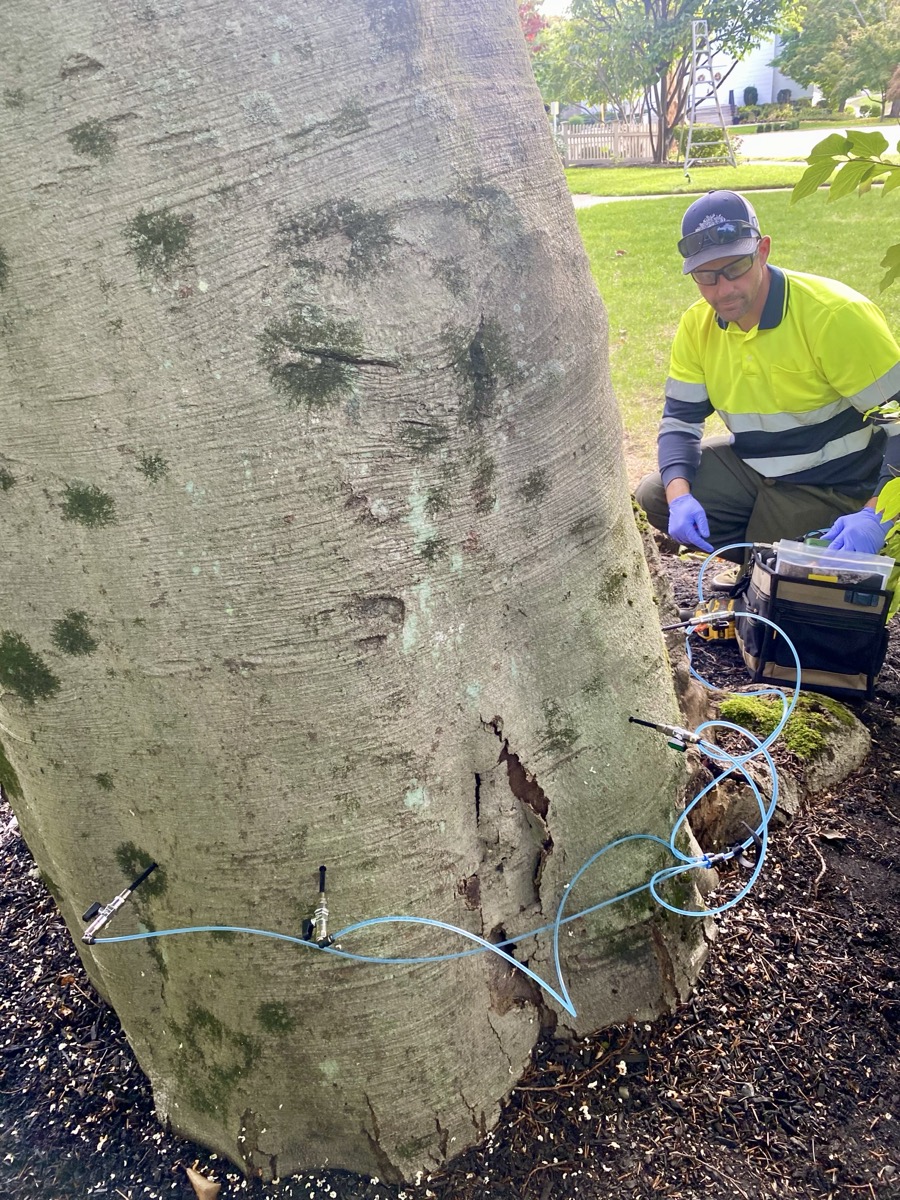
Step 4: Targeted treatments. Trunk injections for emerald ash borer deliver imidacloprid via low-pressure systems (10-20 PSI), reaching canopy in 48 hours without drift—ideal for Canton Junction near wetlands. Spongy moth and winter moth receive Bacillus thuringiensis (Bt) sprays timed to larval hatch (May-June), safe for bees. Hemlock woolly adelgid management combines horticultural oil drenches and imidacloprid injections, applied fall/winter when crawlers settle.
Equipment includes certified Macro-Injectors for precision, avoiding soil saturation in Canton's rocky soils. Safety protocols: full PPE, traffic control on Washington Street jobs, and drone scouting for tall white pines in Pecunit hilltops. Structural pruning per ANSI A300 removes codominant leaders in white oaks, reducing sail effect by 40%.
Step 5: Monitoring and follow-up. We install data loggers for moisture in tulip trees and revisit quarterly. Reports detail metrics like leaf area index improvements—often 25% post-fertilization.
For Canton’s climate, we time injections pre-budbreak to match sap flow in eastern hemlocks. Homeowner tip: Water deeply (1 inch/week) during July droughts to support treatments; mulch 3 inches deep, keeping off trunks to prevent vole damage in American beech.
Our process yields 85% success rates on aging canopies, per client data, extending life 10-20 years. Based in Plymouth/Cohasset, we serve Canton efficiently. Contact 508-369-5009 to start.
Common Plant Health Care Projects in Canton Neighborhoods
In Canton Center, historic Washington Street properties feature aging red oaks and sugar maples needing deep root fertilization to combat chlorosis from compacted soils post-construction. We inject iron chelates, restoring green-up within one season.
Canton Junction homes near rail lines deal with white pine weevils; our trunk injections of acephate protect leaders, preventing crooked growth that invites wind failure.
Ponkapoag borders Blue Hills Reservation, where chestnut oaks lean toward yards—hazard assessments lead to selective cabling or removals, followed by hemlock woolly adelgid treatments via soil drenches on adjacent evergreens.
Knollwood's hilltop exposure demands structural pruning on shagbark hickories; we thin crowns to mitigate ice storm snaps, common after February thaws.
Canton Corner sees spongy moth defoliation on American beech; Bt applications timed to egg hatch (late April) preserve foliage without broad sprays.
Pecunit properties along reservation trails require emerald ash borer monitoring—though rare, trunk injections safeguard ashes amid oak-hickory stands.
Springdale's mature tulip trees suffer winter moth; we deploy pheromone traps for early detection, followed by targeted sprays.
Reservoir Pond Area faces root rot in white pines from wet soils; aerification and fungicide injections restore drainage.
Blue Hills frontage in Ponkapoag and Pecunit prompts frequent hazard tree work—our assessments identify 20-30° leans, using rigging for safe felling near homes.
Storm cleanup post-ice events hits hilltops like Knollwood; we chip debris per Canton bylaws, then apply PHC to survivors.
Southeast Arborist tailors these to neighborhoods: IPM scouting in Canton Center, injection clinics for Junction pines. ISA standards ensure compliance. Your trees gain resilience—call 508-369-5009.
Plant Health Care Costs in Canton, MA
Plant health care costs in Canton MA vary by property size, tree count, and issues, but deliver strong ROI by averting $2,000-$10,000 removals. Base assessments start at $250-$400 for 1-acre lots in Canton Center, including soil tests and tree mapping—essential for Blue Hills-edge hazards in Ponkapoag.
Deep root fertilization runs $150-$300 per tree for large oaks (24"+ DBH), covering 1,000 sq ft root zone. A 5-tree program in Knollwood hilltops totals $1,000-$1,500 annually, boosting vigor 30% via customized NPK blends for Norfolk soils.
Pest treatments: Hemlock woolly adelgid injections cost $20-$40 per foot of hemlock height—$400 for a 20' tree in Pecunit. Spongy moth Bt sprays: $300-$600 per property in Canton Junction, covering 10 oaks. Emerald ash borer trunk injections: $12-$18 per inch DBH, or $300 for a 20" ash near Reservoir Pond.
Custom programs bundle services: $2,000-$4,000 yearly for 10-15 trees in Springdale, including quarterly monitoring, fertilization, and two treatments. Factors raising costs: access challenges on Canton Corner slopes (+20%), lab diagnostics (+$100), or drone surveys for tall hickories (+$200).
Value proposition: ISA data shows PHC extends life 15 years, increasing property values 5-10% via healthy canopies—critical in Canton's suburban market (median home $700K). Avoid DIY pitfalls like over-fertilizing maples, causing burn in acidic soils.
Compared to Norwood or Dedham, Canton's reservation influence demands specialized IPM, but our Plymouth base keeps overhead low. Multi-year contracts save 15-20%. Transparent quotes detail line items; no surprises.
Homeowner tip: Prioritize high-value trees (oaks over 30" DBH) for max ROI. Schedule via 508-369-5009 for Canton-specific pricing.
When to Schedule Plant Health Care in Canton
Schedule plant health care Canton MA seasonally to match tree biology and local threats. Spring (March-May): Deep root fertilization pre-budbreak for red oaks and maples in Canton Center—soil warms to 50°F, optimizing uptake before summer drought.
Early summer (May-June): Spongy moth and winter moth treatments when larvae feed; scout egg masses in April for Ponkapoag oaks.
Fall (September-October): Hemlock woolly adelgid injections as crawlers settle; ideal for Blue Hills-adjacent hemlocks in Knollwood before winter dormancy.
Winter (December-February): Dormant oil for adelgids or emerald ash borer prophylactics on ashes near Reservoir Pond.
Urgency signs: 25%+ canopy dieback in white pines (weevil or root issues), adelgid "white fuzz" on hemlock bases, or spongy moth webs on hickories—act within 2 weeks to save trees.
Post-storm: Ice or wind damage in Pecunit hilltops needs immediate assessment to prune broken ends, preventing decay.
Annual programs start anytime; biennial for stable properties. Canton's Zone 6b timing avoids July heat stress. Call 508-369-5009 now for spring slots.
Frequently Asked Questions About Plant Health Care in Canton
What is plant health care in Canton MA? Plant health care Canton MA encompasses IPM, fertilization, and injections to maintain trees like chestnut oaks and eastern hemlocks amid Blue Hills pests and soils.
How do I know if my Canton trees need PHC? Look for thinning canopies in sugar maples (nutrient lack), adelgid on Ponkapoag hemlocks, or codominant stems in Canton Center red oaks. Our free consult identifies issues.
Are Southeast Arborist treatments safe for Canton pets/kids? Yes, ISA Certified applications use low-toxicity options like Bt for winter moth—zero residual on turf after rain. Trunk injections avoid foliar exposure.
How long do PHC results last in Canton? Fertilization: 1-2 years; injections: 1-3 years per emerald ash borer cycle. Annual monitoring in Springdale ensures continuity.
Does insurance cover plant health care Canton MA? Not typically, but prevents claims—healthy trees reduce liability on Washington Street properties.
Can PHC save declining Blue Hills-edge trees? Yes, 80% success on woolly adelgid hemlocks in Pecunit via combined therapies.
What's the difference from general spraying? Our IPM thresholds treatments, unlike calendar sprays—safer, effective for Canton's variable pests.
How to prepare my Canton property for service? Clear 20' around trees in Reservoir Pond Area; note pet zones. We handle permits.
Plant Health Care Throughout Canton
Southeast Arborist provides plant health care across Canton neighborhoods: Canton Center's historic shades, Junction's pines, Ponkapoag and Pecunit's reservation borders, Knollwood hilltops, Canton Corner beeches, Springdale maples, Reservoir Pond wetness. We extend to nearby Stoughton, Sharon, Randolph, Milton, Norwood, Dedham.
Our South Shore base ensures prompt response. ISA Certified, ANSI-compliant. Call 508-369-5009 for your custom plan.