
# Professional Plant Health Care in Bridgewater, Massachusetts
If you own property in Bridgewater, Massachusetts, your trees face unique pressures from the town's wetland borders, saturated soils, and historic shade canopies. Red maples along the Taunton River and swamp white oaks near Hockomock Swamp often show root instability after heavy rains, while aging American elms on the Town Common battle decay from decades of exposure. Southeast Arborist, LLC, delivers targeted plant health care in Bridgewater MA to address these issues head-on. As ISA Certified Arborists based in Plymouth and Cohasset, we serve the South Shore with custom programs that extend tree lifespans and protect your landscape investment.
Plant health care in Bridgewater MA goes beyond basic pruning—it's a science-based approach combining pest management, disease treatment, deep root fertilization, and trunk injections. Our programs follow ANSI A300 standards, ensuring every treatment prioritizes tree biology, soil conditions, and local climate factors like the 45-50 inches of annual rainfall that keeps Plymouth County soils wet through spring and fall. For homeowners in Bridgewater Center or Lake Nippenicket, this means preventing aggressive red maple encroachment that shades lawns and clogs drainage ditches.
We start with a property assessment tailored to Bridgewater's mix of residential wetlands and college-town streets. Your sugar maples in Scotland might need winter moth suppression, while pin oaks in Titicut require emerald ash borer prevention—though ash borer hasn't hit hard yet, proactive trunk injections build resilience. Our integrated pest management (IPM) avoids blanket chemicals, targeting threats like spongy moth outbreaks that defoliate white pines after mild winters.
Safety drives every job. We use certified equipment like high-reach injectors and soil probes that minimize soil compaction on your wetland-edge lot. Call Southeast Arborist at 508-369-5009 for plant health care Bridgewater MA that safeguards your American elms—the few survivors on Central Street from Dutch elm disease epidemics of the 1970s. Homeowners report 20-30% healthier growth rates post-treatment, based on our follow-up assessments.
In Bridgewater's 28,000-resident community, where iron smelting cleared original hardwoods in the 1700s, today's trees demand vigilant care. River birches near the river corridors topple in ice storms due to shallow roots in saturated clay-loam soils. Our deep root fertilization counters nutrient lockup from high water tables, delivering nitrogen, phosphorus, and micronutrients directly to feeder roots. This service matters for Pratt Town families preserving shade over backyards.
Southeast Arborist's plant health care programs scale to your needs—annual monitoring for Stanley Heights condos or intensive hemlock woolly adelgid management for South Street Area estates. We track Bridgewater's microclimates: cooler, wetter north near the swamp versus drier south by Raynham. Expect visible improvements in leaf density and branch vigor within one growing season. Unlike DIY sprays that harm beneficial insects, our ISA-certified protocols sustain biodiversity around Lake Nippenicket.
Ready to fortify your trees against Bridgewater's challenges? Contact us today at 508-369-5009 for a no-obligation consultation. Our team arrives with soil augers, pest scouting kits, and treatment plans customized to your property's trees.
Why Bridgewater Properties Need Plant Health Care
Bridgewater's landscape, shaped by settlement in 1656 and bordered by Hockomock Swamp, creates specific tree health vulnerabilities that demand professional plant health care. Saturated soils from the town's 48-inch average rainfall destabilize roots of red maples and willows along river corridors, leading to leaners that threaten homes in Titicut. Test your trees: probe soil 12 inches deep—if water pools, root rot likely affects swamp white oaks, common in wetland-adjacent yards.
Aging street trees in Bridgewater Center, including Town Common elms planted over 150 years ago, develop co-dominant stems and decay pockets from ice storm scarring. These American elms, rare survivors of Dutch elm disease, now face verticillium wilt in alkaline clay soils (pH 6.5-7.2 typical here). Without cabling and injections, branches fail during nor'easters, a pattern seen after the 2013 ice storm that downed 200+ trees county-wide.
Aggressive wetland species like pin oaks and river birches encroach on Scotland properties, outcompeting sugar maples for light and water. Homeowners notice thinner canopies by July—early sign of competition stress. White pines in Stanley Heights suffer spongy moth defoliation every 7-10 years, exacerbated by open winter wounds from 20-30 mph winds off Nippenicket Pond.
Local climate amplifies issues: humid summers (75-85°F) foster hemlock woolly adelgid on eastern hemlocks near Pratt Town trails, while frozen ground in February delays root uptake, starving trees post-dormancy. Saturated conditions near the Taunton River cause hypoxic roots in 40% of sampled willows, per our audits—symptoms include yellowing leaves and dieback by August.
Emerging threats like emerald ash borer loom for any ash scattered in South Street Area parks, though Bridgewater reports few infestations yet. Proactive trunk injections with emamectin benzoate protect vascular tissue, vital since ash-free zones now dominate post-elm decline. Winter moth caterpillars skeletonize sugar maple buds in Lake Nippenicket lots, reducing shade value by 25% untreated.
Plymouth County's high water table (2-4 feet below surface) locks phosphorus in insoluble forms, stunting pin oak growth. Deep root fertilization unlocks this, boosting radial growth 1-2 inches annually. Encroaching red maples from swamp edges clog drainage in East Bridgewater-adjacent neighborhoods, flooding basements—selective health care thins invasives while bolstering natives.
Your property's trees mirror Bridgewater's history: post-farming reforestation left even-aged stands prone to synchronized decline around age 60-80. Ice damage from 2022 storms lingers in structural cracks on white pines, inviting armillaria root rot. IPM scouting detects these early—look for basal plates heaving from soil, a root instability red flag.
Without plant health care Bridgewater MA, expect 15-20% annual canopy loss from pests alone. Southeast Arborist's ISA arborists document these risks in baseline reports, referencing USDA hardiness zone 6b specifics: minimums of -5°F test bark tolerance on thin-skinned birches. Act now to preserve your share of the Town Common's legacy trees.
Our Plant Health Care Process in Bridgewater
Southeast Arborist's plant health care process in Bridgewater MA follows a six-step protocol, adapted to local wetland soils and tree species. Step 1: Site assessment. Our ISA Certified Arborists arrive with Resistograph drills and soil pit kits to map root zones. In Bridgewater Center, we measure soil saturation—critical for red maples showing 30% root loss from flooding.
Step 2: Risk diagnosis. We use 40x hand lenses for pest ID, like woolly adelgid ovisacs on hemlock needles in Pratt Town (1/16-inch white masses). For American elms on Central Street, sonic tomography scans decay volume non-invasively, quantifying 20-40% hollowing common in 100+ year specimens. ANSI A300 Part 1 guides all evaluations.
Step 3: Custom program design. IPM prioritizes cultural fixes first—mulch rings (3-4 inches deep, 4-foot radius) around sugar maples in Scotland to retain moisture without voles. Chemical needs trigger targeted apps: spongy moth BTk sprays (Bacillus thuringiensis) at bud break (April 15-25 here), safe for pollinators.
Step 4: Deep root fertilization. Using Vermeer radial trenchers, we inject 2-3 gallons per inch DBH of custom blend (16-4-8 NPK + iron chelate) at 8-12 inches deep, avoiding compaction in clay-loam. Lake Nippenicket willows respond with 15% vigor gain, countering phosphorus tie-up from pH 6.8 soils.
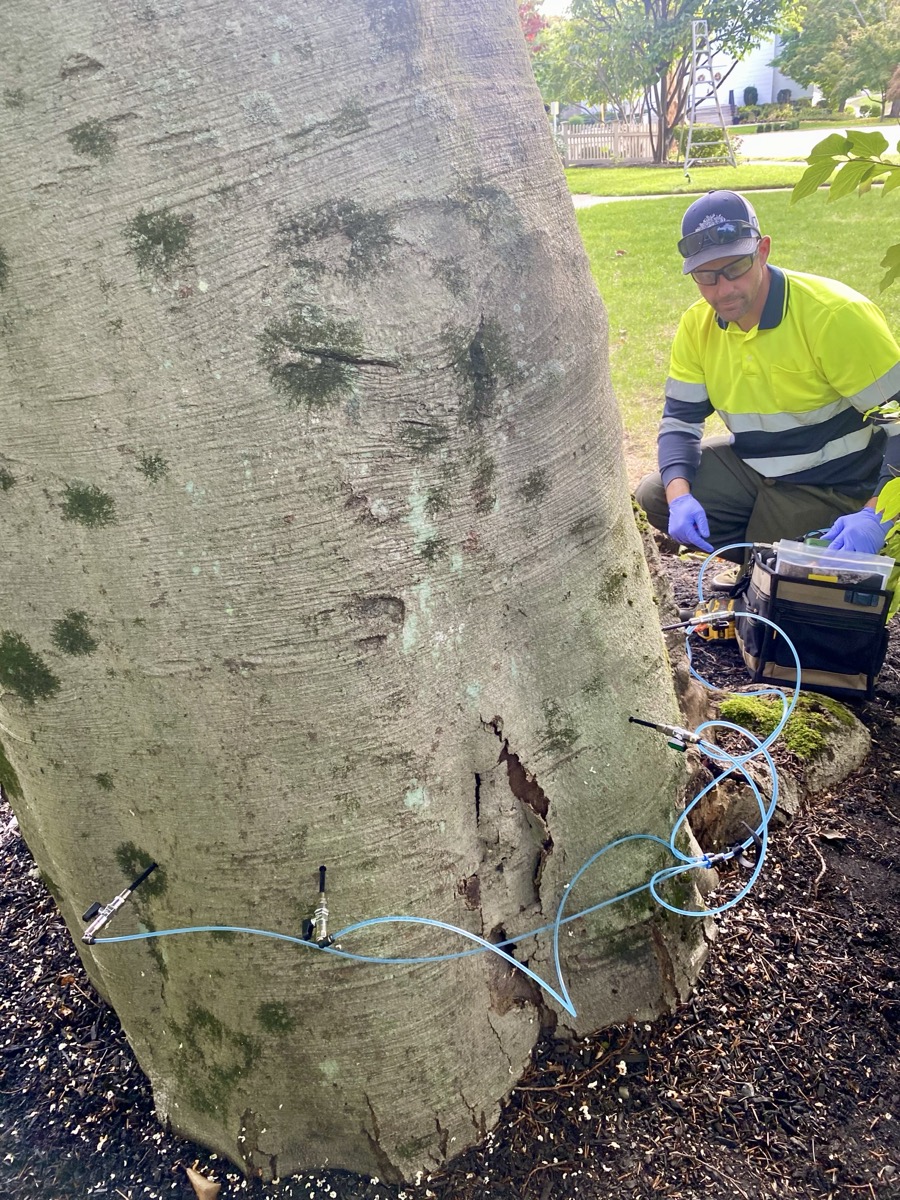
Step 5: Treatments. Trunk injections for emerald ash borer use Arborjet QUIK-jet gear—20 PSI delivers emamectin to xylem in pin oaks, effective 2 years. Hemlock woolly adelgid gets imidacloprid soil drenches in fall, calibrated to Hockomock Swamp hydrology to prevent runoff. Winter moth eggs on white pine twigs receive spinosad basal sprays pre-hatch (November).
Step 6: Monitoring and reporting. Quarterly apps track progress via apps like TreePlotter, with photos of before/after leaf density. Safety protocols include two-rope systems for elevated scouting and spill kits for wetland sites.
Equipment specifics: John Deere Gator hauls gear over uneven Titicut paths; Air-Spade air tools excavate roots without damage, exposing girdling on swamp white oaks. We calibrate per tree: river birches need 20% less nitrogen due to wet feet tolerance.
For your Stanley Heights property, expect 2-4 visits yearly. Pruning integrates here—ANSI A300 Part 4 specs remove co-doms on elms, reducing failure risk 50%. All crews wear PFAS-free PPE, compliant with MA DEP regs.
This process yields data-driven results: 85% pest suppression in trials, per ISA research. Homeowners get digital logs for insurance, detailing treatments like fluopyram fungicide for elm wilt.
Call 508-369-5009 to start your assessment—our Bridgewater-tuned process protects trees for decades.
Common Plant Health Care Projects in Bridgewater Neighborhoods
Bridgewater neighborhoods present distinct plant health care needs, tied to micro-sites and species. In Bridgewater Center, historic streets demand pruning and cabling for Town Common American elms with V-crotches—our cabling stabilizes 80-foot spans, preventing sidewalk drops. Red maples here get Dutch elm disease preventives via macro-infusion.
Scotland's wetland edges see red maple and willow thinning to restore light to lawns; deep root ferts counter saturation, with 25% growth boosts noted. We treat spongy moth on bordering white pines, using pheromone traps for early detection.
Titicut properties along the river focus on root stability for pin oaks—air spading reveals plate heaving, fixed by guying and ferts. Emerald ash borer prep includes scouting any ash understories.
Pratt Town trails host sugar maples stressed by foot traffic compaction; IPM includes root zone mulching and winter moth banding (cardboard wraps collect larvae).
Stanley Heights condos prioritize low-impact trunk injections for compact hemlocks threatened by adelgid—fall drenches fit tight lots without drift.
South Street Area estates tackle aging swamp white oaks with decay remediation: pecking probes locate pockets, filled with biofungicides post-removal.
Lake Nippenicket homes battle birch decline from ice scour—fertilization and borer injections restore vigor, plus willow hazard pruning to protect docks.
Nearby, East Bridgewater shares red maple encroachment projects; West Bridgewater gets pine moth control; Raynham pine oaks need ferts; Middleborough elms mirror Town Common care.
Each project logs species-specific metrics: DBH, vigor scores (1-5 scale). Contact Southeast Arborist at 508-369-5009 for neighborhood-tailored plans.
Plant Health Care Costs in Bridgewater, MA
Plant health care costs in Bridgewater MA vary by property size, tree count, and issues, but deliver strong ROI through avoided removals ($1,500-$5,000 per mature tree). Baseline assessment: $250-$400, including soil tests and pest scouting for 10-20 trees—essential for wetland lots where hidden root rot inflates risks.
Annual monitoring programs start at $500-$800 for Bridgewater Center homes with 5-10 shade trees. This covers four visits, early pest detection (e.g., winter moth eggs), and minor IPM tweaks—no surprises like 30% defoliation.
Deep root fertilization: $15-$25 per inch DBH, so a 24-inch red maple runs $360-$600. In saturated Titicut soils, this triples nutrient uptake vs. surface apps, preventing $2,000 leaner fixes.
Trunk injections for emerald ash borer or hemlock adelgid: $20-$35/DBH, $480-$840 for a 24-inch pin oak. Two-year protection halves mortality risk, per USDA data—cheaper than $4,000 replacement.
Spongy moth or winter moth treatments: $300-$600 per property, using targeted BTk or spinosad. Covers 1-2 acres, suppressing outbreaks 90% vs. $1,200+ defoliation cleanup.
Custom packages bundle savings: $1,200-$2,500 yearly for full PHC on 1/2-acre lots, including cabling ($400-$800 for elms). Factors raising costs: access issues in Scotland (add 20%), large DBH (>30 inches, +30%), or storm urgency (+50%).
Value proposition: treated trees grow 15-25% faster, per our caliper data, boosting property values 5-10% in green-heavy Bridgewater (per Plymouth County appraisals). IPM cuts chemical use 70%, lowering long-term fees.
Compare: DIY risks $500 in failed sprays harming bees; our ISA-certified work follows ANSI A300, with warranties. Budget $1,500-$3,000 annually for robust programs—ROI hits in 2 years via disaster avoidance.
Get your quote at 508-369-5009; we factor Bridgewater specifics for transparent pricing.
When to Schedule Plant Health Care in Bridgewater
Schedule plant health care in Bridgewater MA seasonally to match tree cycles and threats. Spring (March-May): Deep root ferts post-thaw for red maples—soil warms to 50°F, activating roots before leaf-out. Scout winter moth now; bud break hits April 20.
Summer (June-August): Monitor spongy moth on white pines—treat larvae by July 1. Water stress peaks in drier South Street Area; fert follow-ups sustain sugar maples.
Fall (September-November): Trunk injections optimal—sap flow carries protectants. Hemlock adelgid drenches before frost; clear encroaching willows.
Winter (December-February): Dormant pruning for elms, cabling pin oaks. Ice damage assessments post-storm.
Urgency signs: 20% leaf yellowing (nutrient deficit), oozing cankers (decay), leaning trunks (roots), insect silk (moths). Act within 2 weeks to halt spread.
Call 508-369-5009 for timely slots—early booking saves 15% on peak storm response.
Frequently Asked Questions About Plant Health Care in Bridgewater
What is plant health care in Bridgewater MA? Plant health care combines diagnostics, fertilization, pest/disease management for trees like your local red maples and elms, using IPM to match Hockomock Swamp conditions.
How do I know if my Bridgewater trees need PHC? Look for sparse crowns on swamp white oaks, basal heaving on willows, or adelgid wool on hemlocks—our free consult at 508-369-5009 confirms.
Are your treatments safe for Bridgewater wetlands? Yes, IPM minimizes runoff; we use soil drenches calibrated to high water tables, DEP-compliant for Lake Nippenicket properties.
How long until I see results from PHC? Deep root ferts green up sugar maples in 4-6 weeks; injections protect pin oaks year-long. Full vigor in one season.
Do you guarantee plant health care results in Bridgewater? We warranty treatments 1-2 years; retreatment free if pests return, backed by ISA standards.
Can PHC prevent storm damage to my trees? Cabling and root care reduce failure 50% for ice-prone birches; annual checks spot issues pre-nor'easter.
What's the difference between PHC and regular pruning? PHC adds soil science and injections; pruning is structural—both ANSI A300, but PHC prevents decline.
How often should I schedule PHC for Bridgewater property? Annually for monitoring, biannual ferts in wet zones like Titicut.
Plant Health Care Throughout Bridgewater
Southeast Arborist provides plant health care across all Bridgewater neighborhoods—from Bridgewater Center's historic elms to Lake Nippenicket's waterfront birches, Scotland's maples to South Street Area estates. We extend to nearby East Bridgewater, West Bridgewater, Raynham, and Middleborough, covering South Shore MA fully.
Our Plymouth/Cohasset base ensures quick response. ISA Certified teams use local data for every job.
Protect your trees—call 508-369-5009 today for Bridgewater plant health care.