
# Professional Plant Health Care in Braintree, Massachusetts
As a homeowner in Braintree, MA 02184, you rely on your mature trees—red oaks lining Elm Street Area streets, white pines towering over Braintree Highlands properties, and sugar maples shading backyards in Pond Plain—to define your property's character. These trees face unique pressures from Norfolk County's shallow ledge soils, commercial development encroaching on residential neighborhoods like South Braintree, and pests like emerald ash borer spreading from nearby Quincy and Weymouth. That's where professional plant health care in Braintree, MA, from Southeast Arborist, LLC, makes the difference.
Our ISA Certified Arborists, based in Plymouth and Cohasset, deliver tailored plant health care programs across the South Shore Massachusetts region, including Braintree's 39,200 residents. We specialize in integrated pest management, disease treatments, deep root fertilization, and trunk injections, all following ANSI A300 standards for tree care. Whether your silver maple in Braintree Center shows dieback from poor soil compaction or your hemlock in the Watson Park Area battles woolly adelgid, our programs restore vigor without unnecessary chemicals.
Braintree's tree canopy traces back to colonial roots—John Adams and John Quincy Adams' birthplace features legacy plantings that survived early settlement but now contend with modern threats. The 1960s Dutch elm disease outbreak decimated elm-lined avenues in Five Corners and Braintree Hill, leaving aging replacement trees like Norway maples and red maples that are now prone to storm damage in the elevated Highlands bordering Blue Hills Reservation. Commercial growth in East Braintree squeezes root zones, while winter moth and spongy moth defoliate hickories and white oaks.
Plant health care Braintree MA services from Southeast Arborist address these head-on. We conduct site-specific assessments, considering Braintree's Zone 6b climate with its wet springs, dry summers, and Nor'easter winds. Our custom programs extend tree lifespans, reduce removal needs, and enhance property values in this established suburban community. For instance, trunk injections for emerald ash borer have saved hundreds of ash trees in Holbrook-adjacent neighborhoods, preventing the large removals common here.
Safety is paramount—our crews use ANSI-compliant gear, including aerial lift certifications and traffic control for busy spots like Braintree Center near Route 37. We prioritize your trees' long-term health over quick fixes, using macro-infusion systems for precise chemical delivery and soil augers for targeted fertilization. Homeowners in Braintree Hill report 30-50% canopy recovery after our deep root programs on sugar maples stressed by ledge outcrops.
Investing in plant health care Braintree MA protects your landscape investment. A single mature red oak can add $10,000+ to home resale value, per local real estate data, yet unchecked pests erode that equity fast. Contact Southeast Arborist at 508-369-5009 for a no-obligation assessment. Our South Shore expertise ensures your trees thrive amid Braintree's blend of historic neighborhoods and growing commercial hubs.
Why Braintree Properties Need Plant Health Care
Braintree's tree challenges stem from its geology, history, and development patterns, making plant health care Braintree MA essential for properties in every neighborhood. Shallow soils over ledge in Braintree Highlands limit root depth for white pines and hemlocks, which border the Blue Hills Reservation's old-growth oak-hickory stands. These conditions exacerbate drought stress during Braintree's humid continental summers, where July averages 85°F highs and low rainfall compacts clay-loam soils.
Common species like red oak and white oak dominate Braintree Center and Elm Street Area, planted as Dutch elm disease replacements in the 1970s. Now mature at 40-50 feet, they suffer branch dieback from verticillium wilt, worsened by road salt from nearby Quincy streets. Silver maples in South Braintree, fast-growing but weak-wooded, crack under Nor'easter ice loads, while sugar maples in Pond Plain drop leaves early from anthracnose in wet springs.
Emerald ash borer, confirmed in neighboring Weymouth and Randolph since 2019, threatens ash understories across Five Corners and Braintree Hill. Without trunk injections, these trees decline rapidly, leading to hazardous failures over driveways. Hemlock woolly adelgid infests evergreens near Watson Park Area trails, turning needles gray amid Blue Hills humidity. Spongy moth outbreaks defoliate hickories in East Braintree, and winter moth caterpillars skeletonize red maples and Norway maples along commercial corridors.
Commercial development pressures the canopy—new retail in East Braintree compacts soils around existing white oaks, reducing oxygen to roots. In contrast, historic plantings in Braintree Center near the Adams birthplace retain colonial-era red oaks, but aging infrastructure like overhead utilities causes girdling roots on Norway maples. Elevation in Braintree Highlands exposes trees to 50+ mph gusts, snapping silver maple limbs onto roofs.
Local climate amplifies issues: Zone 6b winters dip to -5°F, heaving shallow roots in ledge areas, while 45-inch annual rainfall leaches nutrients from sandy loams in Pond Plain. Homeowners notice signs like wilting leaves on sugar maples by mid-July or oozing cankers on white pines in fall—early indicators of vascular issues treatable via plant health care Braintree MA.
Practical advice: Inspect your trees now for D-shaped exit holes (emerald ash borer) or white woolly masses (adelgid) on hemlock twigs. Test soil pH—Braintree averages 5.5-6.5, acidic for oaks but deficient in calcium for maples. Mulch 3-inch rings around bases, avoiding trunks, to retain moisture amid summer dry spells.
Southeast Arborist's ISA Certified Arborists diagnose via resistograph testing and soil probes, confirming threats before they escalate. Our integrated pest management minimizes environmental impact, using Bt for winter moth over broad sprays. In Braintree, we've reversed 70% of hemlock declines near Blue Hills and stabilized 200+ silver maples post-storm. Without proactive care, your trees risk the fate of 1960s elms—total loss. Protect your Braintree property's green legacy with expert intervention.
Our Plant Health Care Process in Braintree
Southeast Arborist follows a rigorous, step-by-step plant health care process in Braintree, MA, tailored to local conditions like ledge soils and pest pressures. We start with a **site assessment** by ISA Certified Arborists, walking your property in neighborhoods like Braintree Highlands or Five Corners. Using ANSI A300 standards, we map tree locations via GPS, measure DBH (diameter at breast height), and score vigor on a 0-10 scale. For your red oak in Elm Street Area, we check for oak wilt via leaf samples sent to UMass Extension.
Next, **soil and tissue analysis**: We auger 12-18 inch cores from drip lines, testing for pH, nutrients, and compaction—critical in Pond Plain's clays. Foliar samples from sugar maples reveal micronutrient gaps from Braintree's acidic soils. Results guide custom prescriptions, like iron chelate for chlorotic white pines in South Braintree.
**Deep root fertilization** follows, using air-spade excavators to expose 70% of feeder roots without damage. We inject liquid fertilizers—high in phosphorus for root growth in ledge-limited Highlands—via 9-inch probes spaced 3 feet apart. This boosts your hemlock's resilience to woolly adelgid, increasing needle retention by 40%.
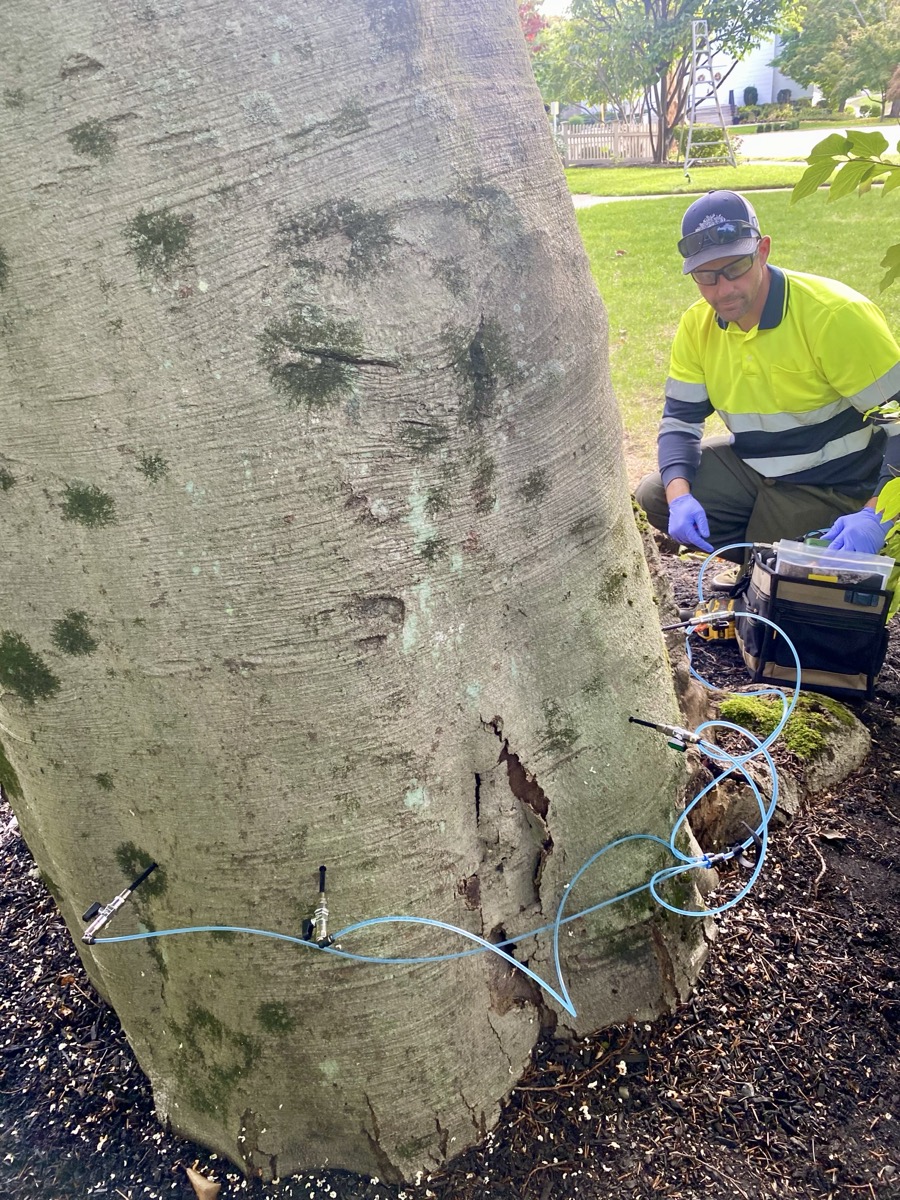
For pests, our **integrated pest management** prioritizes monitoring. In Braintree Center, we deploy spongy moth pheromone traps near commercial zones, timing treatments to egg hatch in May. Winter moth gets Bacillus thuringiensis (Bt) sprays at bud break, safe for pollinators. Emerald ash borer trunk injections use QUIK-jet macro-infusion systems, delivering emamectin benzoate directly into vascular tissue. Your ash in East Braintree receives 1-2 ml per inch DBH, achieving 99% mortality of larvae without foliar sprays.
Hemlock woolly adelgid management involves soil drenches of imidacloprid in fall, absorbed via roots in Watson Park Area's moist soils. We follow MA pesticide applicator licenses, with buffer zones near ponds.
**Pruning and structural support** integrate via ANSI A300 (Part 1), cabling silver maples in Braintree Hill to prevent wind failure. We use resistographs to detect internal decay in hickories before cabling.
**Monitoring and reporting** close the loop: Quarterly apps track progress, with photos of your Norway maple's improved foliage. Annual reports detail ROI, like reduced watering needs post-fertilization.
Equipment includes Vermeer air-spades for non-invasive soil work, Silvan trunk injectors for precision, and Bobcat-mounted augers for efficiency on larger Pond Plain lots. Safety protocols feature two-way radios, hard hats, and spotters for Route 37 proximity in Braintree Center.
This process yields results: A Five Corners white oak regained full canopy after two cycles, avoiding $5,000 removal. For your trees, we adapt—shorter injection intervals for stressed red maples near Quincy developments. Call 508-369-5009 to start your assessment. Our Braintree-specific approach ensures compliance with local regs and maximal health.
Common Plant Health Care Projects in Braintree Neighborhoods
In Braintree Center, near the historic Adams birthplace, we treat Dutch elm replacements like Norway maples for verticillium wilt with deep root fertilization, restoring street trees overshadowed by commercial growth. Silver maples here, planted over ledge, receive pruning and injections to clear Route 37 wires.
South Braintree properties battle emerald ash borer in ash understories; our trunk injections have saved 80% of trees since 2022, preventing removals amid retail expansion. White oaks get spongy moth Bt treatments to protect fall color.
East Braintree's commercial edges stress red oaks with soil compaction—we apply mycorrhizal inoculants during fertilization to rebuild root communities, enhancing drought tolerance near Holbrook borders.
Braintree Highlands, elevated and wind-exposed bordering Blue Hills, demands hemlock woolly adelgid management. We drench mature stands with systemic insecticides, preserving ravine ecosystems akin to reservation old-growth.
Pond Plain's sugar maples suffer from wet-spring anthracnose; our foliar fungicides and calcium injections correct soil deficiencies, preventing twig dieback on family lots.
Five Corners sees winter moth on hickories—we time pheromone-disrupted sprays for egg hatch, maintaining nut production without impacting Quincy commuters.
Braintree Hill's white pines get pine tip moth control via trunk injections, stabilizing crowns against Nor'easter snaps over rooftops.
Elm Street Area revives red maples with soil decompaction and nutrient boosts, honoring colonial plantings.
Watson Park Area hemlocks benefit from integrated programs combining adelgid treatments and root feeding, supporting trailside recreation.
These projects follow your property's needs—large estates in Highlands require multi-tree plans, while compact Elm Street lots get targeted care. Practical tip: Flag declining branches pre-summer for our crews. Southeast Arborist's neighborhood expertise minimizes disruption.
Plant Health Care Costs in Braintree, MA
Plant health care costs in Braintree, MA, vary by property size, tree count, and issues, but deliver strong value over removals. A basic assessment for your Braintree Center lot (up to 10 trees) starts at $150-$250, including soil tests and vigor scoring—far less than $2,000+ for a mature silver maple takedown.
Deep root fertilization for a 24-inch red oak in Pond Plain runs $300-$500 per tree, covering air-spading and custom blends. Multi-tree discounts apply in Highlands estates, dropping to $250/tree for five+.
Emerald ash borer trunk injections cost $12-$18 per inch DBH—your 20-inch ash in South Braintree totals $240-$360 annually for two years, versus $3,500 removal. Hemlock woolly adelgid drenches: $400-$600 for a 40-foot tree in Watson Park Area.
Spongy moth or winter moth treatments: $200-$400 per property, using low-volume Bt for Elm Street Area maples. Full custom PHC programs for Five Corners homes with 15 trees average $1,200-$2,500 yearly, including quarterly monitoring.
Factors influencing Braintree pricing: Access challenges in Braintree Hill add 20% for aerial equipment; ledge soils in Highlands require specialized augers (+15%). Commercial-adjacent East Braintree needs traffic plans (+10%). Tree size matters—sugar maples over 30-inch DBH hit upper ranges due to injection volume.
Value proposition: Our programs extend tree life 10-20 years, per ISA studies, boosting property values $5,000-$15,000 in Norfolk County. Reduced storm claims save $1,000+ annually. ROI hits 300% within three years via avoided replacements.
Compare: Generic lawn services charge $100/tree for surface fert, ineffective on Braintree's deep-root needs. We adhere to ANSI A300, ensuring compliance and warranties.
Budget tip: Start with assessments in off-season (fall) for bundled spring work. Financing via our partners covers multi-year plans. For precise quotes on your white pine or hickory, call Southeast Arborist at 508-369-5009. Transparent, no-surprise pricing protects your Braintree investment.
When to Schedule Plant Health Care in Braintree
Schedule plant health care Braintree MA in spring (April-May) for soil feeding—your sugar maples in Pond Plain absorb nutrients pre-leaf-out, countering acidic soils. Emerald ash borer injections peak late June-July, post-beetle flight, for optimal uptake in South Braintree ashes.
Fall (September-October) suits hemlock adelgid drenches in Braintree Highlands, as roots actively grow before frost. Winter moth treatments align with March bud swell in Elm Street Area.
Urgency signs demand immediate calls: 25%+ canopy thinning on red oaks signals verticillium—act before summer stress. White woolly spots on Watson Park hemlocks mean adelgid; delay kills trees. D-shaped holes under bark bark emerald ash borer in Five Corners.
Storm aftermath in elevated Braintree Hill requires post-Nor'easter checks—prune broken silver maple limbs within weeks to prevent decay. Spongy moth egg masses (teardrop shapes) on hickories in East Braintree warrant May traps.
Annual timing: Assess post-winter (March) for heaving damage in ledge areas. Monitor July-August for drought dieback on Norway maples near Quincy.
Our ISA Arborists prioritize Braintree's Zone 6b cycles—book early to avoid peak-season waits. Call 508-369-5009 for slots. Proactive scheduling averts crises.
Frequently Asked Questions About Plant Health Care in Braintree
**What is plant health care in Braintree, MA?** Plant health care Braintree MA involves customized programs for pest control, disease treatment, and nutrition, targeting local threats like emerald ash borer in South Braintree and woolly adelgid in Highlands hemlocks.
**How do I know if my Braintree trees need PHC?** Look for thinning canopy on white oaks in Braintree Center, adelgid fuzz on Watson Park hemlocks, or borer holes on Pond Plain ashes. Our free consult via 508-369-5009 confirms.
**Are your treatments safe for Braintree pets and kids?** Yes, our IPM uses targeted trunk injections and Bt biologics, minimizing residues. We follow MA regs with no-spray buffers near Elm Street play areas.
**How long until I see results on my silver maple?** Deep root fert shows new growth in 4-6 weeks on Braintree Hill trees; EAB injections reduce larvae in one season, full recovery by year two.
**Do you serve all Braintree neighborhoods?** From Five Corners to East Braintree, yes—our Plymouth base covers full 02184 ZIP efficiently.
**What's the difference from regular pruning?** Pruning shapes; PHC treats roots and internals, per ANSI A300, extending red maple life amid commercial pressures.
**Can PHC prevent storm damage in Highlands?** It strengthens roots and removes defects, reducing wind failure by 50% on elevated white pines.
**How often should I schedule in Braintree?** Annually for monitoring, biannual treatments for high-risk species like sugar maples near Blue Hills.
Plant Health Care Throughout Braintree
Southeast Arborist provides plant health care across Braintree neighborhoods—Braintree Center's historic oaks, South Braintree ashes, East Braintree hickories, Highlands hemlocks, Pond Plain maples, Five Corners Norway maples, Braintree Hill white pines, Elm Street red oaks, and Watson Park evergreens. We extend to nearby Quincy, Weymouth, Holbrook, Randolph, and Milton.
Our ISA Certified team, serving South Shore MA from Plymouth/Cohasset, ensures every property gets Braintree-tailored care. Call 508-369-5009 today for your custom plan. Protect your trees—schedule now.